BPSC Mains GS Paper-I: History & Culture
About Course
BPSC Mains GS Paper-I: History & Culture
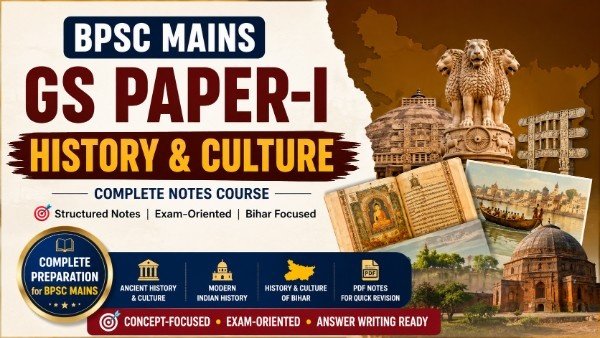
BPSC Mains GS Paper-I: History & Culture course provides structured, exam-oriented and concept-focused notes designed specifically for the BPSC Mains examination. The course helps aspirants develop a clear understanding of historical developments, cultural traditions and Bihar’s role in the national movement, which are frequently asked in the exam.
The course begins with Ancient Indian History & Culture, covering Mauryan and Pala art, the influence of religion on art, major temple architecture styles such as Nagara, Dravida and Vesara, and the unique Patna Kalam painting tradition.
The Modern Indian History section explains tribal and popular movements, British economic policies, the concept of Drain of Wealth, land revenue systems, major national movements, important constitutional acts, and the ideas of key leaders like Mahatma Gandhi and Jawaharlal Nehru.
The course also covers History and Culture of Bihar, including the Revolt of 1857 in Bihar, Champaran Satyagraha, role of peasants and women, Kisan Sabha, and thoughts of Jayaprakash Narayan.
The content is organised to support quick revision and effective answer writing for BPSC Mains.
Topics covered under the course
1. Ancient Indian History & Culture
| Sl No | Topic Name |
|---|---|
| 1 | Mauryan Art |
| 2 | Pala Art |
| 3 | Effect of religion on Mauryan Art and Pala Art |
| 4 | Nagara, Dravida and Vesara style of temple architecture |
| 5 | Patna Kalam Painting |
2. Modern Indian History
| Sl No | Topic Name |
|---|---|
| 1 | Santhal Revolt |
| 2 | Munda Revolt |
| 3 | Tribal revolts in Indian freedom struggle |
| 4 | Economic impact of British rule in India |
| 5 | Concept of Drain of Wealth |
| 6 | Land revenue system of British India |
| 7 | Orientalist–Anglicist controversy |
| 8 | Downward Filtration Theory |
| 9 | Wood’s Despatch |
| 10 | Development of Western & Technical education in India |
| 11 | Causes of Sepoy Mutiny of 1857 |
| 12 | Rise of Nationalism in India |
| 13 | Boycott and Swadeshi Movement |
| 14 | Rise and progress of revolutionary movements in India |
| 15 | Khilafat Movement |
| 16 | Non-Cooperation Movement |
| 17 | Civil Disobedience Movement |
| 18 | Quit India Movement |
| 19 | Government of India Act 1858 |
| 20 | Government of India Act 1892 |
| 21 | Morley–Minto Act 1909 |
| 22 | Government of India Act 1919 |
| 23 | Government of India Act 1935 |
| 24 | Rowlatt Act |
| 25 | Communal Award and Poona Pact |
| 26 | Cripps Mission |
| 27 | Cabinet Mission |
| 28 | Thoughts of Mahatma Gandhi |
| 29 | Thoughts of Jawaharlal Nehru |
| 30 | Thoughts of Rabindranath Tagore |
| 31 | Role of Subhas Chandra Bose in freedom struggle |
| 32 | Lord Dalhousie |
| 33 | Lord Curzon |
3. History & Culture of Bihar
| Sl No | Topic Name |
|---|---|
| 1 | Mutiny of 1857 and Bihar |
| 2 | Kunwar Singh and Mutiny of 1857 |
| 3 | Important tribal revolts of Bihar |
| 4 | Champaran Satyagraha and Bihar |
| 5 | Non-Cooperation Movement and Bihar |
| 6 | Civil Disobedience Movement and Bihar |
| 7 | Quit India Movement and Bihar |
| 8 | Quit India Movement and Jayaprakash Narayan |
| 9 | Role of women of Bihar in Indian freedom struggle |
| 10 | Role of peasants of Bihar in freedom struggle post Champaran |
| 11 | Kisan Sabha and Swami Sahajanand Saraswati |
| 12 | Thoughts of Jayaprakash Narayan |
| 13 | Development of Western & Technical Education in Bihar |
Course Content
BPSC Mains GS Paper-I: History & Culture Notes (PDF)
Lesson 1: Ancient Indian History & Culture Notes (PDF)
Lesson 2: Modern Indian History Notes (PDF)
Lesson 3: History & Culture of Bihar Notes (PDF)
Student Ratings & Reviews