1. Introduction
The revolt began at Meerut on 10 May 1857 and soon spread to large parts of northern India, including Bihar. During the mutiny of 1857, Bihar assumed importance due to its early conquest by the East India Company and its role in the colonial economy. During the mutiny of 1857 in Bihar, the Patna Division of the Bengal Presidency comprised Patna, Bihar, Saran, Shahabad, Tirhut, and Champaran.
Since the seventeenth century, Bihar had been significant for European trading companies, particularly for indigo and opium production. The forced cultivation of indigo and exploitation of peasants by European planters and local zamindars created deep agrarian discontent, which later contributed to popular participation in the revolt.
Master History & Culture. Ace BPSC Mains.
BPSC Mains GS Paper-I: History & Culture Course
Master Ancient Indian History, Modern Indian History & Bihar History with structured, exam-oriented notes designed specifically for BPSC Mains.
✓ 50+ Exam-Oriented Topics • ✓ Comprehensive History & Culture Notes • ✓ Bihar-Specific Coverage • ✓ Updated for 72nd BPSC Mains
2. Beginning of the munity of 1857 in Bihar
The first major incident in Bihar was the Patna uprising of 3 July 1857, led by Pir Ali, a book-seller. On this occasion, Dr. Lyell, the Deputy Opium Agent of the Patna Opium Agency, was killed. This attack directly targeted the opium revenue system, one of the most important sources of British income. The British administration responded with severe repression. Pir Ali was convicted and hanged, while several others were executed, imprisoned, or deported. The brutal actions of Commissioner William Tayler reflected the colonial state’s fear of popular resistance.
3. Expansion of the mutiny of 1857 in Bihar
Following the Patna uprising, the revolt gained momentum with the Danapur (Dinapur) mutiny on 25 July 1857. Three regiments stationed at the Danapur cantonment rebelled and crossed the Son River into Shahabad. There they joined forces with Kunwar Singh, the Raja of Jagdishpur, who had already initiated resistance against British rule. This event marked the beginning of a widespread and prolonged revolt in Bihar, which continued for more than a year.
4. Kunwar Singh: Leader of the Revolt in Bihar
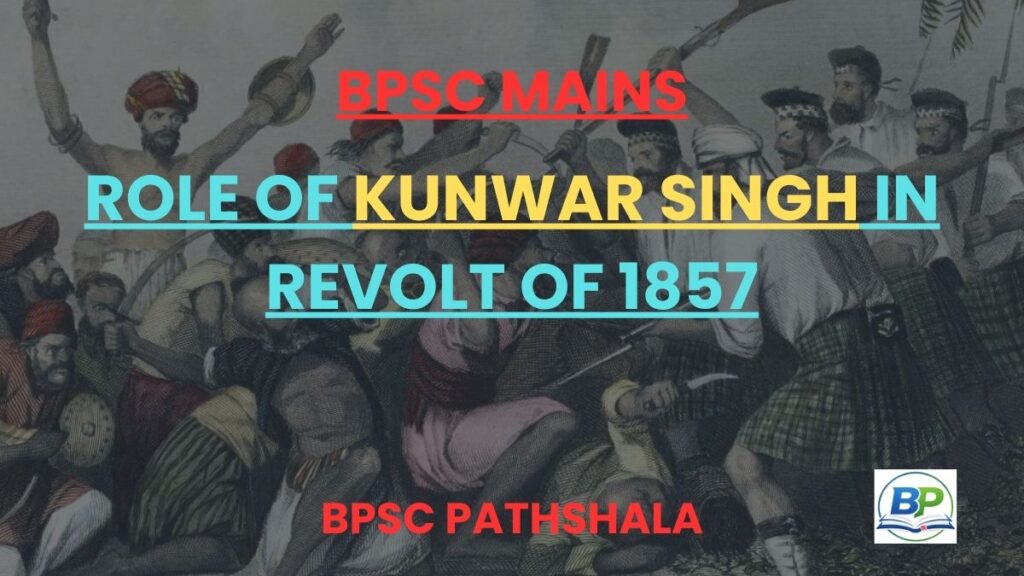
Kunwar Singh (1777–1858) emerged as the most prominent leader of the mutiny of 1857 in Bihar. Belonging to the Ujjainiya Rajput house of Jagdishpur, he took up arms at the age of nearly eighty. Despite failing health, he provided determined leadership and became the chief organiser of resistance in the region. He was supported by his relatives, local chiefs, rebel sipahis, peasants, and tribal groups.
Kunwar Singh was widely regarded as a natural leader by the rebels. Many believed that British authority had collapsed and that his leadership symbolised the end of Company rule. Leaders and rebel groups from Danapur, Chhotanagpur, Manbhum, Singhbhum, and Palamau sought to coordinate their struggles under his command.
Prepare Smarter. Study Better. Ace BPSC Mains.
BPSC Mains GS Paper 1 & 2 Complete Course
Access comprehensive BPSC Mains Notes for GS Paper 1 & 2, covering 378+ topics across 24 PDF lessons, with dedicated Bihar coverage, practice questions and downloadable study material.
✓ GS Paper 1 & 2 • ✓ 378+ Topics • ✓ 24 PDF Lessons • ✓ Bihar-Specific Coverage • ✓ Downloadable Notes
5. Popular Participation and Regional Spread
The mutiny of 1857 in Bihar witnessed joint action by soldiers and civilians. In Patna and Chhotanagpur divisions, civilians actively fought alongside rebel troops. In Shahabad, Rajputs rose under Kunwar Singh’s leadership, while in Gaya, villagers and Bhojpuri rebels strengthened the rebel forces. Tribal participation was significant in areas such as Hazaribagh, Singhbhum, and Manbhum, where Santhals, Kols, and other groups joined the uprising. The impact of the Danapur mutiny was also felt in Champaran, Saran, Muzaffarpur, and Purnea, demonstrating the wide geographical spread of the revolt in Bihar.
6. Military Strategy and Later Campaigns of Kunwar Singh
Kunwar Singh adopted guerrilla warfare tactics, avoiding fixed positions and attacking weaker British outposts. Although his forces suffered a setback at Bibiganj in August 1857, he continued the struggle by moving across regions such as Mirzapur, Rewa, Banda, Kanpur, Lucknow, Azamgarh, and Ghazipur. His mobility and coordination with local supporters enabled the rebellion to survive for an extended period.
By April 1858, Kunwar Singh returned to Jagdishpur despite having lost an arm. He defeated British forces in a final engagement but died shortly thereafter on 26 April 1858.
7. Role of Amar Singh and Continuation of Resistance
After Kunwar Singh’s death, his brother Amar Singh carried forward the struggle. The forests of Jagdishpur became the base of resistance, and guerrilla warfare continued to trouble British forces. Contemporary observers, including Engels, noted Amar Singh’s military skill and the serious threat posed by rebel activities to British communication lines, especially the Grand Trunk Road. Amar Singh was eventually captured and died in British custody in 1860.
8. Role of Indigo Planters and Colonial Policy After 1857
During the mutiny of 1857 in Bihar, European indigo planters largely supported the British by protecting treasuries and European settlements. Their loyalty during the crisis strengthened their position in the post-1857 period. The colonial administration responded by appeasing the landed aristocracy and reinforcing zamindari control over peasants. This led to the formation of a ‘triple alliance’ of British officials, zamindars, and planters to suppress peasant resistance and stabilise colonial rule in Bihar.
9. Conclusion
The mutiny of 1857 in Bihar was not merely a military mutiny but a broad-based resistance involving peasants, tribals, local leaders, and rebel soldiers. Though lacking uniform organisation, it demonstrated widespread popular discontent against colonial exploitation. Kunwar Singh emerged as the most significant symbol of resistance in Bihar, and his leadership highlighted the depth and resilience of anti-colonial sentiment. Despite its failure, the revolt exposed the weaknesses of British rule and influenced subsequent colonial policies and later nationalist movements.