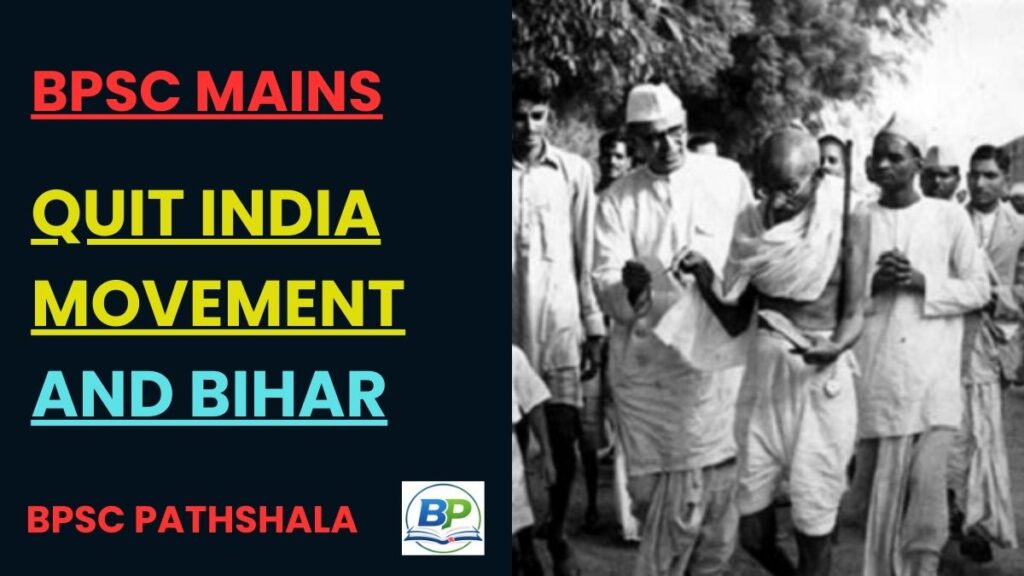
The Quit India movement of 1942 was one of the greatest upsurges of modern history. Bihar played a decisive role in the movement in the face of most ruthless repression. The Congress Working Committee passed a resolution on August 5, 1942 in Bombay, later called the Quit India Resolution, which demanded the withdrawal of the British power from India. This resolution was fully endorsed by the All-India Congress Committee held at Bombay on August 7 and 8, 1942. It was here that Mahatma Gandhi gave the famous slogan of “Do or Die”. The Quit India Movement and Bihar are closely connected, as Bihar witnessed one of the most intense popular uprisings during the August Movement of 1942. The role of Bihar in the Quit India Movement highlights mass participation, student sacrifice and administrative paralysis.
Master History & Culture. Ace BPSC Mains.
BPSC Mains GS Paper-I: History & Culture Course
Master Ancient Indian History, Modern Indian History & Bihar History with structured, exam-oriented notes designed specifically for BPSC Mains.
✓ 50+ Exam-Oriented Topics • ✓ Comprehensive History & Culture Notes • ✓ Bihar-Specific Coverage • ✓ Updated for 72nd BPSC Mains
To prevent the outbreak of mass civil disobedience, the Government, in the early hours of August 9, arrested Mahatma Gandhi and all members of the CWC. In Bihar too, many nationalists were arrested. The District Magistrate of Patna W. G. Archer arrested Rajendra Prasad and he was sent to Bankipur jail. The advocate general Baldeva Sahay resigned from his office in protest to Govt. repression. Phulan Prasad Verma, Shrikrishna Sinha, Anugraha Narayan Sinha and some other leaders were also arrested. Despite the arrest of prominent leaders, the Quit India Movement and Bihar entered a phase of mass and spontaneous resistance.
Prepare Smarter. Study Better. Ace BPSC Mains.
BPSC Mains GS Paper 1 & 2 Complete Course
Access comprehensive BPSC Mains Notes for GS Paper 1 & 2, covering 378+ topics across 24 PDF lessons, with dedicated Bihar coverage, practice questions and downloadable study material.
✓ GS Paper 1 & 2 • ✓ 378+ Topics • ✓ 24 PDF Lessons • ✓ Bihar-Specific Coverage • ✓ Downloadable Notes
The repression inflicted by the government failed to check mass upheaval. The students played a heroic role in this freedom movement. On August 11, a band of students marched in order to hoist the national flag on the building of the Patna secretariat. Under the orders of the District Magistrate W.G. Archer, the thirteen or fourteen rounds were fired in which seven students were killed and several were injured. The seven student’s martyrs were:
The sacrifice of students during the Quit India Movement and Bihar became a symbol of youthful patriotism and courage.
| Name | District | School/College |
| Umakant Sinha | Saran | Rammohan Roy Seminary |
| Ramanand Singh | Patna | Rammohan Roy Seminary |
| Jagatpati Kumar | Gaya | BN College |
| Satish Prasad Jha | Bhagalpur | Patna College Patna |
| Devipada Choudhary | Bhagalpur | Millar High School |
| Rajendra Singh | Saran | Patna High School |
| Ram Govind Singh | Patna | Punpun High School |
As a result of this incident, a widespread upheaval broke out spontaneously. There was a complete strike in Patna on August 12. The same evening a meeting was organised by Jagat Narayan Lal, in which it was decided to cripple the government machinery. To paralyse the administration, the agitators uprooted railways lines, damaged telegraphs wires and telephones, burnt police stations, seized post offices and other government buildings.
The government did not hesitate in using any method of repression to suppress the movement. There were a large-scale arrests and imprisonments. Some areas were placed under the control of military. By October-November, 1942, the movement lost its momentum, but was not yet completely over. The movement went underground and many patriots of Bihar went to Nepal Terai.