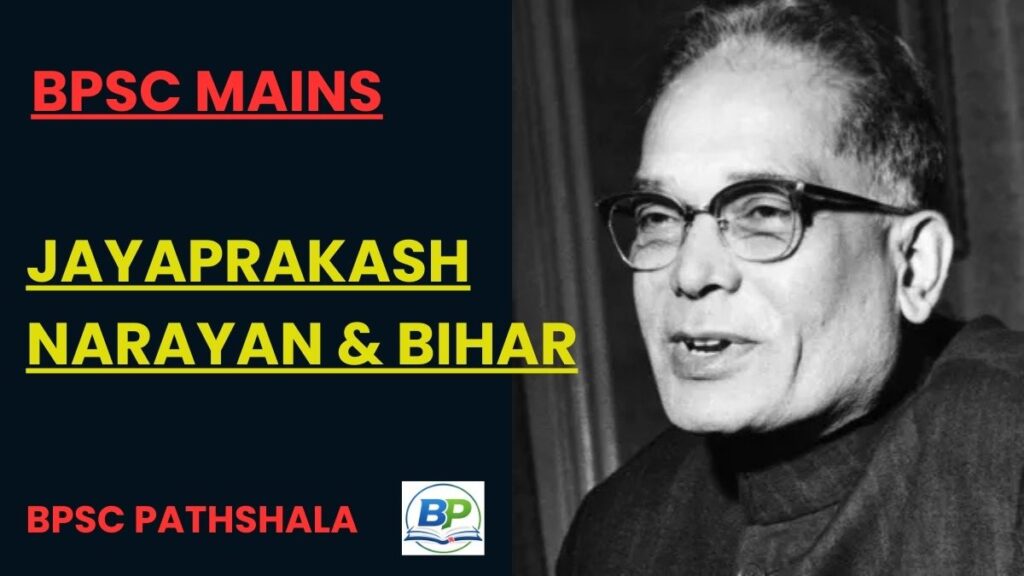
1. Introduction: Jayaprakash Narayan and Indian Freedom Movement
Jayaprakash Narayan and Indian Freedom Movement occupy a unique place in the history of modern India. He has the rare distinction of actively participating in three major popular movements of the country. He fought against British colonial rule, especially during the Quit India Movement, risking his life. Later, he led a powerful movement against corruption and authoritarianism in the 1970s, and before that, he dedicated nearly a decade to the Bhoodan Movement in the 1950s and 1960s to bring about social change through transformation of human conscience.
Master History & Culture. Ace BPSC Mains.
BPSC Mains GS Paper-I: History & Culture Course
Master Ancient Indian History, Modern Indian History & Bihar History with structured, exam-oriented notes designed specifically for BPSC Mains.
✓ 50+ Exam-Oriented Topics • ✓ Comprehensive History & Culture Notes • ✓ Bihar-Specific Coverage • ✓ Updated for 72nd BPSC Mains
2. Early Life and Background of Jayaprakash Narayan
Jayaprakash Narayan was born on 11 October 1902 in Sitab Diyara village of Saran district, Bihar. After passing his matriculation examination at the age of 18 in 1920, he started working in Patna. He married Prabhavati Devi in the same year. Responding to the nationalist call of Maulana Abul Kalam Azad to boycott English education, he left Patna College just 20 days before his examination and joined Bihar Vidyapeeth, established by Dr. Rajendra Prasad.
3. Education Abroad and Ideological Formation
Leaving his wife at Sabarmati Ashram under the care of Mahatma Gandhi, Jayaprakash Narayan went to the United States in 1922 and enrolled at Berkeley University, California. To support his education, he worked in ranches, factories, slaughterhouses and mines. These experiences brought him face to face with the suffering of the working class. Deeply influenced by the writings of M. N. Roy, he became convinced that inequality in wealth, property, status and opportunity was the central problem of human society.
Prepare Smarter. Study Better. Ace BPSC Mains.
BPSC Mains GS Paper 1 & 2 Complete Course
Access comprehensive BPSC Mains Notes for GS Paper 1 & 2, covering 378+ topics across 24 PDF lessons, with dedicated Bihar coverage, practice questions and downloadable study material.
✓ GS Paper 1 & 2 • ✓ 378+ Topics • ✓ 24 PDF Lessons • ✓ Bihar-Specific Coverage • ✓ Downloadable Notes
4. Return to India and Entry into National Politics
After completing his studies, Jayaprakash Narayan returned to India in 1929 with visible influence of Karl Marx on his thinking. During his journey back, he interacted with several communist leaders in London and India, discussing issues related to freedom and revolution. However, he disagreed with Indian communists who opposed the Indian National Congress, which was leading the freedom struggle. On the invitation of Jawaharlal Nehru, he joined the Congress in 1929.
5. Role in Civil Disobedience and Congress Socialist Party
Jayaprakash Narayan soon became actively involved in the Indian freedom struggle. He was imprisoned in 1932 for participating in the Civil Disobedience Movement. During his imprisonment in Nasik Jail, he came into close contact with leaders like Ram Manohar Lohia, Ashok Mehta, Minoo Masani and Achyut Patwardhan. These associations led him to join the Congress Socialist Party (CSP) under Acharya Narendra Dev, a left-wing group within the Congress.
6. Socialist Leadership and Opposition to British Rule
As General Secretary of the CSP in December 1939, Jayaprakash Narayan urged people to take advantage of the Second World War to end British exploitation and overthrow colonial rule. For this, he was imprisoned for nine months. After his release, he met Mahatma Gandhi and Subhas Chandra Bose, attempting unsuccessfully to reconcile differences between them for strengthening the freedom movement.
7. Quit India Movement and Underground Resistance
The Quit India Movement of August 1942 brought out the most courageous qualities of Jayaprakash Narayan. Along with Ram Manohar Lohia and Aruna Asaf Ali, he took charge of the movement after senior leaders were arrested. Soon, he too was detained under the Defence of India Rules and imprisoned in Hazaribagh Central Jail. In November 1942, on Diwali, he executed a daring jail escape, turning him into a national folk hero.
8. Underground Activities and Arrest
After escaping, Jayaprakash Narayan worked underground to sustain the freedom struggle. He organised an “Azad Dasta” in Nepal to fight British tyranny. In September 1943, he was arrested from Punjab while travelling by train and was subjected to severe torture. In January 1945, he was shifted from Lahore Fort to Agra Jail. Following Gandhi’s insistence, he and Lohia were finally released in April 1946.
9. Post-Independence Transformation and Bhoodan Movement
With independence approaching, Jayaprakash Narayan became convinced of the futility of violence as a means of social change. However, his commitment to the poor remained intact. This led him to associate closely with Vinoba Bhave’s Bhoodan Movement, marking the second major phase of his public life focused on peaceful social reform.
10. Total Revolution and Leadership in the 1970s
The third phase of Jayaprakash Narayan and Indian Freedom Movement emerged in the early 1970s amid rising unemployment, corruption and inflation. In 1974, students of Gujarat invited him to lead the Nav Nirman Andolan. In June the same year, from Gandhi Maidan, Patna, he gave the call for “Total Revolution”, urging students to challenge corrupt political institutions. During this period, he came to be popularly known as “JP”.
11. Emergency, Janata Party and National Legacy
The movement led by JP ultimately resulted in the declaration of Emergency and later the formation of the Janata Party, which came to power in 1977 as India’s first non-Congress government at the Centre. Jayaprakash Narayan played a crucial role in uniting all non-Congress forces. As a tribute to this great revolutionary, the Government of India posthumously awarded him the Bharat Ratna in 1999. Jayaprakash Narayan and Indian Freedom Movement remain an enduring inspiration for democracy and moral politics in India.