1. Introduction: Kisan Sabha and Swami Sahajanand Saraswati
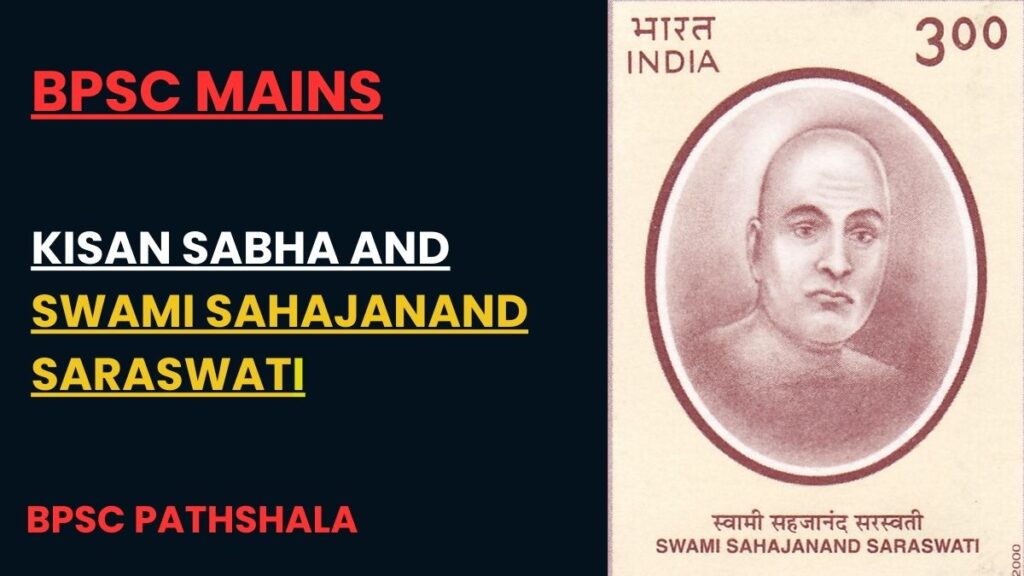
Kisan Sabha and Swami Sahajanand Saraswati occupy a central place in the history of India’s peasant movements. The All India Kisan Sabha emerged as a mass organisation of peasants fighting against feudal exploitation, zamindari oppression and colonial agrarian policies. The roots of this movement lay in Bihar, where Swami Sahajanand Saraswati mobilised peasants and transformed agrarian discontent into an organised political force.
Master History & Culture. Ace BPSC Mains.
BPSC Mains GS Paper-I: History & Culture Course
Master Ancient Indian History, Modern Indian History & Bihar History with structured, exam-oriented notes designed specifically for BPSC Mains.
✓ 50+ Exam-Oriented Topics • ✓ Comprehensive History & Culture Notes • ✓ Bihar-Specific Coverage • ✓ Updated for 72nd BPSC Mains
2. Swami Sahajanand Saraswati: Architect of the Peasant Movement
Swami Sahajanand Saraswati was the pioneer of the organised peasant movement in Bihar. He founded the Bihar Provincial Kisan Sabha (BPKS) in 1929 to unite peasants against zamindari exploitation. His leadership gave ideological clarity and organisational strength to peasant struggles.
Swami Sahajanand believed that political freedom was meaningless without economic freedom for peasants. For him, abolition of zamindari and land rights for tillers were essential parts of the freedom struggle.
3. Formation of All India Kisan Sabha
The success of the Bihar Kisan Sabha under Swami Sahajanand’s leadership paved the way for a nationwide organisation. The All India Kisan Sabha was founded in 1936 at the Indian National Congress Lucknow Session, initially known as the All India Kisan Congress.
- Swami Sahajanand Saraswati became the first President
- N. G. Ranga was appointed Secretary
- The organisation later came to be known as Akhil Bhartiya Kisan Sabha
This marked the transformation of regional peasant struggles into a national agrarian movement.
4. Objectives of the Kisan Sabha Movement
Under the leadership of Swami Sahajanand Saraswati, the Kisan Sabha adopted clear objectives:
- Abolition of the zamindari system
- Reduction of land revenue
- Institutionalisation of cheap rural credit
- Protection of tenants’ rights
- End to illegal cesses and forced labour
These demands directly challenged the feudal structure supported by British colonial rule.
Prepare Smarter. Study Better. Ace BPSC Mains.
BPSC Mains GS Paper 1 & 2 Complete Course
Access comprehensive BPSC Mains Notes for GS Paper 1 & 2, covering 378+ topics across 24 PDF lessons, with dedicated Bihar coverage, practice questions and downloadable study material.
✓ GS Paper 1 & 2 • ✓ 378+ Topics • ✓ 24 PDF Lessons • ✓ Bihar-Specific Coverage • ✓ Downloadable Notes
5. Kisan Sabha and Congress Governments (1937–39)
In the 1937 provincial elections, the Indian National Congress formed governments in several provinces, including Bihar. Some reforms were introduced:
- Land revenue in Bihar was fixed at the 1911 level
- Tenants cultivating land for 12 years were given ownership rights
However, many Congress leaders were themselves zamindars, which created a class conflict within the party. As a result, the Congress governments failed to fully implement peasant-friendly reforms.
6. Growing Rift between Kisan Sabha and INC
Due to unfulfilled promises, peasants became disillusioned with the Congress. Swami Sahajanand Saraswati openly criticised the INC leadership for protecting landlord interests. This growing tension weakened the relationship between the Congress and the Kisan Sabha.
When Quit India Movement was launched in 1942, Swami Sahajanand and other peasant leaders did not support the Congress call, believing that peasant interests had been ignored.
7. Socialist and Communist Influence on Kisan Sabha
Gradually, the Kisan Sabha came under the influence of socialists and communists. The rift between the INC and AIKS became clear during the Haripura Session of the Congress. In May 1942, the Communist Party of India (CPI) took control of the All India Kisan Sabha across the country.
8. Split of Kisan Sabha after 1964
After the split of the Communist Party of India in 1964, the Kisan Sabha also divided into two organisations:
- All India Kisan Sabha (CPI) – Peasant wing of CPI
- All India Kisan Sabha (CPI-M) – Also known as Akhil Bhartiya Kisan Sabha (36 Canning Lane)
Both organisations continue to function as peasant fronts.
9. Objectives of All India Kisan Sabha (Present)
Even today, the All India Kisan Sabha works as a platform for peasants and rural labourers with the following aims:
- Abolition of landlordism
- Free distribution of land to agricultural labourers
- Improvement of living standards in rural areas
- Development of agriculture and rural industries
- Ending exploitation of peasants and rural workers
10. Conclusion: Legacy of Swami Sahajanand Saraswati
Kisan Sabha and Swami Sahajanand Saraswati represent the most organised and radical phase of India’s peasant movement. Swami Sahajanand’s leadership ensured that agrarian issues became central to the national struggle. His vision linked freedom from British rule with freedom from feudal oppression, making him one of the most important mass leaders of modern India.