1. Introduction
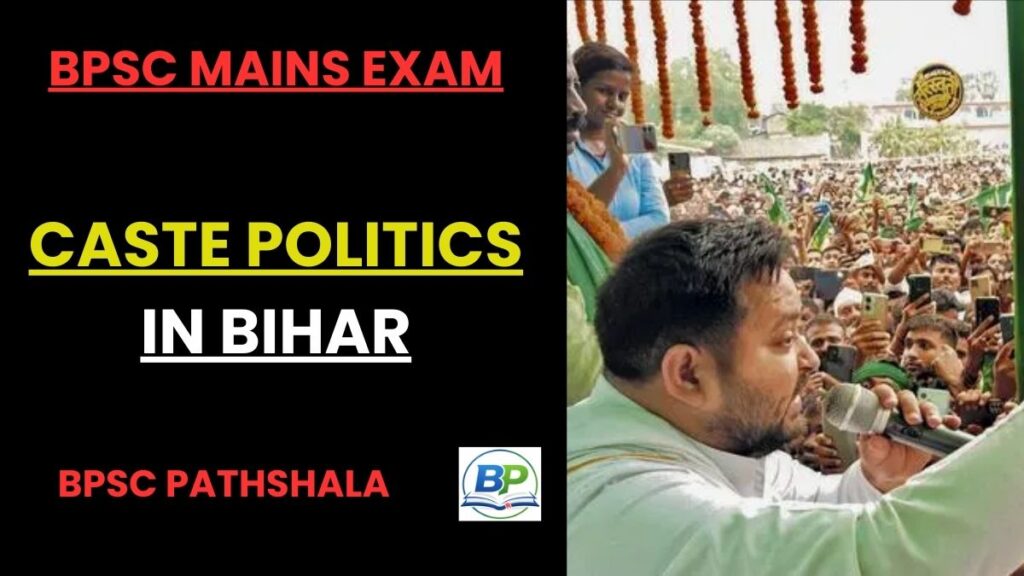
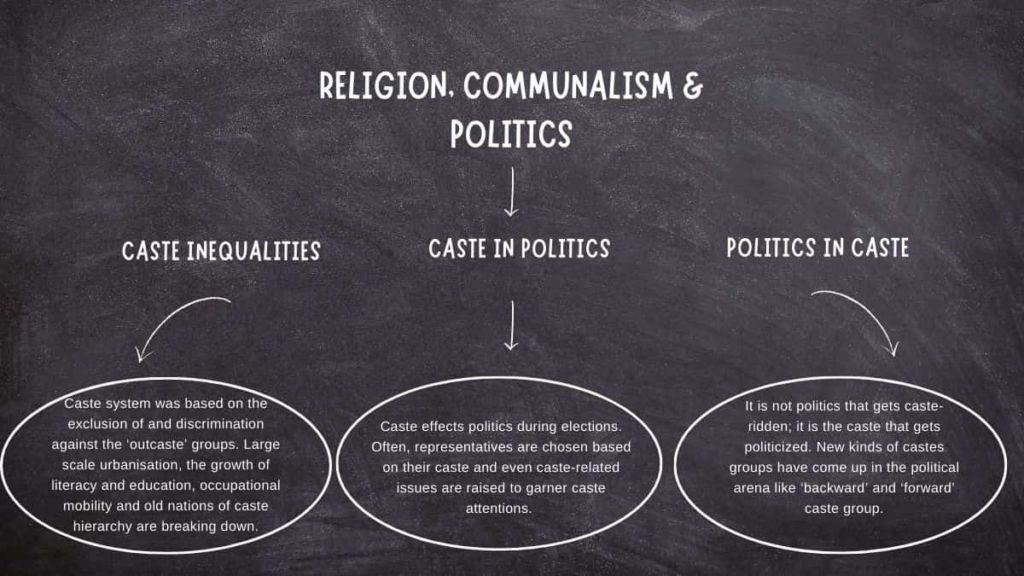
The caste politics in Bihar is deep-rooted and continues to shape electoral behaviour, party strategies, leadership patterns, and governance outcomes. Bihar’s society is historically stratified along caste lines, and politics has often mirrored this social reality. From the freedom movement to the era of coalition politics, caste has remained a powerful factor in determining who gets political power and how it is exercised.
In Bihar, caste is not merely a social identity; it functions as a political resource. Political mobilisation, vote-bank formation, and leadership legitimacy have largely revolved around caste alliances. Understanding Bihar politics, therefore, is incomplete without understanding the caste structure and its interaction with democracy.
Master Indian Polity. Write Better Mains Answers.
BPSC Mains GS Paper-II: Indian Polity Course
Complete Polity preparation covering Constitution, Executive, Parliament, Judiciary, Elections, Governance and Bihar-specific issues
with structured PDF notes.
✓ 50+ Exam-Oriented Topics • ✓ 4 Comprehensive PDF Lessons • ✓ Bihar-Specific Topics • ✓ Designed for 72nd BPSC Mains
2. Social Structure of Bihar: A Caste Overview
In order to understand the caste politics in Bihar, Bihar’s caste population structure is to be considered which can broadly be divided into:
- Upper castes: Brahmins, Bhumihars, Rajputs, Kayasthas
- Other Backward Classes (OBCs): Yadavs, Kurmis, Koeris, etc.
- Extremely Backward Classes (EBCs)
- Scheduled Castes (SCs)
- Scheduled Tribes (STs) (numerically small in Bihar)
Historically, upper castes dominated land, education, administration, and politics, while lower castes remained socially and economically marginalised. This imbalance laid the foundation for caste-based political assertion in the post-Independence period.
3. Early Phase: Upper Caste Dominance (1950s–1980s)
In the initial decades after Independence, caste politics in Bihar was largely controlled by upper-caste elites.
- Congress leadership was dominated by upper castes
- Political power aligned with land ownership and social status
- Lower castes had limited political representation despite numerical strength
Elections during this phase were influenced by caste, but upper castes acted as political gatekeepers, deciding candidates and policy priorities. This period witnessed limited social justice politics.
Prepare Smarter. Study Better. Ace BPSC Mains.
BPSC Mains GS Paper 1 & 2 Complete Course
Access comprehensive BPSC Mains Notes for GS Paper 1 & 2, covering 378+ topics across 24 PDF lessons, with dedicated Bihar coverage, practice questions and downloadable study material.
✓ GS Paper 1 & 2 • ✓ 378+ Topics • ✓ 24 PDF Lessons • ✓ Bihar-Specific Coverage • ✓ Downloadable Notes
4. Mandal Politics and Rise of OBC Assertion
A turning point of caste politics in Bihar, came with the implementation of the Mandal Commission recommendations in the late 1980s and early 1990s.
Key Changes Brought by Mandal Politics
- Political mobilisation of OBCs, especially Yadavs and Kurmis
- Demand for representation, dignity, and social justice
- Decline of upper-caste monopoly over power
The emergence of leaders like Lalu Prasad Yadav marked the beginning of backward caste empowerment in Bihar politics. His politics was built on the slogan of social justice and empowerment of the marginalised.
MY (Muslim–Yadav) Coalition
One of the most influential caste-based political formations in Bihar has been the MY coalition.
Features of MY Politics
- Alliance of Yadavs (dominant OBC group) and Muslims
- Provided electoral stability to Rashtriya Janata Dal (RJD)
- Helped consolidate backward caste identity in politics
This coalition redefined Bihar’s electoral arithmetic and demonstrated how caste alliances could decisively influence election outcomes.
Role of Nitish Kumar and Kurmi–EBC Politics
The next phase saw the rise of Nitish Kumar, who attempted to restructure caste politics in Bihar.
Key Shifts Under Nitish Kumar
- Focus on Extremely Backward Classes (EBCs)
- Social engineering beyond single-caste dominance
- Emphasis on governance, development, and law and order
Nitish Kumar tried to move Bihar politics from identity-only politics to development-oriented caste accommodation, though caste remained central to political calculations.
5. Caste and Electoral Politics in Bihar
The role of caste politics in Bihar’s electoral process is not symbolic; it is measurable and reflected in candidate selection, voting behaviour, and coalition formation. Electoral data, surveys, and post-election studies clearly show that caste acts as the core organising principle of elections in Bihar.
Candidate Selection: Caste as the First Filter
Political parties in Bihar prioritise caste arithmetic before ideology or experience while distributing tickets.
- Bihar has 243 Assembly constituencies, many of which have a dominant caste group influencing outcomes.
- Parties routinely conduct internal caste surveys at constituency level before finalising candidates.
- According to analyses based on Election Commission of India election data: Constituencies with 30–40% dominance of a single caste usually see candidates from that caste fielded by all major parties.
- For example: Yadav-dominated seats: RJD almost invariably fields Yadav candidates. Kurmi/EBC pockets: JD(U) prioritises Kurmi or EBC candidates. Upper-caste dominated areas (Bhumihar, Rajput): BJP fields candidates accordingly.
Why Caste Matters for Winnability
- Voting patterns in Bihar show low volatility within caste groups
- Parties believe caste candidates bring:
- Guaranteed vote consolidation
- Local legitimacy
- Organised booth-level mobilisation
Hence, merit is often secondary to caste identity in ticket distribution.
Voting Behaviour: Community-Driven Electoral Choices
In Bihar, voting is largely collective rather than individual. Studies by Association for Democratic Reforms and CSDS show that over 60–70% voters consider caste while voting in Assembly elections. Voting decisions are often taken at, family level, Tola or mohalla level, Caste association level.
Role of Caste Elders and Influencers in caste politics in Bihar
Local caste leaders act as vote mobilisers and negotiators with political parties. Political parties promise tickets, Local development works, Administrative postings in return for caste-based vote consolidation.
Examples from Elections
In the 2020 Bihar Assembly elections Yadavs voted overwhelmingly for RJD, Upper castes largely consolidated behind BJP and EBC votes emerged as a swing factor. This shows that caste loyalty still outweighs performance voting in large parts of rural Bihar.
6. Coalition Politics: Balancing Caste Blocks
Why Coalitions Are Necessary
No single caste group in Bihar is large enough to win elections alone. Even the largest caste groups like Yadavs form around 14–15% of the population. Hence, elections are won by coalitions of castes, not individuals
Caste-Based Electoral Coalitions
- MY (Muslim–Yadav) coalition: Backbone of RJD’s electoral strength
- Upper caste + EBC + Kurmi combination: Core support base of NDA alliances
- Dalits and Mahadalits act as swing voters in many seats
- Post-poll surveys show that parties that successfully combine at least 3–4 caste groups cross the majority mark.
- Coalitions are reworked every election cycle based on: Demographic shifts, Political alliances and Reservation and welfare policies
Thus, coalition politics in Bihar is essentially caste coalition politics.
Caste as the Backbone of Electoral Strategy
Putting all elements together: Candidate selection ensures caste representation, Voting behaviour ensures caste consolidation and Coalition politics ensures caste arithmetic balance. This makes caste the foundation of electoral strategy in Bihar, not just one of many factors.
Caste politics in Bihar’s electoral process is institutionalised, data-backed, and deeply embedded. From ticket distribution to voting patterns and alliance formation, caste functions as the most reliable predictor of electoral outcomes. While development and governance issues are gaining importance, they continue to operate within the larger framework of caste-based mobilisation. Any realistic analysis of Bihar elections must therefore treat caste not as a distortion of democracy, but as a structural reality shaping democratic competition.
7. Caste and Governance: Benefits and Limitations
Positive Aspects
- Political inclusion of historically marginalised groups
- Increased representation of OBCs, SCs, and EBCs
- Strengthening of democratic participation
Negative Aspects
- Overemphasis on caste at the cost of development
- Patronage politics and favouritism
- Weak focus on merit and institutional efficiency
Caste-based governance often prioritises group loyalty over policy performance, affecting long-term development.
8. Caste Census and Renewed Debate
The recent caste survey in Bihar has reignited debates on caste politics in Bihar.
Political Implications
- Demand for proportionate representation
- Renewed push for expanded reservations
- Strengthening of caste-based political narratives
The caste census has reinforced the idea that numbers matter in democracy, especially in Bihar’s politics.
9. Caste vs Development Politics: A False Dichotomy?
While caste politics in Bihar is often criticised, in Bihar it has, provided a voice to the voiceless, corrected historical injustices and enabled political empowerment. However, excessive reliance on caste identity risks diverting attention from education, health, and employment and creating permanent social divisions. The real challenge is balancing social justice with development.
Recent trends indicate gradual changes as urban youth show interest in jobs, education, and infrastructure, migration and education are diluting rigid caste identities and Social media is reshaping political mobilisation. Yet, even these new voters often remain caste-conscious during elections, indicating slow but incomplete change.
10. Conclusion
The caste politics in Bihar political system is undeniable and deeply entrenched. From upper-caste dominance to backward caste assertion and coalition politics, caste has shaped leadership, electoral outcomes, and governance patterns in the state. While caste-based politics has enabled social justice and representation, it has also constrained policy-driven governance.
The future of Bihar politics lies not in eliminating caste—which is unrealistic—but in transcending caste dominance through inclusive development, quality governance, and issue-based politics. Only when caste identity coexists with development priorities can Bihar achieve both social justice and sustainable progress.
BPSC Mains Practice Questions: Caste politics in Bihar
Q1. Caste has played a decisive role in shaping Bihar’s political system since Independence. Analyse how caste has influenced electoral politics, leadership patterns, and governance outcomes in Bihar.
Q2. The Mandal phase transformed Bihar’s politics from elite dominance to backward caste assertion. Examine the impact of Mandal politics on party strategies, caste coalitions, and democratic participation in Bihar.
Q3.Caste-based politics in Bihar has been both an instrument of social justice and a constraint on development-oriented governance. Critically evaluate this statement with suitable examples.
Tip for Aspirants:
While answering, link caste dynamics with representation, governance quality, development indicators, and democratic deepening. Use Bihar-specific examples for higher marks.
Read also…