1. Introduction
Special Category Status for Bihar has emerged as a major policy demand in recent years due to the state’s persistent economic backwardness, weak infrastructure, and vulnerability to natural disasters. Although the Constitution does not explicitly mention Special Category Status, it has been used as a policy tool to promote balanced regional development in India.
Special Category Status (SCS) is a classification granted by the Central Government to support the development of states facing structural, geographical, and socio-economic disadvantages. Although the Indian Constitution does not explicitly provide for Special Category Status, the concept evolved through policy decisions, beginning with the recommendations of the 5th Finance Commission in 1969. The objective of SCS was to ensure equitable development by providing preferential financial assistance to states with inherent constraints.
Initially, Special Category Status was accorded to states such as Jammu and Kashmir, Assam, and Nagaland, and later extended to several hill and North-Eastern states based on parameters like difficult terrain, low population density, tribal concentration, strategic border location, and weak state finances. Over time, eleven states, including Telangana, have been granted this status. Earlier, SCS states received enhanced plan assistance through the Planning Commission and the National Development Council.
In recent years, the demand for Special Category Status for Bihar has gained political and policy attention due to persistent economic backwardness, frequent natural disasters, weak infrastructure, and low per-capita income. However, with the abolition of the Planning Commission and changes introduced by the 14th and 15th Finance Commissions, the relevance and feasibility of granting new SCS have come under debate. Understanding the concept, benefits, limitations, and Bihar’s demand for Special Category Status is therefore crucial from the perspective of federalism, fiscal policy, and regional development.
Master Indian Polity. Write Better Mains Answers.
BPSC Mains GS Paper-II: Indian Polity Course
Complete Polity preparation covering Constitution, Executive, Parliament, Judiciary, Elections, Governance and Bihar-specific issues
with structured PDF notes.
✓ 50+ Exam-Oriented Topics • ✓ 4 Comprehensive PDF Lessons • ✓ Bihar-Specific Topics • ✓ Designed for 72nd BPSC Mains
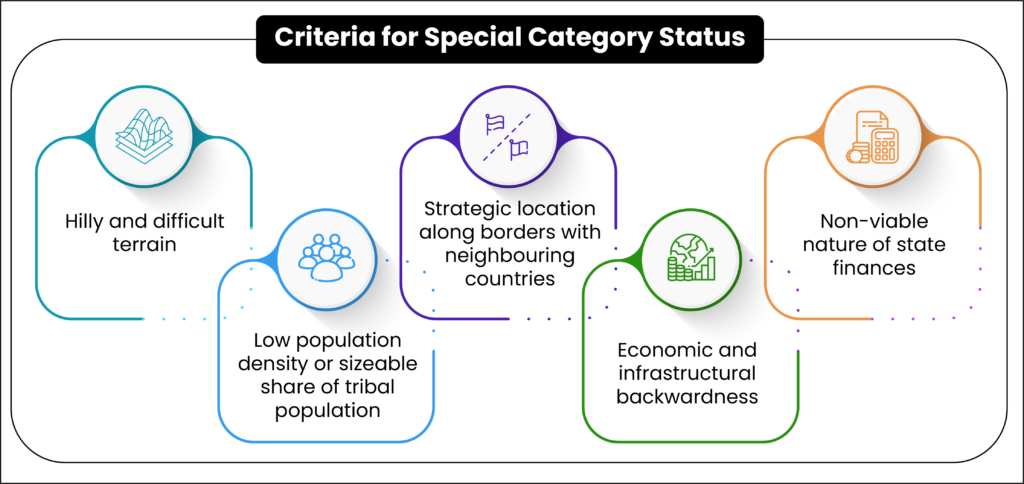
2. Parameters (Based on Gadgil Formula):
- Hilly Terrain;
- Low Population Density and/or Sizeable Share of Tribal Population;
- Strategic Location along Borders with Neighbouring Countries;
- Economic and Infrastructure Backwardness; and
- Nonviable Nature of State finances.
3. Benefits of SCN
- In the past, SCS states used to receive approximately 30% of central assistance, determined by the Gadgil-Mukherjee formula.
- However, following the recommendations of the 14th and 15th Finance Commissions (FC) and the dissolution of the Planning Commission, this assistance to SCS States has been subsumed in an increased devolution of the divisible pool funds for all States (increased to 41% in the 15th FC from 32%).
- The Centre pays 90% of the funds required in a Centrally-Sponsored Scheme to special category status states as against 60% or 75% in case of other states, while the remaining funds are provided by the state governments.
- Unspent money in a financial year does not lapse and is carried forward.
- Significant concessions are provided to these states in excise and customs duties, income tax and corporate tax.
- 30% of the Centre’s Gross Budget goes to Special Category states.
Prepare Smarter. Study Better. Ace BPSC Mains.
BPSC Mains GS Paper 1 & 2 Complete Course
Access comprehensive BPSC Mains Notes for GS Paper 1 & 2, covering 378+ topics across 24 PDF lessons, with dedicated Bihar coverage, practice questions and downloadable study material.
✓ GS Paper 1 & 2 • ✓ 378+ Topics • ✓ 24 PDF Lessons • ✓ Bihar-Specific Coverage • ✓ Downloadable Notes
4. Why is Special Category Status for Bihar being demanded?
Bihar’s demand for Special Category Status for Bihar is rooted in low per-capita income, limited industrial growth, and frequent floods and droughts. The state argues that additional central assistance is necessary to bridge developmental gaps.
Economic Disparities:
Bihar faces significant economic challenges, including a lack of industrial development and limited investment opportunities. The bifurcation of the state resulted in the shifting of industries to Jharkhand, exacerbating the employment and economic growth issues in Bihar.
Natural Calamities:
The state grapples with natural calamities like floods in the northern region and severe droughts in the southern part. These recurring disasters disrupt agricultural activities, affecting livelihoods and economic stability.
Lack of Infrastructure:
Infrastructure, especially in terms of irrigation facilities and water supply, remains inadequate. The absence of sufficient resources for irrigation impacts agricultural productivity, a primary source of livelihood for a large portion of the population.
Poverty and Social Development:
Bihar has a high poverty rate, with a significant number of families living below the poverty line. With a per-capita GDP of around Rs 54,000, Bihar has consistently been one of the poorest States. BIhar is home to around 94 lakh poor families and the granting of SCS will help the government get about RS 2.5 lakh crore required to fund various welfare measures over the next five years.
Funding for Development:
Seeking SCS is also a means to secure substantial financial assistance from the central government, allowing Bihar to access funds required for development projects and addressing long-standing socio-economic challenges.
5. Benefit on grant of special category status for Bihar
The grant of Special Category Status for Bihar would provide the state with enhanced financial support from the central government, enabling greater investment in infrastructure, health, education, and employment generation. Higher central funding in centrally sponsored schemes would help Bihar address long-standing development gaps, improve irrigation and connectivity, and strengthen disaster management in flood- and drought-prone regions.
Additionally, Special Category Status for Bihar would offer tax incentives and concessions that can attract private investment and industries to the state. This would promote industrial growth, create jobs, and reduce regional inequalities, ultimately supporting inclusive and sustainable development in Bihar.
6. Does Bihar fulfill criteria for the grant of SCS?
Although Bihar meets most of the criteria for the grant of special category status for Bihar, it does not fulfil the requirement of hilly terrain and geographically difficult areas, which is considered to be the primary reason for difficulty in infrastructural development. In 2013, the Raghuram Rajan Committee set up by the Centre, placed Bihar in the “least developed category” and suggested a new methodology based on a ‘multi -dimensional index’ for devolving funds instead of a SCS, which can be revisited to address the State’s socio-economic backwardness.
7. Do other States also want SCS?
Since its bifurcation in 2014, Andhra Pradesh has asked for a grant of SCS on the grounds of revenue loss due to Hyderabad going to Telangana.
Additionally, Odisha has also been requesting for the SCS, highlighting its vulnerability to natural calamities such as cyclones and a large tribal population (nearly 22%).
However, the Central government citing the 14th FC report, which made a recommendation to the Centre that no State be accorded the SCS, has repeatedly denied their demands.
8. Concerns related to Special Category Status
Resource Allocation
Granting SCS entails providing additional financial assistance to the state, which can strain the central government’s resources. Balancing the allocation of funds among various states becomes crucial, and granting SCS might lead to disparities or dissatisfaction among non-SCS states.
Dependency on Central Assistance:
States with SCS often become heavily reliant on central assistance. This could potentially discourage efforts toward self-sufficient and independent economic growth strategies.
Implementation Challenges:
Even after the grant of SCS, there might be challenges in utilizing the funds effectively due to administrative inefficiencies, corruption, or lack of proper planning. Ensuring that the allocated funds are used for intended purposes is a significant challenge.
9. Conclusion
In conclusion, Special Category Status for Bihar remains a significant issue in India’s federal and fiscal discourse. While structural challenges justify Bihar’s demand, evolving Finance Commission frameworks require alternative mechanisms to address regional disparities.
BPSC Mains Practice Questions-(Special Category Status for Bihar)
Q1. “Special Category Status is viewed as a tool for correcting regional imbalances, but its relevance has changed in the post–Finance Commission era.” Critically examine Bihar’s demand for Special Category Status, highlighting its justification, limitations, and alternative policy options.
Q2. Bihar’s socio-economic backwardness has renewed the debate on Special Category Status. Discuss the constitutional position, criteria, and potential benefits of granting Special Category Status to Bihar.
Q3 The abolition of the Planning Commission and increased tax devolution have altered the significance of Special Category Status. In this context, analyse whether granting Special Category Status for Bihar is still a viable solution to its development challenges.
Also Read…