1. Definition of E-Governance
E-Governance refers to the use of information and communication technology (ICT) by the government to deliver public services, improve administrative efficiency, ensure transparency, and promote citizen participation. It aims to make governance simple, accountable, and citizen-centric by reducing human interface, delays, and corruption. In the context of E-Governance in Bihar, digital tools are increasingly being used to bridge governance gaps in a resource-constrained and populous state.
2. Why E-Governance
The need for E-Governance in Bihar arises due to multiple governance challenges:
- Large population and high demand for public services
- Administrative delays and procedural complexity
- Corruption and lack of transparency
- Poor physical access to government offices, especially in rural areas
- Need for inclusive, time-bound, and cost-effective service delivery
E-governance helps Bihar overcome these constraints by bringing government services to citizens’ doorsteps digitally.
Master Indian Polity. Write Better Mains Answers.
BPSC Mains GS Paper-II: Indian Polity Course
Complete Polity preparation covering Constitution, Executive, Parliament, Judiciary, Elections, Governance and Bihar-specific issues
with structured PDF notes.
✓ 50+ Exam-Oriented Topics • ✓ 4 Comprehensive PDF Lessons • ✓ Bihar-Specific Topics • ✓ Designed for 72nd BPSC Mains
3. Elements of E-Governance
The framework of E-Governance in Bihar rests on four key elements:
- Government to Citizen (G2C): Online delivery of services like certificates, pensions, and welfare benefits
- Government to Government (G2G): Digital coordination between departments
- Government to Business (G2B): Online licenses, registrations, and compliance
- Government to Employee (G2E): HRMS, payroll, and service records
Together, these elements enhance efficiency, transparency, and accountability.
4. Implementation of E-Governance in Bihar
(a) General Administration & Service Delivery
- ServicePlus / e-District Bihar:
- Online issuance of caste, income, residence, and birth/death certificates
- Reduces physical visits to offices and middlemen
- Right to Public Services (RTPS) Portal:
- Time-bound delivery of notified services
- Tracks applications digitally, improving accountability
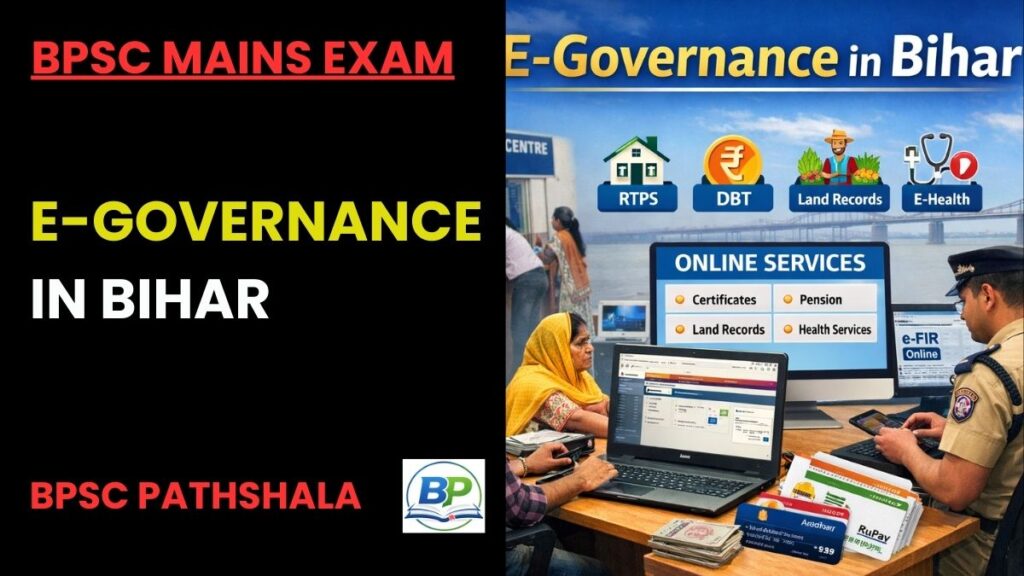
This has become the backbone of E-Governance in Bihar. Under the Right to Public Services (RTPS) Act, Bihar delivers 40+ citizen services online, and over 6–7 crore applications have been disposed of digitally since its launch, significantly reducing physical visits and delays.
(b) Revenue and Land Reforms Department
- Bihar Bhumi Portal: Online access to land records, jamabandi, and mutation status
- Online Land Mutation System: Reduces disputes and corruption in land administration
Digitisation of land records is crucial in a land-sensitive state like Bihar. The Bihar Bhumi portal provides online access to land records, and over 90% of jamabandi records have been digitised, helping reduce land disputes and rent-seeking in land administration.
(c) Social Welfare and DBT Mechanism
- Direct Benefit Transfer (DBT): Scholarships, pensions, and welfare payments transferred directly to bank accounts
- PFMS Integration: Ensures transparency and prevents leakage
DBT has strengthened trust in E-Governance in Bihar.
(d) Education Sector
- e-Shiksha Kosh & School MIS: Digital monitoring of teachers, students, and infrastructure
- Online Scholarship Portals: For SC, ST, OBC, EBC, and minority students
- Digital Attendance Systems: Improves accountability in schools
These initiatives support inclusive and transparent education governance.
(e) Health Sector
- e-Hospital & Online OPD Registration (selected districts)
- Digital Health Records & Telemedicine Initiatives
- Online Monitoring of Health Facilities
E-governance improves access and monitoring in Bihar’s public health system.
(f) Police and Law & Order
- Online FIR and e-Challan System
- Crime and Criminal Tracking Network (CCTNS)
- Dial-112 Emergency Response System
These initiatives enhance citizen safety and police responsiveness. With the implementation of CCTNS, 100% of police stations in Bihar are connected digitally, enabling online FIRs, better crime tracking, and faster inter-district coordination.
(g) Panchayati Raj and Local Governance
- e-Gram Swaraj Portal: Online planning, accounting, and monitoring of Panchayats
- Online Fund Flow and Audit Systems
This strengthens decentralised governance through digital means.
(h) Employment and Skill Development
- Online Portals for Student Credit Card, Kushal Yuva Program
- Digital Registration for Employment Exchanges
Technology supports youth-centric governance in Bihar.
Prepare Smarter. Study Better. Ace BPSC Mains.
BPSC Mains GS Paper 1 & 2 Complete Course
Access comprehensive BPSC Mains Notes for GS Paper 1 & 2, covering 378+ topics across 24 PDF lessons, with dedicated Bihar coverage, practice questions and downloadable study material.
✓ GS Paper 1 & 2 • ✓ 378+ Topics • ✓ 24 PDF Lessons • ✓ Bihar-Specific Coverage • ✓ Downloadable Notes
5. Hurdles in implementing E-Governance in Bihar
Despite progress, E-Governance in Bihar faces several challenges. These hurdles limit the full potential of digital governance.
- Digital divide due to low internet penetration in rural areas. According to NFHS-5, only about 37–40% of households in Bihar have access to the internet, one of the lowest figures among Indian states. This severely limits the reach of E-Governance in Bihar, especially in rural areas.
- Low digital literacy among citizens and frontline staff. As per the Periodic Labour Force Survey (PLFS), Bihar has one of the lowest levels of computer and internet literacy in India, particularly among women and elderly citizens. This restricts effective use of online government portals.
- Inadequate infrastructure and frequent power issues. Data from the National Power Portal shows that Bihar still faces power supply instability in rural areas, affecting the functioning of Common Service Centres (CSCs) and online service delivery.
- Language barriers, as many portals are not fully vernacular-friendly
- Cyber security and data privacy concerns
6. Conclusion
E-Governance in Bihar has emerged as a powerful tool to improve transparency, efficiency, and citizen satisfaction. From land records and welfare delivery to policing and education, digital initiatives have transformed service delivery. However, bridging the digital divide, improving infrastructure, and enhancing digital literacy are essential to make e-governance truly inclusive. With sustained political will and institutional capacity, e-governance can become a cornerstone of good governance in Bihar.
BPSC Mains Practice Questions (E-Governance in Bihar)
Q1. E-Governance has emerged as a key instrument for improving transparency and service delivery in Bihar. Examine the progress of E-Governance in Bihar with suitable examples from different sectors.
Q2. Despite several digital initiatives, e-governance outcomes in Bihar remain uneven. Discuss the major challenges in the effective implementation of E-Governance in Bihar and suggest measures to overcome them.
Q3. E-Governance can transform citizen–state interaction in a developing state like Bihar. Analyse how digital platforms have strengthened accountability and reduced corruption in Bihar’s administration.
Also Read….