1. Introduction
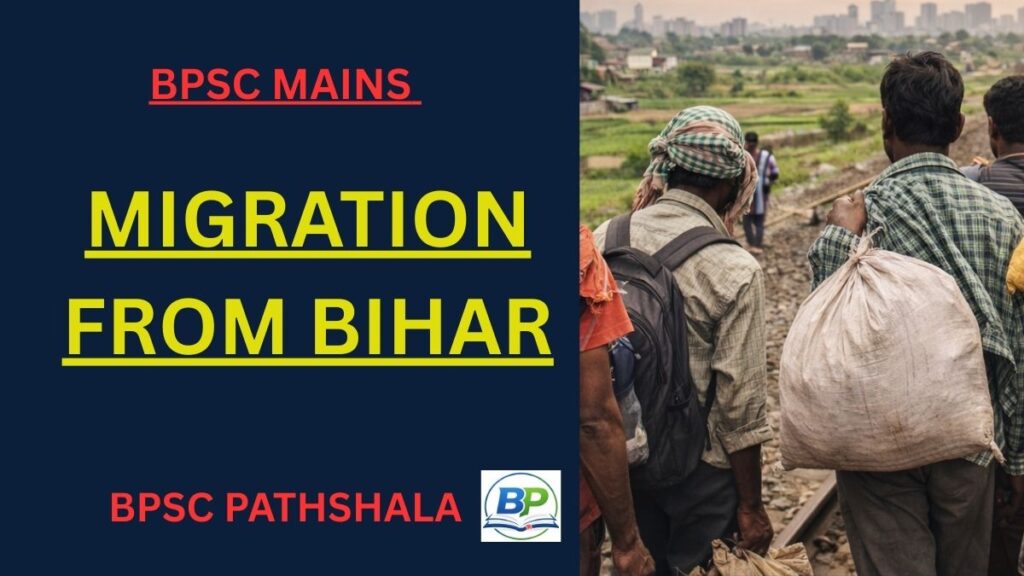
Migration from Bihar is one of the most visible features of the state’s socio-economic structure. Bihar has remained a major source of migrant labour for decades due to limited employment opportunities within the state. According to Census data, Bihar is among the top out-migrating states in India. Migration is largely seasonal and distress-driven, with people moving to other states for construction work, factory jobs, transport services, and informal sector employment. While migration helps households survive through remittances, it also highlights deep-rooted problems related to agriculture, industry, urbanisation, and job creation in Bihar.
Master Geography & Economy. Ace BPSC Mains.
BPSC Mains GS Paper-2: Geog & Economy Course
Master Indian Geography, Bihar Geography, Indian Economy, Bihar Economy, Agriculture and Industry with structured, exam-oriented
PDF notes designed specifically for BPSC Mains.
✓ 6 Comprehensive Lessons • ✓ 80+ Exam-Oriented Topics • ✓ Bihar-Specific Coverage • ✓ Mains Answer Writing Focus
2. Reasons for Out-Migration from Bihar
The primary reason for migration from Bihar is the lack of sufficient employment opportunities within the state. Bihar’s economy is heavily dependent on agriculture, which employs a large share of the population but contributes relatively less to income. Low productivity, small landholdings, and frequent floods and drought-like conditions reduce farm earnings.
Industrial development in Bihar has remained weak. The absence of large-scale manufacturing and limited growth of labour-intensive industries restrict non-farm employment. As a result, surplus rural labour is pushed out of the state.
Low wage levels further encourage migration. Daily wages for agricultural and construction labour in Bihar are significantly lower than those in industrialised states, making interstate migration economically attractive.
Poor urbanisation also plays a major role. Bihar has one of the lowest urbanisation levels in India (around 11–12%), which means fewer cities capable of absorbing rural migrants. Instead of migrating to towns within Bihar, people migrate directly to other states.
Key reasons in brief:
- Low agricultural income and seasonal employment
- Weak industrial base and limited non-farm jobs
- Low wages compared to destination states
Social networks strengthen this process. Once migration begins from a village, relatives and acquaintances follow the same route, making migration easier and more permanent.
3. Impact of Migration on Bihar’s Economy
Migration from Bihar has a mixed impact on the state’s economy.
On the positive side, remittances play a crucial role. A significant share of rural households depends on money sent by migrant workers. Remittances support consumption, improve access to education and healthcare, and reduce extreme poverty in many districts.
However, the negative impacts are more structural and long-term. Continuous out-migration leads to shortage of labour in agriculture during peak seasons such as sowing and harvesting. This raises wage costs and affects agricultural operations.
Migration also results in the loss of young and productive workers. Bihar loses a large part of its working-age population, which weakens local entrepreneurship, skill availability, and industrial growth. Over time, migration becomes a substitute for development rather than an outcome of development.
Economic impact in brief:
- Positive: remittances, poverty reduction, household stability
- Negative: labour shortage, loss of human capital, slow local growth
Prepare Smarter. Study Better. Ace BPSC Mains.
BPSC Mains GS Paper 1 & 2 Complete Course
Access comprehensive BPSC Mains Notes for GS Paper 1 & 2, covering 378+ topics across 24 PDF lessons, with dedicated Bihar coverage, practice questions and downloadable study material.
✓ GS Paper 1 & 2 • ✓ 378+ Topics • ✓ 24 PDF Lessons • ✓ Bihar-Specific Coverage • ✓ Downloadable Notes
4. Ways to Reverse Migration from Bihar
Reversing migration from Bihar requires addressing its root causes rather than restricting mobility.
The most effective solution is employment generation within the state. Promoting labour-intensive industries such as food processing, textiles, leather, and small manufacturing can absorb surplus labour.
Improving agricultural productivity is equally important. Better irrigation, flood control, access to technology, and diversification towards high-value crops can increase farm income and reduce distress migration.
Urban development must be strengthened. Developing tier-2 and tier-3 cities as economic centres can encourage rural-to-urban migration within Bihar instead of interstate migration.
Skill development aligned with local industry needs can help retain youth. When skilled workers find suitable jobs locally, migration pressure reduces naturally.
5. Government Initiatives Related to Migration
The Bihar Government has increasingly recognised migration as a development challenge.
Employment generation through rural wage employment programmes provides income support during agricultural off-seasons and helps reduce short-term distress migration. During crises such as the COVID-19 pandemic, special measures were taken for returning migrants, highlighting the scale of migration from Bihar.
Industrial policies have been revised to attract investment in agro-based industries, food processing units, and small manufacturing clusters. These sectors are labour-intensive and suitable for Bihar’s workforce.
Urban infrastructure development, housing schemes, and city development projects aim to strengthen towns so that they can function as employment hubs. Skill development programmes focus on improving employability of youth, both within Bihar and outside.
Key policy focus areas:
- Rural employment and income support
- Industrial investment and job creation
- Urban development and skill training
6. Conclusion
Migration from Bihar is primarily driven by economic distress, low agricultural income, weak industrialisation, and slow urban growth. While migration provides short-term relief through remittances, it also exposes long-term structural weaknesses in the state’s economy. Sustainable reduction in migration is possible only through job-led growth, agricultural transformation, and balanced urban development. Migration should evolve from a compulsion for survival to a choice based on opportunity, making it a true indicator of development rather than deprivation.
BPSC Mains Practice Questions (Based on Migration from Bihar)
Q 1. Migration from Bihar is largely distress-driven rather than opportunity-driven. Discuss the major causes of out-migration from Bihar and examine its economic impact on the state.
Q 2. Evaluate the role of agriculture, industrial development, and urbanisation in shaping migration patterns from Bihar. Suggest measures to reverse distress migration.
Q.3 While migration provides remittances to Bihar, it also creates long-term developmental challenges. Critically analyse this statement with reference to recent government initiatives.
Also Read….