1. Introduction
Tourism in Bihar holds a unique position in India’s tourism landscape because of the state’s deep historical, cultural, and religious roots. Bihar is the land of ancient civilizations, powerful empires, and spiritual movements that shaped not only India but also large parts of Asia. From Buddhism and Jainism to ancient universities and freedom struggle sites, Bihar’s tourism heritage is exceptionally rich.
Despite this, tourism in Bihar has not developed in proportion to its historical importance. Poor infrastructure, weak promotion, and governance challenges have kept the sector underperforming. Yet, with focused planning and investment, tourism in Bihar can emerge as a major driver of employment, income, and regional development.
Master Geography & Economy. Ace BPSC Mains.
BPSC Mains GS Paper-2: Geog & Economy Course
Master Indian Geography, Bihar Geography, Indian Economy, Bihar Economy, Agriculture and Industry with structured, exam-oriented
PDF notes designed specifically for BPSC Mains.
✓ 6 Comprehensive Lessons • ✓ 80+ Exam-Oriented Topics • ✓ Bihar-Specific Coverage • ✓ Mains Answer Writing Focus
2. Current State of Tourism in Bihar
At present, tourism in Bihar is underdeveloped but steadily growing. The state receives a significant number of domestic tourists, mainly pilgrims, while foreign tourist inflow remains limited and concentrated in a few locations. Data trends show that:
- Bihar receives over 3–4 crore domestic tourists annually, largely for religious and cultural reasons.
- Foreign tourist arrivals form a very small share and are mostly concentrated in Bodh Gaya, due to its global Buddhist significance.
- In 2024, around 7.36–7.37 lakh foreign tourists visited Bihar, showing a strong rebound after the pandemic and growth compared to previous years.
- Tourism’s contribution to Bihar’s economy remains much lower than the national average, indicating underutilisation of potential.
Tourist inflow is seasonal and site-specific, which means economic benefits are unevenly distributed and limited in duration.
3. Tourism Potential in Bihar
Bihar has one of the most diverse tourism potentials in India, cutting across religion, culture, history, and nature.
3.1 Religious and Spiritual Tourism (Core Strength)
Tourism in Bihar is globally recognised for its religious and spiritual significance. Bihar is the birthplace and working land of two major world religions—Buddhism and Jainism. Bodh Gaya is where Gautama Buddha attained enlightenment under the Bodhi Tree and attracts pilgrims from Sri Lanka, Japan, Thailand, Myanmar, and Tibet. Rajgir and Nalanda were important centres of Buddhist learning in ancient Magadha. Vaishali is the birthplace of Lord Mahavira, making Bihar central to Jain pilgrimage as well. Historically known as Magadha, the region hosted ancient sanghas, councils, and universities, giving Bihar unmatched spiritual tourism potential in India.
3.2 Cultural and Historical Tourism
Tourism in Bihar is deeply enriched by its cultural and historical legacy. Bihar was the heartland of ancient Magadha, which gave rise to powerful empires like the Mauryas and Guptas. Patna (ancient Pataliputra) was the capital of Emperor Ashoka and Chandragupta Maurya and one of the largest cities of the ancient world. Nalanda and Vikramshila were globally renowned centres of learning, attracting scholars from China, Korea, and Central Asia. Archaeological remains, Ashokan pillars, and museum sites across Bihar highlight its role in shaping India’s political, cultural, and intellectual history, offering immense potential for heritage tourism.
3.3 Natural and Eco-Tourism
Tourism in Bihar also has growing potential in natural and eco-tourism, though this dimension remains underdeveloped. The most important natural attraction is the Valmiki Tiger Reserve, the only tiger reserve in the state, located in West Champaran along the India–Nepal border. It is rich in forests, wildlife, and riverine ecosystems and offers scope for jungle safaris and eco-tourism. The Kanwar Lake (Asia’s largest oxbow lake) is an important wetland and bird habitat, attracting migratory birds during winter.
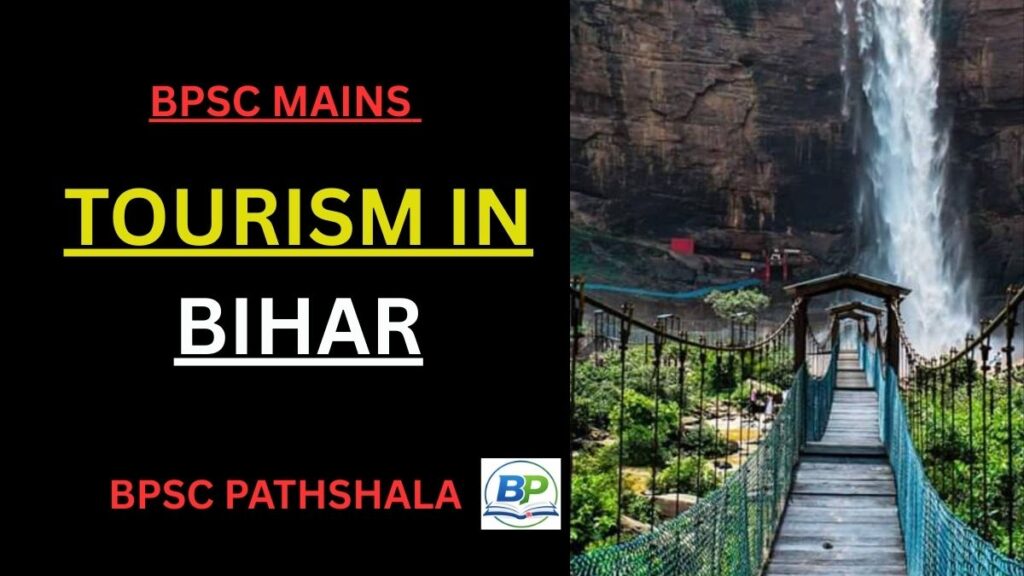
Bihar also has scenic landscapes such as the Kaimur Hills, forests, and waterfalls like Kakolat Falls. With proper conservation, infrastructure, and promotion, eco-tourism can generate sustainable livelihoods while protecting Bihar’s natural heritage. Eco-tourism can promote sustainable tourism, especially in lesser-known regions.
Eco-tourism in Bihar also includes Rajgir, known for forested hills, hot springs, nature trails, ropeway, and scenic landscapes, combining natural beauty with spiritual and historical significance.
3.4 Adventure and River Tourism
Tourism in Bihar has emerging scope in adventure and river tourism, especially along the Ganga. River cruises, boating, and riverfront activities in Patna and nearby stretches can attract domestic tourists. Adventure tourism is developing in Rajgir, which offers a ropeway to hilltops, trekking routes, and nature trails. Though currently limited, these activities can diversify Bihar’s tourism beyond pilgrimage if supported by infrastructure and safety measures. This segment can attract younger tourists and diversify tourism beyond pilgrimage.
3.5 Medical and Wellness Tourism (Emerging Area)
Tourism in Bihar is gradually expanding into medical and wellness tourism due to affordable healthcare and improving medical infrastructure. Bihar attracts patients from India’s North-Eastern states as well as neighbouring countries such as Bangladesh, Nepal, Bhutan, and Myanmar. The state offers comparatively low-cost medical treatment in fields like general surgery, orthopaedics, cardiac care, and diagnostics, making it attractive for economically weaker patients. In recent years, several modern hospitals, medical colleges, and diagnostic centres have been developed, especially in urban areas like Patna. With better branding, international connectivity, and support services, Bihar has the potential to emerge as a regional hub for affordable medical and wellness tourism. However, this requires strong infrastructure and branding.
4. Reasons for Backwardness of Tourism in Bihar
Despite rich potential, tourism in Bihar remains backward due to structural weaknesses.
The most important issue is poor infrastructure, including roads, accommodation, sanitation, and last-mile connectivity at tourist sites. Many heritage locations lack basic facilities.
Weak marketing and branding have also hurt tourism. Bihar’s image is not promoted effectively at national and international levels, unlike other states with similar heritage.
Law and order concerns, though improved in recent years, have historically discouraged tourists. In addition, limited private sector participation and low investment in hospitality have constrained growth.
Key constraints (brief):
- Inadequate infrastructure
- Poor promotion and branding
- Limited tourist facilities
- Concentration on few sites only
5. Government Initiatives to Boost Tourism in Bihar
The Bihar Government has identified tourism as a priority sector and has taken several policy and infrastructure measures to strengthen tourism in Bihar, especially after 2015.
One major initiative is the development of tourism circuits, particularly the Buddhist Circuit, connecting Bodh Gaya, Rajgir, Nalanda, and Vaishali. This circuit is actively promoted to attract foreign tourists from Buddhist countries.
To improve accessibility, the state has introduced tourist bus services connecting major tourist destinations and improved road connectivity to heritage sites. The government has also promoted river and water-based tourism, including projects like the Karamchat Dam houseboat initiative, aimed at diversifying tourism beyond religious sites.
Budgetary allocation for tourism has increased steadily in recent years. In the Bihar Budget 2025–26, the tourism department’s allocation was increased significantly from around ₹462.44 crore in 2024–25 to over ₹1,103 crore, marking more than a 2.5-fold rise to boost tourism infrastructure and services.
- Infrastructure at tourist destinations
- Tourist amenities such as guest houses, interpretation centres, and ghats
- Promotion through festivals, fairs, and digital platforms
Special emphasis has been laid on public–private partnership (PPP) for hotels, resorts, and tourism services. Together, these initiatives reflect a shift from neglect to planned tourism-led development in Bihar, though outcomes are still evolving.ment in hotels, resorts, and tourism services have been introduced to improve tourist experience and employment generation.
Prepare Smarter. Study Better. Ace BPSC Mains.
BPSC Mains GS Paper 1 & 2 Complete Course
Access comprehensive BPSC Mains Notes for GS Paper 1 & 2, covering 378+ topics across 24 PDF lessons, with dedicated Bihar coverage, practice questions and downloadable study material.
✓ GS Paper 1 & 2 • ✓ 378+ Topics • ✓ 24 PDF Lessons • ✓ Bihar-Specific Coverage • ✓ Downloadable Notes
6. Way Forward for Tourism in Bihar
For tourism in Bihar to become a growth engine, a multi-dimensional approach is needed.
Priority must be given to infrastructure-led tourism development, especially accommodation, sanitation, and digital connectivity. Diversification beyond religious tourism is essential to ensure year-round tourist inflow.
Skill development in hospitality, local guides, and tourism services can generate employment for youth. Public–private partnerships and effective global branding, particularly targeting Buddhist countries, can significantly boost foreign tourist arrivals.
7. Conclusion
Tourism in Bihar is a sector of immense promise but limited performance. The state possesses globally significant religious, cultural, and historical assets that very few regions in the world can match. However, poor infrastructure, weak promotion, and policy gaps have kept tourism underdeveloped.
With focused governance, infrastructure investment, and diversification, tourism in Bihar can emerge as a powerful tool for economic growth, employment generation, and cultural diplomacy. Developing tourism is not just about attracting visitors; it is about reclaiming Bihar’s rightful place in global history and heritage.
BPSC Mains Practice Questions (Based on Tourism in Bihar
- Tourism in Bihar has immense historical and religious potential but remains underdeveloped. Analyse the present status of tourism in Bihar and examine the reasons for its backwardness.
- Religious and cultural heritage forms the core strength of tourism in Bihar. Discuss how this potential can be leveraged for employment generation and regional development.
- Evaluate the role of recent government initiatives in promoting tourism in Bihar. Suggest further measures required to make tourism a sustainable growth engine for the state.
Also Read….