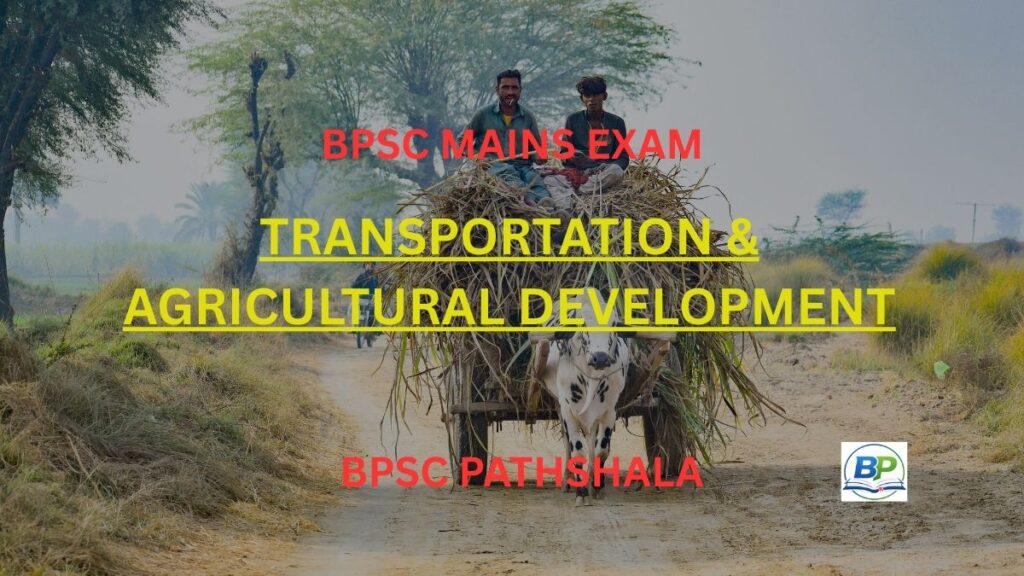
1. Introduction
Transportation & agricultural development are closely connected pillars of India’s rural economy. Agriculture contributes around 15–18% to India’s GDP and supports nearly 45% of the workforce, making it a backbone of livelihoods. However, without efficient transportation systems, farmers struggle to sell their produce at fair prices.
India produces over 330 million tonnes of food grains annually, along with large quantities of fruits, vegetables and dairy products. A significant share of perishable produce—estimated at 20–30% in some cases—gets wasted due to weak transport and storage facilities. This directly affects farmers’ income and food security.
According to the Ministry of Agriculture & Farmers Welfare, Government of India, improving rural connectivity and supply chain infrastructure remains essential for strengthening Transportation & agricultural development in the country. Good roads, railways and cold chain networks act like a bridge between farms and markets. When transportation improves, crops reach mandis (agricultural markets) and urban centres faster, reducing losses and increasing profits. Therefore, strengthening transportation & agricultural development together is essential for doubling farmers’ income and ensuring rural prosperity.
Master Geography & Economy. Ace BPSC Mains.
BPSC Mains GS Paper-2: Geog & Economy Course
Master Indian Geography, Bihar Geography, Indian Economy, Bihar Economy, Agriculture and Industry with structured, exam-oriented
PDF notes designed specifically for BPSC Mains.
✓ 6 Comprehensive Lessons • ✓ 80+ Exam-Oriented Topics • ✓ Bihar-Specific Coverage • ✓ Mains Answer Writing Focus
2. Meaning and Linkage
Transportation & agricultural development are interdependent processes Transportation refers to the movement of farm inputs like seeds, fertilizers and machinery to villages, and the movement of harvested crops from farms to markets. Agricultural development means increasing farm productivity, improving technology use and raising farmers’ income.The linkage is simple: when transport improves, agriculture becomes more profitable. India has a rural road network of over 4 million km, mainly developed under rural connectivity programmes. Studies show that villages connected by all-weather roads experience higher market participation and better crop prices. For example:
- Better roads reduce travel time to mandis and cut transport costs.
- Cold chain transport reduces spoilage of fruits, vegetables and dairy products.
- Improved connectivity encourages farmers to shift from subsistence farming to commercial crops.
Thus, transportation & agricultural development grow together. Efficient transport systems not only support production but also help farmers access larger and more competitive markets.
3. Role in Agricultural Growth
Transportation plays a crucial role in strengthening Transportation & agricultural development by supporting production, distribution and diversification of crops. Without proper connectivity, even high agricultural output cannot translate into higher income.
India produced over 330 million tonnes of food grains in 2022–23, but timely transport is essential to move this surplus to deficit regions. Efficient transportation reduces post-harvest losses, especially in perishables like fruits and vegetables, where losses are estimated at 20–30% due to weak logistics. Transportation supports agricultural growth in the following ways:
- Timely supply of inputs
Fertilizers, seeds and farm machinery reach rural areas faster through improved road networks. - Market expansion
Farmers can sell beyond local mandis and access national markets through rail and highway connectivity. - Crop diversification
Better transport encourages farmers to grow high-value crops like vegetables, dairy and floriculture. - Support to allied activities
Dairy and fisheries depend on cold chain transport to maintain quality.
Thus, strong transport systems directly enhance productivity, reduce waste and increase profitability, making Transportation & agricultural development deeply interconnected in India.
Prepare Smarter. Study Better. Ace BPSC Mains.
BPSC Mains GS Paper 1 & 2 Complete Course
Access comprehensive BPSC Mains Notes for GS Paper 1 & 2, covering 378+ topics across 24 PDF lessons, with dedicated Bihar coverage, practice questions and downloadable study material.
✓ GS Paper 1 & 2 • ✓ 378+ Topics • ✓ 24 PDF Lessons • ✓ Bihar-Specific Coverage • ✓ Downloadable Notes
4. Impact on Farmers’ Income
Efficient connectivity has a direct impact on farmers’ earnings, making Transportation & agricultural development crucial for rural prosperity. When transport facilities improve, farmers are able to sell produce in better markets instead of depending only on nearby traders.
India has more than 7,000 regulated mandis, but many farmers still travel long distances to reach them. Studies show that villages connected by all-weather roads under rural road schemes witnessed an increase in farm incomes and crop prices. At the same time, post-harvest losses in perishables are estimated at ₹90,000 crore annually, largely due to weak logistics and storage. Better transportation improves income in the following ways:
- Higher price realization
Farmers can access larger markets where competition leads to better prices. - Reduced middlemen dependence
Direct access to mandis and urban markets increases bargaining power. - Lower transport cost
Good roads reduce fuel expenses and travel time. - Support for exports
Efficient port and rail connectivity helps farmers participate in agricultural exports, which crossed USD 50 billion in recent years.
Thus, improved transport networks strengthen Transportation & agricultural development by directly increasing farmers’ income and reducing rural poverty.
5. Transport Modes in Agriculture
Different transport systems support Transportation & agricultural development in India. Each mode plays a specific role depending on distance, cost and type of produce.
- Roadways
Roads carry nearly 65% of freight movement in India and are most important for short-distance transport from farms to mandis. India has over 6.3 million km of road network, connecting rural areas to markets. - Railways
Rail transport is useful for bulk movement of food grains like rice and wheat. Indian Railways moves millions of tonnes of food grains annually for the Food Corporation of India (FCI), ensuring national food distribution. - Waterways
Inland waterways offer a low-cost option for bulk agricultural goods. India has about 14,500 km of navigable waterways, which can reduce transport costs for fertilizers and grains. - Air transport
Used mainly for high-value and perishable items like fruits, flowers and seafood. Under special cargo schemes, agricultural exports reach international markets quickly. - Cold chain logistics
India has over 8,000+ cold storage facilities, but gaps still exist. Refrigerated transport is essential to reduce spoilage in dairy, meat and horticulture.
Together, these modes strengthen Transportation & agricultural development by improving efficiency, reducing losses and expanding market access.
6. Government Initiatives
The Government of India has launched several schemes to strengthen Transportation & agricultural development, focusing on rural connectivity, cold chains and market integration.
- Pradhan Mantri Gram Sadak Yojana (PMGSY)
The Pradhan Mantri Gram Sadak Yojana has constructed over 7 lakh km of rural roads, improving connectivity to thousands of villages and boosting farm-to-market access. - PM Gati Shakti National Master Plan
The PM Gati Shakti integrates road, rail, port and logistics planning to reduce delays and improve freight efficiency across sectors, including agriculture. - Kisan Rail
Launched by Indian Railways, Kisan Rail services transport perishable farm produce with refrigerated coaches. Hundreds of routes have been operated, benefiting farmers in states like Maharashtra and Bihar. - Agriculture Infrastructure Fund (AIF)
Provides financial support for building warehouses, cold storages and supply chain infrastructure. The scheme has sanctioned projects worth over ₹20,000 crore, strengthening post-harvest logistics. - Sagarmala Programme
The Sagarmala Programme improves port connectivity, supporting agricultural exports which have crossed USD 50 billion in recent years.
These initiatives show that coordinated policy efforts are improving Transportation & agricultural development to raise farmers’ income and reduce wastage.
7. Key Challenges
Despite progress, several obstacles still weaken Transportation & agricultural development in India. Structural gaps in rural infrastructure and logistics reduce efficiency and farmer profitability.
- High post-harvest losses
India loses an estimated 20–30% of fruits and vegetables due to weak storage and transport systems. This translates into losses worth nearly ₹90,000 crore annually. - Inadequate cold chain network
Although India has over 8,000 cold storage units, most are concentrated in a few states like Uttar Pradesh and West Bengal, creating regional imbalance. - Poor rural connectivity in remote areas
While PMGSY has improved connectivity, some hilly and tribal regions still lack reliable all-weather roads. - High logistics cost
India’s logistics cost is around 13–14% of GDP, which increases input prices and reduces farmers’ competitiveness. - Fragmented supply chain
Small landholdings (average farm size around 1.08 hectares) make it difficult to organize efficient bulk transport.
These challenges show that without addressing infrastructure gaps and supply chain inefficiencies, the full potential of Transportation & agricultural development cannot be realized.
8. Way Forward
To strengthen Transportation & agricultural development, India must focus on integrated planning, technology adoption and rural infrastructure expansion. Reducing logistics cost from the current 13–14% of GDP to around 8–10% can significantly improve farmers’ competitiveness and profitability. Key measures include:
- Expansion of cold chain networks
Increasing refrigerated transport and storage facilities can reduce the current 20–30% post-harvest losses in perishables. - Promotion of multimodal transport
Greater use of railways and inland waterways can lower fuel consumption and transport cost for bulk crops. - Digital agriculture platforms
Linking farmers to national markets through digital systems can improve price transparency and reduce middlemen. - Strengthening Farmer Producer Organizations (FPOs)
Collective marketing by FPOs can help small farmers (average landholding 1.08 hectares) access bulk transport and better markets. - Sustainable and green transport
Promoting electric vehicles and fuel-efficient logistics can reduce emissions while supporting long-term growth.
With coordinated reforms and infrastructure investment, Transportation & agricultural development can boost rural income, reduce wastage and support inclusive economic growth in India.
BPSC Mains Practice Questions – Transportation & Agricultural Development
- Discuss the role of transportation in promoting agricultural development in India. Examine how improved connectivity influences productivity, market access and farmers’ income.
- “Efficient transportation is essential for doubling farmers’ income and reducing regional disparities.” Analyse this statement in the context of Transportation & agricultural development in India.
Also Read…
- Characteristic of Indian Monsoon
- Effect of Monsoon on Indian Economy
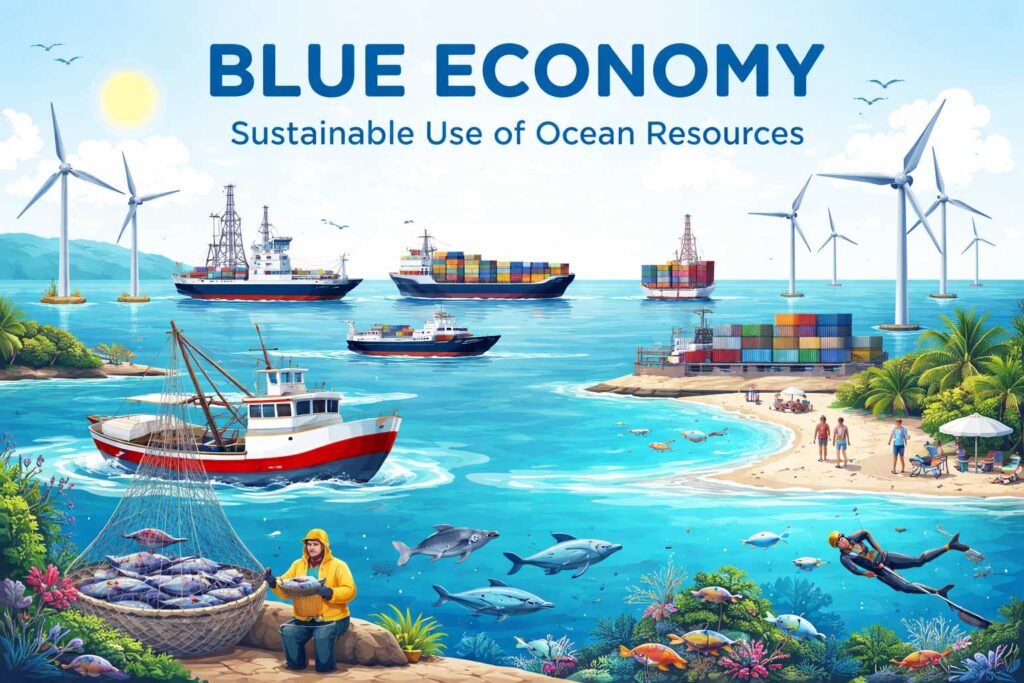
- Blue Economy: Growth with Sustainability in the 21st Century
- Inland Waterway in India: National Waterways, Economic Importance, Challenges and Future Prospects
- Transportation & Industrial Development in India: Role, Impact, Challenges and Future Trends