1. Introduction to Sustainable Development
Sustainable development is a model of growth that aims to balance economic progress, social well-being and environmental protection. It recognizes that development should not only improve the present quality of life but also protect resources for future generations. In simple terms, it means using natural resources wisely so that both present and future needs are fulfilled.
The concept gained global recognition in 1987 when the Brundtland Commission defined sustainable development as development that meets present needs without compromising the ability of future generations to meet their own needs. Today, it forms the foundation of global policy frameworks like the Sustainable Development Goals (SDGs) adopted in 2015.
The need for sustainable development has become urgent due to rising global challenges. For example, global temperatures have already increased by about 1.1°C above pre-industrial levels, and nearly 1 million species are at risk of extinction due to environmental degradation. At the same time, extreme poverty has declined significantly—from 36% in 1990 to below 9% in recent years—showing that development can produce positive results when managed responsibly.
Thus, sustainable development is not only about environmental conservation but also about inclusive economic growth and social justice. It calls for coordinated efforts by governments, businesses, communities and individuals to build a resilient future for both people and the planet.
Master Geography & Economy. Ace BPSC Mains.
BPSC Mains GS Paper-2: Geog & Economy Course
Master Indian Geography, Bihar Geography, Indian Economy, Bihar Economy, Agriculture and Industry with structured, exam-oriented
PDF notes designed specifically for BPSC Mains.
✓ 6 Comprehensive Lessons • ✓ 80+ Exam-Oriented Topics • ✓ Bihar-Specific Coverage • ✓ Mains Answer Writing Focus
2. Definition and Evolution of Sustainable Development
The idea of sustainable development evolved as the world began to realize that rapid industrial growth was damaging the environment. The most widely accepted definition was given in 1987 by the World Commission on Environment and Development in its report Our Common Future. It defined sustainable development as development that meets the needs of the present without compromising the ability of future generations to meet their own needs. This idea introduced the principle of intergenerational equity, meaning fairness between present and future generations.
The roots of sustainable development can be traced back to global environmental movements of the 1970s. The United Nations Conference on the Human Environment was the first major international conference that placed environmental issues on the global agenda. It led to the creation of the United Nations Environment Programme to coordinate global environmental action.
The concept gained further momentum at the United Nations Conference on Environment and Development, also known as the Earth Summit. This conference produced important documents like Agenda 21 and the Convention on Biological Diversity, linking environment and development more clearly.
Over time, sustainable development expanded beyond environmental protection to include poverty reduction, gender equality and economic growth. In 2015, the United Nations adopted the 2030 Agenda for Sustainable Development, which includes 17 Sustainable Development Goals (SDGs) and 169 targets to be achieved by 2030.
Thus, sustainable development has evolved from an environmental concern into a comprehensive global framework that integrates economic, social and ecological dimensions of development.
3.Core Elements of Sustainable Development
Sustainable development rests on three interconnected pillars: economic growth, social inclusion and environmental protection. These three elements must be balanced to ensure long-term progress without ecological damage or social inequality.
3.1 Environmental Sustainability
Environmental sustainability ensures that natural resources are used responsibly and are not treated as unlimited. It focuses on conservation, pollution control and climate action.
- Renewable energy is expanding globally at about 5% annual growth over the past decade.
- However, CO₂ concentrations continue to rise, and 2018 was among the warmest years on record.
- Nearly 1 million species are at risk of extinction due to biodiversity loss.
Environmental sustainability includes promoting renewable energy, water conservation, sustainable transport and green construction practices.
3.2 Social Sustainability
Social sustainability aims to create a just and inclusive society. It promotes access to healthcare, education and equal opportunities.
- The global under-5 mortality rate declined by 49% between 2000 and 2017, showing progress in health.
- Yet, inequality remains high, and extreme poverty is still three times higher in rural areas than urban areas.
Gender equality, poverty eradication and community empowerment are central to social sustainability.
3.3 Economic Sustainability
Economic sustainability focuses on steady and inclusive economic growth without environmental harm.
- Extreme poverty declined from 36% in 1990 to around 8–9% in recent years, but progress has slowed.
- Investment in green technologies and equal distribution of resources are key to long-term growth.
It promotes wealth generation while ensuring that economic development does not degrade the environment. Thus, sustainable development requires harmonizing economic, social and environmental goals. If one pillar weakens, overall development becomes unstable.
Prepare Smarter. Study Better. Ace BPSC Mains.
BPSC Mains GS Paper 1 & 2 Complete Course
Access comprehensive BPSC Mains Notes for GS Paper 1 & 2, covering 378+ topics across 24 PDF lessons, with dedicated Bihar coverage, practice questions and downloadable study material.
✓ GS Paper 1 & 2 • ✓ 378+ Topics • ✓ 24 PDF Lessons • ✓ Bihar-Specific Coverage • ✓ Downloadable Notes
4.Integration of Scientific and Traditional Knowledge
For sustainable development to succeed, modern science must work together with traditional and local knowledge systems. Scientific research provides advanced technology and data-driven solutions, while traditional knowledge offers practical, community-based practices developed over generations.
In many rural areas, traditional water harvesting systems, crop diversity and forest conservation methods have supported ecological balance for centuries. Globally, indigenous communities protect nearly 80% of the world’s remaining biodiversity, highlighting the value of community knowledge in conservation.
India has recognized this integration through initiatives like the National Ayush Mission and the Traditional Knowledge Digital Library, which document and protect traditional medicinal knowledge. Combining scientific innovation with community-based practices accelerates sustainable development and ensures solutions are locally relevant and environmentally sound.
5.Global Issues Affecting Sustainable Development
Despite global efforts, several challenges threaten the achievement of sustainable development. These issues are interconnected and require coordinated international action.
- Climate Change: Climate change is one of the most serious global threats. Global temperatures have already increased by about 1.1°C above pre-industrial levels, leading to rising sea levels and extreme weather events. Tackling climate change and promoting sustainable development are mutually reinforcing goals, as both aim to reduce environmental degradation and ensure long-term resilience.
- Loss of Biodiversity: The natural environment is deteriorating rapidly. Around 1 million plant and animal species are at risk of extinction, and ocean acidity has increased by 26% compared to pre-industrial times. Biodiversity loss directly affects food security, livelihoods and ecological balance.
- North–South Divide: There is significant inequality between developed and developing countries. The “North” (developed countries) comprises just over 20% of the world’s population but consumes nearly 80% of global energy, while many developing countries struggle to meet basic needs. This imbalance creates tension in global climate and sustainability negotiations.
- Intellectual Property Rights (IPRs): Access to green technology and innovation is essential for sustainable development. However, strict intellectual property regimes sometimes limit affordable access to environmentally friendly technologies in developing nations.
These global issues show that sustainable development is not only an environmental concern but also an economic and political challenge that demands global cooperation.
6. Major Global Initiatives on Sustainable Development
Over the decades, several global agreements and conferences have shaped the framework of sustainable development. These initiatives aim to balance economic growth with environmental protection and social equity.
6.1 Stockholm Conference, 1972
The United Nations Conference on the Human Environment was the first major global effort to address environmental issues. It resulted in the Stockholm Declaration and led to the creation of the United Nations Environment Programme, which coordinates environmental activities within the UN system.
6.2 Earth Summit, 1992
Held in Rio de Janeiro, the United Nations Conference on Environment and Development linked environment and development more clearly. It produced key outcomes such as:
- Framework Convention on Climate Change (UNFCCC)
- Convention on Biological Diversity (CBD)
- Agenda 21
- Rio Declaration
6.3 Kyoto Protocol, 1997
The Kyoto Protocol set binding emission reduction targets for developed countries to combat climate change.
6.4 Paris Agreement, 2015
The Paris Agreement aims to limit global warming to well below 2°C above pre-industrial levels. As of recent reports, 186+ countries have ratified the agreement.
6.5 Sustainable Development Goals (SDGs), 2015
Under the 2030 Agenda for Sustainable Development, the United Nations adopted 17 Sustainable Development Goals and 169 targets to be achieved by 2030. The SDGs are universal and apply to all countries, though they are not legally binding.
These initiatives demonstrate global commitment to sustainable development, but implementation remains uneven due to political, economic and technological challenges.
7. Progress and Challenges in Achieving Sustainable Development
Over the past two decades, the world has made measurable progress toward sustainable development, but major challenges remain.
Progress
According to recent global assessments:
- Extreme poverty declined from 36% in 1990 to around 8–9% in recent years.
- The under-5 mortality rate fell by nearly 49% between 2000 and 2017.
- Access to electricity has expanded to the vast majority of the global population.
- Marine protected areas have more than doubled since 2010, reflecting efforts to conserve biodiversity.
- Over 186 countries have ratified the Paris Agreement, showing widespread climate commitment.
Renewable energy capacity has grown steadily, and the cost of solar and wind energy has fallen significantly over the last decade.
Challenges
Despite these gains, serious obstacles continue:
- Inequality is increasing both within and among countries.
- Global hunger has been rising again after years of decline.
- Youth unemployment remains higher than adult unemployment worldwide.
- Extreme poverty is three times higher in rural areas than urban areas.
- 2018 was among the warmest years on record, and CO₂ levels continue to rise.
- Ocean acidity has increased by 26% compared to pre-industrial levels, and land degradation continues.
These trends show that while sustainable development has achieved partial success, the pace of progress is uneven and fragile. Without stronger international cooperation and policy reforms, gains may be reversed.
8. Way Forward for Sustainable Development
Achieving sustainable development requires deeper, faster and more coordinated action at global, national and local levels. While progress has been made, current efforts are not sufficient to meet the 2030 targets.
8.1 Transform Production and Consumption Patterns
Developed countries must reduce excessive consumption of fossil fuels and plastics. Sustainable production models, circular economy practices and green technologies should be promoted. Aligning public and private investments with the SDGs is essential for long-term sustainability.
8.2 Protect Environmental Commons
Global commons such as oceans, forests and the atmosphere must be safeguarded. Climate change mitigation strategies like carbon sequestration, carbon trading and renewable energy expansion need stronger implementation. Conservation of biodiversity and restoration of degraded land are equally critical.
8.3 Strengthen Climate Action
Under the Paris Agreement, countries must enhance their Nationally Determined Contributions (NDCs) to limit global warming. Climate finance mechanisms such as the Green Climate Fund should support developing countries.
8.4 Reform Food and Agricultural Systems
Food systems need structural transformation. Sustainable agriculture, efficient irrigation and reduction of food waste can address hunger while protecting natural resources.
8.5 Reduce Inequality and Promote Inclusive Growth
Policies must ensure equal access to healthcare, education and economic opportunities. Addressing gender inequality and rural poverty is essential for balanced development.
8.6 Encourage Global Cooperation
The North–South divide must be narrowed through technology transfer, climate finance and fair trade practices. International cooperation remains central to achieving sustainable development goals.
In conclusion, sustainable development demands a shift in policies, incentives and lifestyles. A more optimistic and resilient future is possible only through collective action that integrates economic progress, social justice and environmental protection. Detailed targets and global progress on sustainable development can be accessed through the United Nations Sustainable Development Goals (UN SDGs) platform, which provides official updates and reports on the 2030 Agenda.
BPSC Mains Practice Questions – Sustainable Development
- Define sustainable development. Discuss its core elements and explain why balancing economic growth, social inclusion and environmental protection is essential for long-term development.
- Examine the major global initiatives taken to promote sustainable development. How do the Sustainable Development Goals (SDGs) aim to address global challenges?
- Despite global efforts, achieving sustainable development remains a challenge. Analyse the major obstacles and suggest measures to overcome them.
Also Read…
- Characteristic of Indian Monsoon
- Effect of Monsoon on Indian Economy
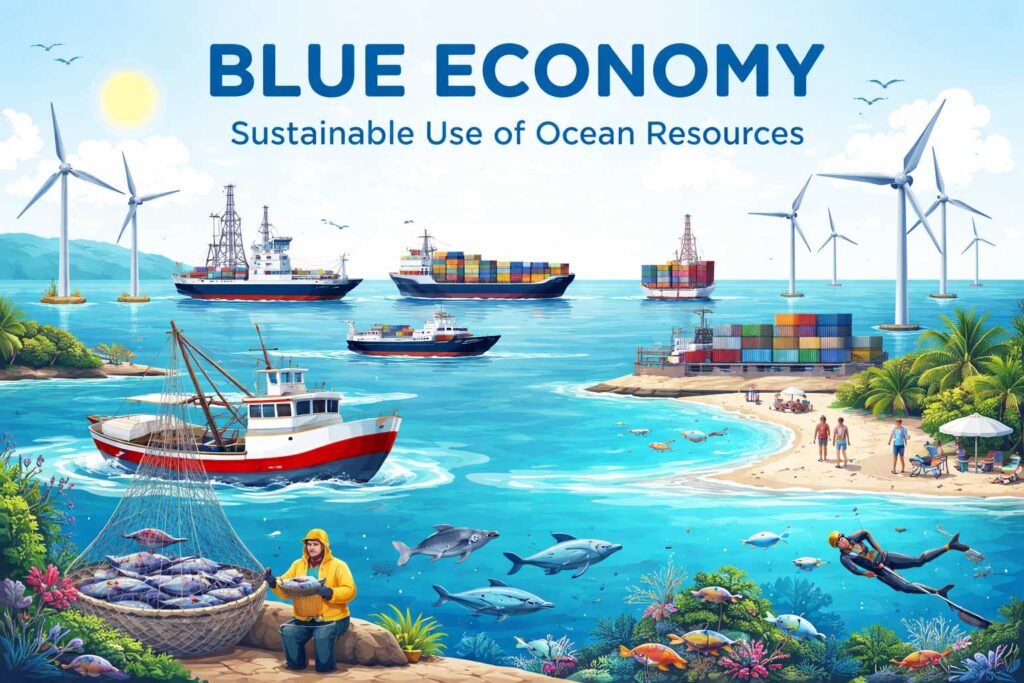
- Blue Economy: Growth with Sustainability in the 21st Century
- Inland Waterway in India: National Waterways, Economic Importance, Challenges and Future Prospects
- Transportation & Industrial Development in India: Role, Impact, Challenges and Future Trends
- Transportation & agricultural development
- River dispute among Indian States
- Multipurpose River Valley Projects in India
- Rain Shadow area