Blue Economy: Growth with Sustainability in the 21st Century
1. Introduction
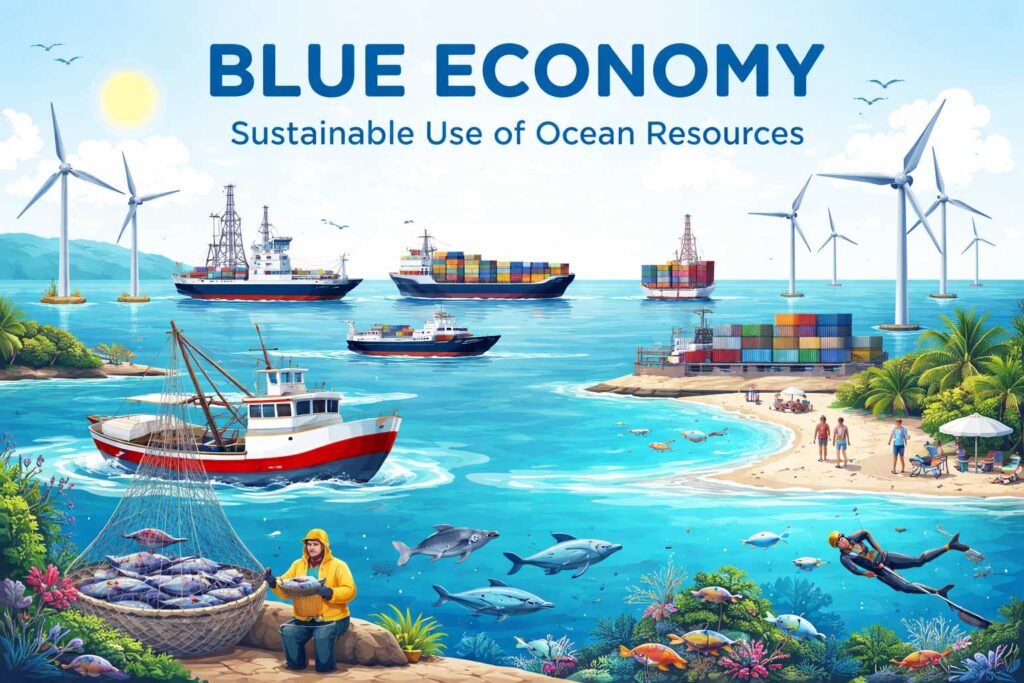
The Blue Economy refers to the sustainable use of ocean and marine resources for economic growth, employment generation, and improved livelihoods while ensuring the health of marine ecosystems. In simple terms, it means earning from the oceans without destroying them. The idea promotes a balance between development and environmental protection.
Oceans cover nearly 71% of the Earth’s surface, contain about 97% of the planet’s water, and represent 99% of the living space by volume. Recognising their importance, Sustainable Development Goal 14 (Life Below Water) calls for conservation and sustainable use of marine resources. The Blue Economy has therefore emerged as a key global development strategy.
2. Concept and Evolution of Blue Economy
The concept of the Blue Economy gained global attention after the Rio+20 Summit (2012), where sustainable ocean-based growth was highlighted. Unlike the traditional ocean economy—which focused mainly on extraction such as fishing and oil drilling—the Blue Economy integrates economic growth, social inclusion, and environmental sustainability.
The global ocean economy is currently valued at around USD 1.5 trillion annually, making it the world’s seventh-largest economy. It is projected to reach nearly USD 3 trillion by 2030, indicating massive growth potential if managed sustainably.
3. Blue Economy in Indian Context
India has significant advantages for developing the Blue Economy. The country has a coastline of about 7,500 km and an Exclusive Economic Zone (EEZ) of 2.2 million sq km, which may expand further with extended continental shelf claims. India also possesses:
- 12 major ports
- Over 200 minor and intermediate ports
- Around 30 shipyards
Its strategic location in the Indian Ocean Region (IOR)—through which nearly 80% of global maritime oil trade passes—gives India geopolitical and economic leverage.
4. Major Sectors of Blue Economy in India
4.1 Fisheries and Aquaculture
India is the third-largest fish producer globally and the second-largest in aquaculture. Fisheries contribute around 1.1% to India’s GDP and support the livelihoods of nearly 2.8 crore people. Sustainable aquaculture and mariculture can increase seafood exports while reducing pressure on wild fish stocks.
4.2 Shipping and Port-led Development
About 95% of India’s trade by volume and 70% by value is carried through maritime transport. Efficient ports and shipping reduce logistics costs and enhance competitiveness. The port-led development model aims to transform coastal areas into industrial and logistics hubs.
4.3 Coastal and Marine Tourism
India’s vast coastline offers strong potential for tourism. Coastal tourism generates employment in hospitality, transport, and local crafts. Globally, marine tourism contributes nearly USD 390 billion annually, and India can expand its share through sustainable planning.
4.4 Offshore Oil and Gas
India imports more than 85% of its crude oil requirement, making offshore exploration crucial for energy security. Offshore oil and gas fields in the Arabian Sea and Bay of Bengal contribute significantly to domestic production.
4.5 Renewable Ocean Energy
Ocean-based renewable energy—such as tidal, wave, and offshore wind—offers long-term sustainability. India has an estimated offshore wind potential of over 70 GW, particularly along the Gujarat and Tamil Nadu coasts.
4.6 Marine Biotechnology
Marine biodiversity holds immense potential for pharmaceuticals, cosmetics, and bio-products. The ocean’s natural capital is estimated at around USD 24 trillion, showing the untapped economic value of marine ecosystems.
5. Growth Prospects and Economic Potential
The Blue Economy offers strong employment and export opportunities. Globally, ocean-based industries employ over 3 billion people directly or indirectly. For India, expansion in fisheries exports, shipbuilding, logistics, and coastal manufacturing can generate millions of jobs.
India’s fisheries exports crossed USD 8 billion in recent years, indicating rising global demand. With improved infrastructure and sustainability standards, this figure can grow further.
6. Need for Blue Economy
Marine ecosystems face serious threats:
- Over 30% of global fish stocks are overexploited
- About 8 million tonnes of plastic enter oceans annually
Climate change has caused rising sea levels and coral bleaching, threatening coastal populations. In India, nearly 40% of the population lives within 100 km of the coast, making sustainable marine management essential.
The Blue Economy ensures that development does not compromise ocean health.
7. Blue Economy 2.0: Climate-Resilient Approach
7.1 Coastal Restoration and Adaptation
Mangroves and coral reefs act as natural barriers against storms. Studies show mangroves can reduce wave energy by up to 66%. Restoration efforts protect biodiversity and reduce disaster risk in cyclone-prone areas.
7.2 Sustainable Aquaculture and Mariculture
Expanding mariculture reduces pressure on wild fish stocks while meeting rising protein demand. Scientific aquaculture improves productivity and reduces environmental damage.
7.3 Integrated and Multi-Sectoral Governance
Effective implementation requires coordination among fisheries, shipping, environment, and energy departments. Integrated Coastal Zone Management (ICZM) promotes balanced development.
8. Challenges in Implementing Blue Economy
Despite high potential, challenges remain:
- Marine pollution and plastic waste
- Overfishing and illegal fishing
- Weak enforcement of maritime regulations
- Climate change impacts like sea-level rise
Rising ocean temperatures threaten biodiversity and coastal livelihoods. Without strict regulation, economic exploitation can damage long-term sustainability.
9. Government Initiatives in India to Strengthen the Blue Economy
To operationalise the vision of the Blue Economy, India has launched several large-scale policy and investment initiatives aimed at port modernisation, fisheries development, marine research, and maritime infrastructure. These initiatives seek to combine economic growth with sustainability and coastal livelihood enhancement.
Sagarmala Programme
Launched in 2015, the Sagarmala Programme focuses on port-led development to reduce logistics costs and promote coastal industrialisation. The programme aims to modernise ports, improve connectivity to hinterlands, and develop coastal economic zones. More than 800 projects have been identified under Sagarmala, with an estimated investment of over ₹5 lakh crore. Since nearly 95% of India’s trade by volume moves through sea routes, strengthening port infrastructure directly enhances trade competitiveness and supports Blue Economy objectives.
Deep Ocean Mission
Approved in 2021 with an estimated budget of over ₹4,000 crore, the Deep Ocean Mission focuses on exploration of deep-sea minerals, marine biodiversity, and ocean climate services. One of its key components is the development of a manned submersible vehicle capable of exploring ocean depths up to 6,000 metres. The mission supports sustainable resource utilisation, marine biotechnology research, and improved understanding of ocean climate interactions, which are essential for long-term Blue Economy planning.
Pradhan Mantri Matsya Sampada Yojana (PMMSY)
Launched in 2020 with an outlay exceeding ₹20,000 crore, PM Matsya Sampada Yojana aims to transform India’s fisheries sector. It focuses on enhancing fish production, modernising infrastructure, promoting aquaculture, and increasing exports. India’s fisheries exports have crossed USD 8 billion annually, and the scheme seeks to double fishers’ income while ensuring sustainable practices. It also supports cold chains, value addition, and coastal employment generation.
Maritime India Vision 2030
The Maritime India Vision 2030 provides a comprehensive roadmap for modernising ports and shipping. It aims to increase port capacity to over 3,000 million tonnes per annum, improve turnaround time, promote green ports, and encourage private sector participation. The plan also promotes digitalisation, skill development, and sustainable maritime operations.
Together, these initiatives reflect India’s strategic commitment to building a robust and sustainable Blue Economy framework that balances economic ambition with ecological responsibility. For official information on ocean research, marine policies, and the Blue Economy, visit the Ministry of Earth Sciences website. The portal provides details on the Deep Ocean Mission, ocean services, climate studies, and marine resource management initiatives.
10. Way Forward
To fully realise the potential of the Blue Economy, India must:
- Strengthen marine governance and monitoring
- Promote green shipping and clean fuels
- Expand renewable ocean energy
- Encourage coastal community participation
- Enhance regional cooperation in the Indian Ocean
Sustainability must remain central to avoid overexploitation.
11. Conclusion
The Blue Economy offers India a unique opportunity to align economic development with environmental sustainability. With its long coastline, vast EEZ, and strategic location in the Indian Ocean, India can emerge as a leading maritime power. However, success depends on balancing growth with conservation. A sustainable and climate-resilient Blue Economy can ensure employment, trade expansion, and ecological security for future generations.
BPSC Mains Practice Questions: Based on Blue Economy
- What is the Blue Economy? Discuss its major sectors and explain its relevance for India’s economic growth and environmental sustainability.
- Examine the growth potential of the Blue Economy in India. Highlight the role of fisheries, shipping, renewable energy, and port-led development in achieving sustainable development goals.
- The Blue Economy must balance development with conservation. Analyse the major challenges in implementing Blue Economy initiatives and suggest measures to ensure climate-resilient and sustainable maritime governance.
Also Read…