Caste Census in Bihar
1. Background
The caste census in Bihar has emerged as one of the most significant socio-political developments in recent years. Caste has historically shaped Bihar’s social structure, access to resources, political mobilisation, and governance priorities. While India conducted a comprehensive caste census during the colonial period (1931), post-Independence censuses have largely excluded caste data, except for Scheduled Castes (SCs) and Scheduled Tribes (STs). This absence of updated caste data created a gap between policy intent and social reality.
Against this backdrop, Bihar undertook a state-level caste survey to generate empirical data on caste composition and socio-economic conditions. The objective was not merely political assertion, but evidence-based policymaking—especially in a state marked by deep social inequalities, high poverty levels, and dependence on welfare schemes. Thus, the caste census in Bihar represents an attempt to align governance with ground realities rather than assumptions.
2. Constitutional aspects
The caste census in Bihar raises important constitutional questions related to equality, federalism, and social justice.
- Article 14 (Right to Equality) allows reasonable classification to address historical disadvantages. Accurate caste data strengthens such classification.
- Articles 15(4) and 16(4) empower the state to make special provisions for socially and educationally backward classes. However, identification of backwardness requires reliable data.
- Article 46 (DPSP) directs the state to promote the interests of SCs, STs, and other weaker sections. A caste census supports this constitutional mandate.
- Federalism: Since “Census” is a Union subject, the state-led caste survey sparked debate. However, Bihar positioned it as a survey for welfare planning, not a population census.
Therefore, constitutionally, the caste census in Bihar can be justified as a tool for implementing equality and social justice provisions, provided it remains within the framework of cooperative federalism.
3. Political and Governance implications
Politically, the caste census in Bihar has reshaped public discourse. It has shifted debates from ideology-driven narratives to data-driven politics. Political parties are now compelled to address questions of proportional representation, policy targeting, and inclusiveness with empirical backing. From a governance perspective, the caste census has several implications:
- Targeted welfare delivery: Schemes can be designed according to actual population shares rather than estimates.
- Administrative accountability: Data compels governments to justify allocation patterns.
- Democratic deepening: Marginalised groups gain visibility in policymaking.
However, critics argue that caste data may reinforce identity politics and divert attention from development issues. The challenge for Bihar’s governance lies in using caste data as a means for inclusive development, not as an end in itself.
4. Bihar caste survey findings
The findings of the caste census in Bihar broadly highlighted the following trends:
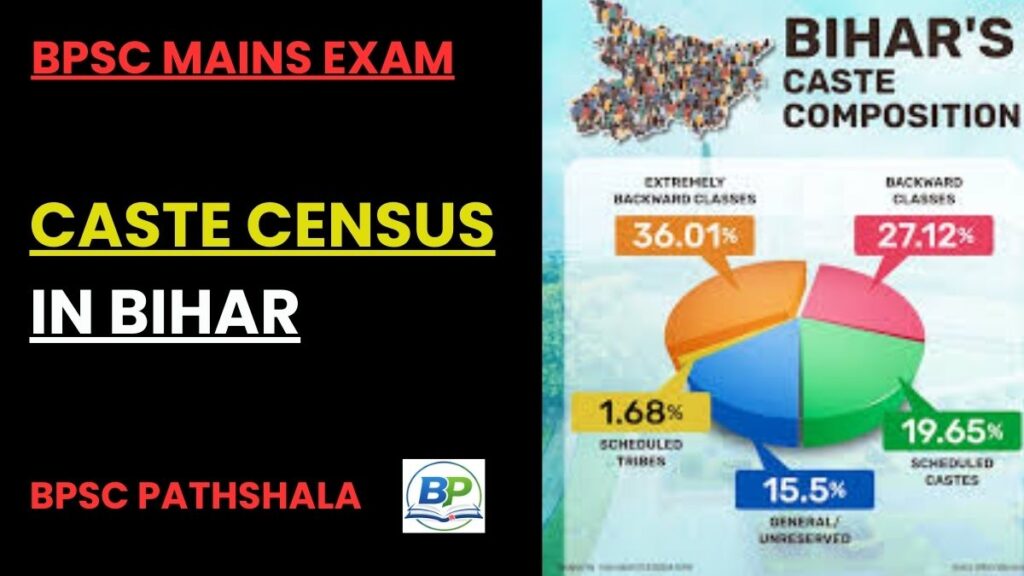
- The caste census in Bihar revealed that Other Backward Classes (OBCs) and Extremely Backward Classes (EBCs) together constitute more than 60% of the state’s population.
- According to the Bihar caste survey, upper castes account for around 15% of the population. However, historical records and governance data show that upper castes have traditionally dominated in Land ownership, bureaucracy, Political leadership and in educational institutions.
- The survey highlighted that Scheduled Castes form nearly 20% of Bihar’s population, yet they continue to lag behind on key socio-economic indicators:
- Economic vulnerability cuts across caste lines, but is more pronounced among backward and extremely backward classes.
These trends underscore the mismatch between social structure and policy design. The caste census thus provides a factual basis to recalibrate affirmative action, welfare schemes, and development planning.
5. Supreme court context
The Supreme Court’s jurisprudence plays a crucial role in shaping the future impact of the caste census in Bihar.
- The Court has consistently upheld affirmative action, but within constitutional limits such as the 50% reservation cap (Indra Sawhney case).
- It has emphasised the need for empirical data to justify reservation policies, especially for identifying backward classes.
- Recent judgments have indicated openness to revisiting rigid limits, provided data-backed justification exists.
In this context, the caste census in Bihar strengthens the evidentiary base required to defend welfare and reservation policies in courts. At the same time, any policy changes based on caste data must withstand judicial scrutiny on grounds of equality and reasonableness.
6. Centre–State debate
The caste census in Bihar has intensified the Centre–State debate over powers, data, and governance.
- The Union Government has argued that a caste census can only be conducted at the national level.
- Bihar countered this by conducting a state survey, asserting its right to collect data for welfare planning.
- This reflects a broader debate on cooperative vs competitive federalism, where states seek greater autonomy to address local challenges.
The issue also highlights asymmetry in India’s federal structure: while states bear the responsibility of welfare delivery, critical data remains centrally controlled. Bihar’s initiative has therefore reopened discussions on decentralisation of data governance.
7. Governance opportunities and risks of the caste census in Bihar
The caste census in Bihar presents a critical governance moment, offering both transformative opportunities and serious risks. Its ultimate impact depends not on the data itself, but on how the state uses it in policymaking and administration.
(a) Governance Opportunities
The foremost opportunity lies in evidence-based policymaking. For decades, welfare schemes, reservations, and development plans were designed using outdated or assumed caste data. The caste census in Bihar provides empirical and disaggregated data, enabling the government to align policies with actual social realities. This can improve targeting of schemes related to education, health, housing, and livelihoods, especially for OBCs, EBCs, and SCs who form the majority of the population.
Secondly, the census enhances administrative accountability and transparency. Once population proportions and deprivation levels are known, governments can be questioned on whether budgetary allocations, scholarships, and benefits are proportionate and equitable. This reduces arbitrariness in governance and strengthens democratic oversight.
Thirdly, the caste census supports constitutional social justice goals. Articles 15, 16, and 46 require the state to uplift socially and educationally backward classes. Accurate caste data strengthens the constitutional justification for affirmative action and helps defend policies against judicial scrutiny, particularly in matters of reservation and welfare targeting.
Finally, the caste census has the potential to deepen inclusive governance. Marginalised communities gain visibility in state planning, moving governance away from elite-driven assumptions towards participatory and representative decision-making.
(b) Governance Risks
Despite these benefits, the caste census in Bihar also carries significant risks. The most prominent is politicisation of caste identities. If caste data is used primarily for electoral mobilisation rather than governance reform, it may reinforce identity politics and deepen social divisions. This could undermine social cohesion and distract from broader development goals such as employment generation and infrastructure growth.
Another risk is administrative overreach and policy rigidity. Excessive reliance on caste categories may lead to mechanical allocation of resources without considering intra-caste inequalities or economic criteria. Governance must avoid treating caste as the sole determinant of deprivation.
There is also a risk of implementation failure. Bihar already faces capacity constraints, fiscal limitations, and governance challenges. Without strong institutions, trained personnel, and monitoring mechanisms, caste-based data may not translate into meaningful outcomes.
Lastly, Centre–State friction could intensify if caste data leads to demands for expanded reservations or fiscal support beyond existing constitutional frameworks, creating legal and political uncertainty.
8. Conclusion
The caste census in Bihar marks a critical shift from perception-based governance to data-driven policymaking. It has constitutional backing in the principles of equality and social justice, significant implications for governance and federalism, and strong relevance in contemporary judicial debates.
While concerns of political misuse remain valid, ignoring caste realities risks perpetuating structural inequalities. The real test for Bihar lies not in collecting caste data, but in using it responsibly—to promote inclusive growth, social harmony, and constitutional morality.
BPSC Mains Practice Questions (Caste Census in Bihar)
Q1. Examine the background and constitutional justification of the caste census in Bihar and analyse its relevance for evidence-based governance.
Q2. Discuss the political and governance implications of the caste census in Bihar. How can caste data be used to promote inclusive development without deepening social divisions?
Q3. Analyse the Centre–State debate surrounding the caste census in Bihar in the context of federalism and Supreme Court jurisprudence on social justice.
Also Read….