Champaran Satyagraha and Bihar
1. Introduction
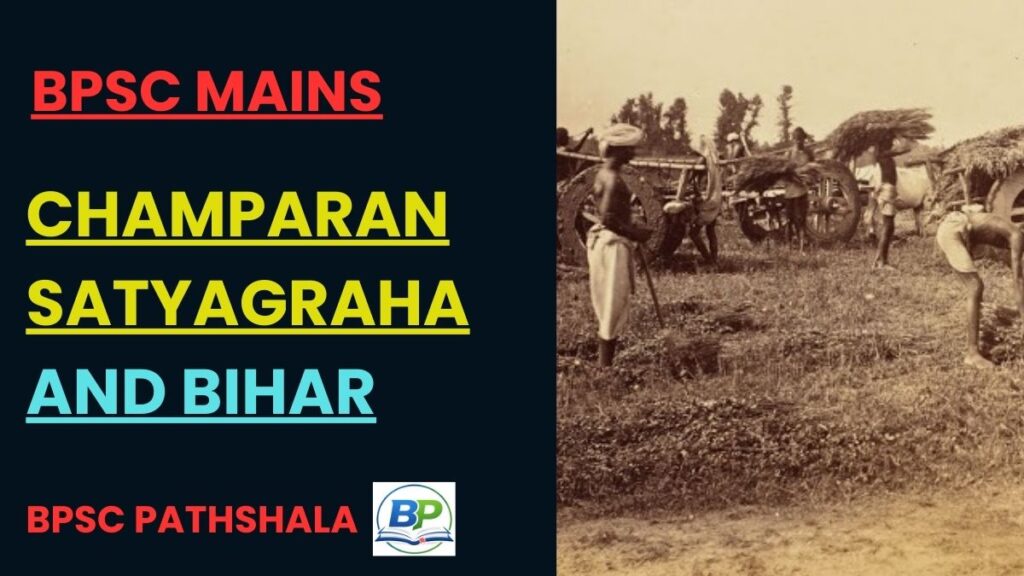
Champaran Satyagraha and Bihar occupy a central place in the history of India’s national movement. The Champaran region of north-western Bihar became a major centre of colonial agrarian exploitation due to forced indigo cultivation under European planters. The suffering of peasants under the tinkathia system created widespread resentment and resistance. When Mahatma Gandhi arrived in Champaran in 1917, the movement transformed local agrarian protest into a powerful experiment of non-violent resistance. This episode marked the first successful application of Gandhian Satyagraha in India and firmly linked Bihar with the rise of mass politics.
Get Complete BPSC Mains History Notes PDF
Download organised history notes for bpsc mains designed for quick revision and better answer writing.
| Instant access | Downloadable PDFs | Structured BPSC mains preparation |
2. Background of Champaran Satyagraha and Bihar
Indigo cultivation in Champaran dates back to the late eighteenth century, but it expanded rapidly after the establishment of the first indigo factory at Bara village in 1813. By the mid-nineteenth century, indigo had replaced traditional crops like sugar and became the dominant commercial crop in the region.
- Indigo cultivation was controlled by European planters
- Production was export-oriented and profit-driven
- Peasants were reduced to instruments of colonial revenue
3. Tinkathia System in Champaran
The most oppressive feature of indigo cultivation in Champaran was the tinkathia system. Under this system, peasants (ryots) were compelled to cultivate indigo on 3 kathas per bigha of land, amounting to 3/20th of their holdings, without any legal basis.
- Imposed at the will of indigo planters
- No statutory or contractual legitimacy
- Severely reduced food crop cultivation
After 1900, with the rise of synthetic indigo in Europe, indigo cultivation became unprofitable. To compensate for losses, planters forced peasants to pay tawan (damages) to be released from indigo contracts, often as high as ₹100 per bigha.
4. Growing Peasant Discontent in Champaran
The exploitative nature of indigo cultivation led to widespread peasant resentment in Champaran, similar to earlier unrest in Bengal. Low remuneration, physical harassment, illegal exactions, and bonded agreements created a volatile agrarian situation.
- First resistance in 1867 (Lalsariya factory)
- Renewed agitation in 1907–08, especially in Sathi and Bettiah
- Violence and mass protests against tinkathia system
These movements reflected deep-rooted agrarian distress but lacked effective national leadership.
5. Genesis of the Champaran Satyagraha in Bihar
The agrarian crisis in Champaran finally culminated in the Champaran Satyagraha (1917), an event that marked the beginning of Gandhian mass politics in India. Ironically, even Mahatma Gandhi was initially unaware of Champaran’s location or its indigo problem.
- Gandhi had recently returned from South Africa
- Known for successful Satyagraha against apartheid
- Emerged as a moral and political symbol for oppressed peasants
6. Role of Raj Kumar Shukla and Bihar Leaders
The initiative to bring Gandhi to Champaran was taken by Raj Kumar Shukla, a well-off but deeply aggrieved peasant. Along with Brajkishore Prasad, a prominent Bihari lawyer, Shukla met Gandhi at the Lucknow Congress Session (1916). A resolution on Champaran peasants was passed. Shukla persistently followed Gandhi to Kanpur and Sabarmati. Gandhi Ji finally agreed to visit Champaran via Calcutta. This persistence highlights the role of local leadership in national movements.
7. Role of Mahatma Gandhi in Champaran Satyagraha
Gandhi arrived in Muzaffarpur and informed the Tirhut Commissioner that his mission was humanitarian, not agitational. Despite this, British officials remained apprehensive and decided to prevent his entry into Champaran using Section 144 of CrPC. Gandhi reached Motihari on 15 April 1917. He was served an order to leave the district. Gandhi Ji refused and accepted legal consequences. This marked Gandhi’s first civil disobedience on Indian soil.
8. Trial of Mahatma Gandhi: A Turning Point
Gandhi was charged under Section 188 IPC and summoned to court on 18 April 1917. Thousands of peasants gathered outside the courtroom, turning the trial into a mass political event.
- Gandhi pleaded guilty but offered no defence
- Declared willingness to accept punishment
- Emphasised humanitarian and national service
The moral authority of Gandhi placed the colonial administration in a dilemma.
9. Withdrawal of Case and Permission for Inquiry
The Lieutenant Governor intervened, citing weak legal grounds for Section 144 and ordered the withdrawal of the case. Gandhi was granted permission to conduct an inquiry into agrarian conditions.
- First victory of Satyagraha in India
- Established legitimacy of non-violent resistance
- Strengthened peasants’ faith in constitutional protest
10. Conduct of the Champaran Inquiry
Gandhi began systematic inquiry in Motihari and Bettiah, assisted by leaders like Rajendra Prasad, Mazharul Haq, J.B. Kriplani, Brajkishore Prasad, and others. Thousands of peasant testimonies recorded. Volunteers worked without fear or remuneration. Gandhi emerged as a messianic figure among peasants. The inquiry exposed the structural injustice of the tinkathia system.
11. Opposition and Government Intervention
European planters and the Bihar Planters’ Association opposed Gandhi’s inquiry, alleging bias and potential violence. Under pressure, the government intervened and called Gandhi for discussions with senior officials.
- Gandhi submitted a preliminary report
- Refused to abandon his co-workers
- Asserted moral integrity and collective effort
11. Champaran Agrarian Inquiry Committee
In June 1917, the government appointed a Committee of Inquiry, with Gandhi as a member. The committee examined landlord-tenant relations and submitted its report in October 1917.
Key Recommendations
- Abolition of the tinkathia system
- Voluntary indigo cultivation only
- Refund of one-fourth of tawan paid by peasants
- Abolition of illegal cesses (abwab)
Champaran Agrarian Act, 1918
The government accepted most recommendations. Based on the committee report, Champaran Agrarian Bill was introduced in November 1917 and passed in 1918, becoming the Champaran Agrarian Act.
- End of planter domination
- Legal relief to peasants
- Institutionalisation of Gandhian methods
13. Significance of Champaran Satyagraha in Bihar
Champaran Satyagraha marked a watershed in Indian national movement.
- First successful Gandhian mass movement in India
- Entry of peasants into national politics
- Validation of Satyagraha and civil disobedience
- Foundation of Congress-led mass struggle
Get Complete BPSC Mains History Notes PDF
Download organised history notes for bpsc mains designed for quick revision and better answer writing.
| Instant access | Downloadable PDFs | Structured BPSC mains preparation |