Comparison of thoughts of Nehru and Gandhi
1. Introduction
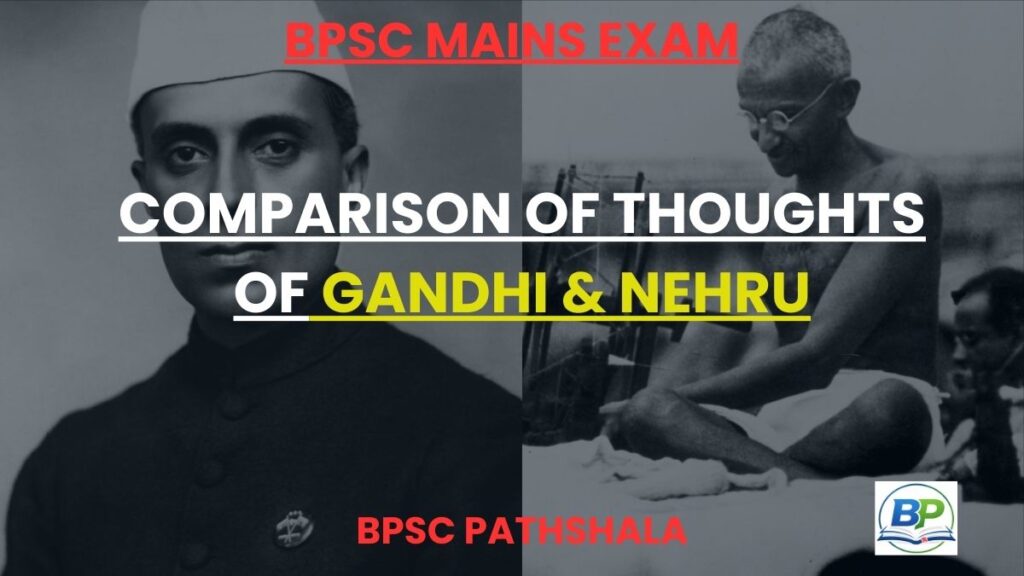
The comparison of thoughts of Nehru and Gandhi helps in understanding two different yet complementary visions that shaped India’s freedom struggle and post-independence development. While Mahatma Gandhi emphasised moral values, village life and non-violence, Jawaharlal Nehru focused on modernisation, industrial growth and scientific temper. Their ideas differed in approach but aimed at India’s overall progress.
Get Complete BPSC Mains History Notes PDF
Download organised history notes for bpsc mains designed for quick revision and better answer writing.
| Instant access | Downloadable PDFs | Structured BPSC mains preparation |
2. Economic Development
In the comparison of thoughts of Nehru and Gandhi, Gandhi’s economic ideas were centred on village self-sufficiency. He supported a decentralised economy based on cottage industries and handicrafts. Gandhi opposed large-scale industrialisation, believing it caused exploitation and inequality. He advocated “production by the masses” rather than mass production.
Nehru supported industrialisation and state-led economic planning. He believed heavy industries, public sector enterprises and Five-Year Plans were essential for removing poverty and unemployment. In the comparison of thoughts of Nehru and Gandhi, Nehru’s approach was modern, growth-oriented and technology driven.
3. Education
Thoughts of Gandhi
Gandhi believed education should be moral and practical. Through Basic Education (Nai Talim), he stressed craft-based learning, manual labour and character building. Education, according to Gandhi, must connect students with village life.
Thoughts of Nehru
In contrast, the comparison of thoughts of Nehru and Gandhi shows Nehru’s emphasis on modern education. He promoted universities, IITs and scientific institutions. Nehru believed education should develop scientific temper, rational thinking and technical skills.
4. Society and Social Change
Thoughts of Gandhi
Gandhi believed social change must come through moral reform and change of heart. He emphasised truth, non-violence, simplicity and ethical living. Social harmony and cooperation were central to his vision.
Thoughts of Nehru
Nehru believed social change required legal and institutional reforms. In the comparison of thoughts of Nehru and Gandhi, Nehru supported state action, democratic institutions and progressive laws to achieve equality and justice.
5. Caste System and Untouchability
Thoughts of Gandhi
Gandhi strongly opposed untouchability and called the oppressed classes Harijans. He wanted to reform society from within and believed in social harmony without completely dismantling traditional structures.
Thoughts of Nehru
Nehru rejected the caste system entirely. He believed caste divisions hindered national unity and modernisation. In the comparison of thoughts of Nehru and Gandhi, Nehru favoured constitutional equality and legal abolition of caste discrimination.
6. Role of the State
Thoughts of Gandhi
Gandhi supported a minimal role of the state and preferred decentralisation. He believed excessive state power threatened individual freedom and village autonomy.
Thoughts of Nehru
Nehru supported a strong and active state. The comparison of thoughts of Nehru and Gandhi highlights Nehru’s belief that government intervention was necessary for economic planning, welfare and nation-building.
7. Science and Technology
Thoughts of Gandhi
Gandhi was cautious about modern science and machines. He feared they could increase unemployment and exploitation. He preferred technology suitable to Indian conditions.
Thoughts of Nehru
Nehru was a strong supporter of science and technology. In the comparison of thoughts of Nehru and Gandhi, Nehru viewed scientific progress as the backbone of modern India and promoted research institutions and scientific education.
8. Vision of India
Thoughts of Gandhi
Gandhi envisioned India as a moral, spiritual and village-centred society based on non-violence and simplicity.
Thoughts of Nehru
Nehru imagined India as a modern, industrial, secular and scientific nation with a global outlook. The comparison of thoughts of Nehru and Gandhi reflects this fundamental difference in vision.
9. Conclusion
The comparison of thoughts of Nehru and Gandhi reveals two distinct yet complementary approaches to nation-building. Gandhi focused on moral regeneration, decentralisation and village life, while Nehru emphasised modernisation, industrial development and scientific temper. Together, their ideas shaped India’s freedom struggle, Constitution and democratic framework, making both thinkers equally important in understanding modern India.
BPSC Mains Practice Questions: Comparison of thoughts of Nehru and Gandhi
- Compare and contrast the thoughts of Nehru and Gandhi on economic development, role of the state and vision of modern India. How did their differing approaches influence post-independence policies?
- The comparison of thoughts of Nehru and Gandhi reflects both ideological differences and complementary nation-building visions. Critically examine this statement with suitable examples.
Also Read…
Get Complete BPSC Mains History Notes PDF
Download organised history notes for bpsc mains designed for quick revision and better answer writing.
| Instant access | Downloadable PDFs | Structured BPSC mains preparation |