BPSC Mains GS Paper-2: Science & Technology
About Course
BPSC Mains GS Paper-2: Science & Technology
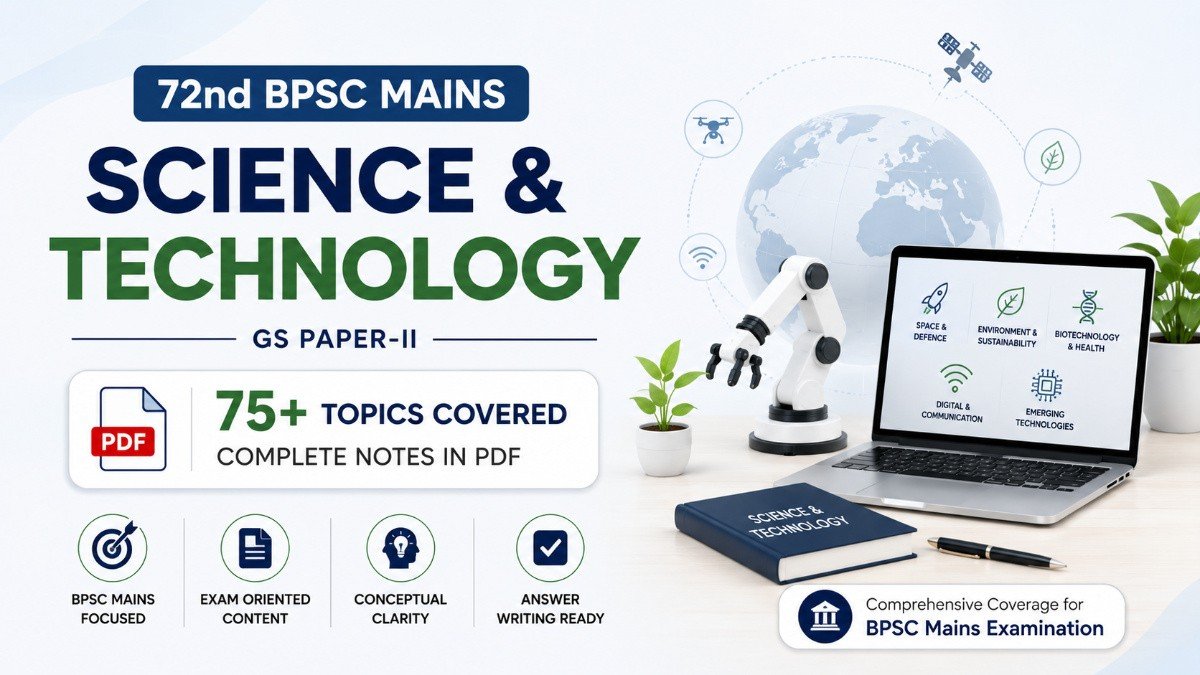
Prepare BPSC Mains General Studies Paper-2 (Section III: Science & Technology) with comprehensive, structured, and exam-oriented notes designed specifically for the latest BPSC syllabus. This course brings together all important Science & Technology topics in a systematic manner, making it easier to build conceptual understanding, revise quickly, and write high-scoring answers in the Mains examination.
The course has been prepared after extensive research and is updated with the latest government policies, scientific developments, current affairs, reports, facts, data, and relevant examples. Every topic is presented in a structured format covering introduction, concepts, applications, advantages, challenges, government initiatives, way forward, and conclusion, making it ideal for answer writing.
All notes are provided in downloadable PDF format and can also be studied directly within the course through the embedded PDF viewer.
Course Highlights
- Comprehensive coverage of BPSC GS Paper-2 (Section III: Science & Technology)
- Fully updated for the 72nd BPSC Mains Examination
- Structured, easy-to-understand notes
- Latest facts, data, reports and government initiatives
- Current affairs integrated with static concepts
- Answer-writing oriented content
- Downloadable high-quality PDF notes
- Mobile and desktop friendly
Course Structure
Lesson 1: India’s Space Programme and Space Governance
This lesson provides a comprehensive understanding of India’s space programme, launch vehicle technology, major ISRO missions, emerging space technologies, and India’s evolving space governance framework. It also covers recent developments and future space initiatives that are highly relevant for BPSC Mains answer writing.
| S. No. | Topic Name |
|---|---|
| 1 | Indian Space Programme |
| 2 | Characteristics of Indian Space Programme |
| 3 | Satellite Launch Vehicles: SLV, SLV III, ASLV, PSLV, GSLV, LVM3 |
| 4 | SSLV (Small Satellite Launch Vehicle) Operationalisation |
| 5 | Use of Space Technology for Development of India |
| 6 | Upcoming Projects of ISRO |
| 7 | Gaganyaan Mission |
| 8 | Chandrayaan-3 |
| 9 | Aditya-L1 Mission |
| 10 | NAVIC |
| 11 | Artemis Programme (NASA Moon Mission) |
| 12 | Reusable Satellite Launch Vehicle (RSLV) |
| 13 | Space Debris |
| 14 | Mission Shakti |
| 15 | James Webb Telescope |
| 16 | Indian Space Policy, 2023 |
| 17 | Space Tourism |
| 18 | IN-SPACe and Private Sector Regulation in Space |
Lesson 2: Defence Technology and Internal Security
This lesson provides a comprehensive understanding of India’s defence technologies, indigenous missile programmes, modern warfare systems, and strategic defence initiatives. It also covers emerging technologies in border security, defence manufacturing, cyber warfare, and electronic warfare, with a special focus on Atmanirbhar Bharat in defence.
| S. No. | Topic Name |
|---|---|
| 1 | Integrated Guided Missile Development Programme (IGMDP) |
| 2 | Anti-Ballistic Missile Development Programme |
| 3 | Application of Drone Technology |
| 4 | Swarm Drones |
| 5 | Artificial Intelligence (AI) in Defence |
| 6 | Use of Technology in Border Management |
| 7 | Science and Technology in Defence Equipment Production |
| 8 | Cyber Warfare |
| 9 | Electronic Warfare |
| 10 | Atmanirbhar Bharat in Defence |
| 11 | Defence Corridors |
Lesson 3: Environment, Climate Change and Energy Resources
This lesson provides a comprehensive understanding of environmental challenges, climate change, biodiversity conservation, and sustainable energy resources. It covers pollution, renewable energy, India’s climate commitments, and major government initiatives, enabling aspirants to write analytical and well-structured answers in the BPSC Mains examination.
| S. No. | Topic Name |
|---|---|
| 1 | Environmental Pollution (Special Focus on Air Pollution) |
| 2 | Waste Management |
| 3 | Plastic Pollution |
| 4 | Illegal Mining and its Environmental Impact |
| 5 | Air Quality Index (AQI) and Health Impact |
| 6 | Net Zero Target of India (2070) |
| 7 | Causes and Effects of Climate Change on Humans |
| 8 | Global Warming |
| 9 | Biodiversity |
| 10 | Renewable Energy Resources in the Context of India |
| 11 | Solar Energy |
| 12 | Nuclear Energy in India |
| 13 | Energy Generation from Urban Waste |
| 14 | Electric Mobility in India |
| 15 | Energy Security vs Sustainability Debate |
| 16 | National Green Hydrogen Mission |
| 17 | Biofuels Policy (Ethanol Blending Programme) |
| 18 | National Action Plan on Climate Change (NAPCC) |
Course Content
BPSC Mains GS Paper-2: Science and Technology (PDF)
Lesson 1: India’s Space Programme & Space Governance (PDF)
Lesson 2: Defence Technology & Internal Security (PDF)
Lesson 3: Environment, Climate Change & Energy Resources (PDF)
Lesson 4: Agriculture, Biotechnology & Health Technologies (PDF)
Lesson 5: Digital Technology, Communication & Cyber Security (PDF)
Lesson 6: Emerging Technologies & Advanced Science (PDF)
Student Ratings & Reviews