Demographic Dividend in Bihar: Turning Population into Prosperity
Demographic Dividend in Bihar – Why This Topic Matters Today
Demographic dividend in Bihar refers to the economic growth opportunity created because a large share of the population is young and in the working age group. When more people are capable of working and fewer people are dependent, the overall income of society can increase. Bihar is currently in such a stage where its population structure can support rapid economic growth if the right policies and job opportunities are created.
Bihar has one of the youngest populations in India. This creates a natural advantage. However, this advantage will only work if the youth population gets quality education, proper skills and employment opportunities. If these are not provided, the same population can become a burden in the form of unemployment and migration.
1. What is Demographic Dividend?
Demographic dividend is a stage when the share of working age population, usually defined as people between 15 to 64 years, becomes larger than the dependent population, which mainly includes children (0–14 years) and elderly people (65 years and above). In this situation, more people are capable of working, producing goods and services, and paying taxes, while fewer people depend on them for support. This creates a strong possibility for faster economic growth.
In simple terms, if more people are earning and fewer people are dependent, the total income of society increases. This is the basic idea behind demographic dividend in Bihar. For Bihar, this phase is very important because a large share of its population is young, and many people will enter the working age group in the coming years, creating a big opportunity for economic development.
2. Population Profile of Bihar
According to Census 2011, Bihar had a population of around 10.4 crore. Current population estimates suggest that the population has crossed 13 crore. This shows that Bihar continues to have high population growth compared to many other states. This growing population can support demographic dividend in Bihar if managed properly through education and employment generation.
Bihar has a very strong youth base. Estimates suggest that nearly 55 to 60 percent of the population is below the age of 25 years. This means Bihar will continue to get new workers for the next two to three decades. This is the biggest strength for demographic dividend in Bihar because economic growth depends heavily on workforce availability.
NFHS data shows that fertility rate in Bihar is slowly declining. Earlier it was above 3.4 but now it is close to 3.0. Declining fertility rate supports demographic dividend because it reduces dependency ratio and allows families and government to invest more in education and health.
Census data shows that Bihar is still largely rural. Around 89 percent population lives in rural areas and only around 11 percent lives in urban areas. This means success of demographic dividend in Bihar will depend largely on rural education, rural employment and rural infrastructure.
3. Working Age Population and Employment Situation
PLFS data shows that labour force participation in Bihar is lower than many Indian states. As per PLFS 2022–23, Bihar’s overall Labour Force Participation Rate is around 50–51%, which is lower than several better performing states. Female labour force participation is especially very low. In Bihar, female participation is roughly in the 15–20% range, while India’s female average is much higher. This shows that Bihar has population advantage but has not yet fully converted it into employment advantage.
If female workforce participation increases significantly, demographic dividend in Bihar can grow much faster. Data across India shows that when women work, household income rises, children stay longer in school and health spending improves. This directly supports long term economic development and helps Bihar use its demographic dividend more effectively.
4. Why Demographic Dividend is a Big Opportunity for Bihar
Large Youth Workforce Base
Bihar has one of the youngest populations in India. Estimates show that nearly 55–60% of Bihar’s population is below 25 years, while working age population (15–59 or 15–64 years) is continuously increasing. Census 2011 already showed Bihar had more than 58% population in working age group, and this share is rising. This gives Bihar a natural advantage because a large workforce can support production and economic activities. If this workforce is properly trained, it can support growth in agriculture, industry and service sector and strengthen demographic dividend in Bihar.
High Economic Growth Potential
Economic theory and global experience show that when working population increases, economic growth chances also increase. More workers means more production of goods and services. It also increases consumption demand inside the economy. This leads to higher business activity and higher tax collection for government.
India itself benefited from demographic dividend between 2005–2020 when working age population increased. Bihar is entering this phase now. If job creation improves, demographic dividend in Bihar can significantly improve state GDP growth rate.
Poverty Reduction Potential
Bihar still has high poverty levels compared to many Indian states. When more people get stable jobs, household income rises. According to various economic surveys, states with higher employment levels show faster poverty reduction.
If Bihar generates enough jobs in manufacturing, agriculture processing and services, demographic dividend in Bihar can directly reduce poverty levels, especially in rural districts.
Migration Reduction and Balanced Development
Bihar has one of the highest out-migration rates in India. Large numbers of workers migrate to states like Delhi, Punjab, Gujarat and Maharashtra mainly due to lack of local jobs.
If Bihar creates employment inside the state, migration pressure can reduce. This will help local economic growth, improve family stability and support balanced regional development. This is why demographic dividend in Bihar is not only an economic opportunity but also a social stability opportunity.
Long Term Development Advantage
If Bihar successfully uses demographic dividend, it can improve human development indicators such as education, health and living standards. Countries like South Korea and China used demographic dividend to achieve rapid economic growth. Bihar has similar opportunity if policy, industry and skill development work together.
Demographic dividend in Bihar is therefore not just about population numbers. It is about converting youth population into productive and skilled workforce that supports long term economic growth.
5. Current Ground Reality in Bihar
Education levels in Bihar are improving but still lower compared to many developed states. Census 2011 shows Bihar’s literacy rate was around 61.8%, which was among the lowest in India at that time. Female literacy was around 51–52%, much lower than male literacy. NFHS-5 data also shows improvement in school attendance, but higher education participation is still low. This affects quality of workforce and reduces full benefit of demographic dividend in Bihar.
Skill gap is another major problem. Government reports and skill surveys show that a large share of youth have general degrees but lack technical or vocational skills. Industry demand is shifting towards trained workers in manufacturing, electrical work, construction technology and digital services, but trained manpower supply is still limited in Bihar.
PLFS data shows that many youth are either unemployed or working in low income jobs. Bihar’s unemployment rate is not always very high on paper, but underemployment is a serious issue. Many people work in low productivity agriculture or informal sector jobs where income is unstable and low.
Female workforce participation remains very low, mostly in the range of 15–20% as per PLFS estimates. This is much lower than many Indian states. If women employment increases, Bihar can experience faster economic growth and stronger demographic dividend impact because women income improves family education, nutrition and health outcomes.
6. Key Sectors Where Bihar Can Use Youth Power
Agriculture Modernization and Allied Activities
Agriculture is still the largest employer in Bihar. Various surveys show that around 70–75% of Bihar’s workforce is linked directly or indirectly to agriculture. However, agriculture contributes much less to state income compared to workforce share, which shows low productivity. Bihar is one of the largest producers of crops like rice, maize and vegetables in India, but most produce is sold as raw product. If food processing industries grow, farmers and rural youth can earn more.
Allied sectors like dairy and fisheries also have strong potential. Bihar is among top states in milk production growth in recent years. Fish consumption is also high in eastern India, creating demand for fisheries sector jobs. Modernising agriculture through cold storage, food processing and supply chain can support demographic dividend in Bihar.
MSME and Small Industries Growth
MSME sector is important because it creates jobs with lower capital investment. According to government MSME data, Bihar has lakhs of registered and unregistered small units, mostly in food processing, textiles, leather and local manufacturing. Small industries are labour intensive, meaning they can absorb large youth workforce.
Bihar’s industrial contribution to state economy is still low compared to national average. This means there is large space for MSME expansion. If MSME clusters are developed district wise, they can become major support system for demographic dividend in Bihar by creating local employment.
Infrastructure and Construction Sector
Infrastructure sector creates mass employment quickly. Bihar has seen major growth in road construction, rural connectivity and bridge building in last 15–20 years. Government spending on infrastructure has increased significantly, which supports construction jobs.
Construction sector is one of the largest employers of migrant labour from Bihar in other states. If similar construction growth continues inside Bihar through housing, smart cities and transport projects, it can absorb large youth workforce and strengthen demographic dividend in Bihar.
Digital Economy and Service Sector Opportunities
Digital economy is emerging as a new employment source. India’s digital services and IT enabled services sector is growing rapidly. Even small towns now have access to internet and digital platforms. This allows youth to work in online services, e-commerce, digital marketing and remote support jobs.
Government digital programs and increasing smartphone penetration are helping rural youth connect to digital work opportunities. If digital skill training expands, digital economy can become a strong pillar supporting demographic dividend in Bihar, especially for educated youth and women.
7. Migration: Loss or Opportunity
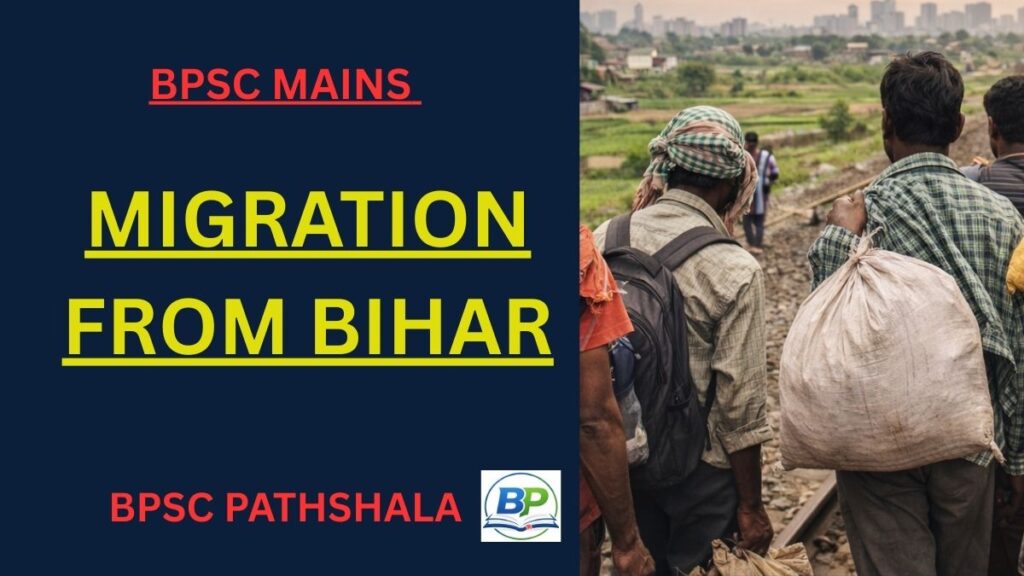
Many youth from Bihar migrate mainly due to lack of local employment opportunities. Census 2011 migration data showed that Bihar is one of the top out-migration states in India, with lakhs of workers moving to states like Delhi, Maharashtra, Punjab, Gujarat and Haryana. Economic Survey and labour studies also show that a large share of construction and informal sector workers in north and west India come from Bihar. This shows migration is mainly job-driven and linked to limited local industrial development.
Remittances sent by migrant workers play a major role in Bihar’s rural economy. RBI and migration studies show that states like Bihar receive thousands of crores of rupees every year as remittance income from migrant workers. This money is mostly used for household consumption, education, healthcare and house construction. In many districts, remittance income is a major support for local markets and rural spending.
Many migrant workers also learn technical and industrial skills while working in other states. Labour studies show that migrant workers often gain experience in construction, manufacturing, transport and service sector jobs. If Bihar develops more industries locally, returning migrants can bring skill, experience and work discipline, which can support demographic dividend in Bihar and strengthen local economy.
8. Role of Education and Skill Development
School education access has improved in Bihar over the last two decades. Government data shows school enrolment at primary level is now very high. However, learning quality remains a concern. National learning surveys like ASER reports have repeatedly shown that many students in higher classes still struggle with basic reading and arithmetic. Census 2011 showed literacy rate in Bihar was around 61.8%, and though it has improved since then, it is still below many developed states. Quality education is necessary to create a skilled workforce and fully utilise demographic dividend in Bihar.
Skill training infrastructure still needs major expansion. Bihar has increased the number of ITIs and polytechnic institutes in recent years, but demand is still much higher than supply. Labour and skill reports suggest that only a small percentage of youth in Bihar receive formal vocational training compared to industrial states. Since industry demand is rising for technical and machine-based skills, expanding industry-linked training centres is necessary to support demographic dividend in Bihar.
Digital education and online skill training are emerging as fast solutions. Internet and smartphone penetration has increased rapidly in Bihar in recent years. Government digital skill and online learning programs are helping youth access training even from rural areas. If digital skill training expands further, it can help youth become job ready faster and support future workforce demand linked to demographic dividend in Bihar.
9. Government Support for Youth
Government support plays a very important role in converting population advantage into economic advantage. In Bihar, several government programs focus on skill development, employment generation and entrepreneurship promotion. These programs are designed to improve employability and support demographic dividend in Bihar.
The Bihar government has expanded skill development programs in the last decade to reduce unemployment and migration. Many schemes target school pass youth, dropouts, women and economically weaker sections.
Bihar Skill Development Mission (BSDM)
Bihar Skill Development Mission is the main umbrella program for skill training in the state. It was launched to provide industry-relevant skill training to youth between 15 to 28 years of age. The mission provides training in sectors like retail, hospitality, construction, electrical work and digital services.
BSDM training centres are present in many districts. The aim is to make youth job ready and reduce migration. This scheme is directly linked to improving demographic dividend in Bihar because it focuses on employable skills instead of only academic education.
Kushal Yuva Program (KYP)
Kushal Yuva Program is one of the most well known youth skill programs in Bihar. It focuses on three core skills which are communication skills, basic computer knowledge and behavioural skills.
This program mainly targets intermediate pass youth and helps them become ready for private sector jobs. Since digital and communication skills are basic job requirements today, KYP plays an important role in supporting demographic dividend in Bihar.
Student Credit Card Scheme
Though mainly an education scheme, Student Credit Card Scheme supports skill development and higher education. Under this scheme, students can get education loans up to around 4 lakh rupees for higher studies or technical courses.
This scheme helps youth access professional education and technical training, which improves workforce quality and supports demographic dividend in Bihar.
Mukhyamantri Nishchay Yojana (Skill and Youth Components)
Mukhyamantri Nishchay Yojana includes multiple youth focused components such as skill training, student financial support and employment oriented programs. It focuses on improving youth employability and basic infrastructure like internet and electricity, which indirectly supports skill development.
This scheme is important because demographic dividend in Bihar needs both skill training and supporting infrastructure.
Bihar Startup Policy
Bihar Startup Policy aims to promote entrepreneurship among youth. Under this policy, financial support, incubation support and training support are provided to new startups.
Startup ecosystem helps create local jobs. Instead of only job seeking, youth can become job creators. This is very important for long term success of demographic dividend in Bihar.
Industrial Training Institutes (ITI) Expansion and Polytechnic Growth
Bihar government has increased number of ITIs and polytechnic colleges in recent years. Technical training is important because industries need skilled workers. Expansion of these institutes is helping improve technical workforce supply. This directly supports demographic dividend in Bihar by improving job readiness of youth.
These government schemes are helping improve employability, skill development and entrepreneurship. If implementation quality improves and industry linkage increases, these programs can play a major role in converting Bihar’s youth population into productive workforce and fully utilising demographic dividend in Bihar.
10. Major Challenges Bihar Must Solve
Bihar still has a weak industrial base, with the manufacturing sector contributing a much smaller share to state economy compared to industrial states. Economic Survey trends show Bihar’s per capita income is still among the lowest in India, which reflects limited industrial and private sector growth. Low private investment also reduces job creation capacity, forcing many youth to migrate.
Health and nutrition challenges are also serious. NFHS-5 data shows high levels of child stunting (around 40%) and undernutrition among women and children. Poor nutrition directly affects future workforce productivity.
Gender gap in employment is another major challenge. PLFS data shows female labour force participation in Bihar is only around 15–20%, much lower than national average. These structural challenges directly limit demographic dividend in Bihar.
11. What If Bihar Misses This Opportunity
If Bihar fails to use demographic dividend properly, unemployment can rise sharply. Every year, lakhs of youth enter working age group in Bihar. If enough jobs are not created, youth unemployment can increase. PLFS trends already show low labour participation and high dependence on informal jobs. This means future pressure on job market can become very high.
Social tension can also increase if large numbers of educated youth remain unemployed. Many global and Indian studies show that high youth unemployment can increase crime, social unrest and economic frustration.
Migration can rise further. Bihar is already one of the highest out-migration states as per Census migration data. If local jobs do not grow, migration pressure will increase and skilled youth will continue leaving the state.
Economic growth can slow down because unemployed population does not contribute to production or tax revenue. In such a situation, population advantage can turn into population burden. More dependent population means higher pressure on government welfare spending, lower savings and slower development. This is how missing demographic dividend can become a long term economic challenge for Bihar.
12. Conclusion: Population Burden to Population Power
Bihar’s biggest strength is its large youth population, which can become the foundation of long term economic growth. Data shows that a large share of Bihar’s population is in or entering the working age group. If quality education improves, skill training expands and industries create enough jobs, demographic dividend in Bihar can significantly increase income levels and reduce poverty.
However, if education quality, health indicators and employment opportunities do not improve, this population advantage can create pressure on jobs and resources. The future of Bihar will depend on how effectively it converts its young population into a skilled, healthy and productive workforce that supports sustainable economic development.
BPSC Mains Practice Questions: Demographic Dividend in Bihar
1. “Bihar is entering the phase of demographic dividend, but structural challenges may limit its benefits.” Discuss this statement in the context of education, employment and industrial development in Bihar.
2. Explain the concept of demographic dividend. Analyse the opportunities and challenges of demographic dividend in Bihar using Census, NFHS and PLFS data trends.
3. Migration, low female workforce participation and skill gap are major barriers in utilising demographic dividend in Bihar. Examine with suitable examples and suggest policy measures.
Also Read….
- Agriculture in Bihar
- Urbanization in Bihar
- Migration from Bihar: Causes, Economic Impact, and Policy Responses
- Tourism in Bihar
- Flood in Bihar: Causes, Impacts, and Sustainable Solutions
- Drought in Bihar: Causes, Impacts, and Sustainable Solutions
- River System of Bihar
- Inland Waterways in Bihar: Potential, Challenges, and the Way Forward
- Irrigation in Bihar: Need, Sources, Challenges, and Government Support