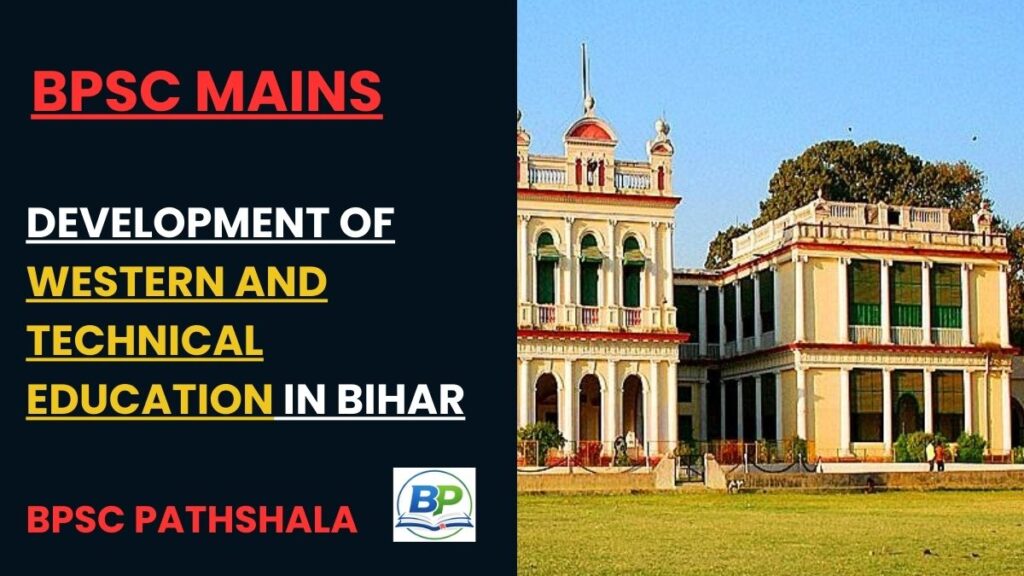
Development of Western and Technical Education in Bihar
1. Introduction: Development of Western and Technical Education in Bihar
The development of Western and technical education in Bihar has a long and layered history. Bihar has been an important centre of learning since ancient times, with renowned institutions like Nalanda University and Vikramshila University attracting scholars from across the world. Early education in Bihar was primarily based on Vedas, Shastras and philosophy, but it lacked exposure to scientific and technical knowledge developing elsewhere.
Get Complete BPSC Mains History Notes PDF
Download organised history notes for bpsc mains designed for quick revision and better answer writing.
| Instant access | Downloadable PDFs | Structured BPSC mains preparation |
2. Education in Bihar before British Rule
During the medieval period, cities like Patna, Bhagalpur and Bihar Sharif emerged as important centres of learning. Bihar was especially famous for advanced studies in Persian and Sanskrit. Institutions teaching regional and dialect languages were also established.
- These institutions were mostly run on donations
- Zamindars, rajas and wealthy classes funded education
- Decline of zamindari income later affected educational standards
This background set the stage for the introduction of Western education.
3. Early British Policy on Education
In modern India, the East India Company showed little interest in promoting education. A modest beginning was made through the Charter Act of 1813, which allocated one lakh rupees annually for the promotion of education.
- Emphasis was on English medium
- Focus was on Western science and knowledge
- Indigenous education systems were largely ignored
This marked the initial phase in the development of Western and technical education in Bihar.
4. Macaulay’s Policy and Spread of English Education (1835)
The year 1835 was a turning point. Under Lord William Bentinck, it was declared that all educational funds would be spent only on English education, following Thomas Babington Macaulay’s proposal.
As a result:
- Zila Schools were opened at Deoghar, Bihar Sharif, Bhagalpur, Arrah and Chapra
- In 1863, schools at Motihari, Chaibasa and Hazaribagh were approved
- A High School was opened at Pakur (1859)
English education thus began spreading systematically in Bihar.
5. Wood’s Dispatch and Growth of Higher Education
In 1854, Charles Wood issued the famous Wood’s Dispatch, regarded as the Magna Carta of English Education in India.
Following this:
- Patna College was established in 1863
- It became the oldest and most prestigious college of Bihar
- Higher education gained institutional stability
This phase significantly strengthened the development of Western education in Bihar.
6. University Education and Technical Institutions
In 1917, the British government appointed the Saddler Commission, which recommended:
- Practical science education
- Technological diplomas and degrees
Major developments included:
- Establishment of Patna University (1917)
- Postgraduate Arts department (1917)
- Physics and Chemistry departments (1919)
- Agricultural Research Centre, Pusa (1902)
- Indian School of Mines, Dhanbad (1926) for mineral studies
These institutions marked the foundation of technical education in Bihar.
7. Growth of Professional Education
To promote specialised education:
- Patna Medical College was established in 1925
- Patna Engineering College was set up for engineering education
- Patna Science College was established in 1928 as an independent science institution
These developments strengthened the scientific and technical base of Bihar.
8. Role of Social and Religious Organisations
Several voluntary organisations contributed to spreading education:
- Arya Samaj promoted Vedic education through DAV Schools
- Brahmo Samaj supported social reform and education
- Christian Missionaries opened modern schools
For Muslim education:
- Sir Syed Ahmad Khan’s Aligarh Movement inspired reforms
- Mohammedan Education Society was formed in Patna
- Mohammedan Anglo-Arabic School was started in 1866
9. Development of Female Education in Bihar
One of the most important developments was women’s education:
- St. Joseph’s School, Patna (1847) was opened for girls
- Two more girls’ schools were established in 1867
- Patna Women’s College (1940) became the first women-only college
This marked a major social transformation in Bihar.
10. Limitations of British Education Policy
Despite these developments, mass education was neglected:
- Literacy rate at independence was only 16%
- Education largely benefited urban elites
However, Western education introduced:
- Democracy
- Equality
- Rule of law
Educated Indians soon recognised British hypocrisy, which fueled the freedom struggle.
11. Conclusion: Significance of Western and Technical Education in Bihar
The development of Western and technical education in Bihar played a crucial role in shaping modern Bihar. Though colonial policies were limited and selective, the spread of English, scientific and technical education created an educated middle class. This class not only contributed to administrative and technical fields but also became a driving force behind India’s national movement and democratic awakening.
Get Complete BPSC Mains History Notes PDF
Download organised history notes for bpsc mains designed for quick revision and better answer writing.
| Instant access | Downloadable PDFs | Structured BPSC mains preparation |