Good Governance in India
1. Introduction
Good governance refers to the process of decision-making and the manner in which decisions are implemented for the welfare of society. It operates at multiple levels, including national, state, local, corporate, and international governance. Good governance in India focuses on ensuring transparency, accountability, participation, and efficiency in public administration so that government policies translate into real benefits for citizens.
The concept of good governance gained global recognition after the World Bank’s 1992 report, “Governance and Development,” which defined it as the way power is exercised in managing a country’s economic and social resources for development. This definition highlights that governance is not merely about authority but about responsible and people-centric use of power.
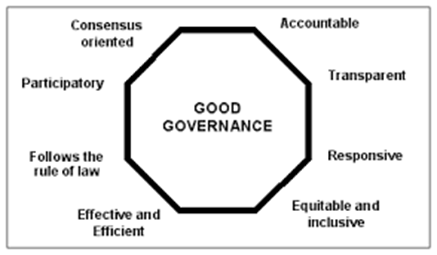
Good governance is characterised by eight core principles: participation, rule of law, consensus-orientation, transparency, accountability, responsiveness, effectiveness and efficiency, and equity and inclusiveness. Together, these principles ensure that corruption is minimised, the voices of minorities and vulnerable sections are heard, and public institutions remain answerable to the people.
In a diverse democracy like India, good governance is essential for inclusive growth, social justice, and sustainable development. It not only addresses present needs but also safeguards the interests of future generations. Therefore, understanding the principles, initiatives, and challenges of good governance in India is crucial for strengthening democracy and improving the quality of public service delivery.
Good governance has 8 major characteristics. It is,
- Participatory
- consensus-oriented
- accountable
- transparent
- responsive
- effective and efficient
- equitable and inclusive
- follows the rule of law.
It assures that corruption is minimized, the views of minorities are taken into account and that the voices of the most vulnerable in society are heard in decision-making. It is also responsive to the present and future needs of society.
2. 8 Principles of Good Governance by United Nations
Participation:
- People should be able to voice their own opinions through legitimate immediate organizations or representatives.
- This includes men and women, vulnerable sections of society, backward classes, minorities, etc.
- Participation also implies freedom of association and expression.
Rule of Law:
- Legal framework should be enforced impartially, especially on human rights laws.
- Without rule of law, politics will follow the principle of matsya nyaya ie law of fish which means the strong will prevail over the weak.
Consensus Oriented:
- Consensus oriented decision-making ensures that even if everyone does not achieve what they want to the fullest, a common minimum can be achieved by everyone which will not be detrimental to anyone.
- It mediates differing interests to meet the broad consensus on the best interests of a community.
Equity and Inclusiveness:
- Good governance assures an equitable society.
- People should have opportunities to improve or maintain their well-being.
Effectiveness and Efficiency:
- Processes and institutions should be able to produce results that meet the needs of their community.
- Resources of the community should be used effectively for the maximum output.
Accountability:
- Good governance aims towards betterment of people, and this can not take place without the government being accountable to the people.
- Governmental institutions, private sectors, and civil society organizations should be held accountable to the public and institutional stakeholders.
Transparency:
- Information should be accessible to the public and should be understandable and monitored.
- It also means free media and access of information to them.
Responsive governance
- means that the government listens to citizens and acts on their needs in a timely and effective manner. Public authorities promptly address complaints, deliver services without delay, and adapt policies based on public feedback.
- A responsive government reduces red tape, improves service quality, strengthens public trust, and ensures that governance remains people-centric rather than authority-centric.
3. References of Good Governance in India
- Importance of governance is clearly inscribed in Indian Constitution which is built on-premise of Sovereign, Socialist, Secular and Democratic Republic committing itself to democracy, rule of law and welfare of people.
- Under Sustainable Development Goals, Goal 16 can be considered to be directly linked as it is dedicated to improvement in governance, inclusion, participation, rights, and security.
4. Initiatives for Good Governance in India
Right to Information
- As a party to the International Covenant on Civil and Political Rights (ICCPR), India is under an international obligation to effectively guarantee citizens the Right to Information as per Article 19 of the ICCPR.
- RTI Act, 2005 marks a significant shift in Indian democracy. It gives greater access of the citizen to the information which in turn improves the responsiveness of the government to community needs.
- The right to information, promotes openness, transparency and accountability in administration by making the government more open to public scrutiny.
E-Governance
- The National e-Governance Plan envisions to make all government services accessible to the common man in his locality, through common service delivery outlets and ensure efficiency, transparency & reliability of such services at affordable costs.
- E-Governance effectively delivers better programming and services in the era of newly emerging information and communication technologies (ICTs), which herald new opportunities for rapid social and economic transformation worldwide.
- E-Governance has a direct impact on its citizens who derive benefits through direct transactions with the services offered by the government.
- Programs launched under e-Governance: Pro-Active Governance and Timely Implementation (PRAGATI), Digital India Program, MCA21 (to improve the speed and certainty in the delivery of the services of Ministry of Company Affairs), Passport Seva Kendra (PSK), online Income tax return, etc.
- Focus on ‘Minimum Government, Maximum Governance’.
Legal Reforms
- The Central Government has scrapped nearly 1,500 obsolete rules and laws with an aim to bring about transparency and good governance in India.
- Reform criminal justice and procedural laws with focus on pre-institution mediation.
Ease of Doing Business
- Steps were taken by the government to improve business conditions including legislation meant to improve the country’s business environment and policy ecosystems (such as the Bankruptcy Code, the Goods and Services Tax or GST, and the anti-money-laundering law).
- Government has launched the ‘Make in India’ initiative.
Decentralization
- Centralised Planning Commission was abolished, replacing it with the think tank called the National Institution for Transforming India (NITI Aayog), which would usher in an era of “cooperative federalism”.
- 14th Finance Commission increased the tax devolution of the divisible pool to states from 32% to 42% for years 2015 to 2020. It provides more freedom to states to initiate schemes based on local factors.
Police Reforms
- Modernizing police forces and implementing the Model Police Act of 2015.
- Reform of the First Information Report (FIR) lodging mechanism, including introducing filing e-FIRs for minor offences.
- Launch a common nation-wide emergency number to attend to emergency security needs of citizens.
Aspirational Districts Programme
- The Aspirational Districts Programme (ADP) was launched in January 2018 to transform the lives of people in the under-developed areas of the county in a time bound manner.
- Anchored in NITI Aayog, the programme is aimed at transforming 115 most backward districts with focused interventions in the field of health and nutrition, education, agriculture and water management, financial inclusion and skill development.
Good Governance in India Index
- The Good Governance Index Was launched on the occasion of Good Governance Day on 25 December 2019.
- The Good Governance Index is a uniform tool across States to assess the Status of Governance and impact of various interventions taken up by the State Government and Union Territories.
- The objectives of Good Governance Index are to provide quantifiable data to compare the state of governance in all states and Union Territories, enable states and Union Territories to formulate and implement suitable strategies for improving governance and shift to result oriented approaches and administration.
5. Challenges to Good Governance in India
Criminalization of Politics
- According to the Association of Democratic Reforms, 43% of Members of Parliaments of Lok Sabha 2019 are facing criminal charges. It is a 26% increase as compared to 2014.
- The criminalisation of the political process and the unholy nexus between politicians, civil servants, and business houses are having a baneful influence on public policy formulation and governance.
- The political class as such is losing respect. Therefore, it is necessary to amend Section 8 of the Representation of the People’s Act 1951 to disqualify a person against whom the criminal charges that relate to grave and heinous offenses and corruption are pending.
Corruption
- Corruption is a major obstacle in improving the quality of good governance in India. While human greed is obviously a driver of corruption, it is the structural incentives and poor enforcement system to punish the corrupt that have contributed to the rising curve of graft in India.
- According to the Corruption Perception Index – 24 (released by Transparency International), India’s ranking has slipped to 96.
Gender Disparity
- According to Swami Vivekananda, “it is impossible to think about the welfare of the world unless the condition of women is improved. It is impossible for a bird to fly on only one wing”.
- One way to assess the state of the nation is to study the status of its women. As women comprise almost 50% of the population it is unfair that they are not adequately represented in government institutions and other allied sectors.
- Therefore, in order to ensure good governance, it is essential to ensure the empowerment of women.
Growing incidence of violence
- Resorting to illegal force is considered to be a law and order problem. But when one looks at it from the point of view of the principles of Good Governance in India, it becomes clear that peace and order is the first step to development.
Delay in Justice
- A citizen has the right to avail timely justice, but there are several factors, because of that a common man doesn’t get timely justice.
Centralisation of Administrative System
- Governments at lower levels can only function efficiently if they are empowered to do so. This is particularly relevant for the Panchayati Raj Institutions (PRIs), which currently suffer from inadequate devolution of funds as well as functionaries to carry out the functions constitutionally assigned to them.
Marginalization of Socially and Economically Backward People
- The socially and economically backward sections of the society have always been marginalised in the process of development. Although there are constitutional provisions for their upliftment but in practice, they are lagging behind in so many areas like education, economic well-being etc.
6. Conclusion
Good governance in India is essential for ensuring inclusive development, social justice, and sustainable growth. Citizens are willing to cooperate with the state and even bear costs when public services are delivered in a transparent, accountable, and fair manner. However, this requires a governance system that is free from bias, corruption, and arbitrariness, and one that places citizens at the centre of decision-making.
To strengthen good governance in India, there is a need to realign public administration with the Gandhian principle of Antyodaya, ensuring that the benefits of development reach the last and the most vulnerable sections of society. Promoting probity in governance, ethical conduct among public officials, and institutional accountability must remain key priorities.
The continued emphasis on the ideals of Sabka Saath, Sabka Vikas and Sabka Vishwas can help build trust between the state and citizens. By reinforcing transparency, participation, and responsiveness, India can move closer to a governance framework that not only delivers efficiently but also upholds democratic values and public confidence.
BPSC Mains Practice Questions: Good Governannce
Q1. Define good governance and discuss its eight core principles. Examine how these principles are reflected in the constitutional framework and administrative practices in India.
Q2. Critically analyse the major initiatives taken in India to promote good governance. Evaluate the role of RTI, e-governance, decentralisation and institutional reforms in improving transparency and accountability.
Q3. Discuss the key challenges to good governance in India such as corruption, criminalisation of politics, gender disparity and delay in justice. Suggest practical measures to strengthen ethical, inclusive and citizen-centric governance.
Also Read…..