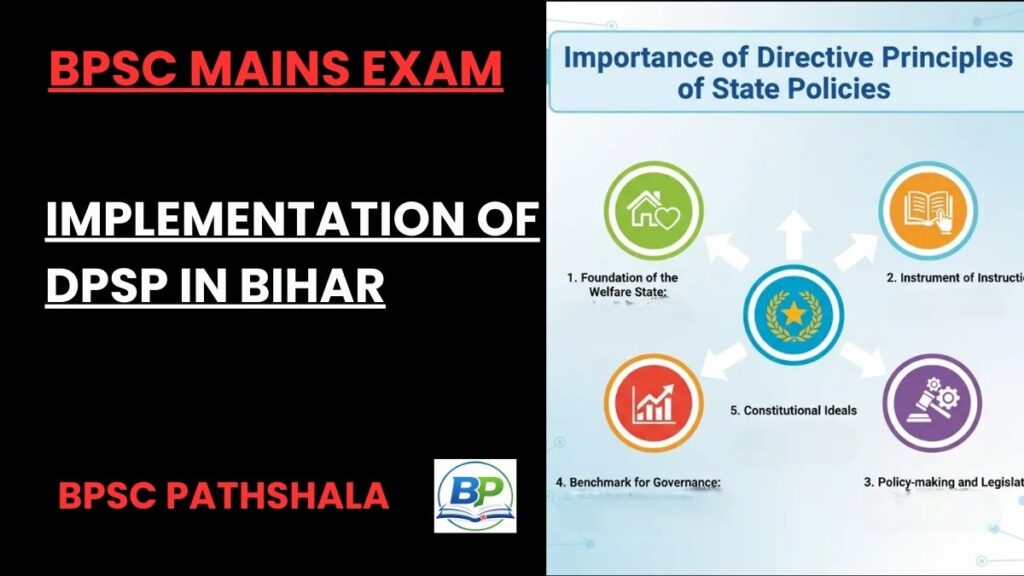
Implementation of DPSP in Bihar
1. Introduction: Directive Principles of State Policy (DPSP)
The Directive Principles of State Policy (DPSP) form the moral and socio-economic foundation of the Indian Constitution. Enshrined in Part IV (Articles 36–51), DPSPs guide the State in framing laws and policies aimed at establishing social justice, economic welfare, and inclusive development. Though non-justiciable, they are fundamental to governance. The implementation of DPSP in Bihar reflects the State’s efforts to address poverty, inequality, social justice, and public welfare within its resource constraints.
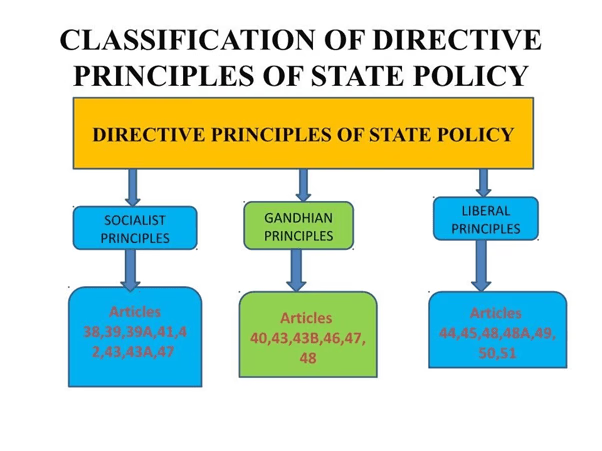
2. Classification of DPSP
The DPSPs are broadly classified into three categories:
- Socialistic Principles: Aim at social and economic justice (Articles 38, 39, 41, 42, 43, 47).
- Gandhian Principles: Reflect Gandhian ideals like prohibition, village self-governance, and upliftment of weaker sections (Articles 40, 46, 47).
- Liberal–Intellectual Principles: Promote modern democratic ideals such as uniform civil code, education, environment protection, and international peace (Articles 44, 45, 48A, 51).
The implementation of DPSP in Bihar can be clearly analysed through this classification.
3. Implementation of DPSP in Bihar
The implementation of DPSP in Bihar can be best understood by analysing how the State has translated different categories of Directive Principles into concrete policies and welfare schemes. Though DPSPs are non-justiciable, Bihar has used them as a guiding framework for governance and social reform.
(a) Socialistic Principles: Economic and Social Justice
(Articles 38, 39, 41, 42, 43, 43A, 45, 47):- These DPSPs aim to reduce inequality, ensure livelihood, education, health, and dignified living conditions.
Article 38: Social Order Based on Justice
- Bihar’s welfare-oriented governance model focuses on inclusive development.
- Flagship initiatives like Saat Nischay Yojana (Phase-I & II) aim at:
- Rural roads
- Drinking water
- Skill development
- Youth employment
This reflects the State’s effort to reduce social and economic inequalities.
Article 39: Right to Adequate Livelihood & Equitable Distribution
- Jeevika (Bihar Rural Livelihoods Promotion Society):
- Empowers women through SHGs
- Enhances income generation and financial inclusion
- Over 1 crore women connected to self-help groups
- Bihar Student Credit Card Scheme:
- Supports higher education and employability
These schemes show the implementation of DPSP in Bihar by promoting livelihood security.
Article 41: Right to Work, Education, and Public Assistance
- Mukhyamantri Nishchay Swayam Sahayata Bhatta:
- Unemployment allowance to educated youth
- Social Security Pension Schemes:
- Old age pension
- Widow pension
- Disability pension
They provide minimum social security to vulnerable groups.
Article 42 & 43: Just Conditions of Work and Living Wages
- Labour welfare measures for construction workers
- Maternity benefits through health and welfare departments
- Skill training under Kushal Yuva Program
These measures support dignified working conditions.
Article 45: Early Childhood Care and Education
- Mukhyamantri Balika/Balak Cycle Yojana
- Mukhyamantri Poshak Yojana
- Strengthening of Anganwadi services and PM POSHAN (Mid-Day Meal)
These schemes have significantly improved school enrolment, especially of girls.
Article 47: Public Health and Prohibition
- Liquor Ban in Bihar (2016):
- Aimed at improving public health and women’s safety
- Mukhyamantri Chikitsa Sahayata Kosh
- Expansion of Primary Health Centres (PHCs)
This is a classic example of implementation of DPSP in Bihar inspired by Gandhian ideals.
(b) Gandhian Principles: Rural Development and Social Upliftment
(Articles 40, 46, 47)
Article 40: Village Panchayats
- Strengthening Panchayati Raj Institutions (PRIs)
- Devolution of functions to local bodies
- Gram Sabha as a platform for grassroots democracy
This deepens decentralised governance.
Article 46: Upliftment of SCs, STs, and Backward Classes
- Mahadalit Vikas Mission
- Hostel, scholarship, and housing schemes for SC/ST students
- Reservation in education and public employment
These measures aim to correct historical injustices.
Article 47: Prohibition and Nutrition
- Liquor ban
- Nutrition programmes for women and children
- Focus on preventive healthcare
Bihar has gone further than most states in operationalising this DPSP.
(c) Liberal–Intellectual Principles: Modern Democratic Ideals
(Articles 44, 48, 48A, 50, 51)
Article 48 & 48A: Environment and Animal Protection
- Jal–Jeevan–Hariyali Abhiyan:
- Water conservation
- Tree plantation
- Renewable energy
- River rejuvenation and biodiversity initiatives
This shows growing emphasis on sustainable development.
Article 50: Separation of Judiciary from Executive
- Independent functioning of judiciary at district level
- Strengthening of judicial infrastructure
Though gradual, this supports rule of law.
Article 51: International Peace and Cooperation
- While foreign policy is a Union subject, Bihar:
- Promotes cultural diplomacy
- Encourages educational and economic cooperation
4. Overall Assessment of implementation of DPSP in Bihar
The implementation of DPSP in Bihar reflects a strong welfare orientation, particularly in education, social justice, public health, and rural development. However, outcomes vary due to fiscal limitations, governance capacity, and implementation gaps.
Bihar has actively used the DPSPs as a moral compass for governance, even though they are non-enforceable. From education and health to prohibition and social justice, the State has translated many constitutional ideals into policy action. Strengthening institutions, improving delivery mechanisms, and aligning DPSPs with long-term development planning will further deepen the implementation of DPSP in Bihar and help realise the constitutional vision of a welfare state.
5. Main hurdles in implementing DPSP in Bihar
The implementation of DPSP in Bihar faces several structural and administrative challenges. Chronic resource constraints, low per-capita income, and high population pressure limit the State’s capacity to fully realise welfare goals. Weak infrastructure, governance bottlenecks, and shortage of skilled manpower affect effective delivery of schemes.
Certain DPSPs, such as uniform economic development and employment generation, remain difficult due to limited industrialisation. Additionally, corruption, leakages, and poor monitoring reduce the impact of welfare programmes. Since DPSPs are non-justiciable, their implementation largely depends on political will and fiscal capacity, which varies over time.
6. Conclusion
The implementation of DPSP in Bihar demonstrates the State’s commitment to social justice, welfare, and inclusive growth despite significant limitations. Through schemes related to education, health, prohibition, social security, and decentralization, Bihar has translated many Directive Principles into actionable policies.
However, sustained progress requires better governance, fiscal strengthening, and institutional efficiency. Strengthening implementation mechanisms and aligning DPSPs with development planning can help Bihar move closer to the constitutional vision of a just and welfare-oriented state.
BPSC Mains – Practice Questions (Implementation of DPSP in Bihar)
Q1. Directive Principles of State Policy provide the moral foundation of governance in India. Examine the implementation of DPSP in Bihar with suitable examples of state government schemes.
Q2. Although DPSPs are non-justiciable, several of them have been implemented through welfare-oriented policies in Bihar. Analyse this statement by categorising DPSPs and citing relevant Bihar government initiatives.
Q3. Bihar has actively implemented Gandhian and Socialistic principles of DPSP, but faces constraints in liberal–intellectual principles.
Critically evaluate the statement.
Also Read…