Industrial Backwardness of Bihar: Causes, Impact and the Way Forward
1. Introduction
The industrial backwardness of Bihar is one of the most important structural challenges facing the state’s economy. Bihar has a rich historical legacy, fertile land, abundant labour, and a strategic location in eastern India. Yet, compared to other Indian states, industrial development in Bihar has remained limited for decades.
This backwardness has restricted employment generation, forced large-scale migration, and kept per capita income among the lowest in India. Even today, Bihar’s economy is dominated by agriculture and low-productivity services, while the manufacturing sector plays only a marginal role.
According to the Bihar Economic Survey 2025–26, although the state’s economy is growing faster than the national average, the manufacturing sector has expanded only modestly. This highlights the need to understand why Bihar lagged behind in industrialisation and how it can move forward.
2. Reasons for Industrial Backwardness of Bihar
Low Share of Industry in State Economy
One of the clearest indicators of industrial backwardness is the low contribution of industry to Bihar’s economy. The industrial sector contributes around 3–4 percent to Bihar’s Gross State Domestic Product, while the national average is around 20 percent.
Even within the secondary sector, growth is driven largely by construction rather than manufacturing. This shows that Bihar has not developed a strong factory-based industrial structure.
Infrastructure Deficiency
Industrial development requires reliable infrastructure, which Bihar historically lacked. For decades, poor road connectivity increased transport costs and reduced market access. Power supply was unreliable, making industrial operations costly and uncertain. Industrial land with basic facilities such as water, drainage, and connectivity was limited.
Although infrastructure has improved significantly in recent years, these historical deficiencies created a long-term disadvantage for industrial growth.
Shortage of Skilled Manpower
Bihar has abundant labour, but industrialisation requires skilled labour, not just numbers. Low levels of industrial training, weak ITI and polytechnic coverage in earlier decades, and limited urbanisation resulted in a mismatch between labour skills and industrial needs. Modern industries require machine operators, technicians, supervisors, and engineers, which Bihar struggled to supply. As a result, investors preferred states with a ready skilled workforce.
Historical and Structural Factors
A major structural shock came with the bifurcation of Bihar in 2000. The mineral-rich Chotanagpur plateau, which went to Jharkhand, housed most of the earlier heavy industries, coal mines, and mineral-based units.
This left Bihar with very limited mineral resources, making heavy industrialisation difficult. Additionally, the freight equalisation policy discouraged industries from locating near raw material sources. This policy removed locational advantages, preventing Bihar from developing resource-based industries.
Law and Order Perception
For a long time, Bihar suffered from poor law and order perception. This discouraged private investment and industrial entrepreneurship. Even when improvements were made, investor confidence took time to return, as industrial decisions are influenced by long-term perceptions rather than short-term changes.
3. Impact of Industrial Backwardness of Bihar on Bihar’s Economy and Society
High Unemployment and Underemployment
Industrial backwardness has limited Bihar’s capacity to generate non-farm jobs. As a result, surplus labour from agriculture is not absorbed into manufacturing or industry. According to the Periodic Labour Force Survey, more than 60 percent of workers in Bihar are self-employed, largely in low-productivity activities. Casual labour also forms a large share of employment, indicating the absence of stable, factory-based industrial jobs and the persistence of disguised unemployment in rural areas.
Large-Scale Migration
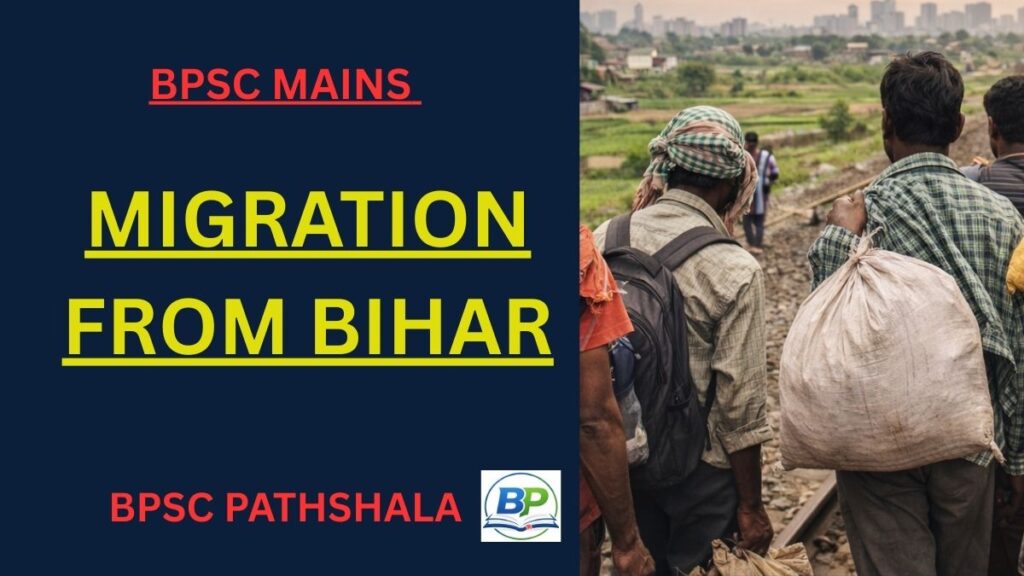
Bihar is among the largest migrant-sending states in India. Census and labour survey estimates show that millions of workers migrate annually to states such as Delhi, Maharashtra, Punjab, and Gujarat. The lack of local industrial employment is a major push factor behind this migration. Industrial backwardness thus imposes social costs in the form of family separation and economic insecurity, while destination cities face pressure on housing and urban services.
Low Per Capita Income
The weak industrial base has directly affected income levels. According to the Bihar Economic Survey 2025–26, Bihar’s per capita GSDP at current prices is around ₹76,000, which is among the lowest in India and far below the national average. Limited industrialisation restricts access to high-productivity manufacturing jobs, keeping average incomes low despite overall economic growth.
Overdependence on Agriculture and Informal Sector
More than half of Bihar’s workforce is dependent on agriculture, while a large proportion of non-farm workers are engaged in the informal sector. These sectors are characterised by low wages, seasonal employment, and income uncertainty. Industrial backwardness reinforces this dependence and slows the structural shift of labour from low-productivity agriculture to higher-productivity industry.
4. Way to Industrialisation in Bihar
- Industrialisation in Bihar must follow a context-specific path rather than copying heavy-industry models of mineral-rich states.
- The focus should be on labour-intensive and agro-based industries that match Bihar’s resource base and demographic profile.
- Key sectors include food processing, textiles, handloom, leather, dairy, fisheries, and small manufacturing units. These sectors can absorb large numbers of workers and create value close to rural areas.
- Cluster-based industrial development, where small units operate together with shared infrastructure, is more suitable for Bihar than large standalone factories.
5. Bihar Government Support and Schemes
The Bihar government has taken multiple policy and institutional measures to address the problem of industrial backwardness and create a supportive environment for industrial growth in Bihar. These steps focus on investment promotion, ease of doing business, entrepreneurship, and sector-specific support.
Bihar Industrial Investment Promotion Policy
The Bihar Industrial Investment Promotion Policy provides incentives related to capital investment, land allotment, electricity duty exemption, and employment generation. According to the Bihar Economic Survey 2025–26, the state received over 4,300 investment proposals in recent years, with food processing emerging as the leading sector in terms of operational industrial units. This indicates growing investor interest, particularly in agro-based industries.
Abolition of APMC Act
Bihar abolished the APMC Act to allow free movement and direct sale of agricultural produce. This reform enables industries to procure raw materials directly from farmers without mandis. As a result, agro-based and food processing industries benefit from lower procurement costs and more reliable supply chains, while farmers gain better price realisation.
Single Window Clearance Act
The Bihar Single Window Clearance Act ensures time-bound approvals for industrial projects. Thousands of proposals have received Stage-I clearances under this system, significantly reducing delays. Faster approvals have improved Bihar’s ease of doing business and reduced entry barriers for new industries.
Entrepreneurship Promotion Schemes
Schemes like Mukhyamantri Udyami Yojana and Bihar Laghu Udyami Yojana promote first-generation entrepreneurs. Between 2023–24 and 2024–25, applications under these schemes increased sharply, reflecting rising entrepreneurial activity. These schemes support small manufacturing units by providing financial assistance, training, and handholding support.
Together, these policy measures are gradually improving Bihar’s industrial ecosystem. While challenges remain, data from recent surveys show that focused incentives, regulatory reforms, and entrepreneurship support are helping Bihar move towards a more industrially balanced economy.
6. Bihar Budget 2026–27 & Bihar Economic Survey 2025-26: Industrial Perspective
The Bihar Budget 2026–27 adopts an ecosystem-based approach to industrial development, focusing on infrastructure, skills, and enterprise support rather than direct industrial subsidies. This approach aligns with Bihar’s structural needs and resource base.
Capital Expenditure and Infrastructure Push
The budget continues the trend of high capital expenditure, which has risen steadily over recent years. According to the Bihar Economic Survey 2025–26, capital expenditure increased from about 15.8 percent of total expenditure in 2020–21 to over 22 percent in 2024–25, reflecting a clear shift towards asset creation. In 2026–27, major allocations to roads, power, irrigation, and urban infrastructure directly reduce logistics costs and improve connectivity for industries, especially MSMEs.
Power and Logistics Support
The Economic Survey highlights that per capita power consumption in Bihar has nearly tripled since 2011–12, and grid and transmission capacity have expanded significantly. Reliable electricity is a critical factor for manufacturing and small industries. Improved road connectivity under sustained public investment has also linked rural production centres with urban markets, supporting industrial supply chains.
Agriculture and Allied Sector Linkages
The budget maintains strong support for agriculture and allied sectors, which contribute over 23 percent to Bihar’s GSVA. Higher spending on irrigation, fisheries, dairy, and horticulture ensures stable raw material supply for agro-based industries such as food processing, textiles, and leather.
Skills and Enterprise Promotion
Budgetary support for skill development and entrepreneurship complements industrial growth. Rising allocations to skill training programmes and schemes like Mukhyamantri Udyami Yojana have coincided with a sharp increase in applications and beneficiaries, indicating growing MSME activity.
Overall Assessment
Although there is no separate industrial budget head, data from the Budget 2026–27 and Economic Survey 2025–26 show that Bihar is using infrastructure-led growth, power reforms, agricultural strengthening, and skill development as indirect but effective tools to support gradual industrial revival.
7. Way Forward
Overcoming the industrial backwardness of Bihar requires a sustained and multi-pronged strategy.
- Infrastructure development must continue, particularly industrial parks, logistics hubs, and reliable electricity. Skill development must be aligned with industry needs through ITIs, polytechnics, and private-sector partnerships.
- Industrial policy should prioritise labour-intensive and agro-linked industries rather than capital-intensive heavy industries. MSMEs should receive easier access to credit, technology, and markets.
- Improving investor confidence through stable policies, better governance, and positive perception is essential for long-term industrialisation.
8. Conclusion
The industrial backwardness of Bihar is rooted in historical, structural, and policy-related factors. However, it is not irreversible. Recent improvements in infrastructure, governance, and investment climate indicate a slow but steady shift. By focusing on agro-based industries, MSMEs, skill development, and ease of doing business, Bihar can move towards balanced and inclusive industrialisation.
Industrial development is essential not only for economic growth but also for employment generation, migration control, and social transformation. Addressing industrial backwardness is therefore central to Bihar’s long-term development strategy.
BPSC Mains Practice Questions: Industrial Development of Bihar
- “Industrial backwardness in Bihar is not merely an economic issue but a structural and historical one.” Examine this statement in the light of infrastructure, policy, and labour-related factors.
- How does the Bihar Budget 2026–27 support industrial development despite the absence of a separate industrial budget head? Analyse with suitable examples.
- Discuss the role of agro-based and labour-intensive industries in overcoming the industrial backwardness of Bihar. Suggest suitable policy measures.
Also Read….
- Agriculture in Bihar
- Urbanization in Bihar
- Migration from Bihar: Causes, Economic Impact, and Policy Responses
- Tourism in Bihar
- Flood in Bihar: Causes, Impacts, and Sustainable Solutions
- Drought in Bihar: Causes, Impacts, and Sustainable Solutions
- River System of Bihar
- Inland Waterways in Bihar: Potential, Challenges, and the Way Forward
- Irrigation in Bihar: Need, Sources, Challenges, and Government Support