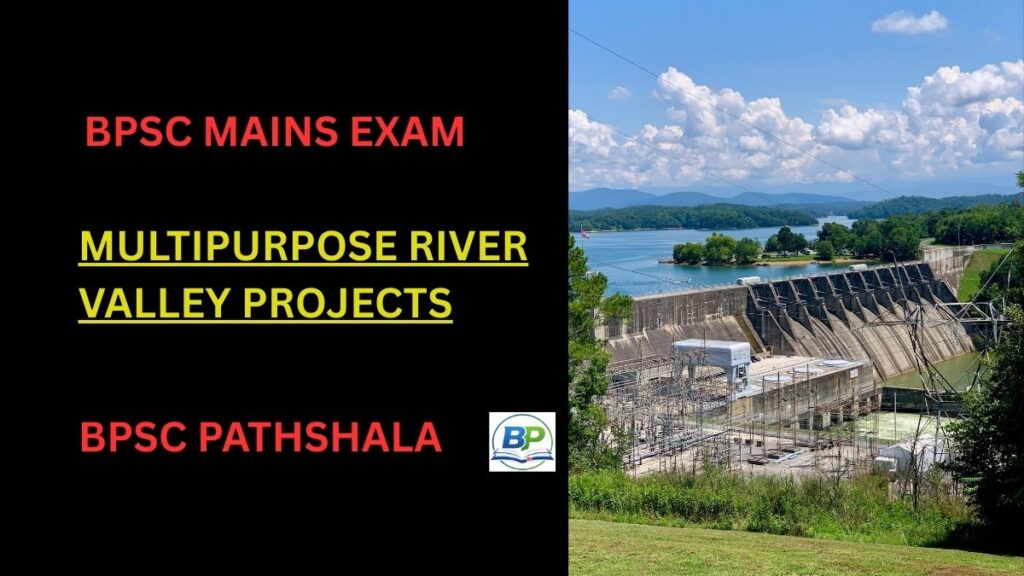
Multipurpose River Valley Projects in India
1. Introduction to Multipurpose River Valley Projects in India
Multipurpose River Valley Projects in India are large-scale development schemes designed to utilize river water for several purposes such as irrigation, electricity generation, flood control and drinking water supply. After independence, India adopted dam construction as a key strategy for economic growth and agricultural expansion.
According to the Central Water Commission (CWC), Government of India, India has more than 5,700 large dams, highlighting the importance of Multipurpose River Valley Projects in India for irrigation, hydropower and flood control.. These projects have helped expand irrigation to over 70 million hectares of land, strengthening food security and rural livelihoods. Hydropower generated from river valley projects also contributes around 11–12% of India’s total installed electricity capacity.
While Multipurpose River Valley Projects in India have supported industrial and agricultural development, they have also generated debates related to environmental sustainability and displacement. Therefore, understanding their role requires a balanced evaluation of both benefits and challenges.
2. Meaning and Objectives of Multipurpose River Valley Projects in India
Multipurpose River Valley Projects in India refer to integrated river development schemes where a dam and reservoir are constructed to serve multiple functions instead of a single purpose. Unlike hydropower projects that mainly generate electricity, these projects combine irrigation, power production, flood control and other uses in one coordinated system. The main objectives include:
- Irrigation Development
Canal networks from dams irrigate millions of hectares of farmland. Around 50% of India’s irrigated area depends directly or indirectly on major and medium irrigation projects. - Hydroelectric Power Generation
India has over 45,000 MW of installed hydropower capacity, supporting industries and urban growth. - Flood Control
Reservoirs store excess monsoon water and reduce flood damage in river basins like the Damodar and Kosi. - Drinking Water Supply
Major cities depend on reservoirs for safe drinking water. - Soil Conservation and Fisheries
Controlled water flow reduces soil erosion, while reservoirs support inland fisheries.
Thus, Multipurpose River Valley Projects in India aim at scientific and planned management of river water resources to promote balanced regional development.
3. Major Multipurpose River Valley Projects in India
Several Multipurpose River Valley Projects in India have played a transformative role in agriculture, industry and regional development. These projects were mainly launched after independence to promote irrigation and power generation.
- Bhakra Nangal Dam
Built on the Sutlej River, it is one of the highest gravity dams in the world. It supports irrigation in Punjab, Haryana and Rajasthan and generates over 1,300 MW of power. - Hirakud Dam
Constructed on the Mahanadi River in Odisha, it is one of the longest earthen dams globally. It provides irrigation to more than 15 lakh hectares and produces hydroelectric power. - Damodar Valley Corporation
Established in 1948, it was modeled on the Tennessee Valley Authority (USA). It controls floods in the Damodar basin and supports thermal and hydro power generation. - Tehri Dam
Located in Uttarakhand on the Bhagirathi River, it has an installed capacity of about 1,000 MW and supplies drinking water to Delhi and other regions.
These examples show how Multipurpose River Valley Projects in India have contributed to irrigation expansion, flood control and energy security.
4. Advantages of Multipurpose River Valley Projects in India
Multipurpose River Valley Projects in India have played a crucial role in economic planning, especially in agriculture, power generation and flood management. These projects were considered engines of growth during the early Five-Year Plans.
4.1 Irrigation Expansion and Food Security
One of the biggest advantages is large-scale irrigation. Canal networks from major dams irrigate millions of hectares of farmland. Today, India has over 70 million hectares of irrigated land, and a significant share depends on major and medium irrigation projects.
Projects like Bhakra Nangal Dam supported the Green Revolution by ensuring reliable water supply to Punjab and Haryana. This helped India move from food shortage in the 1960s to self-sufficiency in food grain production, which now exceeds 330 million tonnes annually.
4.2 Hydroelectric Power Generation
Hydropower is renewable and relatively clean. India has over 45,000 MW of installed hydropower capacity, contributing about 11–12% of total electricity capacity.
Dams like Tehri Dam generate large amounts of electricity that support industries, urban centers and rural electrification.
4.3 Flood Control
Flood-prone rivers like the Damodar and Kosi caused massive destruction before dam construction. The Damodar Valley Corporation significantly reduced flood damage in Jharkhand and West Bengal.
Reservoirs store excess monsoon water and release it gradually, protecting downstream regions.
4.4 Drinking Water Supply
Large reservoirs supply drinking water to major cities. For example, Tehri Dam provides water to Delhi and parts of Uttar Pradesh, supporting millions of people.
4.5 Inland Navigation and Fisheries
Reservoirs promote inland fisheries and generate employment. Controlled water flow also supports navigation in certain stretches, which is a cost-effective mode of transport.
4.6 Regional Development and Employment
These projects create jobs during construction and operation. They also promote tourism and industrial growth around dam sites.
Overall, Multipurpose River Valley Projects in India have contributed significantly to agricultural growth, energy security and regional development. However, these benefits must be weighed against environmental and social costs.
5.Disadvantages of Multipurpose River Valley Projects in India
While Multipurpose River Valley Projects in India have contributed to development, they have also created serious environmental and social challenges. Over time, these concerns have become central to debates on sustainable development.
5.1 Displacement and Rehabilitation Issues
Large dams require vast areas for reservoirs, leading to displacement of people. Since independence, it is estimated that 40–50 million people have been displaced due to major development projects, with dams accounting for a significant share.
In projects like the Sardar Sarovar Dam, thousands of families were relocated, raising concerns about proper compensation and rehabilitation.
5.2 Loss of Forests and Biodiversity
Reservoir submergence leads to destruction of forests and wildlife habitats. Large dam construction has resulted in the submergence of thousands of hectares of forest land, affecting biodiversity and ecological balance.
Deforestation also increases carbon emissions and weakens local climate resilience.
5.3 Siltation and Reduced Lifespan
Rivers naturally carry sediments. Over time, silt accumulates in reservoirs, reducing water storage capacity and power generation efficiency.
Many older dams in India are facing declining efficiency due to heavy siltation, which shortens their economic lifespan.
5.4 Ecological Imbalance
Dams alter the natural flow of rivers, affecting downstream agriculture, fisheries and groundwater recharge. Sudden release of water can also create artificial flooding.
5.5 Risk of Seismic Activity
Large reservoirs increase water pressure on geological faults. In some cases, this has been linked to reservoir-induced seismicity, especially in sensitive Himalayan regions.
5.6 Inter-State Water Conflicts
Control over dam water has led to disputes among states, complicating water-sharing arrangements and affecting federal relations.
Thus, while Multipurpose River Valley Projects in India have supported development, their environmental costs, displacement issues and long-term sustainability challenges demand careful planning and balanced decision-making.
6. Conclusion – Need for a Balanced and Sustainable Approach
Multipurpose River Valley Projects in India have played a transformative role in irrigation expansion, hydropower generation and flood control. With over 5,700 large dams and more than 45,000 MW of hydropower capacity, these projects have supported food security, industrial growth and urban development. They were crucial in strengthening irrigation during the Green Revolution and continue to provide drinking water to millions.
However, environmental degradation, displacement of nearly 40–50 million people, siltation and ecological imbalance highlight the need for reform. Future river valley planning must focus on scientific sediment management, proper rehabilitation policies and environmental safeguards. Greater emphasis on smaller dams, watershed management and sustainable water use can reduce negative impacts.
A balanced approach—where development and ecology move together—is essential to ensure that Multipurpose River Valley Projects in India continue to contribute to national progress without harming nature and society.
BPSC Mains Practice Questions – Multipurpose River Valley Projects in India
- Multipurpose River Valley Projects in India have been described as the “temples of modern India.” Critically examine their contribution to irrigation, power generation and regional development, along with associated environmental challenges.
- Discuss the advantages and disadvantages of Multipurpose River Valley Projects in India. Suggest measures to make such projects more sustainable in the context of climate change and ecological balance.
Also Read…
- Characteristic of Indian Monsoon
- Effect of Monsoon on Indian Economy
- Blue Economy: Growth with Sustainability in the 21st Century
- Inland Waterway in India: National Waterways, Economic Importance, Challenges and Future Prospects
- Transportation & Industrial Development in India: Role, Impact, Challenges and Future Trends
- Transportation & agricultural development
- River dispute among Indian States