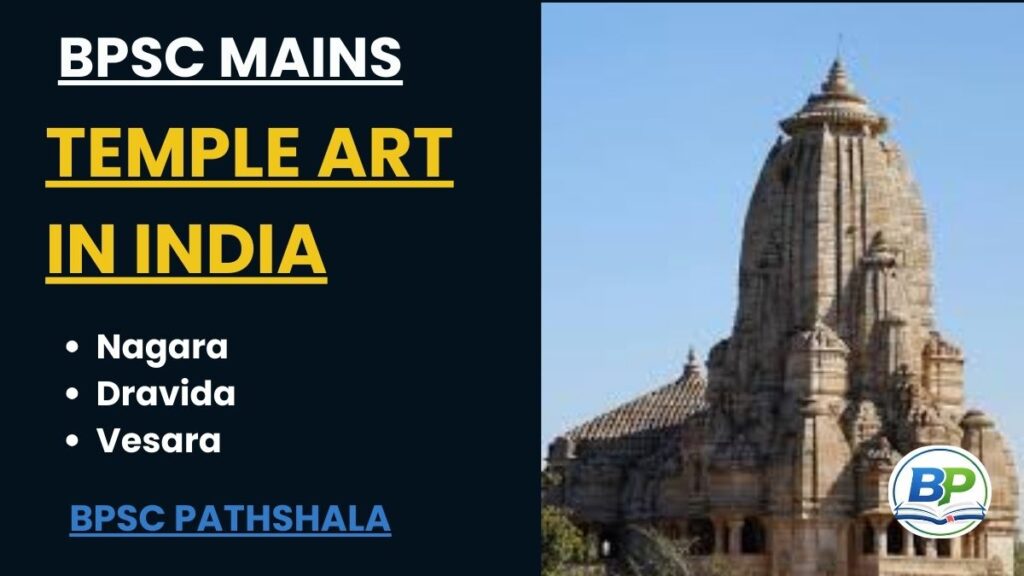
Nagara, Dravida and Vesara Style of Temple Architecture
1. Introduction
There is no direct reference to temples in the early Vedic period. The sacred fire, or “yajnas,” was the focal point of all worship and rites. Yet idol worship also started to be used in the later Vedic period, along with the ritual fire. Simple earth mounds may have served as the initial temples before being replaced by brick construction and grass roofs later on. The Nagara, Dravida and Vesara style of temple architecture represent the three major traditions of Hindu temple construction in India. These styles developed in different regions and reflect variations in religious practices, materials and artistic expression.
Prior to the emergence of distinctive styles, early temples discovered in India can be divided into the following three categories:
- Nirandhara type; with Pradakshinapatha
- Sandhara type; without Pradikshinapatha
- Sarvatobhadra; which can be accessed from all sides
A few of the significant temple sites from this era include Eran, Nachna-Kuthara and Udaygiri in Madhya Pradesh and Deogarh in Uttar Pradesh.
Get Complete BPSC Mains History Notes PDF
Download organised history notes for bpsc mains designed for quick revision and better answer writing.
| Instant access | Downloadable PDFs | Structured BPSC mains preparation |
2. Basic Features of Hindu Temple Architecture
In India, there are many ways in which the temple architecture differs from each other, and each has some prominent features. The Dravida in the southern region and Nagara in the Northern region are the two broad temples of the country. The following are some of the fundamental components of a Hindu temple:
- Sanctum, originally a small cube with a single entrance, eventually expanded into a bigger chamber (Garbhagriha, literally “womb-house”). The primary deity, which is the object of significant ritual attention, is intended to be enshrined in the garbhagriha.
- A mandapa is the name for the temple’s entryway, which could be a veranda or a colonnaded hall with room for many worshippers.
- Freestanding temples typically have a mountain-like tower, which in South India is known as a vimana and can take the form of a curved Shikhar in North India.
- A typical pillar or dhvaj is positioned axially in front of the shrine, together with the Vahan, the mount or vehicle of the primary deity of the temple.
3. Types of Temple Architecture in India
Based on regional variations, Indian temples are broadly classified into Nagara, Dravida and Vesara style of temple architecture. The Gupta Period marked a new phase in the development of temple architecture. Architectural texts from the beginning of the medieval period are known as Shilpashastras. In general, there are three types of temple architecture:
- Dravida style
- Nagara style
- Vesara style
3.1 Dravida Style of Temple Architecture
In the Nagara, Dravida and Vesara style of temple architecture, the Dravida style represents the southern Indian tradition marked by vimanas and gopurams. Dravida’s architectural style was developed in the 7th-8th century AD. Pallavas and Cholas in South India created the Dravida Style of Temple Architecture. The attraction of the Dravida Style was the compound walls and pillars that enclosed the architecture. The vimanas were decorated by sculpting the images of Dwarapalas. The uniqueness of this style is that within an ambulatory hall, the temple is situated. Some of the temples of the Dravida style include;
- The Kailasanatha temple at Kanchipuram.
- Rajarajeswara or Brihadeshwara temple at Thanjavur.
- The Meenakshi Sundareswaratemple at Madurai.
Features of Dravida Temple Style
The main features of this Dravida style of temple architecture are:
- A compound wall encloses the Dravida temple.
- A Gopuram, or entrance doorway, is located in the middle of the front wall.
- The vimana, or main temple tower, is not shaped like the curved shikhara of North India, but rather like a stepped cone that rises up linearly.
- The word “shikhara” is only used in reference to the temple’s top element, which is typically fashioned like a miniature stupika or an octagonal dome.
- The entrance to the garbhagriha is adorned with fierce Dvarapalas, or the doorkeepers, guarding the temple.
- A sizable water tank, sometimes known as a temple tank, is frequently found encased within the complex.
- Subsidiary shrines are either integrated into the main temple tower or are situated next to the main temple as unique, tiny shrines.
3.2 Nagara Style of Temple Architecture
The Nagara style forms an important component of the Nagara, Dravida and Vesara style of temple architecture and developed mainly in North India. Nagara architectural-style temples were developed in North India.This style of architecture is complex, and not enclosed. The top of this temple style has Amalarka, which is a stone-like structure. This structure comprises two buildings, the taller one is the shrine, and the mandapa is the smaller one. The subdivisions of the Nagara Style of Temple Architecture include:
- Rekha-prasada/Latina: It contains a straightforward shikhara with a square base and walls that slope inward to a point at the top. It is the most typical style.
- Phamsana: Roofs made out of numerous slabs that slopingly climb to a single point above the center of the building. Compared to Latina buildings, these are typically wider and shorter.
- Valabhi: Rectangular structures whose roof rises to form a vaulted space. It is also known as wagon-vaulted structures.
Some of the famous Nagara architectural-style temples are;
- The Mahadeva temple at Khajuraho.
- The Sun temple at Madera, Gujarat.
Features of Nagara Temple Style
The main features of this Nagara style of temple architecture are:
- It typically lacks intricate boundary walls or entrances.
- The tallest tower is always exactly above the garbhagriha.
- Nagara temples can be divided into many different types according to the shikhara’s shape.
- The installation of Amalaka or Kalash on Shikhara is another distinguishing element of the Nagara type of temple architecture.
3.3 Vesara style of temple architecture
The temple architecture of Vesara combines the Nagara and Dravidian traditions. The Vesara style, according to several historians, developed in what is now Karnataka. The Chalukyas of Badami (500–753 AD) established the Vesara style, which was afterward perfected by the Rashtrakutas of Manyakheta in Ellora, the Chalukyas of Kalyani in Lakkundi, Dambal, Gadag, etc., and finally exemplified by the Hoysalas. The structures are finely finished, and also, they are well polished.
Some examples of this architectural style are;
- The Kailashnatha temple at Ellora.
- The Hoysaleswara temple at Halebid.
- Navalinga Temples in Kukkanur.
Features of Vesara Temple Style
The main features of this Vesara style of temple architecture are:
- The tower has a vertical shape rather than sloping levels.
- By reducing the elevation of each storey and placing them in descending sequence of height from bottom to top with significant embellishment on each floor, the Chalukyan builders changed the Dravida towers.
- There are two distinguishing characteristics of Chalukya temples: Mantapa and Pillars.
- The panchayatan style and the shrine and secondary shrine plans are reminiscent of the Nagara School.
- The vestibule connecting the sanctum to the mandapa follows the same design as temples in Odisha.
- The wall decoration and miniature decorative towers of Chalukya temples combine Dravida and Nagara architectural elements.
4. Conclusion
In conclusion, the Nagara, Dravida and Vesara style of temple architecture together explain the diversity and evolution of Hindu temple architecture across different regions of India.
Get Complete BPSC Mains History Notes PDF
Download organised history notes for bpsc mains designed for quick revision and better answer writing.
| Instant access | Downloadable PDFs | Structured BPSC mains preparation |