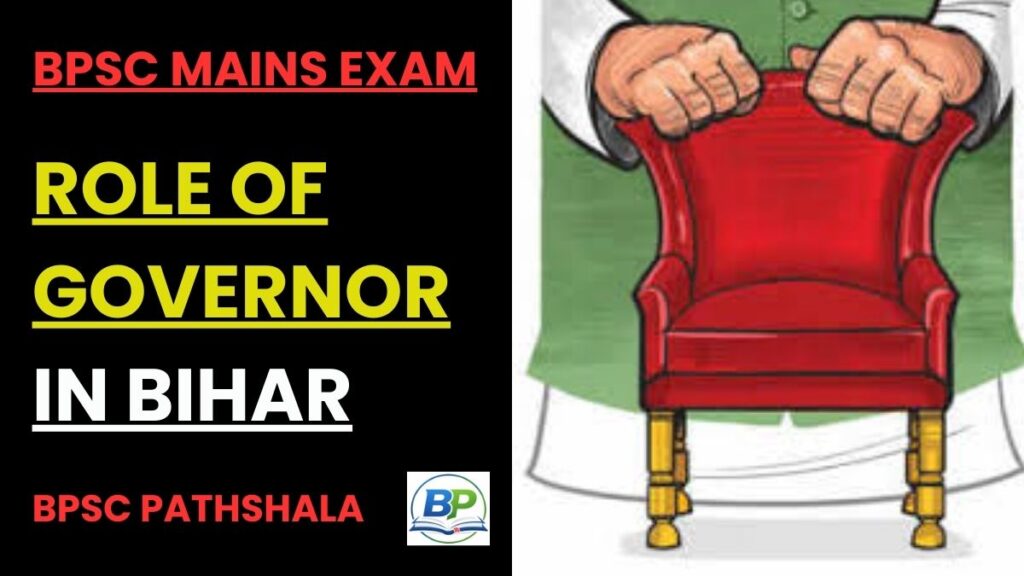
Role of Governor in Bihar Politics
1. Introduction: Appointment and Constitutional Position of the Governor
The Role of Governor in Bihar is rooted in the constitutional framework of India, where the Governor acts as the nominal head of the state while the real executive power rests with the elected government. Under Article 153, each state has a Governor, and Article 155 provides that the Governor is appointed by the President of India. The Governor holds office during the pleasure of the President as per Article 156, making the position constitutionally linked to the Union executive.
In Bihar, as in other states, the Governor is expected to function as a constitutional head, acting on the aid and advice of the Council of Ministers headed by the Chief Minister. The Governor is often described as a “link between the Centre and the State.” While the office is meant to be politically neutral, Bihar’s political history—marked by coalition governments, President’s Rule, and frequent political realignments—has brought the Governor’s role into sharp public and political focus. Thus, understanding the real role of the Governor in Bihar requires examining both constitutional provisions and political practice.
2. Constitutional powers of the Governor
The Role of Governor in Bihar includes executive, legislative, and limited judicial powers as provided by the Constitution.
- Executive Powers: Under Article 154, the executive power of the state is vested in the Governor and exercised in accordance with the Constitution. The Governor appoints the Chief Minister (Article 164) and other ministers on the CM’s advice. Key constitutional posts such as the Advocate General and members of the State Public Service Commission are also appointed by the Governor.
- Legislative Powers: The Governor summons, prorogues, and dissolves the Bihar Legislative Assembly (Article 174). Bills passed by the legislature require the Governor’s assent (Article 200). The Governor may also promulgate ordinances when the legislature is not in session (Article 213).
- Judicial Powers: The Governor has the power to grant pardons, reprieves, or remissions in certain cases under Article 161.
These powers are largely formal and exercised on ministerial advice.
3. Discretionary powers of the Governor
The most debated and politically sensitive dimension of the Role of Governor in Bihar relates to the exercise of discretionary powers. Although India follows a parliamentary system where the Governor normally acts on the aid and advice of the Council of Ministers, the Constitution permits limited discretion in exceptional situations. These discretionary powers are meant to ensure constitutional stability, not political intervention. Key discretionary areas include:
- Appointment of the Chief Minister when no party has a clear majority in the Assembly
- Calling for a floor test to determine majority
- Recommending President’s Rule under Article 356
- Reserving a Bill for the President’s consideration under Article 200
One important area of discretion is the appointment of the Chief Minister when no single party or alliance secures a clear majority in the Bihar Legislative Assembly. In such situations, the Governor must assess competing claims and invite the leader most likely to command majority support. Bihar has witnessed such scenarios during fractured mandates, making the Governor’s judgment crucial for democratic continuity.
Another key discretionary function is the ordering of a floor test. When doubts arise about the government’s majority, the Governor may direct the Chief Minister to prove majority support on the floor of the House. This power is intended to uphold legislative supremacy but has often generated controversy when timing and intent are questioned.
The Governor also exercises discretion while recommending President’s Rule under Article 356 if constitutional machinery is perceived to have failed. In Bihar, past impositions of President’s Rule have made this power highly contentious, leading to allegations of misuse for political ends.
Additionally, under Article 200, the Governor may reserve a Bill for the President’s consideration, especially if it conflicts with the Constitution or Union laws. While legally valid, frequent use of this power can delay state legislation and strain Centre–State relations.
Judicial pronouncements have repeatedly stressed that discretionary powers must be exercised sparingly, objectively, and within constitutional boundaries. Thus, the discretionary role of the Governor in Bihar remains a constitutional necessity but demands restraint, neutrality, and adherence to democratic principles.
4. Governor, Chief Minister, and Council of Ministers: Constitutional relationship
The Role of Governor in Bihar vis-à-vis the Chief Minister and Council of Ministers is clearly defined by the Constitution.
- Article 163 states that the Governor shall act on the aid and advice of the Council of Ministers, except in matters where discretion is expressly allowed.
- Article 164 provides for collective responsibility of the Council of Ministers to the Legislative Assembly, not to the Governor.
- Article 167 mandates the Chief Minister to communicate decisions of the Council of Ministers to the Governor and furnish information when sought.
This framework establishes that the Governor is not a parallel authority to the elected government. In routine governance, the Governor must act as a constitutional figurehead. However, in Bihar, tensions have occasionally surfaced during government formation, confidence motions, and legislative deadlocks, testing this constitutional balance.
5. Committee reports and Supreme Court judgments on Governor’s powers
Several committees and court judgments have shaped the understanding of the Role of Governor in Bihar and other states.
Committee Reports
- Sarkaria Commission (1988):
Recommended that Governors should act as impartial constitutional heads and not as agents of the Centre. It laid down guidelines for government formation and use of Article 356. - Punchhi Commission (2010):
Emphasised restraint in the use of discretionary powers and suggested fixed guidelines for floor tests and President’s Rule.
Supreme Court Judgments
- S.R. Bommai Case (1994):
Held that President’s Rule is subject to judicial review and that floor test is the proper method to determine majority. - Nabam Rebia Case (2016):
Clarified that the Governor cannot interfere in legislative proceedings beyond constitutional limits. - Shivraj Singh Chouhan Case (2020):
Reinforced the principle that floor tests are central to resolving political uncertainty.
These rulings significantly limit arbitrary use of gubernatorial power.
6. Conclusion
The Role of Governor in Bihar is constitutionally defined but politically sensitive. While the Governor is envisaged as a neutral constitutional head, political realities often place the office at the centre of controversy, especially during unstable political phases. Supreme Court judgments and committee recommendations have clearly outlined that the Governor must act with restraint, impartiality, and respect for democratic mandate.
In Bihar’s evolving political landscape, the Governor’s true role lies not in exercising power, but in safeguarding constitutional morality. A restrained and principled Governor strengthens federalism, democratic governance, and public trust in constitutional institutions.
BPSC Mains Practice Questions (Role of Governor in Bihar)
Q1. Examine the constitutional position and discretionary powers of the Governor in Bihar. To what extent have Supreme Court judgments limited the scope of these powers?
Q2. The Governor is expected to act as a neutral constitutional head, yet controversies often arise in practice. Critically analyse the role of the Governor in Bihar with reference to Centre–State relations.
Q3. Discuss the constitutional relationship between the Governor, the Chief Minister, and the Council of Ministers in Bihar. How can constitutional morality ensure harmonious functioning of this relationship?
Also Read….