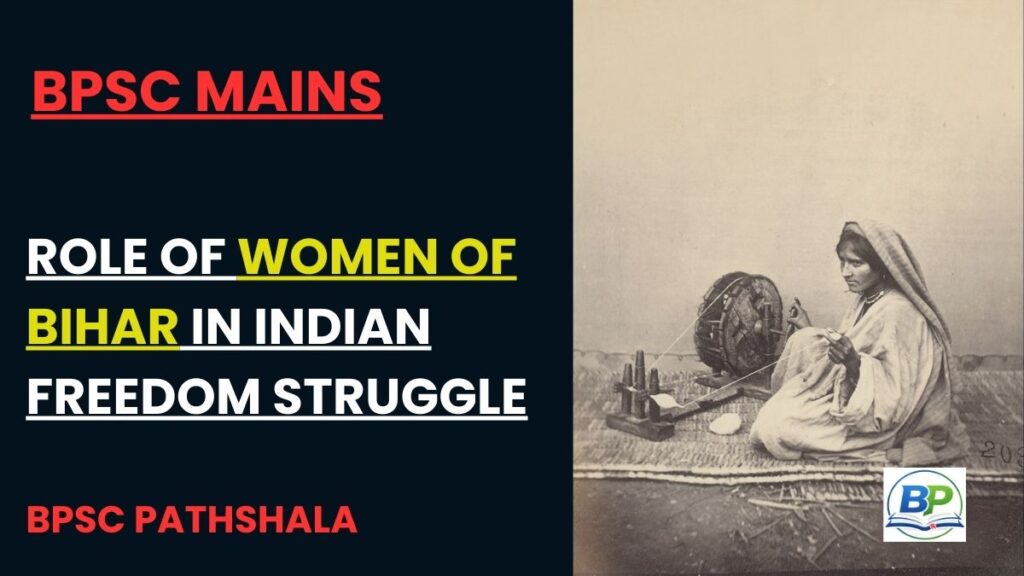
Role of Women of Bihar in Indian Freedom Struggle
1. Introduction: Role of Women of Bihar in Indian Freedom Struggle
The role of women of Bihar in Indian freedom struggle is a proud and inspiring chapter of modern Indian history. Bihar, a land of rich culture and heritage, has played a significant role in India’s journey from the Vedic age to independence. Patna, the capital city located on the banks of the river Ganga, has witnessed the rise and fall of great empires. Along with men, women also left a deep imprint on history through their courage and sacrifice.
During the national movement, women of Bihar actively participated in political and social activities. On the call of Mahatma Gandhi, they accepted social responsibility and joined mass movements. With the spread of women’s education in the 19th century, many educated families encouraged women to participate in public life. Gandhiji’s visits to Bihar inspired women to attend his meetings, leading to their growing involvement in political reform and freedom struggle.
Get Complete BPSC Mains History Notes PDF
Download organised history notes for bpsc mains designed for quick revision and better answer writing.
| Instant access | Downloadable PDFs | Structured BPSC mains preparation |
2. Prabhavati Devi: Gandhian Discipline and Sacrifice
Prabhavati Devi was a prominent woman freedom fighter of Bihar and wife of Jayaprakash Narayan. She married him on 16 May 1920. Encouraged by her husband, she embraced Gandhian ideals, mastered spinning on the charkha, and dedicated her life to national service. The couple decided not to have children until India achieved independence.
She was arrested in Lucknow in 1932 during the boycott of foreign goods. Gandhiji and Rajendra Prasad entrusted her with organising women volunteers. She later established the Mahila Charkha Samiti in Patna to provide employment to abandoned and destitute women. During the Quit India Movement, she was imprisoned in Bhagalpur jail. Her final years were marked by severe illness, yet her dedication never faded.
3. Vindhyavasini Devi: Organising Women for Mass Protest
Vindhyavasini Devi devoted herself to social service after meeting Gandhiji in 1919. She became a permanent member of the Indian National Congress and motivated families to allow their daughters to join national movements. Women under her influence participated fearlessly in protests against foreign goods and liquor.
She was arrested during the Salt Satyagraha in 1930 and later imprisoned in Muzaffarpur jail in 1932. The colonial government even declared the Kanya Swayam Sevika Dal illegal, reflecting the fear generated by women’s organised resistance.
4. Pyari Devi: From Salt Satyagraha to Congress Leadership
Pyari Devi, wife of Jagat Narayan Lal, was married on 12 March 1930. Within weeks, she joined the Salt Satyagraha and was imprisoned for one year. Her popularity and leadership were so strong that she defeated Sahajanand Saraswati to become a member of the All-India Congress Committee, serving until 1939.
She was repeatedly arrested for delivering nationalist speeches and remained a fearless voice against British rule.
5. Tara Rani: Symbol of Courage and Martyrdom
Tara Rani, born in a simple family in Saran district, married Phulendu Babu. She actively mobilised women in her village and joined the Quit India Movement in 1942. Together, they planned to hoist the national flag on the Siwan Police Station.
During the march, police opened fire. Phulendu was fatally wounded, but Tara Rani, undeterred, bandaged him with her sari and continued leading the procession shouting “Inquilab” while holding the Indian flag. Her husband later died, but she continued her struggle, becoming a lasting symbol of courage in the role of women of Bihar in Indian freedom struggle.
6. Sushila Sinha: Student Leadership and Post-Independence Contribution
Born on 26 December 1926 in Bihar, Sushila Sinha joined the Quit India Movement at the age of 16 while studying at Bankipore College, Patna. Inspired by the trials of Indian National Army officers at the Red Fort in 1945, she became actively involved in politics.
She was elected President of the Bihar Students’ Congress and played a role in maintaining communal harmony during Partition, welcoming Gandhiji in Nalanda. She passed away on 14 August 2007 in New Delhi.
7. Impact of Women’s Participation in Bihar
The contribution of women of Bihar strengthened both the freedom struggle and the women’s emancipation movement. Their participation proved that women were equal partners in education, employment and national service. Their courage ensured that Bihar’s freedom movement had a strong mass base.
8. Conclusion: Legacy of Women Freedom Fighters of Bihar
The role of women of Bihar in Indian freedom struggle was decisive and transformative. Most women participants were educated and often spouses of leading freedom fighters, yet their contribution stood independently strong. Once committed, they never stepped back from the path of sacrifice.
Inspirational leadership, especially that of Mahatma Gandhi, played a crucial role in mobilising women. His movements—from Satyagraha to the Dandi March—became powerful motivators. These women proved that they were truly “half the sky,” contributing equally to India’s independence and shaping a legacy of courage and national service.
Get Complete BPSC Mains History Notes PDF
Download organised history notes for bpsc mains designed for quick revision and better answer writing.
| Instant access | Downloadable PDFs | Structured BPSC mains preparation |