Thoughts of Gandhi
1. Introduction
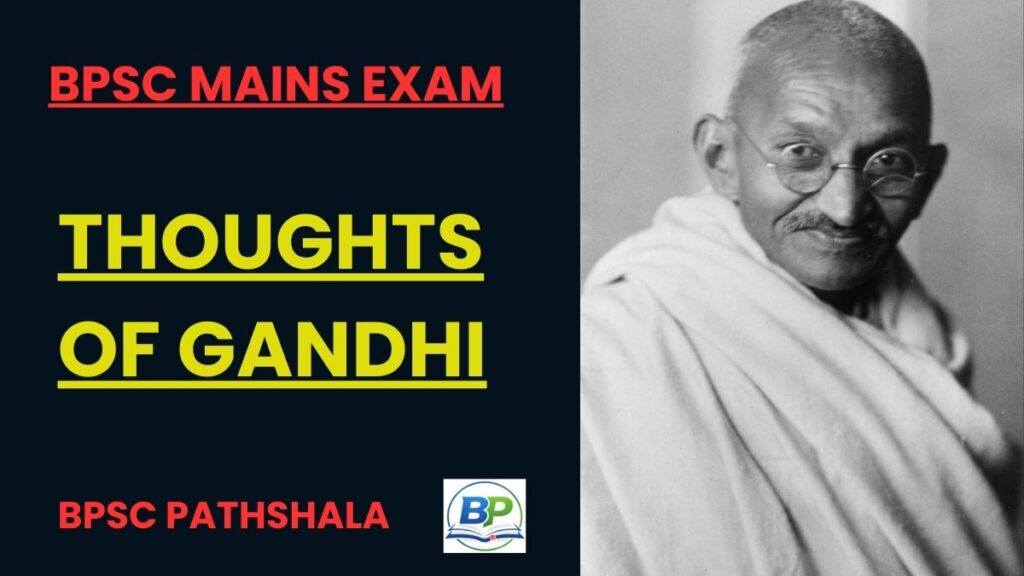
Mahatma Gandhi was born in India in 1869. From 1893 to 1914 he lived in South Africa. Later, he emerged as the face of Indian freedom movement. The thoughts of Gandhi have played a decisive role in shaping India’s freedom struggle as well as its moral and political philosophy.
The base of Gandhian philosophy or thoughts of Gandhi is the spiritual or religious component. He was a firm believer in God. He was also a believer in humanity. He believed that human nature is good. He considered all people are capable of moral development.
Get Complete BPSC Mains History Notes PDF
Download organised history notes for bpsc mains designed for quick revision and better answer writing.
| Instant access | Downloadable PDFs | Structured BPSC mains preparation |
2. Religious and philosopher inspiration to Gandhi
- Gandhiji developed these ideologies from various inspirational sources such as Bhagavad Geeta, Jainism, Buddhism, Bible, Gopal Krishna Gokhale, Tolstoy, and John Ruskin among others.
- Leo Tolstoy’s book ‘The Kingdom of God is within you” had a deep influence on Mahatma Gandhi. The same was the case with John Ruskin’s ‘Unto This Last’.
- Gandhiji paraphrased Ruskin’s book ‘Unto This Last’ as ‘Sarvodaya’, which meant the upliftment of all.
- The goal of Gandhi was to change society and each individual using the values of honesty and non-violence.
- These ideas were further developed by many followers of Gandhi who proudly called themselves “Gandhians”.
Those who actively followed Gandhian principles in life include Vinoba Bhave, Jayaprakash Narayan and Martin Luther King Jr.
3. Thoughts of Gandhi
(a) Truth and non-violence
Truth and non-violence form the core of the thoughts of Gandhi and guide his entire political philosophy. These are generally considered to be the two key ingredients of Gandhian thought.
- It is possible to pursue one without the other. Thus, seeking the truth can be done violently. Nations enter conflicts assuming they are on the side of truth or that the truth is on their side.
- Those who are more sensitive and think the truth is on their side demand that a just war should be fought instead of one that is avoided at all costs.
- The most sensitive were the pacifists among them. By avoiding violence altogether. But it could be argued that in doing so they have gone too far and abandoned truth, especially when interpreted as justice.
- Even Mahatma Gandhi argued that although he was opposed to war, the two parties engaging in it may not stand on the same plane: the cause of one side could be more just than the other so that even a nonviolent person might wish to extend his or her moral support to one side rather than to the other.
- Thus, just as it is possible to pursue truth without being nonviolent, it is also possible to pursue non-violence without pursuing truth.
- It could be proposed that such a disjunction between the two runs the risk of cowardice being mistaken for, or masquerading as nonviolence.
- The point becomes clear if we take the word “truth” to denote the “right” thing to do in a morally charged situation.
Gandhi’s opinion on the non-violent way
- By using a non-violent approach, we aim to eliminate capitalism, not the capitalist. We encourage the investor to think of himself as a trustee for people who rely on him to create, hold onto, and grow his capital.
- The worker is not required to wait for his conversion. Work is power if money is. Both are depending upon one another.
- The moment the worker recognizes his potential, he is in a position to stop being the capitalist’s slave and start sharing in his success.
- If he aims at becoming the sole owner, he will most likely be killing the goose that lays the golden eggs.
- No need for me to worry that someone will replace me if I refuse to cooperate. Because I hope to persuade my co-workers to oppose my employer’s wrongdoing, this method of mass worker education is undoubtedly a slow one, but as it is also the most reliable, it must also be the fastest.
- It is simple to show in the end that the worker is right and that no human being is so flawless as to merit his eliminating the person whom he mistakenly believes to be completely evil.
(b) Satyagraha
The concept was introduced in the early 20th century by Mahatma Gandhi and designated a determined but nonviolent resistance to evil. Satyagraha is one of the most powerful expressions of the thoughts of Gandhi in practical politics.
- The supreme idea of truth naturally leads to the Gandhian ideology of Satyagraha. Protecting the standards and tenets of truth is essential if it is the ultimate reality. God, who is the utmost truth and reality, requires a votary who is completely compassionate and unselfish.
- Gandhi’s Satyagraha became a major tool in the Indian struggle against British imperialism and has since been adopted by protest groups in other countries.
- The ancient Indian philosophy of ahimsa, or “non-injury,” which is rigorously practised by Jains, many of whom reside in Gujarat, where Gandhi was raised, is the inspiration behind Satyagraha.
- Gandhi also drew inspiration from the works of Leo Tolstoy and Henry David Thoreau, the Bible, and the Bhagavad Gita, on which he produced a commentary, to modernize the notion of ahimsa and give it broad political implications as Satyagraha.
- Gandhi first conceived Satyagraha in 1906 in response to a law discriminating against Asians that was passed by the British colonial government of the Transvaal in South Africa.
- In 1917, the Champaran district, which produced indigo, hosted the first Satyagraha campaign in India. Fasting and economic boycotts were used as Satyagraha tactics in India over the ensuing years, up until the British left in 1947.
- Since Satyagraha depends on the opponent, who is the embodiment of evil, upholding a high standard of ethical conduct, and demands an unreasonably high level of commitment from those working for social change, critics of the movement have asserted that it is unrealistic and incapable of achieving universal success.
These arguments have been made both during Gandhi’s lifetime and since. However, Satyagraha left a lasting legacy in South Asia and was a key component of the civil rights movement headed by Martin Luther King Jr. in the United States.
(c) Sarvodaya
- The word “Sarvodaya” means “Universal Uplift” or “Progress of All.” The phrase was first used by Mohandas Gandhi to describe the aim of his political philosophy in his 1908 translation of “Unto This Last,” a work by John Ruskin on political economy.
- Later Gandhians adopted the phrase as a moniker for the social movement in post-independence India that worked to ensure that self-determination and equality reached all strata of Indian society, including the Indian nonviolence leader Vinoba Bhave.
Objects of the Sarvodaya movement
- The idea of Sarvodaya reflects the social and economic dimension of the thoughts of Gandhi.
- The Sarvodaya Movement has as its target the establishment of a whole network of such self-supporting village communities.
- Family ties, which are currently restricted to blood groups, will be extended to include the entire village, erasing any disparities based on race, creed, caste, language, and other factors.
- The planning of agriculture will ensure that there is enough food for everyone. Up until everyone in the hamlet has a job, the industry will operate on a cottage basis.
- Village Council, a body that represents the entire village, will be responsible for determining the requirements of the community.
Principles of the Sarvodaya
- There is no centralized authority, and there is a political and economic atmosphere in the villages.
- The spirit of love, fraternity, truth, nonviolence, and self-sacrifice will permeate all people. The foundation of society will be nonviolence.
- There will be no party system and majority rule and society will be free from the evil of the tyranny of the majority.
- Socialist in the truest sense, the Sarvodaya society. The same ethical, social, and financial standards will apply to all calls. The greatest potential for development exists within each person’s personality.
- Sarvodaya society is based on equality and liberty. There is no room in it for unwholesome competition, exploitation, and class hatred.
- Sarvodaya is a symbol of universal progress. Every person should work independently and adhere to the concept of non-possession. The goal of: from each according to his effort and each according to his needs will then be achievable.
- There won’t be any private property, which serves as a weapon of exploitation and a breeding ground for prejudice and hatred. Similar to how the profit motive will vanish, rent and interest will also disappear.
- The Sarvodaya Movement is based on Truth, nonviolence, and Self-denial.
- The Sarvodaya Movement makes an earnest and audacious effort to foster the environment required to unite such people with steadfast trust in the Welfare of All.
- The benefit to the person would be little. Each quality’s growth is dependent on every other quality. If every quality were somewhat enhanced, the person would benefit more.
(d) Swadeshi
The combination of two Sanskrit terms yields the English word “Swadeshi,” which has Sanskrit roots. Swa and desh both refer to one’s own or one’s nation.
Swadesh, therefore, refers to one’s homeland. The adjectival version of the word swadeshi, which means “of one’s own country,” can be loosely translated as “self-sufficiency” in most settings.
The message of the charkha
- Gandhiji asserts that the Charkha has the distinction of being able to address the issue of economic distress in a way that is most logical, straightforward, affordable, and professional.
- It stands for both the wealth and freedom of the country. It represents commercial peace rather than commercial strife.
- The spinning-meaning wheel is considerably bigger than its diameter. Simple life, helping others, living without hurting others, and forging an unbreakable tie between the wealthy and the poor, capital and labour, and the prince and the peasant are all part of its teachings. Naturally, the bigger lesson applies to everyone.
(e) Trusteeship
Trusteeship is a key component of Gandhian economics that could be called the nonviolent equivalent of ownership.
- The idea was taken from English law by Gandhi. It denotes that one is a trustee rather than the owner of their belongings, including eventually their skills or abilities.
- All must be used for the greater good of society, which includes one’s own welfare in the end. In this system, material possessions do not serve as status symbols that increase our sense of self-worth.
- Trusteeship is a successful strategy for reducing excessive consumption. The economy might be rebalanced under trusteeship and put its focus back on pressing needs.
- Gandhi believed that possessing more than one need necessarily entails robbing others of their requirements. There is enough on the earth to meet everyone’s needs, but not enough to satisfy everyone’s greed, he said.
4. The relevance of thoughts of Gandhi in modern times
The thoughts of Gandhi are not confined to the freedom struggle; they continue to influence India’s policies in economics, environment, governance and international relations. His ideas of self-reliance, non-violence, decentralisation and ethical public life remain deeply relevant in contemporary India.
Economics
- Gandhi emphasised self-sufficiency (Swadeshi) and “production by the masses” rather than mass production. This idea finds reflection in several Government of India initiatives.
- The Make in India programme promotes domestic manufacturing to reduce import dependence and strengthen local industries. Similarly, the Atmanirbhar Bharat Abhiyan focuses on self-reliance in defence, electronics, pharmaceuticals and MSMEs, echoing Gandhian economic nationalism.
- The emphasis on rural empowerment through schemes such as Mahatma Gandhi National Rural Employment Guarantee Act (MGNREGA) supports local employment generation. It aligns with Gandhi’s vision of strengthening villages as economic units.
- Promotion of Khadi and village industries through the Khadi and Village Industries Commission (KVIC) reflects Gandhi’s belief in decentralised cottage industries. The growth of Self-Help Groups under the National Rural Livelihood Mission (NRLM) also embodies his principle of community-based economic empowerment.
- Thus, Gandhi’s economic philosophy continues to shape India’s inclusive and rural-centric development strategy.
Environment
- Gandhi warned against unrestrained industrialisation and excessive consumption. His famous idea that “the Earth provides enough to satisfy every man’s need but not every man’s greed” resonates strongly in the present climate crisis.
- Government initiatives such as the National Action Plan on Climate Change (NAPCC), the International Solar Alliance, and the promotion of renewable energy reflect the need for sustainable development.
- The Swachh Bharat Mission promotes cleanliness and sanitation, reflecting Gandhian emphasis on hygiene and dignity of labour.
- The push for sustainable lifestyles under the global initiative LiFE (Lifestyle for Environment) echoes Gandhi’s call for simple living and responsible consumption.
- Hence, Gandhian environmentalism remains highly relevant in achieving sustainable development.
Administration
- Gandhi’s ideas of transparency, moral politics and decentralisation are visible in governance reforms.
- The strengthening of Panchayati Raj Institutions under the 73rd and 74th Constitutional Amendments aligns with his idea of Gram Swaraj (village self-rule).
- The Right to Information Act, 2005 promotes transparency and accountability in administration.
- The use of digital platforms under Digital India enhances citizen participation and reduces corruption, indirectly strengthening ethical governance.
- His principles of non-violence and dialogue are also relevant in handling internal conflicts. Instead of excessive force, confidence-building measures and development-based approaches are increasingly used in insurgency-affected areas.
- Thus, Gandhian values continue to influence administrative reforms and citizen-centric governance.
International relation
- Gandhi’s philosophy of non-violence and peaceful coexistence influences India’s foreign policy.
- India follows the principle of strategic autonomy and avoids aggressive postures. Its commitment to peaceful dispute resolution, respect for sovereignty and multilateral cooperation reflects Gandhian ideals.
- India’s leadership in the Non-Aligned Movement (NAM) historically reflected non-violent diplomacy. Today, initiatives like Vasudhaiva Kutumbakam (One Earth, One Family, One Future) during India’s G20 Presidency echo Gandhi’s belief in universal brotherhood.
- India’s preference for dialogue in resolving border disputes and its role in humanitarian assistance during global crises demonstrate a peaceful and ethical foreign policy approach.
5. Seven Social sins by Mahatma Gandhi
Seven Social Sins by Mahatma Gandhi were first published in his newspaper Young India in 1925. Those are a comprehensive list of behaviours that cause serious harm to society.
- Wealth without Work
- Pleasure without Conscience
- Knowledge without Character
- Commerce (Business) Without Morality (Ethics)
- Science without Humanity
- Religion without Sacrifice
- Politics without Principle
- Wealth without Work: It depicts making wealth by unfair means, by taking shortcuts. Examples: Black Money, Tax evasion, scams, insider trading, etc.
- Pleasure without Conscience: Earning happiness at the expense of others is equivalent to sin. Selfishness compels a person to disregard the needs of others. Without moral justification, it would promote bad practices. Additionally, it would lead to a rise in drug and alcohol abuse as well as mindless shopping.
- Knowledge without character: A person with character possesses attributes of honesty and integrity. A person who commits this vice may end up like Osama Bin Laden, while a person with moral character may end up like Swami Vivekananda.
- Business without morality: One particular segment of the community would end up being overworked at the expense of another. Social friction and community conflict would rise as a result of this. Examples of this sin include unsafe working conditions, adulteration, and lack of security.
- Science without humanity: The huge pharmaceutical companies keep prescription prices high, making them unaffordable for the poor and those in need. If nuclear power is utilized to generate electricity, that is great, but using it to destroy nations like Hiroshima and Nagasaki by bombing is utterly immoral.
- Religion without sacrifice: Today’s religion consists merely of rituals and activities. Sin is when we fail to live out the moral precepts of brotherhood, compassion, and affection.
- Politics without principle: Criminalization of politics, unaccounted money, and use of muscle power shows politics without principle.
6. Conclusion
The thoughts of Gandhi offer a moral compass for politics, economics and social life. His principles of truth, non-violence, trusteeship, swadeshi and Sarvodaya promote ethical governance, inclusive development and peaceful coexistence. In an era marked by inequality, violence and environmental crisis, Gandhian philosophy remains a guiding force for building a just, humane and sustainable society.
BPSC Mains Practice Questions: Thoughts of Gandhi
Q1. Discuss the core elements of Gandhian philosophy. How do truth and non-violence shape his political thought?
Q2. Examine the concept of Satyagraha and Sarvodaya in the context of India’s freedom struggle and post-independence development.
Q3. Critically analyse the relevance of Gandhian economic ideas such as Swadeshi and Trusteeship in contemporary India.
Q4. Explain Gandhi’s concept of the Seven Social Sins. How do they reflect ethical challenges in modern governance and society?
Also Read…
- Thoughts of Jawaharlal Nehru
- Comparison of thoughts of Nehru and Gandhi
- Thoughts of Tagore
- Thoughts of Jayaprakash Narayan
Get Complete BPSC Mains History Notes PDF
Download organised history notes for bpsc mains designed for quick revision and better answer writing.
| Instant access | Downloadable PDFs | Structured BPSC mains preparation |