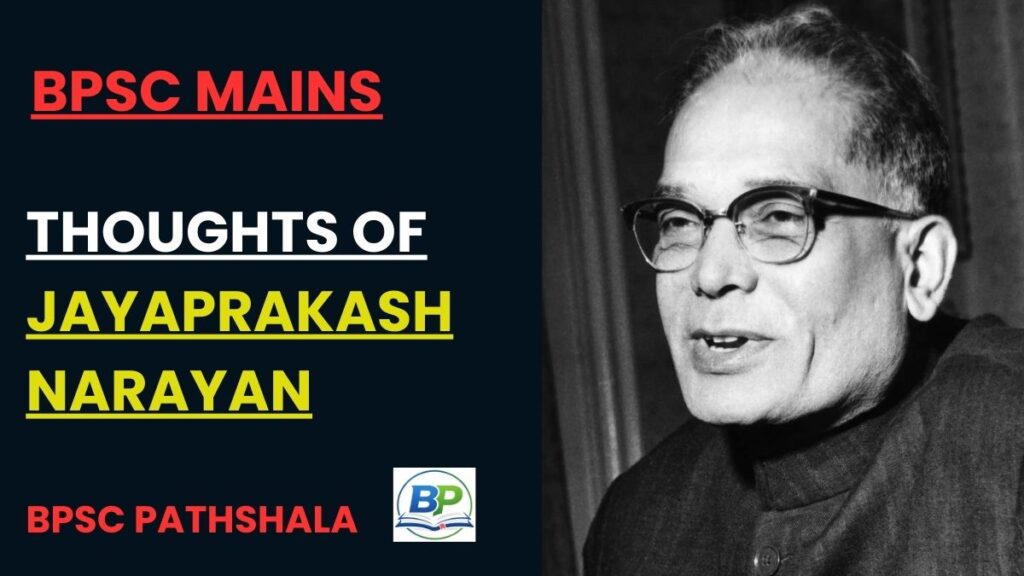
Thoughts of Jayaprakash Narayan
1. Introduction
The thoughts of Jayaprakash Narayan reflect the mind of a dynamic thinker whose ideas evolved with time, responding to the changing needs of Indian society and politics. Jayaprakash Narayan (JP) developed his philosophy through continuous engagement with freedom struggle, social reform and democratic movements. His thoughts can be understood under the following major headings:
Get Complete BPSC Mains History Notes PDF
Download organised history notes for bpsc mains designed for quick revision and better answer writing.
| Instant access | Downloadable PDFs | Structured BPSC mains preparation |
2. Nationalism and Freedom Struggle
In the thoughts of Jayaprakash Narayan, nationalism was inseparable from dignity and self-respect. He firmly believed that political freedom was essential for India’s honour and actively participated in the freedom struggle. However, JP also argued that mere transfer of power from British rulers to Indian elites would not fulfil the aspirations of the masses unless it resulted in genuine empowerment of the people.
3. Socialism and Economic Justice
A key component of the thoughts of Jayaprakash Narayan in his early political life was socialism. He was deeply influenced by Marxist and democratic socialist ideas and believed that freedom would remain incomplete without economic equality and social justice. According to JP, exploitation of peasants and workers lay at the root of poverty and inequality in India. He supported redistribution of resources and reduction of economic disparities through democratic and peaceful means rather than violent revolution.
4. Critique of Capitalism and Authoritarian Communism
In the thoughts of Jayaprakash Narayan, both capitalism and authoritarian communism were flawed systems. He criticised capitalism for concentrating wealth in the hands of a few and neglecting social welfare. At the same time, he rejected authoritarian communism for suppressing individual freedom and moral values. JP believed that India required a unique path based on democratic and ethical socialism that upheld human dignity.
5. Sarvodaya and Gandhian Philosophy
Under the influence of Mahatma Gandhi, the thoughts of Jayaprakash Narayan gradually moved towards Sarvodaya, meaning the welfare of all. He believed that social transformation must be rooted in non-violence, moral persuasion and voluntary cooperation. According to JP, real change should begin at the grassroots level, focusing on villages, self-reliant communities and cooperative economic systems.
6. Decentralisation and Participatory Democracy
Decentralisation occupies a central place in the thoughts of Jayaprakash Narayan. He strongly argued that excessive centralisation weakens democracy and alienates people from governance. JP supported Panchayati Raj and local self-government as essential instruments of participatory democracy, enabling citizens to directly participate in decision-making and administration.
7. Moral Politics and Ethical Governance
One of the most distinctive aspects of the thoughts of Jayaprakash Narayan was his insistence on morality in politics. He believed that politics without ethics leads to corruption, authoritarianism and the decay of democratic institutions. Values such as truth, non-violence, self-discipline and public service formed the moral foundation of his political philosophy.
8. Total Revolution (Sampoorna Kranti)
The concept of Total Revolution (Sampoorna Kranti) represents the most significant contribution of the thoughts of Jayaprakash Narayan in his later years. This idea called for a comprehensive transformation of society—political, social, economic, cultural and moral. JP envisioned Total Revolution as a peaceful, democratic mass movement led by students, youth and civil society to cleanse public life of corruption and restore democratic values.
9. Conclusion
The thoughts of Jayaprakash Narayan represent a lifelong commitment to justice, democracy and ethical leadership. His intellectual journey from socialism to Gandhian Sarvodaya highlights his moral depth and ideological flexibility. Even today, the thoughts of Jayaprakash Narayan remain highly relevant in discussions on governance, decentralisation, corruption and the role of citizens in sustaining democracy.
Get Complete BPSC Mains History Notes PDF
Download organised history notes for bpsc mains designed for quick revision and better answer writing.
| Instant access | Downloadable PDFs | Structured BPSC mains preparation |