Thoughts of Jawaharlal Nehru
1. Introduction
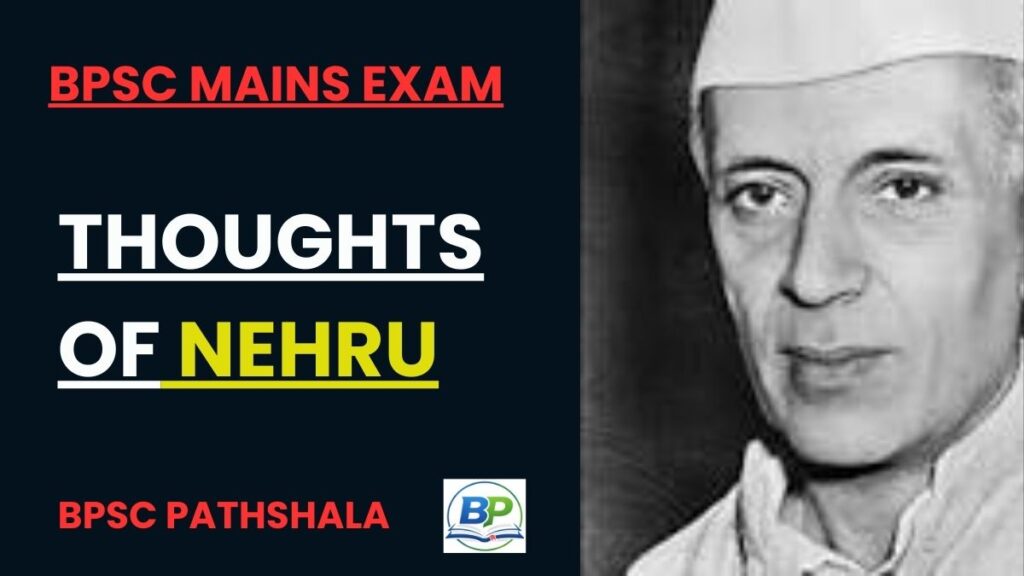
The thoughts of Nehru played a crucial role in shaping India’s freedom struggle and the foundations of modern Indian democracy. Jawaharlal Nehru was not only a mass leader of the national movement but also a visionary thinker who combined nationalism with socialism, secularism and scientific temper. His ideas aimed at building an India free from poverty, ignorance and communal divisions. The thoughts of Nehru continue to influence India’s political system, economic policies and democratic values even today.
Get Complete BPSC Mains History Notes PDF
Download organised history notes for bpsc mains designed for quick revision and better answer writing.
| Instant access | Downloadable PDFs | Structured BPSC mains preparation |
2. Jawaharlal Nehru’s Role in India’s Independence Struggle
Jawaharlal Nehru played an important role in India’s freedom movement. With Gandhi, he led India to independence from British rule. He was firm in his belief that India should gain complete independence from British rule. Nehru joined the Indian National Congress in 1919. In 1929, Gandhi made him the Congress President.
- Gandhi and Nehru formed a deep bond and worked closely together for India’s Swaraj. Nehru organized protests and demonstrations against the British rule.
- In 1928, Nehru gave a historic speech where he said that India’s independence was inevitable. He encouraged other Indians to join the freedom movement.
- When Gandhi launched the civil disobedience movement in 1930, Jawaharlal Nehru fully supported it. He went to jail many times during the struggle.
- Jawaharlal Nehru motivated the youth to join the freedom movement. He inspired thousands of young people to work for India’s independence. The youth saw Nehru as their ideal leader.
- Jawaharlal Nehru stayed in jail for almost 10 years. While in jail, he wrote letters to his daughter Indira and also wrote his famous book, The Discovery of India.
- After Gandhi, Nehru became the most prominent leader of the Indian National Congress. Indians saw him as the first Prime Minister of free India.
- Even when Nehru and Gandhi had disagreements, they remained close. Their partnership to achieve India’s swaraj remained strong till the end.
Nehru and the Quit India Movement
In 1942, when Gandhi launched the Quit India movement, Nehru fully supported it. He gave powerful speeches motivating Indians to fight for complete freedom.
- On August 8 1942, Nehru gave a historic speech in Bombay.
- Nehru was arrested by the British and remained in jail until 1945. Even from jail, Nehru led the freedom movement and spread the message of Quit India.
- India achieved independence on August 15 1947. By then, Nehru had become the symbol of India’s freedom struggle and the inevitable first Prime Minister of independent India. His ideas shaped the democratic and secular foundations of modern India.
Jawaharlal Nehru and Indian National Congress
Jawaharlal Nehru played an important part in the Indian National Congress during India’s freedom fight.
- Nehru joined Congress in 1919 at age 37. At that time, the Congress was becoming more powerful under Mahatma Gandhi’s leadership. Nehru quickly became one of the Congress’s most popular leaders.
- Nehru supported Gandhi’s strategy of peaceful protest against the British. He took part in many demonstrations and campaigns and was jailed many times by the British. Nehru became Gandhi’s closest helper.
- In 1929, Nehru became Congress president. As president, Nehru travelled all over India to spread Gandhi’s message of peace and freedom from British rule. He convinced many people to join the freedom movement.
- As president, Nehru tried to reduce the differences between Hindus and Muslims. He wanted both groups to be united in the movement. But religious tensions kept rising.
- After India became free in 1947, Nehru became India’s first Prime Minister. But he stayed active in Congress.
- As Prime Minister, Nehru worked to strengthen Congress and make it the major political party. He travelled all over India for party meetings.
- Nehru spread the idea of “secular India” through Congress. He said India must give equal rights to people of all religions. This idea of secularism became one of the Indian Constitution’s main principles.
- As prime minister and Congress leader, Nehru worked to end poverty in India and build a modern nation. He focused on developing industries, science, and technology education in India.
- Nehru’s death in 1964 was a big blow to Congress. After Nehru, Congress could not find another charismatic leader to lead the party for many decades.
- Nehru played an important role in Congress as a charismatic leader, effective organizer and main strategist. He strengthened Congress and made it the major political party after India became free. Nehru spread secular and socialist ideals through Congress, which formed the basis of the Indian Constitution and policies.
3. Thoughts of Nehru
Jawaharlal Nehru advocated complete freedom for India. He opposed any type of compromise with the British, like Dominion Status. Nehru supported socialism and secularism. He dreamt of an India which would be free of poverty, illiteracy and communal divisions. Nehru encouraged the spread of science and rational thinking in India. He believed this would help build a modern India. Jawaharlal Nehru popularized the slogan of ‘Purna Swaraj’, or complete independence for India. He spread this message among Indians through his speeches.
(a) Political Philosophy of Nehru
- Jawaharlal Nehru’s political philosophy was rooted in liberal democracy, constitutionalism and parliamentary governance. He firmly believed that political freedom must be followed by democratic institutions that guarantee civil liberties, equality and rule of law. Unlike many newly independent nations that adopted authoritarian models, Nehru ensured that India embraced a parliamentary system based on universal adult franchise from the very beginning in 1950.
- Nehru viewed democracy not merely as a system of elections but as a way of life. He emphasised debate, dissent and tolerance as essential elements of governance. Even when his party enjoyed overwhelming parliamentary majority in the 1950s, he respected opposition voices and maintained institutional autonomy.
- He was committed to constitutional supremacy, meaning that political power must operate within the framework of the Constitution. Fundamental Rights, independent judiciary and federal structure were strengthened during his tenure.
- Nehru also promoted civil liberties and press freedom, understanding that democracy survives only when citizens can question authority. His belief was that democracy enables individuals to develop their full potential while preserving national unity.
- Thus, Nehru’s political philosophy laid the foundation of India’s democratic state, ensuring stability, pluralism and institutional continuity in a newly independent and diverse nation.
(b) Thoughts of Nehru on Secularism and Unity in Diversity
- Secularism formed a central pillar of the thoughts of Nehru. He believed that in a country as diverse as India, the state must remain neutral in matters of religion. For Nehru, secularism did not mean hostility to religion, but equal respect for all religions and complete separation of religion from state policy. He argued that religion is a personal matter and should not influence governance.
- After the traumatic experience of Partition in 1947, Nehru strongly opposed communal politics. He worked to ensure that India would not become a theocratic state. Under his leadership, the Constitution guaranteed Fundamental Rights, including freedom of religion (Articles 25–28), and prohibited discrimination on religious grounds.
- Nehru also promoted the idea of “unity in diversity.” He believed India’s strength lies in its cultural, linguistic and religious diversity. Instead of imposing uniformity, he supported integration through mutual respect. The States Reorganisation Act, 1956, which reorganised states on linguistic basis, reflected his pragmatic approach to preserving unity while accommodating diversity.
- Through secular policies, minority protection and emphasis on national integration, Nehru sought to build an inclusive Indian identity that transcended caste, creed and region. His secular humanism aimed to prevent communal conflict and strengthen democratic stability.
(c) Nehru’s Economic Vision (Socialism and Planning)
- Nehru’s economic philosophy was based on democratic socialism, aiming to combine political democracy with economic justice. He believed that political freedom would be meaningless without reducing poverty, inequality and backwardness. Therefore, the state had to play a central role in economic development.
- In 1950, the Planning Commission was established to guide economic policy through systematic planning. The First Five-Year Plan (1951–56) focused on agriculture and irrigation to address food shortages. The Second Five-Year Plan (1956–61), influenced by the Mahalanobis Model, prioritised heavy industries and capital goods production to build long-term industrial capacity.
- Nehru promoted a mixed economy, where both public and private sectors coexisted, but strategic industries such as steel, mining, power and transport were placed under the public sector. Major projects like Bhilai Steel Plant, Bokaro (later development), and large dams such as Bhakra Nangal symbolised his vision of modern industrial India.
- He considered dams and industries as the “temples of modern India,” reflecting his belief in technological progress and self-reliance. However, critics argue that excessive state control later led to bureaucratic inefficiencies.
- Thus, Nehru’s economic vision laid the foundation of India’s industrial base, public sector expansion and planned development strategy.
(d) Thoughts of Nehru on Scientific Temper and Modernisation
- One of the most distinctive features of the thoughts of Nehru was his strong commitment to scientific temper and rational thinking. He believed that India could overcome poverty, superstition and backwardness only through science, technology and modern education. For Nehru, scientific temper meant developing a spirit of inquiry, logical reasoning and openness to new ideas.
- After independence, he invested heavily in building scientific and technical institutions. Institutions such as the Indian Institutes of Technology (IITs), All India Institute of Medical Sciences (AIIMS), Council of Scientific and Industrial Research (CSIR) laboratories, and the Atomic Energy Commission (1948) were established during his tenure. In 1954, the Department of Atomic Energy was created under Homi Bhabha to promote peaceful use of nuclear energy.
- Nehru believed that modern dams, steel plants and research centres were the “temples of modern India.” He saw industrialisation and technological development as tools to ensure economic self-reliance and national strength.
- He also emphasised expansion of higher education and scientific research to build skilled human capital. His approach aimed at replacing blind faith and dogma with rationality and innovation.
- Thus, Nehru’s emphasis on scientific temper laid the foundation for India’s long-term technological and industrial growth.
(e) Thoughts of Nehru on Secular Humanism and Ethical Politics
- Nehru’s political philosophy was deeply influenced by secular humanism, which placed human dignity, rationality and universal brotherhood above religious dogma. He believed that the progress of society depends not on rigid traditions but on reason, compassion and ethical conduct in public life.
- Unlike purely religious nationalism, Nehru’s humanism emphasised that the state must treat all citizens equally, irrespective of caste, creed or gender. He argued that communal politics weakens national unity and obstructs development. His speeches often stressed that the true strength of India lies in tolerance and coexistence.
- Nehru strongly promoted scientific temper, which was later incorporated as a Fundamental Duty in the Constitution (Article 51A). He believed that rational inquiry and ethical governance would protect India from superstition, fanaticism and authoritarianism.
- In politics, Nehru advocated clean public life, constitutional morality and democratic debate. Even when commanding a strong parliamentary majority, he respected dissent and opposition, reflecting his commitment to ethical democratic practice.
- Thus, Nehru’s secular humanism sought to build a modern nation grounded in equality, rationality and moral responsibility rather than narrow sectarian identities.
(f) Thoughts of Nehru on Education and Social Reform
- Nehru regarded education as the primary instrument of nation-building and social transformation. He believed that political freedom would remain incomplete unless citizens were empowered through literacy, scientific knowledge and social awareness. For him, education was not only about acquiring degrees but about cultivating rational thinking and democratic values.
- During his tenure, emphasis was placed on expanding higher and technical education. Institutions such as the Indian Institutes of Technology (IITs), University Grants Commission (UGC, 1953) and several central universities were established to strengthen quality education. He also supported the development of research institutions and medical education facilities.
- At the school level, efforts were made to expand access to primary education, though universal literacy remained a long-term challenge. Nehru believed education would help dismantle caste prejudices, communal divisions and social backwardness.
- In terms of social reform, Nehru supported progressive legislation such as the Hindu Code Bills, which aimed at improving women’s rights in inheritance and marriage. He promoted gender equality and social justice within the framework of constitutional democracy.
- Thus, Nehru’s vision of education and reform aimed at building an informed, egalitarian and modern society capable of sustaining democratic progress.
4. Relevance and Criticism of Thoughts of Nehru
Thoughts of Nehru continues to shape India’s political and economic framework, yet it has also been subject to debate and criticism. A balanced analysis is essential for BPSC Mains.
Relevance of Thoughts of Nehru
Democratic Stability:
India remains one of the largest functioning democracies in the world. The parliamentary system, independent judiciary, free press and regular elections reflect the strong institutional foundations laid during Nehru’s tenure.
Secularism and Pluralism:
In a diverse country, Nehru’s commitment to secularism and unity in diversity remains crucial for national integration and social harmony.
Scientific and Industrial Base:
Institutions such as IITs, CSIR laboratories, public sector enterprises and atomic energy programmes continue to contribute to India’s technological and industrial growth.
Strategic Autonomy:
The principle of non-alignment evolved into today’s policy of strategic autonomy, allowing India to maintain balanced relations with major global powers.
Criticism of Thoughts of Nehru
Over-Centralised Planning:
Critics argue that excessive state control and license-permit raj created bureaucratic inefficiencies and slowed economic growth in later decades.
Public Sector Dominance:
While public sector industries built infrastructure, lack of competition reduced efficiency and innovation over time.
China Policy and 1962 War:
Nehru’s trust in Panchsheel and underestimation of Chinese intentions led to inadequate military preparedness before the Sino-Indian War.
Kashmir Internationalisation:
Referring the Kashmir issue to the United Nations is often criticised as a strategic miscalculation.
Analytical Assessment
Nehru’s vision was idealistic yet institutionally strong. While some policies required later reforms, his emphasis on democracy, secularism and scientific progress ensured political stability in a newly independent nation.
Thus, Nehruvian thought represents both a foundational framework for modern India and a subject of critical re-evaluation in light of contemporary challenges.
5. Nehru and India’s Foreign Policy
Jawaharlal Nehru was the chief architect of India’s foreign policy in the formative years after independence. As the first Prime Minister and External Affairs Minister (1947–1964), he shaped India’s diplomatic identity based on peaceful coexistence, anti-colonial solidarity, strategic autonomy and moral diplomacy. His foreign policy was deeply influenced by anti-imperialism, non-violence and the desire to preserve India’s sovereignty during the Cold War bipolar world order.
(a) Panchsheel and Peaceful Coexistence
In 1954, India and China signed the Panchsheel Agreement (Five Principles of Peaceful Coexistence) concerning Tibet. The five principles were:
- Mutual respect for territorial integrity and sovereignty
- Mutual non-aggression
- Mutual non-interference in internal affairs
- Equality and mutual benefit
- Peaceful coexistence
These principles later became the foundation of Afro-Asian diplomacy and were endorsed at the Bandung Conference (1955). Panchsheel reflected Nehru’s belief that newly independent nations should avoid military blocs and focus on cooperation.
However, the 1962 Sino-Indian War exposed the limitations of idealistic diplomacy when geopolitical realities overpowered moral commitments.
(b) Non-Alignment Movement (NAM)
During the Cold War, the world was divided between the US-led capitalist bloc and the USSR-led socialist bloc. Nehru refused to align India formally with either camp. Instead, he adopted the policy of Non-Alignment, meaning independent decision-making based on national interest.
In 1961, India became a founding member of the Non-Aligned Movement along with Yugoslavia (Tito), Egypt (Nasser), Indonesia (Sukarno) and Ghana (Nkrumah). Key features of Nehru’s non-alignment:
- Opposition to colonialism and racial discrimination
- Support for disarmament and peaceful settlement of disputes
- Strategic autonomy without joining military alliances like NATO or SEATO
Non-alignment enhanced India’s moral stature globally and positioned it as a leader of the developing world. However, critics argue that in practice India leaned closer to the Soviet Union in later years.
(c) India–USSR Relations
Although officially non-aligned, India developed close ties with the Soviet Union, especially after the mid-1950s. The USSR supported India in:
- Industrial development (Bhilai Steel Plant established with Soviet assistance in 1955)
- Heavy engineering and public sector growth
- Technical and defence cooperation
During the Kashmir issue at the United Nations, the Soviet Union often used its veto power in India’s favour in the Security Council.
This relationship strengthened India’s industrial base and defence preparedness, but it also created perceptions of ideological proximity to socialism.
(d) India–USA Relations
India’s relations with the United States during Nehru’s era were complex. Initially, the US provided economic assistance and food aid under programmes such as PL-480. However, tensions arose because:
- The US viewed India’s non-alignment with suspicion
- The US supported Pakistan militarily through SEATO and CENTO
- Ideological differences existed between India’s socialist planning model and American capitalism
Despite differences, the US provided assistance during the 1962 Sino-Indian War. Thus, Nehru maintained diplomatic engagement while safeguarding strategic autonomy.
(e) India–China Relations and the 1962 War
Nehru initially promoted strong India-China friendship under the slogan “Hindi-Chini Bhai-Bhai.” However, tensions emerged over:
- Border disputes in Aksai Chin (Ladakh region)
- McMahon Line dispute in Arunachal Pradesh
- Chinese construction of a road through Aksai Chin
In October 1962, China launched a military attack. India suffered heavy losses. The war exposed weaknesses in India’s defence preparedness and the over-optimistic assumptions of Panchsheel diplomacy. The 1962 war marked a turning point in Indian foreign policy, leading to:
- Greater focus on defence modernisation
- Increased military expenditure
- Reassessment of idealistic diplomacy
(f) Kashmir Issue in International Politics
After tribal invasions backed by Pakistan in October 1947, the Maharaja of Kashmir signed the Instrument of Accession, making Jammu & Kashmir part of India.
Nehru referred the issue to the United Nations in 1948, seeking international mediation. The UN proposed a ceasefire and plebiscite, but preconditions were never fulfilled.
Critics argue that internationalising the issue complicated matters. However, Nehru believed in peaceful resolution and international legitimacy.
The Kashmir issue became a long-term diplomatic challenge and shaped India-Pakistan relations for decades.
(g) Anti-Colonial and Afro-Asian Solidarity
Nehru strongly supported anti-colonial struggles in Asia and Africa. India supported:
- Indonesia’s independence
- Egypt during the Suez Crisis (1956)
- African decolonisation movements
India emerged as a moral voice against apartheid and imperialism, strengthening its image as a leader of the Global South.
Analytical Assessment of Nehru’s Foreign Policy
Strengths:
- Preserved India’s strategic autonomy during Cold War
- Established India’s leadership in the Non-Aligned Movement
- Secured Soviet support for industrial and defence development
- Positioned India as a moral voice in global politics
Limitations:
- Overestimation of Chinese goodwill
- Defence unpreparedness exposed in 1962
- Complexification of Kashmir through UN referral
- Limited immediate economic returns from moral diplomacy
Nehru’s foreign policy combined idealism with strategic pragmatism. His commitment to non-alignment, peaceful coexistence and anti-colonial solidarity helped India maintain sovereignty in a polarized world. While the 1962 war revealed shortcomings, his vision laid the foundation of India’s strategic autonomy, which continues to shape Indian diplomacy today.
6. Conclusion
In conclusion, the thoughts of Nehru laid the intellectual and moral foundation of modern India. His commitment to democracy, secularism, socialism and scientific temper shaped India’s constitutional values and nation-building process. Nehru believed that political freedom must lead to social justice, economic development and unity in diversity. His vision of a modern, rational and inclusive India continues to guide Indian democracy and governance. Even today, the thoughts of Nehru remain highly relevant in addressing challenges of development, equality and national integration.
BPSC Mains Practice Questions: Thoughts of Nehru
- Discuss the core elements of the thoughts of Nehru. How did his ideas on democracy, secularism and socialism shape the foundations of modern India?
- Examine Jawaharlal Nehru’s role in India’s national movement. How did his leadership within the Indian National Congress influence the course of the freedom struggle and post-independence nation-building?
- Critically analyse the relevance of Nehru’s vision of scientific temper, unity in diversity and secular humanism in contemporary India.
- Critically examine the features of Nehru’s policy of Non-Alignment. How did it help India maintain strategic autonomy during the Cold War?
- Analyse the impact of the 1962 Sino-Indian War and the Kashmir issue on Nehru’s foreign policy. To what extent did these events expose the strengths and limitations of his diplomatic approach?
Read Also…
- Thoughts of Jayaprakash Narayan
- Thoughts of Gandhi
- Comparison of thoughts of Nehru and Gandhi
- Thoughts of Tagore
Get Complete BPSC Mains History Notes PDF
Download organised history notes for bpsc mains designed for quick revision and better answer writing.
| Instant access | Downloadable PDFs | Structured BPSC mains preparation |