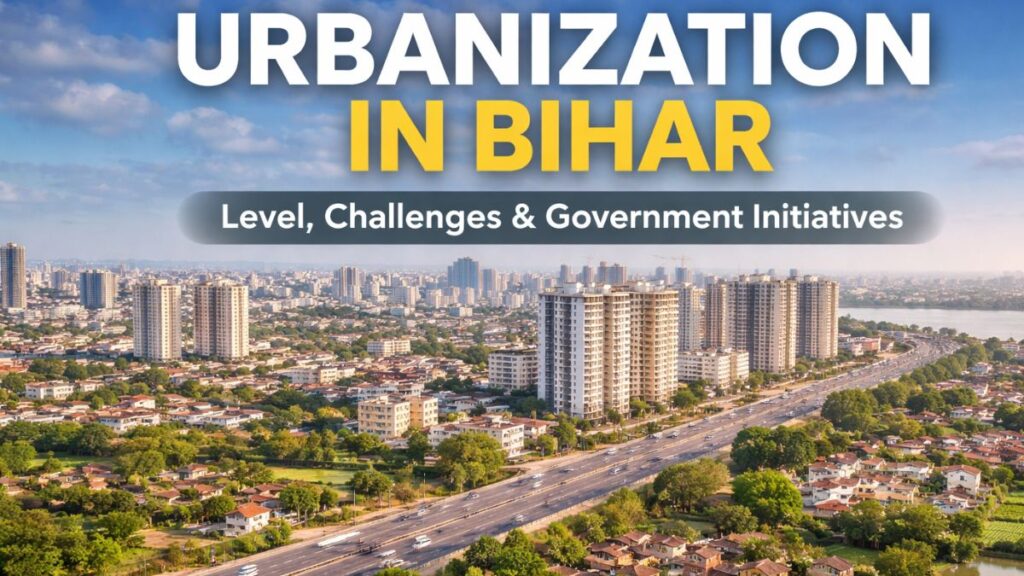
Urbanization in Bihar
Introduction
Urbanization in Bihar refers to the increasing concentration of population in towns and cities along with the growth of non-agricultural economic activities. In most Indian states, urbanization has gone hand in hand with industrial growth, expansion of services, and rising employment opportunities. Bihar, however, presents a contrasting picture. Despite being one of the most populous states, it remains among the least urbanized in the country.
This article examines the level of urbanization in Bihar, explains the reasons behind its low urban growth, and analyses recent initiatives taken by the Bihar Government, keeping the BPSC mains perspective in focus.
Level of Urbanization in Bihar
The level of urbanization in Bihar is significantly lower than the national average. Only about 11–12% of Bihar’s population lives in urban areas, whereas the all-India average is above 30%. This gap clearly shows that Bihar is still predominantly rural in character.
The urban structure of Bihar is also weak and uneven. Patna dominates the urban landscape as the administrative, educational, and service hub. Other cities such as Gaya, Bhagalpur, and Muzaffarpur function mainly as district or regional centres, but they lack strong industrial or commercial bases. Most towns in Bihar are small, with limited employment opportunities and weak urban infrastructure. As a result, they fail to attract large-scale rural migration within the state.
Reasons for Low Level of Urbanization in Bihar
One of the most important reasons for low urbanization in Bihar is the weak industrial base. Urbanization usually accelerates when industries create jobs and pull labour from rural areas. Bihar has witnessed limited industrial growth due to historical neglect, poor investment climate, and lack of large manufacturing units. Without industries, cities remain administrative centres rather than economic growth engines.
Another major factor is the overdependence on agriculture. A very large proportion of Bihar’s population depends on farming and allied activities for livelihood. Agriculture in the state is labour-intensive and low-income, but it still ties people to villages. Instead of moving to towns within Bihar, many people migrate directly to metropolitan cities in other states in search of better wages. This pattern of rural-to-interstate migration, rather than rural-to-urban migration within the state, restricts urban growth in Bihar.
Poor urban infrastructure has further slowed urbanization. Many towns suffer from inadequate water supply, poor drainage, lack of sewerage systems, weak public transport, and shortage of affordable housing. Urban local bodies in Bihar have limited financial and administrative capacity, which affects service delivery. As a result, towns do not offer significantly better living conditions than villages, reducing their attraction for migrants.
The slow growth of secondary cities is another structural problem. In successful urbanizing states, tier-2 and tier-3 cities act as growth poles. In Bihar, urban development remains highly concentrated in Patna, while other towns grow slowly and unevenly. This creates regional imbalance and limits the overall pace of urbanization.
In addition, issues related to administrative classification also play a role. Several large settlements in Bihar function like towns in terms of population size and economic activity but are still classified as rural areas. Delay in declaring new statutory towns keeps the official urban population figures low.
Consequences of Low Urbanization
Low urbanization in Bihar has serious economic and social consequences. It limits the growth of non-farm employment, increases pressure on agriculture, and contributes to large-scale migration to other states. The slow pace of urbanization also delays structural transformation of the economy from agriculture to industry and services, which is essential for long-term development.
From a BPSC mains perspective, low urbanization in Bihar can be seen both as a cause and an outcome of underdevelopment.
Recent Initiatives by Bihar Government to Promote Urbanization
Recognising the importance of urbanization for economic growth, the Bihar Government has taken several initiatives in recent years. There has been increased focus on improving basic urban infrastructure such as roads, drainage, water supply, and street lighting. These investments aim to make towns more liveable and capable of supporting larger populations.
Under the Smart City framework, cities like Patna, Gaya, Bhagalpur, and Muzaffarpur have been selected for area-based development, digital governance, better mobility, and improved waste management. These efforts are intended to enhance the quality of urban life and improve efficiency of city management.
Urban water supply and sanitation have also received attention through schemes like AMRUT. Expansion of drinking water coverage and sewerage networks is crucial, as reliable basic services are a precondition for sustainable urban growth.
The state government has also worked towards strengthening municipal governance by promoting e-governance, improving financial management, and enhancing administrative capacity of urban local bodies. Better governance is essential for effective urban planning and service delivery.
Housing initiatives for the urban poor and migrant workers aim to provide affordable and secure living conditions in towns. Slum improvement programmes focus on basic services and housing security, encouraging permanent urban settlement.
In addition, the Bihar Government has attempted to link urbanization with economic activity by promoting industrial areas, food processing zones, and service hubs near urban centres. Strengthening small and medium towns, especially district headquarters and Nagar Panchayats, is seen as a step towards more balanced and decentralised urbanization.
Critical Evaluation
While policy intent has improved and urban infrastructure investment has increased, the overall pace of urbanization in Bihar remains slow. Employment generation has not kept pace with infrastructure creation, and urban growth continues to depend heavily on central funding. Regional imbalance and weak private investment remain major challenges.
Conclusion
Urbanization in Bihar remains low due to weak industrialisation, overdependence on agriculture, inadequate urban infrastructure, and slow growth of secondary cities. Recent government initiatives reflect a positive shift in approach, but their impact is still limited. For Bihar to achieve sustainable development, urbanization must be employment-oriented, decentralised, and well-governed. Strengthening towns and cities as centres of economic opportunity is essential for reducing migration distress and transforming Bihar’s development trajectory.
BPSC Mains Practice Questions (Based on Urbanization in Bihar)
- Discuss the present level of urbanization in Bihar. Analyse the major structural reasons responsible for the low level of urbanization in the state.
- Urbanization in Bihar has not kept pace with population growth. Examine its socio-economic consequences and suggest measures to promote balanced urban development.
- Evaluate the recent initiatives taken by the Bihar Government to promote urbanization. To what extent can these initiatives transform Bihar’s urban landscape?
Also Read….