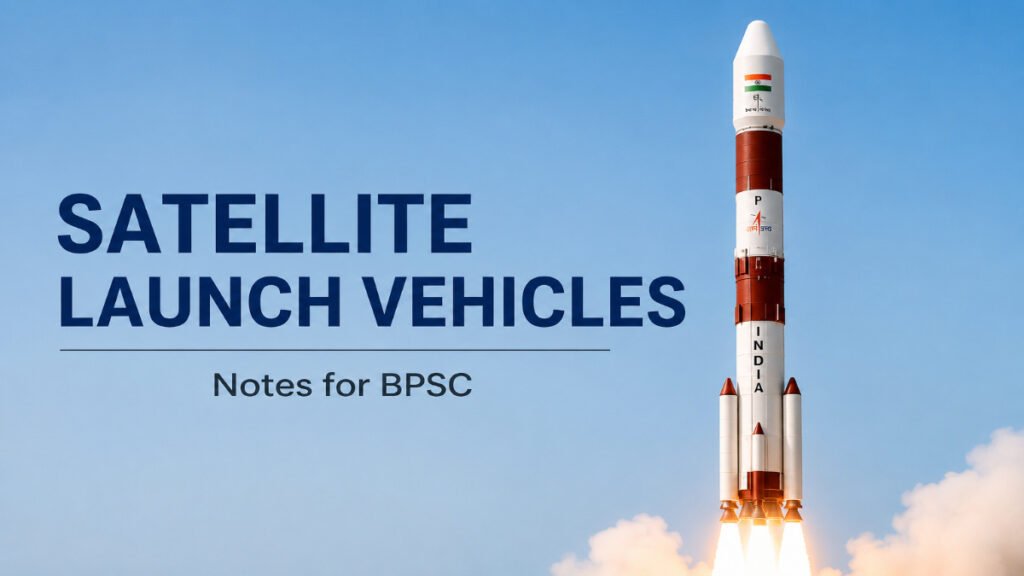
1. Introduction to Satellite Launch Vehicles
A Satellite Launch Vehicle (SLV) or rocket is a vehicle designed to carry satellites or spacecraft from Earth into space by overcoming the Earth’s gravitational force. It generates the enormous thrust required to place satellites into their designated orbits, such as Low Earth Orbit (LEO), Polar Orbit, or Geostationary Orbit (GEO). Once the satellite is successfully deployed, the launch vehicle completes its mission and its stages either burn up in the atmosphere or become space debris.
Satellite Launch Vehicles are an indispensable component of every space programme, as satellites cannot reach orbit without them. Depending on the payload capacity and the target orbit, different types of Satellite Launch Vehicles are used. Over the years, ISRO has developed a series of indigenous launch vehicles—SLV, SLV-3, ASLV, PSLV, GSLV, and LVM3—which have enabled India to achieve self-reliance in satellite launches and emerge as a leading space-faring nation. These Satellite Launch Vehicles Notes for BPSC provide a comprehensive understanding of India’s launch vehicle programme and serve as valuable Notes for BPSC Satellite Launch Vehicle preparation.
2. Classification of Launch Vehicles
Launch vehicles are classified based on the orbit in which they place satellites and their payload carrying capacity.
(i) Based on Target Orbit
- Low Earth Orbit (LEO) Launch Vehicles: These Satellite Launch Vehicles place satellites in Low Earth Orbit (LEO), located at an altitude of 180–2,000 km above the Earth’s surface. They require comparatively less energy and are mainly used for launching Earth observation, remote sensing, scientific, and small communication satellites.
- Polar Sun-Synchronous Orbit (SSO) Launch Vehicles: These launch vehicles place satellites into Polar or Sun-Synchronous Orbits, allowing satellites to pass over the same location at the same local solar time. Such orbits are ideal for remote sensing, cartography, environmental monitoring, and weather observation.
- Geostationary Orbit (GEO) Launch Vehicles: These vehicles place satellites into Geostationary Orbit, approximately 35,786 km above the Earth. Satellites in this orbit revolve at the same speed as the Earth, appearing stationary over one location. They are mainly used for communication, broadcasting, weather forecasting, and navigation.
- Deep Space Launch Vehicles: These are powerful launch vehicles capable of sending spacecraft beyond Earth’s orbit for missions to the Moon, Mars, the Sun, and other celestial bodies. Such missions require high escape velocity and advanced propulsion systems.
(ii) Based on Payload Capacity
- Light-Lift Launch Vehicles: These launch small satellites, generally weighing up to 2 tonnes, into Low Earth Orbit. Examples include SLV, ASLV, and SSLV.
- Medium-Lift Launch Vehicles: These are capable of launching medium-weight satellites into Low Earth Orbit and Geostationary Transfer Orbit. PSLV belongs to this category and is India’s most reliable launch vehicle.
- Heavy-Lift Launch Vehicles: These launch heavy communication satellites, interplanetary spacecraft, and human spaceflight missions. GSLV and LVM3 are India’s heavy-lift launch vehicles and are used for missions such as Chandrayaan, Gaganyaan, and commercial satellite launches.
The choice of a launch vehicle depends on the weight of the satellite and the distance to its intended orbit. As the payload becomes heavier or the target orbit moves farther from Earth, a more powerful launch vehicle is required. These Satellite Launch Vehicles Notes for BPSC explain the classification of Satellite Launch Vehicles in a simple manner and are useful Notes for BPSC Satellite Launch Vehicle preparation.
Master Science & Technology. Maximize Your BPSC Mains Score.
Enroll in the BPSC Science & Tech Course Today
Master Science & Technology for BPSC Mains GS Paper-2 with 75+ exam-oriented topics, 6 structured lessons, and downloadable PDF notes—all in one course.
✔ 75+ Exam-Oriented Topics • ✔ 6 Comprehensive Lessons • ✔ Downloadable PDF Notes • ✔ Updated for 72nd BPSC Mains
3. Evolution of India’s Launch Vehicle Programme
India’s Satellite Launch Vehicles programme has evolved through continuous technological advancement and indigenous innovation. The journey began with the Satellite Launch Vehicle (SLV-3), which successfully launched the Rohini satellite in 1980, making India the sixth country capable of launching satellites using its own rocket. It was followed by the Augmented Satellite Launch Vehicle (ASLV), which served as a technology demonstrator and helped ISRO develop advanced guidance, control, and stage separation technologies despite limited operational success.
The next breakthrough came with the development of the Polar Satellite Launch Vehicle (PSLV), which became operational in 1994 and soon emerged as ISRO’s ‘Workhorse’ due to its exceptional reliability. To launch heavier communication satellites, ISRO developed the Geosynchronous Satellite Launch Vehicle (GSLV), equipped with an indigenous cryogenic upper stage. The introduction of LVM3 (formerly GSLV Mk III) significantly enhanced India’s heavy-lift capability and enabled missions such as Chandrayaan-2, Chandrayaan-3, and the upcoming Gaganyaan Human Spaceflight Mission.
Today, India is entering the next generation of launch technology through the Small Satellite Launch Vehicle (SSLV) for commercial small satellite launches, the Reusable Launch Vehicle (RLV) to reduce launch costs, and the proposed Next Generation Launch Vehicle (NGLV) for future heavy-lift and deep-space missions. This steady evolution has made India largely self-reliant in satellite launches and strengthened its position as a major global space power. These Satellite Launch Vehicles Notes for BPSC trace the complete evolution of Satellite Launch Vehicles in India and serve as comprehensive Notes for BPSC Satellite Launch Vehicle preparation.
4. Major Satellite Launch Vehicles of India
Satellite Launch Vehicle (SLV)
- SLV (Satellite Launch Vehicle) was India’s first experimental Satellite Launch Vehicle.
- It was designed to place small satellites (about 40 kg) into Low Earth Orbit (LEO).
- It was a four-stage solid-propellant launch vehicle.
- The SLV-3 successfully launched the Rohini Satellite (RS-1) on 18 July 1980, making India the sixth country capable of launching satellites using an indigenously developed rocket.
- The programme provided valuable experience in rocket design, propulsion, guidance, and stage separation.
- Although later replaced by more advanced launch vehicles, SLV laid the technological foundation for India’s launch vehicle programme.
Satellite Launch Vehicle-3 (SLV-3)
- SLV-3 was the operational version of the Satellite Launch Vehicle.
- It was 17 metres tall and weighed about 17 tonnes.
- It had a payload capacity of around 40 kg to Low Earth Orbit.
- The project was led by Dr. A. P. J. Abdul Kalam, who later became the President of India.
- The first experimental launch (1979) was unsuccessful, but the second launch (1980) successfully placed Rohini RS-1 into orbit.
- SLV-3 marked the beginning of India’s indigenous satellite launching capability.
Augmented Satellite Launch Vehicle (ASLV)
- ASLV (Augmented Satellite Launch Vehicle) was developed as an improved version of SLV.
- It could launch satellites weighing up to 150 kg into Low Earth Orbit.
- It consisted of five stages, including two strap-on boosters.
- The programme helped ISRO master critical technologies such as multi-stage separation, vehicle control, navigation, and guidance.
- Out of four developmental launches, only one was fully successful.
- Though ASLV had limited operational success, it served as an important technological bridge between SLV and PSLV.
Polar Satellite Launch Vehicle (PSLV)
- PSLV (Polar Satellite Launch Vehicle) is known as the “Workhorse of ISRO” due to its high reliability.
- Its first successful launch took place in 1994.
- It is a four-stage launch vehicle using alternating solid and liquid propulsion.
- It is primarily designed to place satellites into Polar Sun-Synchronous Orbit (SSO) and Low Earth Orbit (LEO).
- It can also launch satellites into Geosynchronous Transfer Orbit (GTO) and interplanetary trajectories.
- Depending on the configuration, PSLV can carry about 1,750 kg to SSO and around 1,400 kg to GTO.
- It successfully launched prestigious missions such as:
- Chandrayaan-1 (2008)
- Mars Orbiter Mission (Mangalyaan) (2013)
- AstroSat (2015)
- Aditya-L1 (2023)
- In 2017, PSLV created a world record by launching 104 satellites in a single mission.
- It is widely used for launching Indian and foreign satellites, making it one of the most commercially successful launch vehicles in the world.
Geosynchronous Satellite Launch Vehicle (GSLV)
- GSLV (Geosynchronous Satellite Launch Vehicle) was developed to launch heavy communication satellites into Geostationary Transfer Orbit (GTO).
- Its first successful developmental flight took place in 2001.
- It is a three-stage launch vehicle comprising:
- Solid first stage
- Liquid second stage
- Cryogenic upper stage
- GSLV Mk-II uses an indigenously developed Cryogenic Upper Stage (CUS).
- It can carry satellites weighing around 2.5 tonnes to GTO and 5 tonnes to LEO.
- It enabled India to become self-reliant in launching heavy communication satellites.
- GSLV is mainly used for launching INSAT and GSAT communication satellites.
Launch Vehicle Mark-3 (LVM3)
- LVM3 (Launch Vehicle Mark-3) was earlier known as GSLV Mk-III.
- It is India’s heaviest operational launch vehicle.
- The first successful orbital launch took place on 5 June 2017.
- It is a three-stage medium-lift launch vehicle consisting of:
- Two solid strap-on boosters
- Liquid core stage
- Cryogenic upper stage
- It can carry approximately:
- 8 tonnes to Low Earth Orbit (LEO)
- 4 tonnes to Geostationary Transfer Orbit (GTO)
- LVM3 has successfully launched:
- CARE Crew Module Experiment
- Chandrayaan-2
- Chandrayaan-3
- OneWeb commercial satellites
- It has been selected as the launch vehicle for Gaganyaan, India’s first human spaceflight mission.
- LVM3 has significantly enhanced India’s capability for heavy-lift launches, commercial missions, and human spaceflight.
Small Satellite Launch Vehicle (SSLV)
- SSLV (Small Satellite Launch Vehicle) is India’s newest launch vehicle developed for the commercial launch of small satellites.
- It is designed to place satellites weighing up to 500 kg into Low Earth Orbit.
- SSLV has a three-stage solid propulsion system with a velocity trimming module.
- It requires minimal launch infrastructure and can be assembled in a short time.
- It offers low-cost, on-demand, and rapid launch services.
- SSLV is expected to strengthen India’s competitiveness in the rapidly growing global small satellite market.
At a Glance
| Launch Vehicle | First Successful Launch | Payload Capacity | Major Use |
|---|---|---|---|
| SLV-3 | 1980 | ~40 kg (LEO) | First indigenous satellite launch |
| ASLV | 1992 | ~150 kg (LEO) | Technology demonstrator |
| PSLV | 1994 | ~1.75 t (SSO) | Remote sensing, planetary & commercial missions |
| GSLV Mk-II | 2001 | ~2.5 t (GTO) | Heavy communication satellites |
| LVM3 | 2017 | ~4 t (GTO), ~8 t (LEO) | Heavy payloads & human spaceflight |
| SSLV | 2023 (operational) | ~500 kg (LEO) | Small satellite launches |
These Satellite Launch Vehicles represent the evolution of India’s indigenous launch capability, from experimental rockets to advanced heavy-lift systems supporting planetary exploration, commercial launches, and human spaceflight. These Satellite Launch Vehicles Notes for BPSC provide a comprehensive overview of every major Indian launch vehicle and serve as reliable Notes for BPSC Satellite Launch Vehicle preparation.
Prepare Smarter. Study Better. Ace BPSC Mains.
BPSC Mains GS Paper 1 & 2 Complete Course
Access comprehensive BPSC Mains Notes for GS Paper 1 & 2, covering 378+ topics across 24 PDF lessons, with dedicated Bihar coverage, practice questions and downloadable study material.
✓ GS Paper 1 & 2 • ✓ 378+ Topics • ✓ 24 PDF Lessons • ✓ Bihar-Specific Coverage • ✓ Downloadable Notes
5. Applications and Significance of Indian Launch Vehicles
Each Satellite Launch Vehicle developed by ISRO has played a distinct role in strengthening India’s space capabilities. As India’s technological expertise grew, launch vehicles evolved from carrying small experimental satellites to supporting planetary exploration and future human spaceflight.
Satellite Launch Vehicle (SLV)
The SLV-3 was India’s first indigenous launch vehicle and marked the beginning of the country’s independent access to space. Although its payload capacity was limited, it demonstrated India’s ability to design, build, and launch rockets without foreign assistance. The successful launch of the Rohini satellite in 1980 laid the foundation for all future launch vehicle programmes.
Augmented Satellite Launch Vehicle (ASLV)
The ASLV was primarily a technology demonstration vehicle. While it had limited operational success, it enabled ISRO to master advanced technologies such as multi-stage separation, vehicle guidance, navigation, and control systems. These technological achievements directly contributed to the development of the highly successful PSLV.
Polar Satellite Launch Vehicle (PSLV)
The PSLV is India’s most versatile and reliable launch vehicle. It is mainly used to launch Earth observation, remote sensing, scientific, navigation, and interplanetary missions into Polar and Sun-Synchronous Orbits. It has successfully launched landmark missions such as Chandrayaan-1, Mars Orbiter Mission (Mangalyaan), and Aditya-L1, besides hundreds of Indian and foreign satellites. Its high reliability has made India a preferred destination for commercial satellite launches.
Geosynchronous Satellite Launch Vehicle (GSLV)
The GSLV was developed to launch heavy communication and meteorological satellites into Geostationary Transfer Orbit. Its greatest significance lies in the successful development of the indigenous cryogenic engine, which enabled India to become self-reliant in launching heavy satellites. GSLV has reduced India’s dependence on foreign launch services for communication satellites.
Launch Vehicle Mark-3 (LVM3)
The LVM3 is India’s heaviest operational launch vehicle and is designed for heavy payloads, deep-space missions, and human spaceflight. It has successfully launched Chandrayaan-2, Chandrayaan-3, and commercial OneWeb satellites, and has been selected for the Gaganyaan Mission. LVM3 has significantly enhanced India’s capability in strategic, scientific, and commercial space missions.
Small Satellite Launch Vehicle (SSLV)
The SSLV is designed for the growing market of small and micro satellites. It offers quick, low-cost, and on-demand launch services, making it suitable for commercial customers, start-ups, universities, and research institutions. SSLV is expected to strengthen India’s competitiveness in the rapidly expanding global small satellite launch market.
Overall Significance
The evolution of India’s Satellite Launch Vehicles reflects the country’s journey from technological dependence to self-reliance. These launch vehicles have enabled India to undertake satellite launches, planetary exploration, commercial missions, and future human spaceflight, while strengthening national security, scientific research, and India’s position in the global space economy. These Satellite Launch Vehicles Notes for BPSC highlight the applications and significance of each Satellite Launch Vehicle and serve as comprehensive Notes for BPSC Satellite Launch Vehicle.
6. Emerging Technologies and Future Launch Vehicles
ISRO is developing next-generation launch technologies to make space missions more economical, efficient, and sustainable. The Reusable Launch Vehicle (RLV) aims to recover and reuse major parts of the rocket, significantly reducing launch costs and minimizing space debris. ISRO has successfully demonstrated this technology through the RLV-LEX (Reusable Launch Vehicle–Landing Experiment). The organisation is also developing the Semi-Cryogenic Engine, which offers higher efficiency, greater payload capacity, and lower launch costs than existing propulsion systems.
Looking ahead, ISRO is working on the Next Generation Launch Vehicle (NGLV), which is expected to replace the existing PSLV, GSLV, and LVM3 in the future. The NGLV is being designed to support heavy payloads, reusable operations, human spaceflight, and deep-space exploration missions. These advanced Satellite Launch Vehicles will play a crucial role in ambitious programmes such as Gaganyaan, the proposed Bharatiya Antariksh Station, lunar sample return missions, and future missions to Mars and Venus, strengthening India’s position as a leading global space power. These Satellite Launch Vehicles Notes for BPSC explain the future roadmap of Satellite Launch Vehicles in India and provide valuable Notes for BPSC Satellite Launch Vehicle for competitive examinations.
7. Conclusion
India’s launch vehicle programme reflects the country’s remarkable progress from launching small experimental satellites to undertaking complex planetary exploration and preparing for human spaceflight. The evolution from SLV and ASLV to PSLV, GSLV, and LVM3 demonstrates India’s growing technological capability and self-reliance in space transportation.
Today, Indian Satellite Launch Vehicles support communication, remote sensing, navigation, scientific research, commercial satellite launches, and national security. With the development of SSLV, Reusable Launch Vehicle (RLV), and the proposed Next Generation Launch Vehicle (NGLV), India is well-positioned to expand its role in the global space economy and achieve ambitious goals in deep-space exploration and human spaceflight. These Satellite Launch Vehicles Notes for BPSC provide a comprehensive understanding of Satellite Launch Vehicles and serve as reliable Notes for BPSC Satellite Launch Vehicle for BPSC Mains and other competitive examinations.
Learn More from ISRO:
Readers interested in exploring the latest developments in Satellite Launch Vehicles, including PSLV, GSLV, LVM3, SSLV, reusable launch systems, upcoming missions, launch schedules, and technical updates, can visit the official website of the Indian Space Research Organisation (ISRO). The website provides authentic information on launch vehicles, space missions, satellite launches, research activities, and official publications related to India’s space programme.
BPSC MAINS PRACTICE QUESTIONS
Q1. Discuss the evolution of India’s Satellite Launch Vehicles. Explain the significance of PSLV, GSLV, LVM3, and SSLV in strengthening India’s space capabilities and achieving self-reliance in space technology.
Q2. Classify Satellite Launch Vehicles on the basis of target orbit and payload capacity. Also discuss the major applications and significance of different Indian launch vehicles in satellite launches, planetary missions, and commercial space activities.
Q3. Emerging launch technologies such as Reusable Launch Vehicle (RLV) and Next Generation Launch Vehicle (NGLV) are expected to transform India’s space programme. Examine the need for these technologies and discuss their role in reducing launch costs, promoting commercialisation, and supporting future deep-space and human spaceflight missions.