1. Introduction
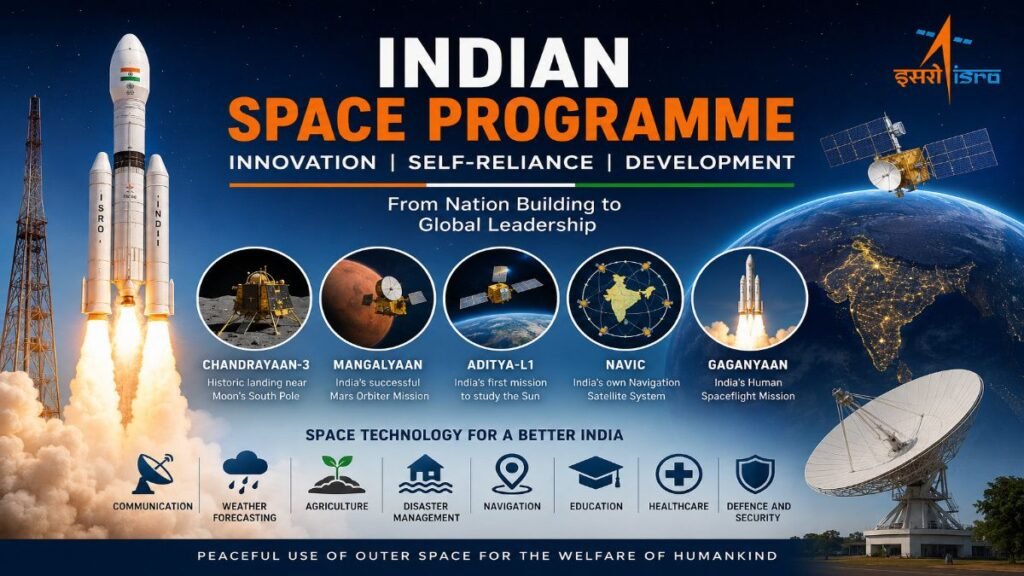
The Indian Space Programme is one of the world’s most successful and cost-effective space programmes, aimed at harnessing space technology for national development, scientific advancement, and strategic self-reliance. Unlike many space-faring nations that initially pursued space exploration primarily for military or geopolitical competition, India adopted a development-oriented approach, using space technology to address the socio-economic needs of its people.
The programme is administered by the Department of Space (DoS) under the Government of India and is primarily implemented by the Indian Space Research Organisation (ISRO), established on 15 August 1969. Over the decades, ISRO has developed indigenous capabilities in satellite design, launch vehicle technology, remote sensing, satellite communication, navigation, planetary exploration, and human spaceflight. These Indian Space Program Notes highlight how ISRO has transformed India into a globally respected space power.
The foundation of India’s space vision was laid by Dr. Vikram Sarabhai, widely regarded as the Father of the Indian Space Programme. He believed that a developing country should utilize advanced technologies not merely for prestige but as powerful tools for improving the quality of life through better communication, education, weather forecasting, natural resource management, and disaster mitigation. This philosophy continues to guide India’s space activities even today. India’s space programme is based on four fundamental principles:
- Peaceful use of outer space for the benefit of humanity.
- Development-oriented applications to support socio-economic growth.
- Self-reliance (Atmanirbharta) through indigenous research and technological innovation.
- Cost-effective and sustainable space missions without compromising reliability and scientific excellence.
Today, India has emerged as a leading global space power with achievements such as the Mars Orbiter Mission (Mangalyaan), Chandrayaan missions, Aditya-L1, and the ongoing Gaganyaan Human Spaceflight Programme. The opening of the space sector to private participation and the growing role of Indian space start-ups have further accelerated the country’s ambition of becoming a major player in the global space economy.
In essence, the Indian Space Programme is not merely about exploring outer space; it is a strategic instrument for national development, technological advancement, scientific research, economic growth, disaster resilience, and enhancing India’s global stature as a responsible and innovative space-faring nation. These BPSC Mains Notes for Indian Space Program provide a comprehensive understanding of its evolution, objectives, and significance for competitive examinations.
2. Evolution of the Indian Space Programme
India’s Space Programme has evolved gradually over the past six decades through continuous scientific innovation, institutional development, and technological self-reliance. What began as a modest research initiative has transformed into one of the world’s most successful and economical space programmes. The evolution of the programme can be understood in the following phases:
Foundation Phase (1960–1970)
This phase marked the beginning of organized space research in India.
- In 1962, the Indian National Committee for Space Research (INCOSPAR) was established under the leadership of Dr. Vikram Sarabhai with the support of the Department of Atomic Energy.
- The objective was to explore the peaceful applications of space technology for national development.
- In 1963, India’s first sounding rocket was launched from the Thumba Equatorial Rocket Launching Station (TERLS) in Kerala.
- During this period, India mainly relied on international cooperation while building indigenous scientific capabilities.
Institutional Development Phase (1969–1980)
This phase witnessed the establishment of dedicated space institutions and the beginning of satellite development.
- On 15 August 1969, the Indian Space Research Organisation (ISRO) was established, replacing INCOSPAR.
- In 1972, the Department of Space (DoS) and the Space Commission were created to provide administrative and policy support.
- In 1975, India launched its first satellite, Aryabhata, with assistance from the Soviet Union.
- Other early satellites, such as Bhaskara-I and Bhaskara-II, were launched for Earth observation and scientific research.
- In 1980, India successfully launched the Rohini Satellite (RS-1) using the indigenously developed SLV-3, making India one of the few countries capable of launching its own satellites.
Expansion and Application Phase (1980–2005)
During this phase, the focus shifted from experimentation to practical applications of space technology.
- Development of the INSAT (Indian National Satellite System) revolutionized communication, television broadcasting, meteorology, and telecommunication.
- The Indian Remote Sensing (IRS) satellite programme became one of the world’s largest civilian remote sensing programmes.
- Development of the Polar Satellite Launch Vehicle (PSLV) significantly enhanced India’s launch capability.
- Satellite technology began supporting agriculture, water resource management, fisheries, disaster management, education, and healthcare.
- India gradually achieved greater technological self-reliance in satellite manufacturing and launch services.
Global Recognition Phase (2005–2020)
This period marked India’s emergence as a globally respected space power.
- In 2008, Chandrayaan-1 became India’s first lunar mission and confirmed the presence of water molecules on the Moon.
- The Mars Orbiter Mission (Mangalyaan), launched in 2013 and successfully entering Mars orbit in 2014, made India the first country to reach Mars in its maiden attempt.
- PSLV gained international recognition for its reliability by launching hundreds of foreign satellites.
- India successfully developed cryogenic engine technology, strengthening its heavy-lift launch capability through GSLV.
- Indigenous satellite navigation system NavIC was established.
New Space Era (2020–Present)
The current phase is characterized by commercialization, private sector participation, human spaceflight, and advanced space exploration.
- The Government opened the space sector to private companies and start-ups.
- Institutions like IN-SPACe and NewSpace India Limited (NSIL) were established to promote commercial activities.
- Chandrayaan-3 (2023) successfully achieved a soft landing near the Moon’s south pole, making India the first country to land in this region.
- Aditya-L1 (2023) became India’s first dedicated solar observation mission.
- SpaDeX (Space Docking Experiment) demonstrated India’s capability in autonomous satellite docking, an important technology for future space stations and human missions.
- The Gaganyaan Mission is preparing India for its first human spaceflight.
- India is also working towards establishing the Bharatiya Antariksh Station and undertaking future lunar and planetary exploration missions.
Timeline of Major Milestones
| Year | Milestone |
|---|---|
| 1962 | Establishment of INCOSPAR |
| 1963 | First sounding rocket launched from Thumba |
| 1969 | Establishment of ISRO |
| 1972 | Creation of Department of Space and Space Commission |
| 1975 | Launch of Aryabhata, India’s first satellite |
| 1980 | Rohini satellite launched using SLV-3 |
| 1994 | First successful PSLV mission |
| 2008 | Chandrayaan-1 launched |
| 2014 | Mars Orbiter Mission successfully entered Mars orbit |
| 2016 | NavIC declared operational |
| 2020 | Space sector opened to private participation |
| 2023 | Chandrayaan-3 soft landing near Moon’s south pole |
| 2023 | Launch of Aditya-L1 |
| 2024 | SpaDeX mission demonstrated autonomous space docking capability |
India’s Space Programme reflects a remarkable journey from launching sounding rockets with international assistance to independently executing complex planetary missions and preparing for human spaceflight. Its evolution highlights the country’s commitment to scientific excellence, self-reliance, and the peaceful use of space for national development. These Indian Space Program Notes provide an overview of the major milestones that have shaped the Indian Space Programme, making them highly useful as BPSC Mains Notes for Indian Space Program.
Master Science & Technology. Maximize Your BPSC Mains Score.
Enroll in the BPSC Science & Tech Course Today
Master Science & Technology for BPSC Mains GS Paper-2 with 75+ exam-oriented topics, 6 structured lessons, and downloadable PDF notes—all in one course.
✔ 75+ Exam-Oriented Topics • ✔ 6 Comprehensive Lessons • ✔ Downloadable PDF Notes • ✔ Updated for 72nd BPSC Mains
3. Vision and Guiding Principles of the Indian Space Programme
The Indian Space Programme is guided by the vision of using space technology for national development while promoting scientific excellence, self-reliance, and the peaceful exploration of outer space.
Vision of the Indian Space Programme
The vision of the Indian Space Programme, as envisaged by Dr. Vikram Sarabhai, is to harness space technology for the socio-economic development of the country rather than treating space exploration merely as a symbol of national prestige. The programme aims to improve governance, communication, resource management, disaster preparedness, scientific research, and enhance India’s strategic capabilities.
Guiding Principles
The Indian Space Programme is based on the following guiding principles:
- Peaceful use of outer space for the benefit of humanity.
- Development-oriented approach, focusing on communication, agriculture, weather forecasting, disaster management, and education.
- Self-reliance (Atmanirbhar Bharat) through indigenous development of satellites, launch vehicles, and space technologies.
- Cost-effective innovation, delivering world-class missions at comparatively lower costs.
- International cooperation while safeguarding national interests.
- Sustainable and responsible use of outer space, in accordance with international space laws and best practices.
These guiding principles have enabled India to emerge as a globally respected space power while ensuring that space technology directly contributes to national development and public welfare. These Indian Space Program Notes explain the core vision and principles that form the foundation of the Indian Space Programme, making them valuable BPSC Mains Notes for Indian Space Program.
Prepare Smarter. Study Better. Ace BPSC Mains.
BPSC Mains GS Paper 1 & 2 Complete Course
Access comprehensive BPSC Mains Notes for GS Paper 1 & 2, covering 378+ topics across 24 PDF lessons, with dedicated Bihar coverage, practice questions and downloadable study material.
✓ GS Paper 1 & 2 • ✓ 378+ Topics • ✓ 24 PDF Lessons • ✓ Bihar-Specific Coverage • ✓ Downloadable Notes
4. Institutional Framework of the Indian Space Programme
India’s Space Programme is governed through a well-defined institutional framework comprising government bodies, research organizations, public sector enterprises, and private entities.
Department of Space (DoS)
- Established in 1972 under the Prime Minister’s Office (PMO).
- Formulates policies and oversees India’s space activities.
- Provides administrative and financial support to ISRO and other space institutions.
- Coordinates national space programmes and international cooperation.
Indian Space Research Organisation (ISRO)
- Established on 15 August 1969.
- Nodal agency responsible for implementing the Indian Space Programme.
- Develops satellites, launch vehicles, space applications, and scientific missions.
- Executes major missions such as Chandrayaan, Mangalyaan, Aditya-L1, and Gaganyaan.
Space Commission
- Constituted in 1972.
- Apex policy-making body for India’s space programme.
- Advises the Government on space policy, long-term planning, and resource allocation.
- Provides strategic direction for national space activities.
NewSpace India Limited (NSIL)
- Incorporated in 2019 as a Government of India enterprise.
- Commercial arm of the Department of Space.
- Markets ISRO’s technologies, satellites, and launch services.
- Promotes commercialization of India’s space capabilities.
Indian National Space Promotion and Authorization Centre (IN-SPACe)
- Established in 2020.
- Autonomous agency under the Department of Space.
- Facilitates and regulates the participation of private companies in the space sector.
- Ensures fair access to ISRO’s infrastructure and expertise.
Antrix Corporation Limited
- Established in 1992.
- Former commercial arm of ISRO.
- Promoted international marketing of ISRO’s products and services.
- Many of its commercial functions are now handled by NSIL.
Private Sector and Space Start-ups
- Participation increased after the 2020 space sector reforms.
- Develop launch vehicles, satellites, propulsion systems, and space applications.
- Supported through policy reforms, IN-SPACe, and government initiatives.
- Contribute to innovation, employment, and the growth of India’s space economy.
Together, these institutions ensure policy formulation, research, regulation, commercialization, and private sector participation, making the Indian Space Programme efficient, self-reliant, and globally competitive. These Indian Space Program Notes explain the institutional architecture governing India’s space sector and serve as useful BPSC Mains Notes for Indian Space Program.
5. Major Space Infrastructure of India
India has developed a robust space infrastructure that supports satellite development, launch operations, mission control, tracking, and space research.
Launch Centres
- Satish Dhawan Space Centre (SDSC), Sriharikota (Andhra Pradesh) – India’s primary spaceport for launching satellites and launch vehicles such as PSLV, GSLV, and LVM3.
- Kulasekarapattinam Spaceport (Tamil Nadu) (under development) – Being developed mainly for launching Small Satellite Launch Vehicles (SSLVs) into polar orbits.
Mission Control and Tracking Facilities
- ISTRAC (ISRO Telemetry, Tracking and Command Network), Bengaluru – Tracks and controls satellites and deep space missions.
- Master Control Facility (MCF), Hassan and Bhopal – Manages geostationary communication and navigation satellites.
Satellite Design and Research Centres
- U. R. Rao Satellite Centre (URSC), Bengaluru – Designs and develops satellites.
- Space Applications Centre (SAC), Ahmedabad – Develops satellite payloads and space applications for communication and remote sensing.
- Physical Research Laboratory (PRL), Ahmedabad – Conducts research in space science, astronomy, and planetary sciences.
Launch Vehicle and Propulsion Centres
- Vikram Sarabhai Space Centre (VSSC), Thiruvananthapuram – Lead centre for launch vehicle design and development.
- Liquid Propulsion Systems Centre (LPSC) – Develops liquid and cryogenic propulsion systems.
- ISRO Propulsion Complex (IPRC), Mahendragiri – Tests rocket engines and propulsion systems.
National Data and Application Centres
- National Remote Sensing Centre (NRSC), Hyderabad – Receives, processes, and disseminates satellite data for agriculture, disaster management, urban planning, and natural resource management.
- Supports various government departments through satellite-based geospatial services.
India’s extensive space infrastructure provides end-to-end capabilities—from designing satellites and launch vehicles to launching, tracking, and utilizing space assets for national development. This robust infrastructure forms the backbone of the Indian Space Programme and is an important component of Indian Space Program Notes as well as BPSC Mains Notes for Indian Space Program.
6. Satellite Systems of India
India has developed a diverse range of satellite systems to support communication, navigation, weather forecasting, Earth observation, scientific research, and national security. These satellites play a crucial role in socio-economic development and strategic applications under the Indian Space Programme.
Communication Satellites (INSAT & GSAT Series)
INSAT (Indian National Satellite System) was launched in 1983 and is one of the largest domestic communication satellite systems in the Asia-Pacific region. GSAT satellites are the newer generation of communication satellites. Placed mainly in Geostationary Orbit (GEO).
Major Applications
- Television broadcasting
- DTH services
- Mobile and broadband communication
- Telemedicine and tele-education
- Disaster warning services
- Secure communication for strategic agencies
Remote Sensing Satellites (IRS & EOS Series)
IRS (Indian Remote Sensing Satellite) programme began in 1988 with IRS-1A. India operates one of the largest civilian remote sensing satellite constellations in the world. New satellites are designated as EOS (Earth Observation Satellites).
Major Applications
- Agriculture and crop monitoring
- Water resource management
- Forest and biodiversity conservation
- Urban and regional planning
- Disaster management
- Mineral exploration
- Environmental monitoring
Navigation Satellites (NavIC)
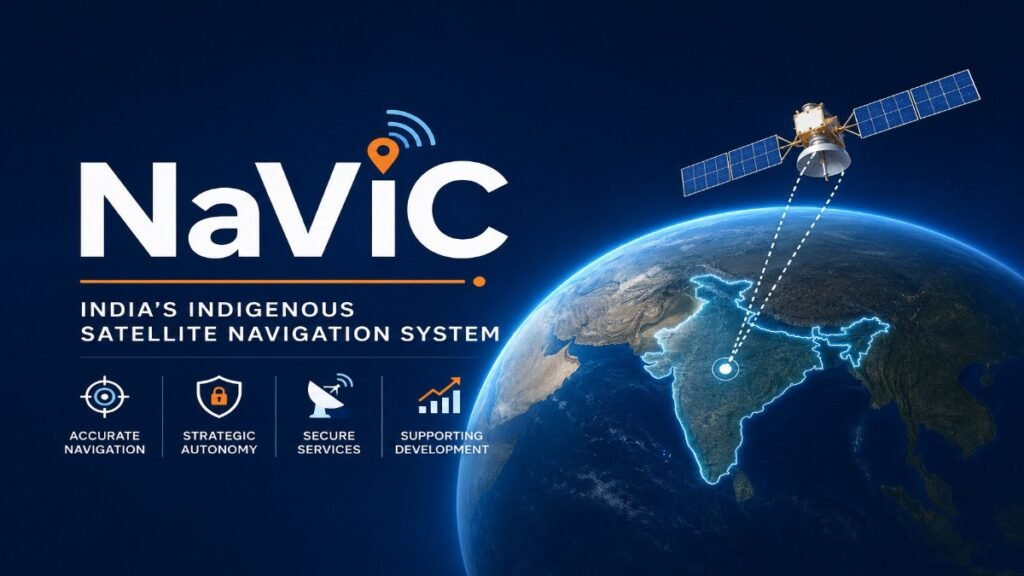
NavIC (Navigation with Indian Constellation) is India’s indigenous regional navigation system. Earlier known as IRNSS (Indian Regional Navigation Satellite System). Provides accurate positioning over India and up to 1,500 km beyond its borders. Offers Standard Positioning Service (SPS) and Restricted Service (RS).
Major Applications
- Road, rail, air, and maritime navigation
- Fleet management
- Disaster warning
- Fisheries
- Defence and strategic operations
Meteorological Satellites
Mainly include INSAT, Kalpana, and INSAT-3D/3DR series. Continuously monitor weather systems over the Indian region.
Major Applications
- Weather forecasting
- Cyclone tracking
- Monsoon monitoring
- Rainfall estimation
- Climate studies
- Early warning of extreme weather events
Scientific and Space Exploration Satellites
Developed for scientific research, astronomy, planetary exploration, and solar studies. Strengthen India’s capabilities in space science and deep-space exploration.
Major Missions
- AstroSat – India’s first dedicated space observatory.
- Chandrayaan-1 – Confirmed the presence of water molecules on the Moon.
- Aditya-L1 – India’s first solar observation mission.
- XPoSat – India’s first X-ray Polarimetry satellite for studying black holes and neutron stars.
Defence and Strategic Satellites
Developed to enhance national security and defence preparedness. Operated in coordination with defence agencies.
Major Satellites
- GSAT-7 (Rukmini) – Indian Navy.
- GSAT-7A – Indian Air Force.
- EMISAT – Electronic Intelligence (ELINT) satellite.
- RISAT Series – Radar Imaging Satellites capable of day-and-night, all-weather surveillance.
Major Applications
- Border surveillance
- Maritime security
- Intelligence gathering
- Secure military communication
- Disaster response
The diverse satellite systems developed under the Indian Space Programme have significantly strengthened India’s communication, navigation, disaster management, scientific research, and national security capabilities. These Indian Space Program Notes provide a comprehensive understanding of India’s satellite ecosystem and are highly useful as BPSC Mains Notes for Indian Space Program.
7. Launch Vehicle Programme
India’s launch vehicle programme is the backbone of its space missions. Launch vehicles are rockets designed to carry satellites and spacecraft into different orbits. Over the years, ISRO has developed a series of indigenous launch vehicles with increasing payload capacity and technological sophistication under the Indian Space Programme.
Satellite Launch Vehicle (SLV)
The Satellite Launch Vehicle (SLV-3) was India’s first experimental satellite launch vehicle. It successfully launched the Rohini Satellite (RS-1) into Low Earth Orbit in 1980, making India the sixth country capable of launching satellites using an indigenously developed rocket. Though it had a limited payload capacity of about 40 kg, SLV laid the foundation for India’s future launch vehicle programme.
Augmented Satellite Launch Vehicle (ASLV)
The Augmented Satellite Launch Vehicle (ASLV) was developed to improve the payload capacity of SLV. It could place satellites weighing around 150 kg into Low Earth Orbit. Although the programme experienced several failures, it helped ISRO master critical technologies such as stage separation, guidance, and control systems, which later proved essential for the success of PSLV.
Polar Satellite Launch Vehicle (PSLV)
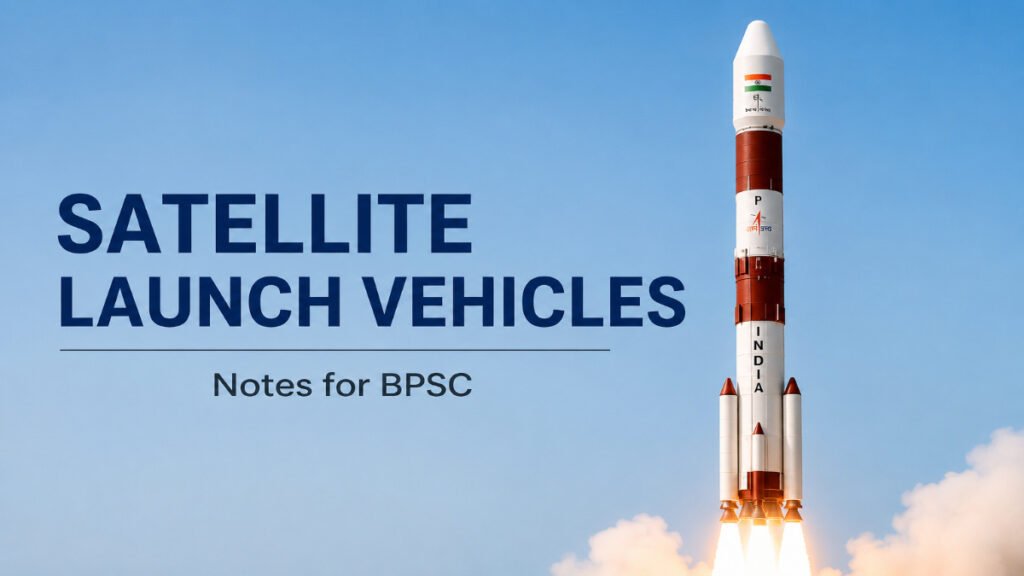
The Polar Satellite Launch Vehicle (PSLV) is regarded as the ‘Workhorse of ISRO’ due to its exceptional reliability and versatility. First successfully launched in 1994, PSLV is capable of placing satellites into Polar Sun-Synchronous Orbit (SSO) as well as Low Earth Orbit. It has launched numerous Indian and foreign satellites and successfully carried out prestigious missions such as Chandrayaan-1, Mars Orbiter Mission (Mangalyaan), AstroSat, and Aditya-L1. It is also known for launching 104 satellites in a single mission (2017), a world record at the time.
Geosynchronous Satellite Launch Vehicle (GSLV)
The Geosynchronous Satellite Launch Vehicle (GSLV) was developed to launch heavier communication satellites into Geostationary Transfer Orbit (GTO). A major achievement of the programme was the successful development of an indigenous cryogenic engine, enabling India to reduce dependence on foreign technology. GSLV significantly enhanced India’s capability to launch high-capacity communication and meteorological satellites.
Launch Vehicle Mark-3 (LVM3)
Earlier known as GSLV Mk III, LVM3 is India’s most powerful operational launch vehicle. It can carry heavy payloads to Low Earth Orbit and Geostationary Transfer Orbit. LVM3 successfully launched Chandrayaan-2, Chandrayaan-3, and is the designated launch vehicle for the Gaganyaan Human Spaceflight Mission. It is also being increasingly used for commercial satellite launches.
Small Satellite Launch Vehicle (SSLV)
The Small Satellite Launch Vehicle (SSLV) is India’s latest launch vehicle, designed to launch small satellites into Low Earth Orbit. It is characterized by low cost, shorter preparation time, and quick turnaround, making it suitable for the rapidly growing commercial small satellite market. SSLV aims to strengthen India’s competitiveness in the global NewSpace economy.
Reusable Launch Vehicle (RLV)
The Reusable Launch Vehicle (RLV) is an experimental programme aimed at developing reusable space transportation systems. By recovering and reusing major components of the launch vehicle, ISRO seeks to significantly reduce the cost of satellite launches. The successful RLV-LEX (Landing Experiment) has demonstrated India’s progress towards reusable launch technology.
India’s launch vehicle programme has evolved from small experimental rockets to advanced heavy-lift launch systems capable of supporting commercial launches, planetary exploration, and future human spaceflight missions, reflecting the country’s growing technological self-reliance. These Indian Space Program Notes explain the evolution of launch vehicles under the Indian Space Programme and are highly relevant as BPSC Mains Notes for Indian Space Program.
8. Major Space Missions of India
India’s space missions reflect the country’s growing capabilities in satellite technology, planetary exploration, astronomy, solar studies, and human spaceflight. These missions have enhanced India’s scientific knowledge, technological expertise, and global standing in space exploration under the Indian Space Programme.
Aryabhata (1975)
Aryabhata was India’s first satellite, launched on 19 April 1975 with Soviet assistance. Named after the ancient Indian mathematician and astronomer, the mission marked India’s entry into the space age. It provided valuable experience in satellite design and space technology, laying the foundation for future indigenous satellite programmes.
Chandrayaan Programme
The Chandrayaan Programme represents India’s lunar exploration efforts. Chandrayaan-1 (2008) discovered evidence of water molecules on the Moon, a landmark scientific achievement. Chandrayaan-2 (2019) successfully placed an orbiter around the Moon, although the lander did not achieve a soft landing. Chandrayaan-3 (2023) successfully landed near the Moon’s south pole, making India the first country to achieve a soft landing in this region and the fourth country to successfully soft-land on the Moon.
Mars Orbiter Mission (Mangalyaan)
Launched in 2013, the Mars Orbiter Mission (Mangalyaan) entered Mars orbit in 2014, making India the first country in the world to reach Mars in its maiden attempt and the first Asian nation to successfully reach Mars orbit. The mission demonstrated India’s capability to undertake complex interplanetary missions at a remarkably low cost and earned global recognition for its cost-effectiveness.
AstroSat
Launched in 2015, AstroSat is India’s first dedicated multi-wavelength space observatory. It studies celestial objects such as black holes, neutron stars, galaxies, and distant stars across multiple wavelengths, including ultraviolet and X-rays. AstroSat has significantly contributed to India’s capabilities in space astronomy.
NavIC Mission
NavIC (Navigation with Indian Constellation) is India’s indigenous regional navigation satellite system. It provides accurate positioning and timing services over India and surrounding regions. NavIC supports transportation, disaster management, fisheries, defence, and various civilian applications, reducing India’s dependence on foreign navigation systems like GPS.
Aditya-L1 Mission
Launched in 2023, Aditya-L1 is India’s first dedicated solar observation mission. Positioned at the Lagrange Point (L1), approximately 1.5 million km from Earth, it studies the Sun’s corona, solar wind, solar flares, and space weather. The mission is expected to improve understanding of solar activities and their impact on Earth’s communication and navigation systems.
XPoSat Mission
Launched in 2024, XPoSat (X-ray Polarimeter Satellite) is India’s first mission dedicated to studying the polarization of X-rays emitted by celestial sources such as black holes and neutron stars. It strengthens India’s capabilities in high-energy astrophysics and complements observations made by AstroSat.
SpaDeX Mission
The Space Docking Experiment (SpaDeX) is a technology demonstration mission aimed at achieving autonomous docking and undocking of two spacecraft in orbit. This capability is essential for future human spaceflight, space stations, satellite servicing, and deep-space exploration missions. The successful demonstration marked a major technological milestone for India.
Gaganyaan Mission
The Gaganyaan Mission is India’s first human spaceflight programme. It aims to send Indian astronauts (Gagannauts) into Low Earth Orbit aboard an indigenously developed spacecraft using the LVM3 launch vehicle. The mission will make India one of the few countries with independent human spaceflight capability and is a significant step towards establishing an Indian space station.
Future Missions
India’s future space roadmap includes the NISAR Mission (jointly with NASA) for Earth observation, Shukrayaan-1 for the exploration of Venus, Chandrayaan-4 for lunar sample return technologies, Mangalyaan-2 for advanced Mars exploration, and the proposed Bharatiya Antariksh Station by 2035. These missions reflect India’s ambition to become a leading global space power through scientific research, technological innovation, and international collaboration.
India’s space missions demonstrate a balanced approach that combines scientific discovery, technological advancement, commercial opportunities, and national development, establishing the country as one of the world’s leading space-faring nations. These Indian Space Program Notes comprehensively cover the landmark missions of the Indian Space Programme and serve as valuable BPSC Mains Notes for Indian Space Program.
9. Applications of Space Technology in India
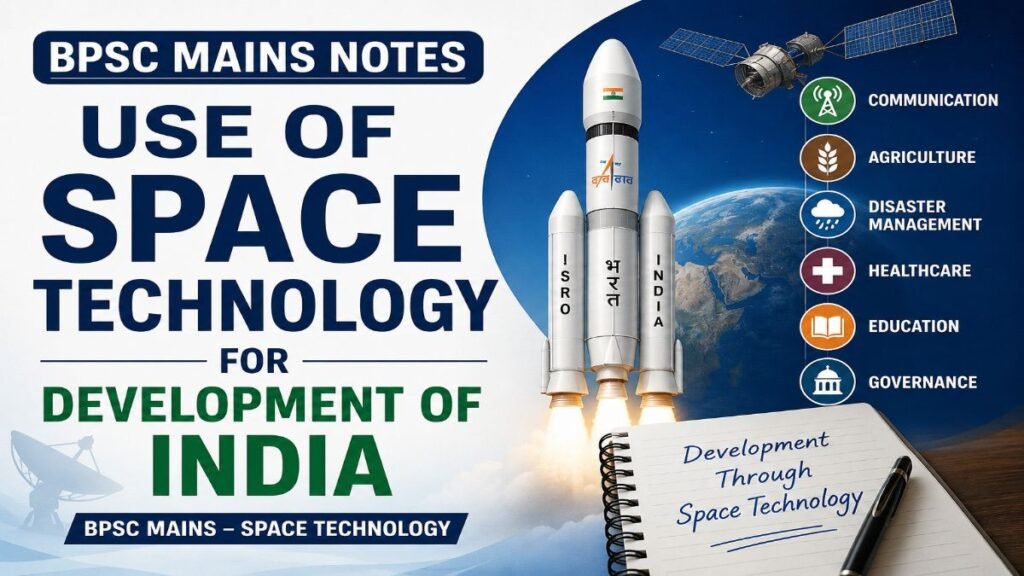
Space technology has become an integral part of India’s socio-economic development. Satellites and space-based services support governance, economic growth, disaster resilience, environmental conservation, and national security. The applications of space technology extend across almost every sector of the economy under the Indian Space Programme.
Communication
Satellite communication has revolutionized India’s communication infrastructure by providing reliable connectivity across the country, including remote and inaccessible regions. Communication satellites of the INSAT and GSAT series support television broadcasting, Direct-to-Home (DTH) services, internet connectivity, mobile communication, telecommunication networks, and satellite-based communication during emergencies. They also facilitate telemedicine, tele-education, and e-Governance services, thereby promoting inclusive development.
Agriculture
Remote sensing satellites play a crucial role in modern agriculture. Satellite imagery is used for crop acreage estimation, crop health monitoring, soil moisture assessment, irrigation planning, drought assessment, and yield forecasting. Programmes such as FASAL (Forecasting Agricultural Output using Space, Agro-meteorology and Land-based Observations) utilize satellite data for agricultural planning. Space technology also assists in identifying suitable areas for horticulture, watershed development, and precision farming.
Water Resources Management
Satellite data helps in mapping rivers, lakes, reservoirs, groundwater potential zones, and watersheds. It supports planning for irrigation projects, rainwater harvesting, floodplain mapping, and sustainable water resource management. Remote sensing is extensively used under programmes like the National Hydrology Project for efficient water management.
Disaster Management
Space technology is an indispensable tool for disaster risk reduction and emergency response. Satellites provide early warning of cyclones, floods, droughts, forest fires, landslides, and tsunamis. During disasters, satellite images help in damage assessment, rescue operations, relief planning, and rehabilitation. The Decision Support Centre (DSC) and National Remote Sensing Centre (NRSC) provide near real-time satellite data to disaster management agencies.
Weather Forecasting and Climate Studies
Meteorological satellites continuously monitor cloud movement, rainfall patterns, cyclones, monsoon systems, and atmospheric conditions. Satellites such as INSAT-3D and INSAT-3DR have significantly improved the accuracy of weather forecasting and early warning systems. These services are particularly important for agriculture, aviation, shipping, fisheries, and disaster preparedness.
Navigation and Transportation
India’s indigenous navigation system NavIC provides accurate positioning, navigation, and timing services. It supports road transport, railways, aviation, maritime navigation, fleet management, logistics, disaster alerts, and emergency services. NavIC is also used by fishermen for navigation and safety in coastal waters and has strategic applications in defence.
Fisheries
Satellite-based ocean observation helps identify Potential Fishing Zones (PFZs) by analyzing sea surface temperature and chlorophyll concentration. These advisories enable fishermen to locate fish-rich areas, reducing fuel consumption, increasing income, and improving marine resource management. Satellite communication also provides weather alerts to enhance fishermen’s safety.
Urban and Regional Planning
Remote sensing and Geographic Information Systems (GIS) are widely used for urban planning, land-use mapping, infrastructure development, smart city planning, transportation network design, and monitoring unauthorized constructions. Satellite data supports sustainable urban development and efficient utilization of land resources.
Environmental Monitoring
Space technology enables continuous monitoring of forests, biodiversity, wetlands, glaciers, coastal ecosystems, desertification, air pollution, and climate change. Satellite observations help assess deforestation, monitor wildlife habitats, detect forest fires, and evaluate environmental degradation. Such information supports evidence-based environmental policymaking and conservation efforts.
Education
Satellite communication has expanded access to quality education, particularly in remote and rural areas. Educational programmes delivered through satellites support distance learning, digital classrooms, teacher training, and higher education. Initiatives such as EDUSAT have strengthened educational outreach across the country.
Healthcare
Satellite technology facilitates telemedicine, enabling specialist doctors in urban hospitals to provide medical consultation to patients in remote and inaccessible regions. It also supports healthcare management during disasters and public health emergencies by ensuring uninterrupted communication and coordination among medical institutions.
Defence and National Security
Space technology has become an important component of India’s defence infrastructure. Satellites provide secure communication, surveillance, border monitoring, maritime domain awareness, reconnaissance, intelligence gathering, and navigation support for the armed forces. Satellites such as GSAT-7, GSAT-7A, EMISAT, and RISAT enhance India’s strategic preparedness and national security.
Governance and Public Administration
Satellite-based applications improve governance by supporting land records management, rural development, infrastructure monitoring, mineral exploration, census activities, and implementation of government schemes. Geospatial technologies are increasingly used for evidence-based policy formulation and efficient public service delivery.
Scientific Research and Space Exploration
Scientific satellites such as AstroSat, Aditya-L1, and planetary missions like Chandrayaan and Mangalyaan have significantly enhanced India’s capabilities in astronomy, planetary science, solar physics, and space research. These missions contribute to global scientific knowledge while promoting indigenous technological innovation.
Commercial and Economic Development
India’s space programme has emerged as an important contributor to the economy through commercial satellite launches, satellite manufacturing, geospatial services, and the growing space start-up ecosystem. With policy reforms and increased private sector participation, the Indian space sector is expected to become a major contributor to the global space economy.
The applications of space technology in India extend far beyond space exploration. From improving agricultural productivity and disaster preparedness to strengthening national security and digital connectivity, space technology has become a powerful instrument for inclusive development and sustainable growth. Its expanding role in governance, commerce, scientific research, and strategic affairs highlights its importance in achieving India’s vision of becoming a technologically advanced and self-reliant nation. These Indian Space Program Notes explain how the Indian Space Programme directly contributes to national development and provide comprehensive BPSC Mains Notes for Indian Space Program.
10. Major Achievements of the Indian Space Programme
India’s Space Programme has achieved remarkable milestones in satellite technology, launch vehicles, planetary exploration, and commercial space services. These achievements have established India as one of the leading space-faring nations while demonstrating its capability to undertake complex missions in a cost-effective manner.
Development of Indigenous Space Technology
One of the greatest achievements of the Indian Space Programme is the development of indigenous capabilities in designing and manufacturing satellites, launch vehicles, cryogenic engines, navigation systems, and space applications. Despite international technology restrictions, India has achieved a high degree of self-reliance in critical space technologies.
Successful Launch Vehicle Programme
ISRO has developed a series of reliable launch vehicles, including PSLV, GSLV, LVM3, and SSLV. The PSLV, popularly known as the ‘Workhorse of ISRO’, has earned a global reputation for its reliability by successfully launching hundreds of Indian and foreign satellites. The successful development of the indigenous cryogenic engine further strengthened India’s heavy-lift launch capability.
Advancement in Satellite Technology
India has established one of the world’s largest civilian satellite programmes. Communication satellites (INSAT/GSAT), Earth observation satellites (IRS/EOS), navigation satellites (NavIC), meteorological satellites, and scientific satellites have significantly contributed to communication, agriculture, disaster management, weather forecasting, resource mapping, and national security.
Landmark Planetary Missions
India has successfully carried out several prestigious deep-space missions. Chandrayaan-1 confirmed the presence of water molecules on the Moon, while Chandrayaan-3 achieved a historic soft landing near the Moon’s south pole in 2023, making India the first country to reach this region. The Mars Orbiter Mission (Mangalyaan) made India the first country to reach Mars orbit in its maiden attempt and the first Asian nation to successfully accomplish the feat.
Development of Indigenous Navigation System
The successful deployment of NavIC (Navigation with Indian Constellation) marked a significant achievement in navigation technology. It provides accurate positioning services over India and neighbouring regions, reducing dependence on foreign navigation systems such as GPS and enhancing both civilian and strategic capabilities.
Advancement in Space Science
Scientific missions such as AstroSat, Aditya-L1, and XPoSat have expanded India’s capabilities in astronomy, solar physics, and high-energy astrophysics. These missions have enabled Indian scientists to contribute significantly to global space research.
Commercial Success in the Global Space Market
India has emerged as a trusted provider of affordable satellite launch services. Through Antrix Corporation and later NewSpace India Limited (NSIL), ISRO has launched hundreds of foreign satellites for numerous countries. The opening of the space sector to private participation has further strengthened India’s position in the global commercial space industry.
Record-Breaking Achievements
ISRO has achieved several world-class records, including launching 104 satellites in a single mission using PSLV in 2017, which was a world record at that time. India has also consistently demonstrated its ability to execute highly complex missions at a fraction of the cost incurred by many other space agencies.
Strengthening National Development
Perhaps the most significant achievement of the Indian Space Programme is its contribution to national development. Space technology has transformed communication, weather forecasting, disaster management, agriculture, fisheries, education, healthcare, navigation, and governance, directly improving the lives of millions of people across the country.
These achievements have transformed the Indian Space Programme into a globally recognized model of scientific excellence, innovation, and cost-effective space exploration. These Indian Space Program Notes highlight the major accomplishments of India’s space sector and serve as comprehensive BPSC Mains Notes for Indian Space Program.
11. Commercialisation of India’s Space Sector
The commercialisation of India’s space sector aims to transform the country from a government-led space programme to a globally competitive space economy. Traditionally, ISRO focused on research and national development, while commercial activities were handled by Antrix Corporation and are now primarily managed by NewSpace India Limited (NSIL), established in 2019.
The space sector was opened to private participation in 2020, leading to the establishment of IN-SPACe (Indian National Space Promotion and Authorization Centre) to facilitate, regulate, and promote the activities of non-government entities. These reforms have encouraged private companies and start-ups to participate in satellite manufacturing, launch vehicle development, satellite-based services, and space technology innovation under the Indian Space Programme.
India’s commercial space ecosystem is expanding rapidly with the emergence of start-ups such as Skyroot Aerospace, Agnikul Cosmos, Pixxel, and Dhruva Space. The sector offers opportunities in satellite launches, Earth observation, communication services, navigation, geospatial applications, and space tourism. India’s cost-effective launch capability, particularly through PSLV and LVM3, has strengthened its position in the global launch services market.
According to the Indian Space Policy, 2023, greater private participation, increased foreign investment, and public-private partnerships are expected to significantly enhance India’s share in the global space economy, generate high-skilled employment, and support the vision of Atmanirbhar Bharat. These Indian Space Program Notes explain how commercialisation is shaping the future of the Indian Space Programme and provide valuable BPSC Mains Notes for Indian Space Program.
12. Space Reforms in India
India has introduced major reforms in the space sector to promote private participation, commercialisation, innovation, and global competitiveness. The landmark Space Sector Reforms (2020) ended ISRO’s monopoly in several space activities and allowed private companies to build satellites, develop launch vehicles, establish launch facilities, and offer space-based services. The establishment of IN-SPACe as an independent regulator and NSIL as the commercial arm of the Department of Space has created an enabling ecosystem for non-government entities under the Indian Space Programme.
The Indian Space Policy, 2023 further clarified the roles of ISRO, NSIL, IN-SPACe, and the private sector. While ISRO will focus on research, advanced technology, and strategic missions, private industries are encouraged to undertake manufacturing, launch services, satellite operations, and downstream applications. These reforms aim to attract investment, strengthen the space start-up ecosystem, enhance India’s share in the global space economy, and support the vision of Atmanirbhar Bharat. These Indian Space Program Notes explain the significance of recent reforms in the Indian Space Programme and provide useful BPSC Mains Notes for Indian Space Program.
13. Emerging Technologies and Future Missions
Emerging Technologies
- Reusable Launch Vehicle (RLV): Aims to reduce the cost of space missions through reusable rocket technology.
- Small Satellite Launch Vehicle (SSLV): Designed for quick, low-cost launches of small satellites.
- Space Docking Technology (SpaDeX): Enables autonomous docking of spacecraft, essential for future space stations and deep-space missions.
- Artificial Intelligence (AI) and Robotics: Increasingly used in satellite operations, mission planning, autonomous navigation, and data analysis.
- Advanced Propulsion Systems: Development of semi-cryogenic and reusable propulsion technologies for next-generation launch vehicles.
Future Missions
- Gaganyaan Mission: India’s first human spaceflight programme aimed at sending Indian astronauts into Low Earth Orbit.
- Bharatiya Antariksh Station: Proposed indigenous space station to be established by 2035.
- Chandrayaan-4: Planned mission to demonstrate lunar sample return technologies.
- Shukrayaan-1: India’s proposed mission to explore Venus and study its atmosphere and surface.
- Mangalyaan-2: Proposed advanced Mars mission with enhanced scientific objectives.
- NISAR Mission: Joint Earth observation mission of ISRO and NASA for monitoring Earth’s ecosystems, glaciers, and natural hazards.
The Indian Space Programme is continuously adopting emerging technologies while preparing for ambitious future missions that will strengthen India’s position as a leading global space power. These Indian Space Program Notes provide an overview of the upcoming technological advancements and missions under the Indian Space Programme, making them valuable BPSC Mains Notes for Indian Space Program.
14. Challenges Before the Indian Space Programme
Despite remarkable achievements, the Indian Space Programme faces several technological, financial, and strategic challenges that need to be addressed to sustain its global competitiveness.
Limited Financial Resources
Although ISRO has consistently delivered cost-effective missions, its budget remains significantly lower than that of major space agencies such as NASA (USA) and CNSA (China). Limited financial resources constrain investments in advanced technologies, deep-space exploration, and human spaceflight programmes.
Technological Challenges
India has achieved self-reliance in many areas, yet advanced technologies such as reusable launch systems, heavy-lift launch vehicles, deep-space communication, and next-generation propulsion systems require continuous research and development. Rapid technological advancements demand sustained innovation and skilled human resources.
Growing Global Competition
The global space sector has become highly competitive with countries like the United States, China, Russia, and members of the European Space Agency (ESA) making rapid progress. In addition, private companies such as SpaceX and Blue Origin have transformed the commercial launch market, increasing competition for cost-effective launch services.
Space Debris and Space Sustainability
The increasing number of inactive satellites, rocket stages, and orbital debris poses a serious threat to operational satellites and future space missions. Ensuring safe and sustainable use of outer space through debris mitigation and space traffic management has become an important challenge for India and the global community.
Regulatory and Commercial Challenges
With the opening of the space sector, India needs a robust regulatory framework to balance innovation, national security, commercial interests, and international obligations. Strengthening the private space ecosystem, attracting investment, and improving ease of doing business remain key priorities.
Despite these challenges, the Indian Space Programme possesses strong institutional capacity, scientific expertise, and policy support to achieve its long-term objectives. These Indian Space Program Notes explain the major challenges facing India’s space sector and serve as comprehensive BPSC Mains Notes for Indian Space Program.
15. Conclusion
India’s Space Programme is a remarkable example of how science and technology can be harnessed for national development and global leadership. From the launch of Aryabhata in 1975 to the successful Chandrayaan-3, Aditya-L1, and the upcoming Gaganyaan Mission, India has demonstrated excellence in satellite technology, launch vehicles, planetary exploration, and space applications. Guided by the vision of Dr. Vikram Sarabhai, the programme has consistently focused on the peaceful use of outer space, self-reliance, and inclusive socio-economic development.
With recent reforms, greater private sector participation, and an ambitious roadmap for future missions, the Indian Space Programme is emerging as a major player in the global space economy. However, sustaining this growth requires continued investment in research, advanced technologies, human resources, and sustainable space practices. As India moves towards becoming a developed nation, its space programme will remain a critical pillar of scientific innovation, strategic capability, economic growth, and national development. These Indian Space Program Notes provide a comprehensive understanding of the Indian Space Programme and serve as reliable BPSC Mains Notes for Indian Space Program for competitive examinations.
Learn More from ISRO:
For the latest updates on India’s space missions, satellite launches, Gaganyaan Mission, Chandrayaan, Aditya-L1, space policies, and official publications, readers can visit the official website of the Indian Space Research Organisation (ISRO). The website provides authentic information, mission details, annual reports, scientific publications, career opportunities, and the latest developments related to the Indian Space Programme.
Practice Question for BPSC Mains
Q1. “India’s Space Programme has evolved from a development-oriented initiative to a major driver of strategic capability, scientific innovation, and economic growth.” Discuss the evolution of the Indian Space Programme. Also examine its major achievements, challenges, and future prospects.
Q2. Discuss the role of the Indian Space Programme in promoting socio-economic development in India. Illustrate your answer with suitable examples from sectors such as agriculture, disaster management, communication, navigation, healthcare, education, and governance.
Q3. The Indian space sector is undergoing a transformational shift with increased private participation and policy reforms. Examine the significance of the Indian Space Policy, 2023, commercialization of the space sector, and the role of institutions such as IN-SPACe and NSIL in strengthening India’s position in the global space economy.