1. Introduction and Key Features
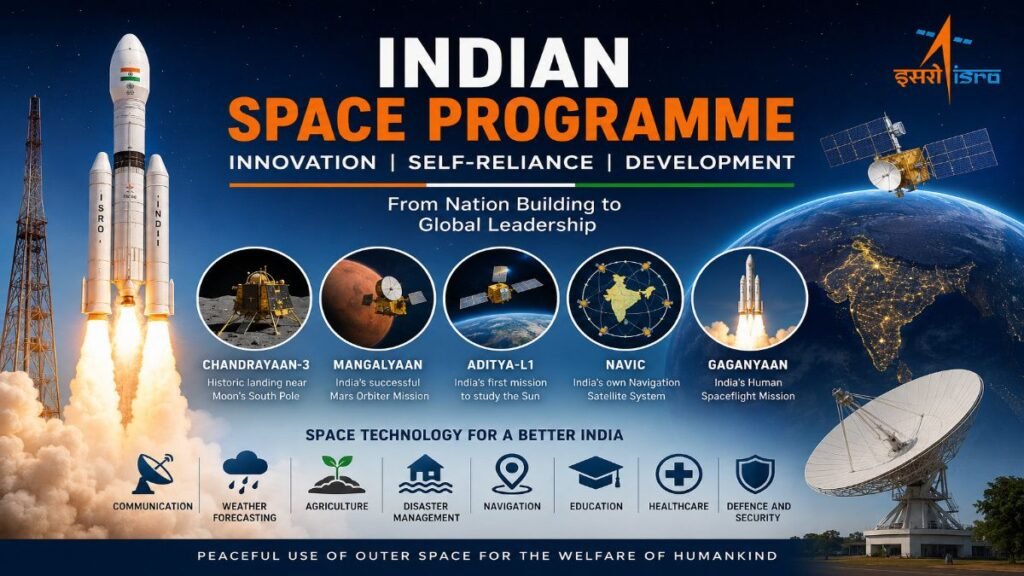
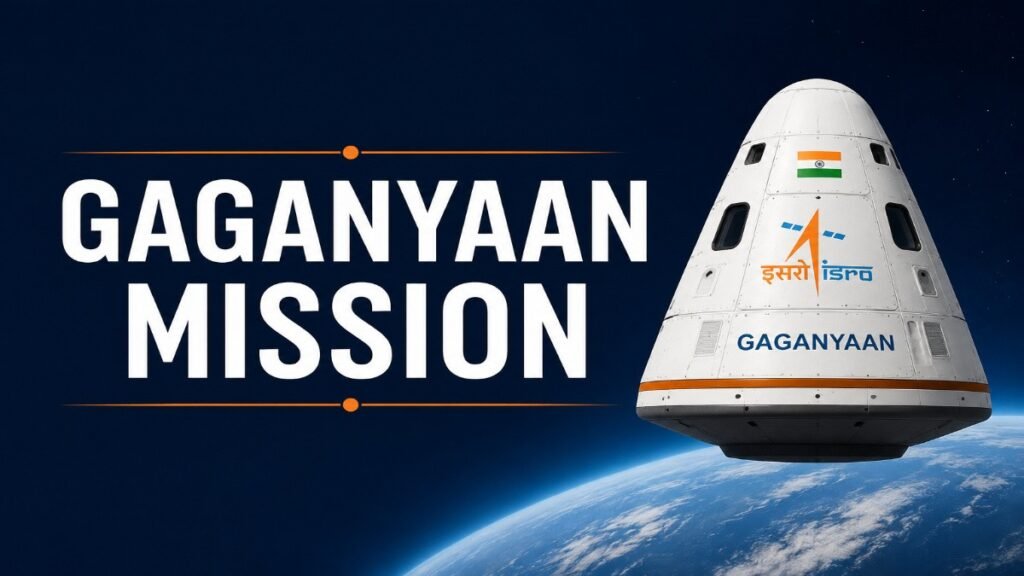
The Gaganyaan Mission is India’s first indigenous Human Spaceflight Programme, developed by the Indian Space Research Organisation (ISRO) to demonstrate the country’s capability to safely send astronauts into space and bring them back to Earth. The programme marks a major milestone in India’s space journey, shifting its focus from satellite launches and planetary exploration to human spaceflight.
The mission aims to place three Indian astronauts (Gaganyatris) in Low Earth Orbit (LEO) at an altitude of about 400 km for a mission lasting up to three days, followed by a safe splashdown in the Bay of Bengal or the Arabian Sea for recovery by the Indian Navy. The astronauts will travel aboard an indigenously developed Crew Module, supported by a Service Module, and launched using the Human-rated LVM3 (HLVM3) launch vehicle.
Before the crewed mission, ISRO will conduct two uncrewed test flights (Gaganyaan-1 and Gaganyaan-2) to validate critical technologies such as the Crew Escape System (CES), Environmental Control and Life Support System (ECLSS), re-entry, parachute deployment and recovery operations. The humanoid robot Vyommitra will participate in the uncrewed missions to assess the spacecraft’s performance under space conditions.
The Gaganyaan Mission programme has been approved by the Government of India with an estimated cost of around ₹20,000 crore (including the expanded programme). The mission is expected to be launched after the successful completion of all qualification and test missions. Upon its successful completion, India will become the fourth country after the United States, Russia and China to independently send humans into space using indigenous technology.
Besides demonstrating human spaceflight capability, the Gaganyaan Mission will serve as the foundation for future missions such as the Bharatiya Antariksha Station, long-duration human space missions and eventual Indian missions to the Moon.
These Gaganyaan Mission Notes provide a concise overview of India’s first human spaceflight programme and are highly useful for aspirants preparing Gaganyaan Mission for BPSC and other competitive examinations.
Master Science & Technology. Maximize Your BPSC Mains Score.
Enroll in the BPSC Science & Tech Course Today
Master Science & Technology for BPSC Mains GS Paper-2 with 75+ exam-oriented topics, 6 structured lessons, and downloadable PDF notes—all in one course.
✔ 75+ Exam-Oriented Topics • ✔ 6 Comprehensive Lessons • ✔ Downloadable PDF Notes • ✔ Updated for 72nd BPSC Mains
2. Mission Architecture and Major Components
The success of the Gaganyaan Mission depends on the seamless integration of advanced launch systems, spacecraft technologies, life-support systems and recovery mechanisms. Each component has been designed to ensure the safety of astronauts throughout the mission. Understanding these systems is essential for aspirants preparing Gaganyaan Mission for BPSC.
Human-rated LVM3 (HLVM3)
The LVM3 (Launch Vehicle Mark-3) has been modified into a Human-rated Launch Vehicle (HLVM3) with enhanced reliability, redundancy and safety features. Capable of carrying up to 10 tonnes to Low Earth Orbit (LEO), it will launch the Crew Module into an orbit of approximately 400 km.
Crew Module (CM)
The Crew Module is the habitable compartment where the astronauts will stay during the mission. The module is reusable after refurbishment, making future missions more cost-effective. It is designed to:
- Accommodate three astronauts.
- Maintain a pressurised and habitable environment.
- Protect the crew from extreme temperatures during atmospheric re-entry.
- Enable safe splashdown using a parachute system.
Service Module (SM)
Before re-entry into Earth’s atmosphere, the Service Module separates from the Crew Module. The Service Module supports the Crew Module throughout the mission by providing:
- Propulsion for orbital manoeuvres.
- Electrical power through solar panels and batteries.
- Thermal control.
- Communication and navigation support.
Environmental Control and Life Support System (ECLSS)
The Environmental Control and Life Support System (ECLSS) is one of the most critical technologies in human spaceflight. This system ensures that astronauts can survive and work comfortably during the mission. It maintains a safe environment inside the Crew Module by:
- Supplying breathable oxygen.
- Removing carbon dioxide and other harmful gases.
- Regulating cabin temperature and humidity.
- Maintaining appropriate air pressure.
- Providing drinking water and waste management facilities.
The development of ECLSS is one of the most important technological achievements of the Gaganyaan Mission, making it a key topic in Gaganyaan Mission Notes.
Crew Escape System (CES)
Astronaut safety is the highest priority in the Gaganyaan Mission. The Crew Escape System (CES) is designed to quickly separate the Crew Module from the launch vehicle in the event of an emergency during launch. The system was successfully demonstrated through the Test Vehicle-D1 (TV-D1) mission in October 2023, validating India’s emergency escape capability.
Astronaut Training
The training programme has been conducted with support from Glavkosmos (Russia) and ISRO’s own Astronaut Training Facility in Bengaluru. The selected Indian astronauts, known as Gaganyatris, have undergone extensive training in:
- Spacecraft operations.
- Survival techniques.
- Microgravity adaptation.
- Emergency procedures.
Mission Sequence
The Gaganyaan Mission follows a phased and safety-oriented approach, ensuring that every critical technology is thoroughly tested before astronauts are sent into space. Instead of directly launching a crewed mission, ISRO has planned a series of test missions to validate the spacecraft, launch vehicle and life-support systems under actual flight conditions.
- The programme begins with Gaganyaan-1 (G1), the first uncrewed test mission, which will carry the Vyommitra humanoid robot aboard the Crew Module. The mission will evaluate the performance of the Human-rated LVM3 (HLVM3), Crew Module, Service Module, Environmental Control and Life Support System (ECLSS), communication systems, orbital operations, atmospheric re-entry, parachute deployment and recovery procedures.
- Following the successful completion of G1, Gaganyaan-2 (G2) will serve as the second uncrewed validation mission. It will further verify the reliability of all onboard systems under actual spaceflight conditions, ensuring that the spacecraft can safely support human life. Any technical issues identified during G1 will be addressed before this mission.
- The final stage is Gaganyaan-3 (G3), India’s first crewed human spaceflight mission, which will carry three Indian astronauts (Gaganyatris) into Low Earth Orbit (LEO) at an altitude of approximately 400 km for a mission lasting about three days. After completing scientific experiments and orbital operations, the Crew Module will re-enter Earth’s atmosphere and make a controlled splashdown in the Indian Ocean, where it will be recovered by the Indian Navy.
This step-by-step mission sequence minimises risks, enhances astronaut safety and lays the technological foundation for future missions such as the Bharatiya Antariksha Station and long-duration human space exploration. These ISRO Gaganyaan Mission for BPSC notes provide a clear understanding of the mission architecture and are valuable BPSC Notes Gaganyaan Mission for competitive examinations.
Prepare Smarter. Study Better. Ace BPSC Mains.
BPSC Mains GS Paper 1 & 2 Complete Course
Access comprehensive BPSC Mains Notes for GS Paper 1 & 2, covering 378+ topics across 24 PDF lessons, with dedicated Bihar coverage, practice questions and downloadable study material.
✓ GS Paper 1 & 2 • ✓ 378+ Topics • ✓ 24 PDF Lessons • ✓ Bihar-Specific Coverage • ✓ Downloadable Notes
3. Significance of Gaganyaan Mission
The Gaganyaan Mission is more than a human spaceflight programme; it is a landmark initiative that will strengthen India’s scientific, technological, economic and strategic capabilities. It is expected to create long-term benefits across multiple sectors and establish India as a leading space-faring nation.
Technological Advancement
The Gaganyaan Mission has led to the development of several advanced indigenous technologies, including the Human-rated LVM3 (HLVM3), Crew Escape System (CES), Environmental Control and Life Support System (ECLSS), precision navigation, avionics, thermal protection systems and reusable crew modules. These technologies will have applications in future human space missions, satellite servicing and deep-space exploration.
Strengthening India’s Global Space Status
The successful completion of the Gaganyaan Mission will make India the fourth country, after the United States, Russia and China, to independently send humans into space using indigenous technology. This achievement will significantly enhance India’s prestige in the global space community and demonstrate its capability in executing complex space missions.
Foundation for Future Space Exploration
The Gaganyaan Mission serves as the technological foundation for India’s long-term space ambitions. The experience gained from the mission will support future projects such as the Bharatiya Antariksha Station (planned by 2035), Chandrayaan-4, lunar exploration, space docking missions and eventual human missions to the Moon and beyond. These developments make the topic particularly important in Gaganyaan Mission Notes for competitive examinations.
Boost to Research and Innovation
The mission will promote research in space medicine, human physiology, robotics, artificial intelligence, material science, life-support systems and microgravity experiments. Scientific experiments conducted during human spaceflight will generate valuable knowledge that can contribute to healthcare, biotechnology and advanced manufacturing.
Strategic and National Security Importance
Mastering human spaceflight technologies enhances India’s strategic capabilities by reducing dependence on foreign nations for advanced space technologies. It strengthens the country’s ability to undertake future defence, surveillance and space infrastructure projects, thereby improving national security and technological self-reliance.
Inspiring Scientific Temper
Like the success of Chandrayaan-3, the Gaganyaan Mission is expected to inspire millions of young Indians to pursue careers in science, technology, engineering and mathematics (STEM). It will promote innovation, scientific research and entrepreneurship, helping India build a knowledge-based economy. For aspirants preparing Gaganyaan Mission for BPSC, this aspect highlights the mission’s broader socio-economic impact beyond space exploration.
Overall, the Gaganyaan Mission is not merely a space mission but a transformative national programme that will shape India’s future in science, technology, industry and global leadership for decades to come. These BPSC Notes Gaganyaan Mission also explain how the ISRO Gaganyaan Mission for BPSC is expected to become a milestone in India’s journey towards becoming a major human spacefaring nation.
4. Challenges
Despite its immense potential, the Gaganyaan Mission presents several technological, financial and operational challenges. Addressing these challenges is crucial for ensuring mission success and establishing India as a long-term human spacefaring nation.
- Ensuring Astronaut Safety: Human spaceflight requires near-perfect reliability, as even minor technical failures can endanger astronauts. Critical systems such as the Crew Escape System (CES), Environmental Control and Life Support System (ECLSS) and re-entry mechanisms must perform flawlessly.
- Development of Advanced Indigenous Technologies: Technologies such as life-support systems, space suits, human-rated launch vehicles, space medicine and long-duration habitation are highly complex and require continuous research and testing. Overcoming these technological challenges is essential for the long-term success of the Gaganyaan Mission.
- High Financial Investment: Human space missions involve significant expenditure on spacecraft development, testing, astronaut training, launch infrastructure and mission operations. Balancing these investments with other national priorities remains a challenge.
- Space Environment Risks: Astronauts are exposed to microgravity, space radiation, extreme temperature variations and space debris, which can affect both human health and spacecraft safety.
- Limited Experience in Human Spaceflight: Unlike the United States, Russia and China, India has no prior experience in conducting independent crewed space missions. Therefore, extensive ground tests and multiple uncrewed missions are essential before launching astronauts.
These challenges highlight that the Gaganyaan Mission is not only a technological endeavour but also a complex scientific and operational programme requiring sustained investment, rigorous testing and continuous innovation. Understanding these issues is important for aspirants preparing Gaganyaan Mission for BPSC and forms an integral part of Gaganyaan Mission Notes.
5. Way Forward
- Successfully complete all uncrewed Gaganyaan Mission flights before undertaking the crewed mission to ensure the reliability of all critical systems and astronaut safety.
- Continue strengthening indigenous technologies under the vision of Atmanirbhar Bharat to reduce dependence on foreign suppliers and enhance self-reliance in human spaceflight capabilities.
- Expand collaboration between ISRO, private industries, start-ups, academic institutions and research laboratories to accelerate innovation in advanced space technologies. Such collaborations will further strengthen the long-term success of the Gaganyaan Mission.
- Invest in advanced research in space medicine, robotics, artificial intelligence and human life-support technologies for long-duration human space missions.
- Build upon the Gaganyaan Mission to establish the Bharatiya Antariksha Station by 2035 and prepare for future lunar and deep-space human exploration missions.
- Promote international cooperation with leading space agencies for knowledge sharing, astronaut training and advanced technology development.
The successful execution of the Gaganyaan Mission will not only mark India’s entry into the elite group of human spacefaring nations but also lay the foundation for sustained human presence in space, advanced scientific research and future interplanetary exploration. It represents a significant step towards achieving the vision of Viksit Bharat 2047 and strengthening India’s position as a global leader in space technology. These Gaganyaan Mission Notes provide a comprehensive roadmap for the future of India’s human spaceflight programme and are highly useful for aspirants preparing Gaganyaan Mission for BPSC and ISRO Gaganyaan Mission for BPSC.
Learn More from ISRO:
Readers interested in the latest updates on the Gaganyaan Mission, astronaut training, uncrewed test flights, Crew Module, Human-rated LVM3 (HLVM3), Vyommitra, and other human spaceflight developments can visit the official website of the Indian Space Research Organisation (ISRO). The website provides authentic information on mission progress, technical details, official announcements, and future plans related to India’s Human Spaceflight Programme.
BPSC Mains Practice Questions
Q1. “The Gaganyaan Mission is not merely a human spaceflight programme but a technological leap towards India’s long-term space ambitions.” Discuss the objectives, mission architecture, significance, and future prospects of the Gaganyaan Mission.
Q2. Examine the major technological components of the Gaganyaan Mission, including the Human-rated LVM3 (HLVM3), Crew Module, Service Module, Environmental Control and Life Support System (ECLSS), and Crew Escape System (CES). How do these technologies ensure mission success and astronaut safety?
Q3. Discuss the major challenges associated with the Gaganyaan Mission. Suggest suitable measures to ensure the successful implementation of India’s first indigenous human spaceflight programme.