
63rd BPSC Pre GS Question Paper with Answer Key
The 63rd BPSC Pre GS Question Paper is an essential resource for candidates preparing for the Bihar Public Service Commission (BPSC) Preliminary Examination. Solving the complete paper helps you understand the exam pattern, question trends, and the overall difficulty level of the examination. On this page, you can access all 150 questions from the 63rd BPSC Pre GS Question Paper along with the official answer key in a simple and easy-to-read format.
Practicing 63rd BPSC Previous Year Questions is one of the most effective ways to improve your preparation, increase accuracy, and build confidence before the examination. After attempting all the questions, you can verify your responses using the official answer key provided at the end of this page. If you want detailed explanations, concept-based analysis, and option-wise discussion for every question, you can explore our BPSC Previous Year Questions Explanation Course.
Quick Information
| Particular | Details |
|---|---|
| Examination | 63rd BPSC Preliminary Examination |
| Date of Exam | 01 Jul 2018 |
| Conducting Body | Bihar Public Service Commission (BPSC) |
| Paper | General Studies (Preliminary) |
| Booklet Series | C |
| Total Questions | 150 |
| Question Type | Multiple Choice Questions (MCQs) |
| Marks | 150 |
| Negative Marking | No |
| Answer Key | Official Answer Key Provided |
| Detailed Explanation | Available in Premium Course |
63rd BPSC Pre GS Questions
The 63rd BPSC Pre GS Question Paper consists of 150 multiple-choice questions (MCQs) covering subjects such as History, Geography, Indian Polity, Economy, General Science, Environment, Current Affairs, and Bihar Special. Solving the complete paper helps candidates understand the exam pattern, improve time management, and evaluate their level of preparation for the BPSC Preliminary Examination.
Attempt all 63rd BPSC Pre GS Questions before checking the official answer key provided at the end of this page. This will help you assess your performance, identify weak areas, and focus your revision on the topics that matter most for the examination.
1. Which one of the following Committees/Commissions recommended the creation of Nyaya Panchayats?
(A) Balwant Rai Mehta Committee
(B) Ashok Mehta Committee
(C) G. V. K. Rao Committee
(D) Sarkaria Commission
(E) None of the above/More than one of the above
2. Which one of the following functions is not the concern of Local Self-Government?
(A) Public Health
(B) Sanitation
(C) Public Utility Services
(D) Maintenance of Public Order
(E) None of the above/More than one of the above
3. The system of Panchayati Raj is mentioned in
(A) the Union List
(B) the State List
(C) the Concurrent List
(D) None of the above
(E) More than one of the above
4. 50% reservation for women in Panchayati Raj Institutions is legalized in certain States such as
I. Bihar
II. Uttarakhand
III. Madhya Pradesh
IV. Himachal Pradesh
(A) Only III
(B) Only II and III
(C) II, III and IV
(D) I, II, III and IV
(E) None of the above/More than one of the above
5. Money Bill can be presented
(A) only in the Lok Sabha
(B) only in the Rajya Sabha
(C) in both the Houses
(D) in joint meeting of both the Houses
(E) None of the above/More than one of the above
6. What is the nature of the Indian Constitution?
(A) Federal
(B) Unitary
(C) Parliamentary
(D) Federal in nature but unitary in spirit
(E) None of the above/More than one of the above
7. Who appoints the Judges of the Supreme Court of India?
(A) The Prime Minister
(B) The President
(C) The Chief Justice of India
(D) The Ombudsman
(E) None of the above/More than one of the above
8. Who is the Ex Officio Chairman of the Rajya Sabha?
(A) The President
(B) The Vice President
(C) The Prime Minister
(D) None of the above
(E) More than one of the above
9. The Prime Minister of India is responsible to whom?
(A) The Cabinet
(B) The President
(C) The Lok Sabha
(D) The Rajya Sabha
(E) None of the above/More than one of the above
10. What is the minimum age for a Member of the Parliament?
(A) 18 years
(B) 21 years
(C) 25 years
(D) 30 years
(E) None of the above/More than one of the above
🚀 Master BPSC Previous Year Questions the Smart Way
BPSC Pre PYQ (60th–71st) | Detailed Solutions
Stop memorizing answers. Understand the concepts behind every BPSC Previous Year Question and prepare with confidence.
| 12 Previous Year Papers | Official Answer Keys | Detailed Question-wise Solutions |
| Original English Question Papers | Updated Exam-Oriented Notes |
12 Comprehensive PDFs • 60th–71st BPSC Prelims • Concept-Based Learning
11. What is the retirement age of the Judges of the Supreme Court?
(A) 60 years
(B) 62 years
(C) 65 years
(D) 70 years
(E) None of the above/More than one of the above
12. Who is the highest Civil Services Officer of the Central Government?
(A) The Attorney General of India
(B) The Cabinet Secretary
(C) The Home Secretary
(D) The Finance Secretary
(E) None of the above/More than one of the above
13. One of the problems in calculating National Income in India is
(A) underemployment
(B) inflation
(C) low level of savings
(D) non-organized sector
(E) None of the above/More than one of the above
14. The apex bank for providing agricultural refinance in India is
(A) RBI
(B) NABARD
(C) SBI
(D) Imperial Bank
(E) None of the above/More than one of the above
15. According to the 14th Finance Commission, the percentage share of States in the net proceeds of the shareable central tax revenue should be
(A) 32 percent
(B) 35 percent
(C) 40 percent
(D) 42 percent
(E) None of the above/More than one of the above
16. Which sector in India attracts the highest FDI equity flow?
(A) Construction Sector
(B) Energy Sector
(C) Automobile Sector
(D) Service Sector
(E) None of the above/More than one of the above
17. Who amongst the following is the present Governor of the RBI?
(A) Bimal Jalan
(B) Arvind Subramanian
(C) Raghuram Rajan
(D) Urjit Patel
(E) None of the above/More than one of the above
18. The size of marginal landholding in India is
(A) more than 5 hectares
(B) 2 hectares to 4 hectares
(C) 1 hectare to 2 hectares
(D) less than 1 hectare
(E) None of the above/More than one of the above
19. Globalization does not include
(A) reduction in import duties
(B) abolition of import licensing
(C) free flow of FDI
(D) disinvestment of Public Sector Equity
(E) None of the above/More than one of the above
20. The Prevention of Money Laundering Act came into force in India during
(A) 1998
(B) 1999
(C) 2001
(D) 2005
(E) None of the above/More than one of the above
21. TRIMS stands for
(A) Trade-Related Income Measures
(B) Trade-Related Incentives Measures
(C) Trade-Related Investment Measures
(D) Trade-Related Innovative Measures
(E) None of the above/More than one of the above
22. NITI Aayog came into existence on
(A) 1st January, 2014
(B) 1st June, 2014
(C) 1st January, 2015
(D) 1st June, 2015
(E) None of the above/More than one of the above
23. ‘Gullak Bachcha Bank’ is a bank based in
(A) Delhi
(B) Patna
(C) Bhopal
(D) Jaipur
(E) None of the above/More than one of the above
24. The base year for All-India Wholesale Price Index (WPI) has been changed by the Government of India from 2004-05 to
(A) 2010–11
(B) 2011–12
(C) 2012–13
(D) 2013–14
(E) None of the above/More than one of the above
25. According to Indian Population Census, 2011, the percentage of literacy among males and females both is lowest for the State of
(A) Arunachal Pradesh
(B) Andhra Pradesh
(C) Bihar
(D) Jammu and Kashmir
(E) None of the above/More than one of the above
26. The average size of landholdings in Bihar in comparison with other States is
(A) lowest
(B) second lowest
(C) highest
(D) second highest
(E) None of the above/More than one of the above
27. The latest per capita income at current prices is lowest for the Indian State of
(A) Bihar
(B) Uttar Pradesh
(C) Odisha
(D) Nagaland
(E) None of the above/More than one of the above
28. The latest annual per capita consumption of electricity in Bihar is
(A) lowest
(B) second lowest
(C) highest
(D) second highest
(E) None of the above/More than one of the above
29. The average yield of cotton is highest in India for the State of
(A) West Bengal
(B) Bihar
(C) Assam
(D) Andhra Pradesh
(E) None of the above/More than one of the above
30. The road length per lakh of population in Bihar is
(A) lowest
(B) second lowest
(C) highest
(D) second highest
(E) None of the above/More than one of the above
31. During 10000 BC, the population of the world was
(A) 2 million
(B) 3 million
(C) 4 million
(D) 5 million
(E) None of the above/More than one of the above
32. Cocos Plate lies between
(A) Central America and Pacific Plate
(B) South America and Pacific Plate
(C) Red Sea and Persian Gulf
(D) Asiatic Plate and Pacific Plate
(E) None of the above/More than one of the above
33. ‘Rust Bowl’ of the USA is associated with which one of the following regions?
(A) Great Lakes region
(B) Alabama region
(C) California region
(D) Pittsburg region
(E) None of the above/More than one of the above
34. Which one of the following approaches is associated with Prof. Amartya Sen?
(A) Basic Needs Approach
(B) Capability Approach
(C) Income Approach
(D) Welfare Approach
(E) None of the above/More than one of the above
35. Which one of the following is known as the ‘Coffee Port’ of the world?
(A) Sao Paulo
(B) Santos
(C) Rio de Janeiro
(D) Buenos Aires
(E) None of the above/More than one of the above
36. Which one of the following States has the highest percentage of area under forests?
(A) Himachal Pradesh
(B) Assam
(C) Andhra Pradesh
(D) Arunachal Pradesh
(E) None of the above/More than one of the above
37. Which one of the following soils is deposited by rivers?
(A) Red soil
(B) Black soil
(C) Alluvial soil
(D) Laterite soil
(E) None of the above/More than one of the above
38. What is the share of hydro-electric power in the total electricity produced in India?
(A) 10 percent
(B) 12 percent
(C) 20 percent
(D) 22 percent
(E) None of the above/More than one of the above
39. Which Census year is called ‘Demographic Divide’ in the population study of India?
(A) 1911
(B) 1921
(C) 1931
(D) 1941
(E) None of the above/More than one of the above
40. The largest number of cotton mills in Tamil Nadu are found in
(A) Chennai
(B) Coimbatore
(C) Madurai
(D) Salem
(E) None of the above/More than one of the above
41. Which one of the following States is the leading producer of rubber in India?
(A) Tamil Nadu
(B) Kerala
(C) Karnataka
(D) Andhra Pradesh
(E) None of the above/More than one of the above
42. National Waterway-1 connects
(A) Kottapuram to Kollam
(B) Sadiya to Dhubri
(C) Haldia to Allahabad
(D) Haldia to Kolkata
(E) None of the above/More than one of the above
43. Khetri Belt of Rajasthan State is famous for
(A) copper mining
(B) gold mining
(C) mica mining
(D) iron ore mining
(E) None of the above/More than one of the above
44. Which one of the following rivers joins the Ganga at Fatuha?
(A) Son
(B) Punpun
(C) Sakri
(D) Balan
(E) None of the above/More than one of the above
45. According to Köppen’s climatic classification, the climate of North Bihar may be explained as
(A) Cwg
(B) Aw
(C) CA’w
(D) CB’w
(E) None of the above/More than one of the above
46. Which soil is predominantly found in the districts of Muzaffarpur, Darbhanga and Champaran?
(A) Black soil
(B) Newer alluvium
(C) Older alluvium
(D) Red soil
(E) None of the above/More than one of the above
47. The largest jute-producing district of Bihar is
(A) Siwan
(B) Gaya
(C) Vaishali
(D) Purnia
(E) None of the above/More than one of the above
48. Triveni Canal has been constructed on the river
(A) Kosi
(B) Son
(C) Gandak
(D) Kamla
(E) None of the above/More than one of the above
49. The salvation place of Mahavirji, the originator of Jain religion, is located at
(A) Maner
(B) Rajgir
(C) Pavapuri
(D) Jalan Fort
(E) None of the above/More than one of the above
50. Kaimur Plateau is famous for
(A) copper
(B) limestone
(C) lithium
(D) bauxite
(E) None of the above/More than one of the above
51. Swami Sahajanand Saraswati published a journal named
(A) Jankranti
(B) Hunkar
(C) Krishak Samachar
(D) Vidrohi
(E) None of the above/More than one of the above
52. Who established a branch of Anushilan Samiti at Patna in 1913?
(A) Rewati Nag
(B) Yadunath Sarkar
(C) Sachindra Nath Sanyal
(D) Mazharul Haque
(E) None of the above/More than one of the above
53. Who organized Kisan Sabha at Munger in 1922–23?
(A) Swami Sahajanand Saraswati
(B) Shri Krishna Singh
(C) Mohammed Jubair
(D) K. N. Singh
(E) None of the above/More than one of the above
54. Bihar Socialist Party was born in 1934 with its Secretary
(A) Acharya Narendra Dev
(B) Jayaprakash Narayan
(C) Rambriksh Benipuri
(D) Karpoori Thakur
(E) None of the above/More than one of the above
55. Who was the member of the Constituent Assembly of India from Bihar?
(A) A. N. Sinha
(B) Rajendra Prasad
(C) Jagjivan Ram
(D) Shyam Nandan Prasad Mishra
(E) None of the above/More than one of the above
56. The first Indian Ministry in Bihar in 1937 came into existence under whose leadership?
(A) Shri Krishna Singh
(B) Md. Yunus
(C) G. S. Lal
(D) Wahab Ali
(E) None of the above/More than one of the above
57. Whom did Rajendra Prasad consider as the father of Pakistan?
(A) Md. Jinnah
(B) Lord Mountbatten
(C) Lord Minto
(D) Liaquat Ali Khan
(E) None of the above/More than one of the above
58. When was Patna Law renamed as Gandhi Maidan?
(A) During Quit India Movement
(B) During Anti-Simon Commission Rally
(C) During Champaran Satyagraha
(D) On the eve of Independence
(E) None of the above/More than one of the above
59. Bombay Presidency Association was established by
(A) Ferozshah Mehta
(B) K. T. Tailang
(C) W. C. Banerjee
(D) Tayabjee
(E) None of the above/More than one of the above
60. Who established Imperial Cadet Corps?
(A) Lord Minto
(B) Lord Curzon
(C) Lord Lytton
(D) Lord Ripon
(E) None of the above/More than one of the above
61. The Declaration of Partition of Bengal was done on
(A) 19th July, 1905
(B) 7th August, 1905
(C) 15th August, 1905
(D) 16th October, 1905
(E) None of the above/More than one of the above
62. Who was given life punishment for the murder of Colonel Wyllie?
(A) Madan Lal Dhingra
(B) Udham Singh
(C) Bhagat Singh
(D) Manmathanath
(E) None of the above/More than one of the above
63. The post of the Indian High Commission was created by which Act?
(A) The Indian Councils Act, 1909
(B) The Government of India Act, 1919
(C) The Government of India Act, 1935
(D) The Indian Independence Act, 1947
(E) None of the above/More than one of the above
64. The Indian National Congress did not take part in which of the following Round Table Conferences?
(A) First
(B) Second
(C) Third
(D) Participated in all
(E) None of the above/More than one of the above
65. Mahatma Gandhi presided over which Session of the Indian National Congress?
(A) 1922
(B) 1924
(C) 1928
(D) 1930
(E) None of the above
66. Who was not the member of the Cabinet Mission?
(A) Pethick-Lawrence
(B) Wavell
(C) Stafford Cripps
(D) A. V. Alexander
(E) None of the above/More than one of the above
67. Who wrote the pamphlet ‘Now or Never’?
(A) Md. Jinnah
(B) Md. Iqbal
(C) Rahmat Ali
(D) Khafi Khan
(E) None of the above/More than one of the above
68. Who declared ‘Sati’ illegal?
(A) Warren Hastings
(B) William Bentinck
(C) Cornwallis
(D) Curzon
(E) None of the above/More than one of the above
69. When was the Punjab Land Alienation Act passed?
(A) 1850
(B) 1895
(C) 1900
(D) 1905
(E) None of the above/More than one of the above
70. The Department of State was established under whose headship?
(A) Mahatma Gandhi
(B) J. L. Nehru
(C) G. B. Pant
(D) Sardar Patel
(E) None of the above/More than one of the above
71. A number when divided by 342 gives a remainder 47. When the same number is divided by 19, what would be the remainder?
(A) 0
(B) 9
(C) 18
(D) 8
(E) None of the above
72. A person who spends 66⅔% of his income is able to save ₹ 1,200 per month. His monthly expenses (in ₹) are
(A) 2,400
(B) 3,000
(C) 2,000
(D) 3,600
(E) 2,800
73. A man gains 20% by selling an article for a certain price. If he sells it at double the price, the percentage of profit will be
(A) 140
(B) 200
(C) 100
(D) 160
(E) 120
74. 10 women can complete a work in 7 days and 10 children take 14 days to complete the work. How many days will 5 women and 10 children take to complete the work?
(A) 6
(B) 5
(C) 3
(D) 7
(E) 4
75. How many numbers between 11 and 90 are divisible by 7?
(A) 10
(B) 9
(C) 13
(D) 12
(E) 11
76. A man can row 7½ km per hour in still water. If in a river running at 1½ km an hour, it takes him 50 minutes to row to a place and back, how far off is the place?
(A) 3 km
(B) 4 km
(C) 2 km
(D) 5 km
(E) 7 km
77. A sum of money invested at compound interest amounts to ₹ 4,624 in 2 years and to ₹ 4,913 in 3 years. The sum of money is
(A) ₹ 4,240
(B) ₹ 4,280
(C) ₹ 4,096
(D) ₹ 4,346
(E) ₹ 4,406
78. A man buys ₹ 20 shares paying 9% dividend. The man wants to have an interest of 12% on his money. The market value of each share is
(A) ₹ 18
(B) ₹ 15
(C) ₹ 21
(D) ₹ 25
(E) ₹ 20
79. The following pie-chart shows the spendings of a country on various sports during a particular year. Study the chart carefully and answer the question:
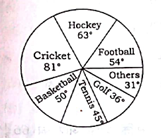
How much percent less is spent on football than that on cricket?
(A) 35½
(B) 29
(C) 32½
(D) 31
(E) 33⅓
80. A invested ₹ 76,000 in a business. After few months, B joined him with ₹ 57,000. At the end of the year, the total profit was divided between them in the ratio 2 :1. After how many months did B join?
(A) 6
(B) 4
(C) 3
(D) 8
(E) 5
81. Quartz crystals used in clocks are
(A) sodium silicate
(B) silicon dioxide
(C) germanium oxide
(D) titanium dioxide
(E) None of the above/More than one of the above
82. Bromine is a
(A) colourless gas
(B) brown solid
(C) highly inflammable gas
(D) red liquid
(E) None of the above/More than one of the above
83. Gases used in welding are
(A) oxygen and hydrogen
(B) oxygen and nitrogen
(C) oxygen and acetylene
(D) hydrogen and acetylene
(E) None of the above/More than one of the above
84. Galvanized iron pipes have a coating of
(A) zinc
(B) mercury
(C) lead
(D) chromium
(E) None of the above/More than one of the above
85. The wavelength of visible spectrum is in the range
(A) 1300 Å–3900 Å
(B) 3900 Å–7600 Å
(C) 7800 Å–8200 Å
(D) 8500 Å–9800 Å
(E) None of the above/More than one of the above
86. Detergents used for cleaning clothes are
(A) carbonates
(B) bicarbonates
(C) bismuthates
(D) sulfonates
(E) None of the above/More than one of the above
87. The element excreted through human sweat is
(A) sulfur
(B) iron
(C) magnesium
(D) zinc
(E) None of the above/More than one of the above
88. Blue vitriol is chemically
(A) sodium sulfate
(B) nickel sulfate
(C) copper sulfate
(D) iron sulfate
(E) None of the above/More than one of the above
89. The positively charged part at the centre of an atom is called as
(A) proton
(B) neutron
(C) electron
(D) nucleus
(E) None of the above/More than one of the above
90. The conversion of a solid directly into gas is called as
(A) sublimation
(B) condensation
(C) evaporation
(D) boiling
(E) None of the above/More than one of the above
91. In human system, insulin controls the metabolism of
(A) fats
(B) carbohydrates
(C) proteins
(D) nucleic acids
(E) None of the above/More than one of the above
92. The antibiotic among the following is
(A) penicillin
(B) aspirin
(C) paracetamol
(D) sulfadiazine
(E) None of the above/More than one of the above
93. Which of the following is mostly carbohydrate?
(A) Wheat
(B) Barley
(C) Rice
(D) Maize
(E) None of the above/More than one of the above
94. The heaviest metal among the following is
(A) gold
(B) silver
(C) mercury
(D) platinum
(E) None of the above/More than one of the above
95. Stainless steel is an alloy of
(A) iron and nickel
(B) iron and chromium
(C) copper and chromium
(D) iron and zinc
(E) None of the above/More than one of the above
96. To protect broken bones, plaster of Paris is used. It is
(A) slaked lime
(B) calcium carbonate
(C) calcium oxide
(D) gypsum
(E) None of the above/More than one of the above
97. A hydrocarbon in which two carbon atoms are joined by a double bond is called as an
(A) alkane
(B) alkene
(C) alkyne
(D) ionic bond
(E) None of the above/More than one of the above
98. The chemical name for vinegar is
(A) methanol
(B) ethanol
(C) acetic acid
(D) ethyl acetate
(E) None of the above/More than one of the above
99. The acid used in a car battery is
(A) acetic acid
(B) hydrochloric acid
(C) nitric acid
(D) sulfuric acid
(E) None of the above/More than one of the above
100. The gas, which comes out on opening a soda water bottle, is
(A) carbon dioxide
(B) hydrogen
(C) nitrogen
(D) sulfur dioxide
(E) None of the above/More than one of the above
101. Which of the following smart cities has become the India’s first city to run on 100% renewable energy during daytime?
(A) Bengaluru
(B) Jaipur
(C) Indore
(D) Diu
(E) None of the above/More than one of the above
102. Mahmoud Abu Zeid has won the 2018 UNESCO/Guillermo Cano World Press Freedom Prize. He hails from which country?
(A) Israel
(B) Iraq
(C) Iran
(D) Egypt
(E) None of the above/More than one of the above
103. The bilateral military exercise ‘Harimau Shakti 2018’ has been conducted between India and which country?
(A) Indonesia
(B) Malaysia
(C) New Zealand
(D) South Korea
(E) None of the above/More than one of the above
104. Which Union Ministry has launched the Second Edition of the ‘Unnat Bharat Abhiyan’?
(A) The Ministry of Home Affairs
(B) The Ministry of Agriculture and Farmers Welfare
(C) The Ministry of Human Resource Development
(D) The Ministry of Rural Development
(E) None of the above/More than one of the above
105. Which Union Ministry in collaboration with Google India has launched a 360° Virtual Reality (VR) video on ‘Incredible India’?
(A) The Ministry of Electronics and Information Technology
(B) The Ministry of Information and Broadcasting
(C) The Ministry of Social Justice and Empowerment
(D) The Ministry of Tourism
(E) None of the above/More than one of the above
106. Which city hosted India’s first-ever nationwide food archaeology conference ‘ArchaeoBroma’?
(A) Mumbai
(B) New Delhi
(C) Indore
(D) Surat
(E) None of the above/More than one of the above
107. What is the India’s rank in the 2018 World Press Freedom Index (WPFI)?
(A) 136th
(B) 138th
(C) 135th
(D) 137th
(E) None of the above/More than one of the above
108. Which institute has been awarded the 2018 National Intellectual Property Award in the category Top R & D Institution/Organization for Patents and Commercialization?
(A) The Council of Scientific and Industrial Research
(B) The Indian Space Research Organization
(C) The Bhabha Atomic Research Centre
(D) The Defence Research and Development Organization
(E) None of the above/More than one of the above
109. Which State has topped the list of States, with most number of beggars, as per data released by the Union Ministry of Social Justice?
(A) West Bengal
(B) Andhra Pradesh
(C) Bihar
(D) Uttar Prades
(E) None of the above/More than one of the above
110. Which district has become the India’s first district to have 100% solar-powered health centres?
(A) Kolkata
(B) Chennai
(C) Bengaluru
(D) Surat
(E) None of the above/More than one of the above
111. Which Indian sports person has bagged Gold in the Men’s 25 m Rapid Fire Pistol Event at the 2018 ISSF Junior Shooting World Cup in Sydney?
(A) Rajkanwar Singh
(B) Anhad Jawanda
(C) B. Sainath
(D) Anish Bhanwala
(E) None of the above/More than one of the above
112. Which State Government has signed a pact with Airport Authority of India (AAI) to develop villages in Kamrup?
(A) West Bengal
(B) Mizoram
(C) Nagaland
(D) Assam
(E) None of the above/More than one of the above
113. Which State has the highest number of fully covered tribal habitations with the safe drinking water?
(A) Madhya Pradesh
(B) Odisha
(C) Rajasthan
(D) Jharkhand
(E) None of the above/More than one of the above
114. ISRO has successfully launched GSAT–6A satellite from which rocket vehicle?
(A) GSLV–F07
(B) GSLV–F09
(C) GSLV–F05
(D) GSLV–F08
(E) None of the above/More than one of the above
115. What is the theme of the 2018 International Day of Forests?
(A) Forests and Water
(B) Forests and Energy
(C) Forests and Sustainable Cities
(D) Forests and Life
(E) None of the above/More than one of the above
116. Who has been elected as the new President of Egypt?
(A) Moussa Mostafa Moussa
(B) El-Sayyid el-Badawi
(C) Abdel Fattah el-Sisi
(D) Ahmed Shafiq Sisi
(E) None of the above/More than one of the above
117. Who has been chosen for the prestigious J. C. Daniel Award for 2017?
(A) Sathyan Anthikkad
(B) K. G. George
(C) Sreekumaran Thampi
(D) Adoor Gopalakrishnan
(E) None of the above/More than one of the above
118. According to recent data released by Indian Cellular Association (ICA), India has acquired what position in the world in producing mobile phones?
(A) First
(B) Second
(C) Third
(D) Fourth
(E) None of the above/More than one of the above
119. Which State Government has rolled out ‘Rupashree Scheme’ for marriage of poor girls?
(A) Tamil Nadu
(B) Odisha
(C) West Bengal
(D) Assam
(E) None of the above/More than one of the above
120. NITI Aayog has launched the ‘Atal New India Challenge’ that will provide grants of up to how much amount to innovative products and solutions?
(A) ₹ 2 crore
(B) ₹ 1 crore
(C) ₹ 1.5 crore
(D) ₹ 2.5 crore
(E) None of the above/More than one of the above
121. Who chaired the first meeting of the think tank on the Framework for National Policy on E-commerce?
(A) Narendra Modi
(B) Arun Jaitley
(C) Suresh Prabhu
(D) Smriti Irani
(E) None of the above/More than one of the above
122. Which of the following districts of Bihar does not share border with Nepal?
(A) Madhubani
(B) Kishanganj
(C) Sitamarhi
(D) Purnia
(E) None of the above/More than one of the above
123. Which of the following is the only UNESCO World Heritage Site present in Bihar State of India?
(A) Mahabodhi Vihar
(B) Buddhist Monastery in Nalanda
(C) Ancient site of Vikramshila Monastery
(D) Tomb of Sher Shah Suri
(E) None of the above/More than one of the above
124. The Union Cabinet has approved MoU between India and SACEP for cooperation on oil and chemical pollution in the South Asian seas region. What does SACEP stand for?
(A) South Asia Compatibility Environment Programme
(B) South Asia Cooperative Environment Programme
(C) South Asia Connective Environment Programme
(D) South Asia Coercive Environment Programme
(E) None of the above/More than one of the above
125. Which State Government has recently signed MoU with South Korea to enhance tourism cooperation?
(A) Kerala
(B) Mizoram
(C) Tamil Nadu
(D) Uttar Pradesh
(E) None of the above/More than one of the above
126. The Indian Council of Forestry Research and Education (ICFRE) has signed MoU with TIFAC for supporting forest-based communities. Where is the headquarter of ICFRE located?
(A) Hyderabad
(B) Bengaluru
(C) Allahabad
(D) Dehradun
(E) None of the above/More than one of the above
127. Which of the following teams has won the Newton-Bhabha Fund for the project on Groundwater Arsenic Research in Ganga River Basin?
(A) India-Russia Joint Team
(B) India-UK Joint Team
(C) India-Japan Joint Team
(D) India-Israel Joint Team
(E) None of the above/More than one of the above
128. The Barh Super Thermal Power Station (BSTPS) is located in which State?
(A) Bihar
(B) Karnataka
(C) Rajasthan
(D) Punjab
(E) None of the above/More than one of the above
129. The International Solar Alliance (ISA) has recently signed a pact with which international organization to promote solar energy deployment in Asia and Pacific?
(A) Asian Infrastructure Investment Bank
(B) New Development Bank
(C) African Development Bank
(D) Asian Development Bank
(E) None of the above/More than one of the above
130. India has signed a tripartite MoU with which countries for civil nuclear cooperation?
(A) USA and Nepal
(B) Japan and Myanmar
(C) Russia and Bangladesh
(D) Germany and Sri Lanka
(E) None of the above/More than one of the above
131. What is the most significant feature of the Indus Valley Civilization?
(A) Burnt brick buildings
(B) First true arches
(C) Buildings of worship
(D) Art and architecture
(E) None of the above/More than one of the above
132. Megasthenes was the ambassador of
(A) Seleucus
(B) Alexander
(C) Darius
(D) the Greeks
(E) None of the above/More than one of the above
133. Kautilya’s Arthashastra is a book on
(A) economic relations
(B) principles and practice of statecraft
(C) foreign policy
(D) wealth accumulation
(E) None of the above/More than one of the above
134. Tripitakas are the sacred books of the
(A) Jains
(B) Hindus
(C) Parsees
(D) Buddhists
(E) None of the above/More than one of the above
135. The central point in Ashoka’s Dhamma is
(A) loyalty to the king
(B) peace and non-violence
(C) respect to elders
(D) religious toleration
(E) None of the above/More than one of the above
136. The division of Mauryan society into seven classes is particularly mentioned in
(A) Kautilya’s Arthashastra
(B) Ashokan edicts
(C) the Puranas
(D) the Indica of Megasthenes
(E) None of the above/More than one of the above
137. The famous Chinese pilgrim Fa-Hien visited India during the reign of
(A) Chandragupta I
(B) Chandragupta II
(C) Ramagupta
(D) Srigupta
(E) None of the above/More than one of the above
138. The Chola age was most famous for
(A) village assemblies
(B) war with the Rashtrakutas
(C) trade with Ceylon
(D) advancement of Tamil culture
(E) None of the above/More than one of the above
139. The mighty gateways found at the temples of South India are called
(A) Shikhars
(B) Gopurams
(C) Devalayas
(D) Mandaps
(E) None of the above/More than one of the above
140. The remains of Vijayanagara empire are found in
(A) Bijapur
(B) Golconda
(C) Hampi
(D) Baroda
(E) None of the above/More than one of the above
141. Who was the first Muslim ruler to formulate the theory of kingship similar to the theory of divine right of the kings?
(A) Aibak
(B) Iltutmish
(C) Balban
(D) Alauddin
(E) None of the above/More than one of the above
142. Paper came to be used in India in the
(A) 12th century
(B) 13th century
(C) 14th century
(D) 15th century
(E) None of the above/More than one of the above
143. European paintings were introduced in the court of
(A) Humayun
(B) Akbar
(C) Jahangir
(D) Shah Jahan
(E) None of the above/More than one of the above
144. Who was the ruler of India when the English East India Company was formed?
(A) Aurangzeb
(B) Akbar
(C) Jahangir
(D) Humayun
(E) None of the above/More than one of the above
145. Which of the following Princely States was not annexed by the British?
(A) Sind
(B) Gwalior
(C) Awadh
(D) Satara
(E) None of the above/More than one of the above
146. What was the ultimate goal of Gandhiji’s Salt Satyagraha?
(A) Repeal of Salt laws
(B) Curtailment of the government’s power
(C) Economic relief to the common people
(D) ‘Purna Swaraj’ for India
(E) None of the above/More than one of the above
147. The Moplah Rebellion of 1921 broke out in
(A) Assam
(B) Kerala
(C) Punjab
(D) Bengal
(E) None of the above/More than one of the above
148. The Swadeshi Movement took place in India during
(A) the Champaran Satyagraha of Gandhiji
(B) the anti-Bengal partition agitation
(C) the protest against the Rowlatt Act
(D) the Non-Cooperation Movement
(E) None of the above/More than one of the above
149. Bihar Provincial Kisan Sabha was formed in
(A) 1929
(B) 1930
(C) 1931
(D) 1932
(E) None of the above/More than one of the above
150. By which Act, Bihar became a separate province?
(A) The Government of India Act of 1935
(B) The Government of India Act of 1919
(C) The Indian Councils Act of 1909
(D) The Indian Independence Act of 1947
(E) None of the above/More than one of the above
ANSWER KEY
| Q No. | A Key | Q No. | A Key | Q No. | A Key | Q No. | A Key | Q No. | A Key |
|---|---|---|---|---|---|---|---|---|---|
| 1 | B | 31 | E | 61 | A | 91 | B | 121 | C |
| 2 | D | 32 | A | 62 | A | 92 | E | 122 | D |
| 3 | B | 33 | E | 63 | B | 93 | C | 123 | E |
| 4 | D | 34 | B | 64 | E | 94 | D | 124 | B |
| 5 | A | 35 | B | 65 | B | 95 | E | 125 | D |
| 6 | D | 36 | D | 66 | B | 96 | D | 126 | D |
| 7 | B | 37 | C | 67 | C | 97 | B | 127 | B |
| 8 | B | 38 | A | 68 | B | 98 | C | 128 | A |
| 9 | C | 39 | B | 69 | C | 99 | D | 129 | D |
| 10 | C | 40 | B | 70 | D | 100 | A | 130 | C |
| 11 | C | 41 | B | 71 | B | 101 | D | 131 | A |
| 12 | B | 42 | C | 72 | A | 102 | D | 132 | A |
| 13 | D | 43 | A | 73 | A | 103 | B | 133 | E |
| 14 | B | 44 | B | 74 | D | 104 | C | 134 | D |
| 15 | D | 45 | A | 75 | E | 105 | D | 135 | E |
| 16 | D | 46 | B | 76 | A | 106 | A | 136 | D |
| 17 | D | 47 | D | 77 | C | 107 | B | 137 | B |
| 18 | D | 48 | C | 78 | B | 108 | A | 138 | A |
| 19 | D | 49 | C | 79 | E | 109 | A | 139 | B |
| 20 | D | 50 | B | 80 | B | 110 | D | 140 | C |
| 21 | C | 51 | B | 81 | B | 111 | D | 141 | C |
| 22 | C | 52 | C | 82 | D | 112 | D | 142 | A |
| 23 | B | 53 | E | 83 | C | 113 | A | 143 | B |
| 24 | B | 54 | B | 84 | A | 114 | D | 144 | B |
| 25 | C | 55 | E | 85 | B | 115 | C | 145 | B |
| 26 | B | 56 | B | 86 | D | 116 | C | 146 | E |
| 27 | A | 57 | C | 87 | E | 117 | C | 147 | B |
| 28 | A | 58 | D | 88 | C | 118 | B | 148 | B |
| 29 | D | 59 | E | 89 | D | 119 | C | 149 | A |
| 30 | E | 60 | B | 90 | A | 120 | B | 150 | A |
Detailed Explanation of All 150 Questions
Want to understand the reasoning behind every answer in the 63rd BPSC Pre GS Question Paper? Our BPSC Previous Year Questions Explanation Course provides detailed explanations for all 150 questions asked in the examination. Each explanation includes the correct answer, option-wise analysis, important concepts, and exam-oriented facts to help you strengthen your preparation.
Whether you are preparing for your first attempt or revising before the examination, this course will help you improve your conceptual understanding and avoid common mistakes. Enroll today to access complete explanations for the 63rd BPSC Pre GS Question Paper along with other BPSC Previous Year Questions in one comprehensive course.
🚀 Master BPSC Previous Year Questions the Smart Way
BPSC Pre PYQ (60th–71st) | Detailed Solutions
Stop memorizing answers. Understand the concepts behind every BPSC Previous Year Question and prepare with confidence.
| 12 Previous Year Papers | Official Answer Keys | Detailed Question-wise Solutions |
| Original English Question Papers | Updated Exam-Oriented Notes |
12 Comprehensive PDFs • 60th–71st BPSC Prelims • Concept-Based Learning
Related BPSC Previous Year Question Papers
Strengthen your preparation by practicing BPSC Previous Year Questions from different examinations. Solving multiple BPSC Pre GS Question Papers helps you understand the exam pattern, identify frequently asked topics, and improve your confidence before the BPSC Preliminary Examination.
- 71st BPSC Pre GS Question Paper
- 70th BPSC Pre GS Question Paper
- 70th BPSC Pre Re-test GS Question Paper
- 69th BPSC Pre GS Question Paper
- 68th BPSC Pre GS Question Paper
- 67th BPSC Pre GS Question Paper
- 67th BPSC Pre Re-test GS Question Paper
- 66th BPSC Pre GS Question Paper
- 65th BPSC Pre GS Question Paper
- 64th BPSC Pre GS Question Paper
- 60–62nd BPSC Pre GS Question Paper
Frequently Asked Questions (FAQs)
1. Is this the official 63rd BPSC Pre GS Question Paper?
Yes. This page contains the 63rd BPSC Pre GS Question Paper based on the official question paper released by the Bihar Public Service Commission (BPSC). The questions are presented in a clean and easy-to-read format for effective practice.
2. Does this page include the official answer key?
Yes. The official answer key for the 63rd BPSC Pre GS Question Paper is provided at the end of this page. Attempt all 150 questions first and then use the answer key to evaluate your performance.
3. Are detailed explanations available for all questions?
Yes. Detailed explanations for all 150 questions are available through our premium BPSC Previous Year Questions Explanation Course. The course includes option-wise analysis, conceptual explanations, and exam-oriented insights to help you improve your score.
4. Where can I find the official BPSC notifications and question papers?
For the latest notifications, official question papers, answer keys, and examination updates, candidates should visit the Official BPSC Website. While this page provides the 63rd BPSC Pre GS Question Paper in an easy-to-read format, the official BPSC website remains the primary source for all official announcements.