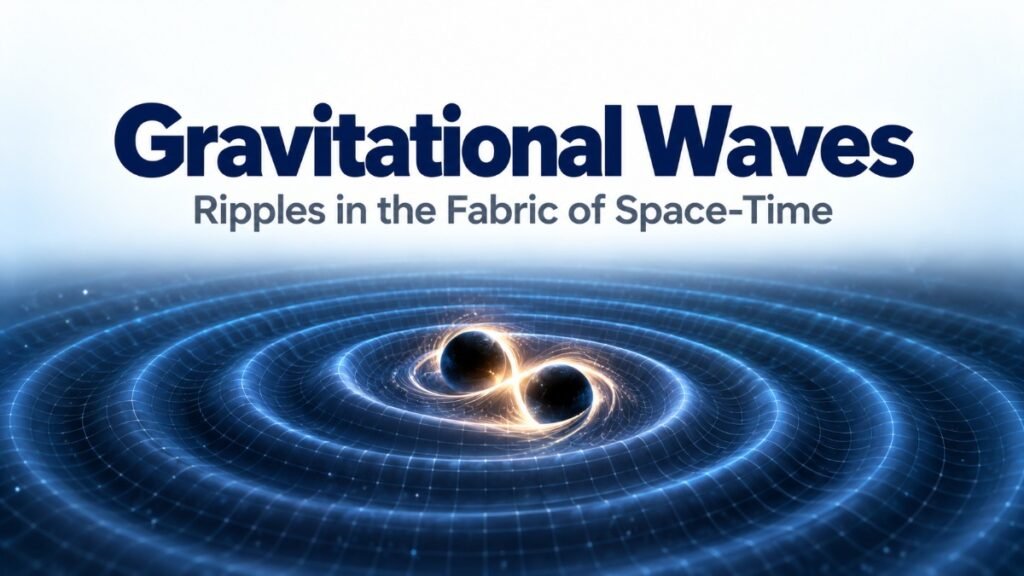
1. Meaning, Discovery and Working of Gravitational Waves
Gravitational Waves are ripples in the fabric of space-time caused by the acceleration of massive celestial objects such as black holes, neutron stars, and supernovae. They were first predicted by Albert Einstein in 1915 as part of his General Theory of Relativity, which states that massive objects bend space-time, and any disturbance in this curvature propagates outward as waves at the speed of light.
Unlike electromagnetic waves, which travel through space carrying light and other forms of radiation, Gravitational Waves are distortions of space-time itself and can pass through matter almost without being absorbed or scattered. As a result, they provide information about regions of the universe that are invisible to conventional telescopes.
The first direct detection of Gravitational Waves was made on 14 September 2015 by the Laser Interferometer Gravitational-Wave Observatory (LIGO) in the United States from the merger of two black holes, and the discovery was announced in 2016. This landmark achievement confirmed Einstein’s century-old prediction and earned the 2017 Nobel Prize in Physics. Today, gravitational waves are detected using highly sensitive laser interferometers such as LIGO (USA), Virgo (Italy), and KAGRA (Japan), which can measure changes in distance smaller than the diameter of a proton.
These developments make Gravitational Waves Notes an important topic for BPSC and UPSC preparation, particularly under Science and Technology and developments in modern astronomy.
Master Science & Technology. Maximize Your BPSC Mains Score.
Enroll in the BPSC Science & Tech Course Today
Master Science & Technology for BPSC Mains GS Paper-2 with 75+ exam-oriented topics, 6 structured lessons, and downloadable PDF notes—all in one course.
✔ 75+ Exam-Oriented Topics • ✔ 6 Comprehensive Lessons • ✔ Downloadable PDF Notes • ✔ Updated for 72nd BPSC Mains
2. Significance and Applications of Gravitational Waves
The discovery of Gravitational Waves has revolutionized modern astronomy by giving rise to Gravitational Wave Astronomy, often referred to as a new window to the universe. Unlike conventional telescopes that observe electromagnetic radiation, gravitational-wave detectors enable scientists to study violent cosmic events such as black hole mergers, neutron star collisions, and supernova explosions, many of which are otherwise impossible to observe directly. They provide an unprecedented opportunity to test the validity of Einstein’s General Theory of Relativity under extreme gravitational conditions and improve our understanding of the fundamental laws of physics.
The detection of gravitational waves from colliding neutron stars has also helped explain the origin of heavy elements such as gold and platinum, which are formed through rapid neutron-capture processes. Furthermore, gravitational waves offer valuable insights into the early universe, potentially revealing information from periods immediately after the Big Bang, where electromagnetic radiation cannot penetrate. Their study contributes significantly to astrophysics, cosmology, nuclear physics, and high-precision instrumentation, while also driving innovations in laser technology, optics, data analysis, artificial intelligence, and quantum sensing.
Thus, Gravitational Waves research not only enhances our knowledge of the universe but also promotes technological advancements with applications beyond astronomy. These developments are an important area covered in Gravitational Waves Notes for BPSC and UPSC Science and Technology preparation.
Prepare Smarter. Study Better. Ace BPSC Mains.
BPSC Mains GS Paper 1 & 2 Complete Course
Access comprehensive BPSC Mains Notes for GS Paper 1 & 2, covering 378+ topics across 24 PDF lessons, with dedicated Bihar coverage, practice questions and downloadable study material.
✓ GS Paper 1 & 2 • ✓ 378+ Topics • ✓ 24 PDF Lessons • ✓ Bihar-Specific Coverage • ✓ Downloadable Notes
3. India’s Contribution, Recent Developments, Challenges and Way Forward
India is emerging as a key contributor to global gravitational-wave research through the LIGO-India Project, a collaborative initiative involving the Department of Atomic Energy (DAE), Department of Science and Technology (DST), and the LIGO Laboratory (USA). Approved by the Union Cabinet in 2023, the observatory is being established at Hingoli district in Maharashtra and is expected to become one of the world’s most advanced gravitational-wave detectors. As part of the global network alongside LIGO (USA), Virgo, and KAGRA, LIGO India will improve the accuracy of locating gravitational-wave sources, increase detection rates, and strengthen international scientific cooperation.
The project is expected to boost India’s capabilities in precision engineering, laser technology, advanced computing, artificial intelligence, and big data analytics while creating opportunities for indigenous manufacturing and high-quality scientific research. It will also help develop skilled human resources and encourage participation of Indian universities and research institutions in frontier science.
Despite its immense potential, gravitational-wave research faces several challenges. Detecting these waves requires extremely sophisticated instruments capable of measuring incredibly tiny distortions, making the technology highly expensive and technically demanding. Environmental vibrations, seismic activity, and human-generated noise can interfere with observations, necessitating advanced isolation systems.
There is also a need for sustained funding, multidisciplinary expertise, and stronger international collaboration. Future projects such as the Laser Interferometer Space Antenna (LISA), Einstein Telescope, and Cosmic Explorer are expected to detect even weaker and more distant gravitational-wave signals, enabling scientists to study the evolution of the universe with greater precision.
For India, ensuring timely completion of LIGO-India, promoting indigenous research, strengthening collaboration between academia and industry, and investing in advanced scientific infrastructure will be crucial. As gravitational-wave astronomy opens an entirely new frontier in understanding the cosmos, India’s growing participation in this field will not only enhance its global scientific stature but also contribute significantly to the vision of Viksit Bharat 2047 by fostering innovation, technological self-reliance, and world-class research.
4. Conclusion
Gravitational Waves have opened a new window for understanding the universe and studying some of its most violent cosmic events. Their detection has strengthened our understanding of Einstein’s theory and created new possibilities in astronomy, astrophysics and fundamental physics. For India, the LIGO India project represents an important step towards building capabilities in advanced scientific research, precision engineering and high-end instrumentation. Continued investment in indigenous technology, skilled human resources and international collaboration will help India contribute more significantly to global gravitational-wave research. Strengthening such frontier science will support innovation, scientific excellence and India’s broader vision of Viksit Bharat 2047.
BPSC Mains Practice Question
What are Gravitational Waves? Explain their significance in modern astronomy and examine India’s contribution through the LIGO-India project.
Learn More About Gravitational Waves
For official information on gravitational-wave research and the LIGO-India project, visit the Department of Science and Technology (DST), Government of India: Department of Science and Technology – LIGO-India. The department provides official information on India’s participation in gravitational-wave research and major scientific infrastructure projects.