1. Quantum Technology: Meaning
Quantum Technology is a field of science that applies the principles of quantum mechanics—the study of the behaviour of matter and energy at the atomic and subatomic levels—to develop next-generation technologies. Unlike conventional technologies, quantum technology harnesses unique quantum phenomena such as superposition and entanglement to perform tasks with greater speed, precision, and security.
The fundamental unit of a quantum computer is the qubit (quantum bit). Unlike a classical bit, which can exist only as 0 or 1, a qubit can exist in multiple states simultaneously, enabling quantum computers to solve highly complex problems much faster than conventional computers.
Master Science & Technology. Maximize Your BPSC Mains Score.
Enroll in the BPSC Science & Tech Course Today
Master Science & Technology for BPSC Mains GS Paper-2 with 75+ exam-oriented topics, 6 structured lessons, and downloadable PDF notes—all in one course.
✔ 75+ Exam-Oriented Topics • ✔ 6 Comprehensive Lessons • ✔ Downloadable PDF Notes • ✔ Updated for 72nd BPSC Mains
2. National Quantum Mission (NQM): Key Features
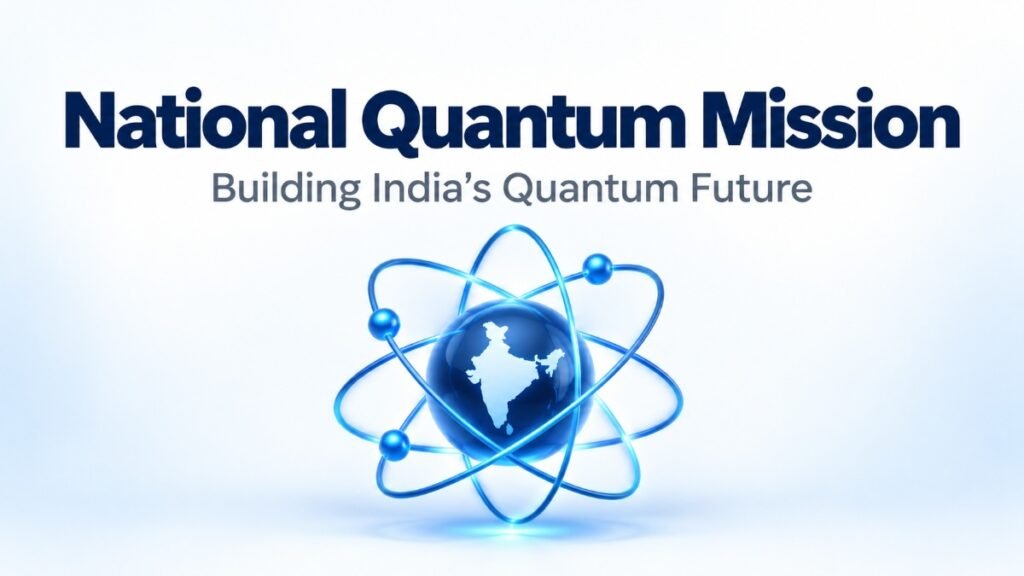
- Launch: Approved by the Union Cabinet in April 2023 with a budget outlay of ₹6,003.65 crore for the period 2023–2031.
- Nodal Ministry: The mission is being implemented by the Department of Science and Technology (DST) under the Ministry of Science and Technology.
- Objective: To establish India as a global leader in Quantum Technologies by promoting research, innovation, indigenous manufacturing, startup ecosystem, and skilled human resources. The National Quantum Mission in India therefore focuses on building a strong domestic quantum ecosystem.
- Quantum Computing: Develop intermediate-scale quantum computers with 50–100 physical qubits within 5 years and 50–1000 physical qubits within 8 years.
- Secure Quantum Communication: Establish satellite-based secure quantum communication over 2,000 km within India, inter-city Quantum Key Distribution (QKD) networks, and long-distance secure communication with other countries.
- Quantum Sensing and Metrology: Develop highly sensitive quantum sensors, magnetometers, and atomic clocks for applications in navigation, precision timing, defence, space, and scientific research.
- Quantum Materials and Devices: Promote the development of advanced quantum materials, including superconductors, novel semiconductors, and topological materials, for next-generation quantum devices.
- Four Thematic Hubs (T-Hubs): The mission will establish dedicated research hubs in premier academic and R&D institutions in four domains:
- Quantum Computing
- Quantum Communication
- Quantum Sensing & Metrology
- Quantum Materials & Devices
- Global Significance: With the launch of the National Quantum Mission, India became the seventh country to have a dedicated national mission on quantum technology after the USA, Austria, Finland, France, Canada, and China.
Prepare Smarter. Study Better. Ace BPSC Mains.
BPSC Mains GS Paper 1 & 2 Complete Course
Access comprehensive BPSC Mains Notes for GS Paper 1 & 2, covering 378+ topics across 24 PDF lessons, with dedicated Bihar coverage, practice questions and downloadable study material.
✓ GS Paper 1 & 2 • ✓ 378+ Topics • ✓ 24 PDF Lessons • ✓ Bihar-Specific Coverage • ✓ Downloadable Notes
3. Applications of Quantum Technology
Computing and Artificial Intelligence (AI)
Quantum technology has the potential to revolutionize computing by solving highly complex mathematical and optimization problems that are beyond the capability of today’s supercomputers. It can significantly accelerate Artificial Intelligence (AI), machine learning, big data analytics, weather forecasting, and scientific simulations, enabling faster decision-making and innovation. Quantum Computing in India is expected to play a crucial role in drug discovery, financial modelling, and optimization of complex industrial processes.
Example: Google’s 105-qubit quantum processor “Willow” (2024) demonstrated advanced quantum error correction, marking a major step towards practical quantum computing and next-generation AI applications.
Cyber Security and Secure Communication
Quantum technology enables ultra-secure communication through Quantum Key Distribution (QKD), where any attempt to intercept transmitted information is immediately detected. This makes quantum communication virtually immune to hacking and highly suitable for protecting banking transactions, military communications, government networks, digital payments, and critical infrastructure. With cyberattacks increasing globally, quantum encryption is expected to become the foundation of future digital security.
Example: In 2022, DRDO and IIT Delhi successfully demonstrated India’s first inter-city Quantum Key Distribution (QKD) link over more than 100 km, marking a significant milestone towards building secure quantum communication networks in the country. Quantum Technology in India can therefore play an important role in strengthening secure communication and protecting critical digital infrastructure.
Defence and National Security
Quantum technology can significantly strengthen national security through secure military communication, advanced surveillance, precision navigation, quantum radar, and faster intelligence processing. Quantum communication networks are highly resistant to cyberattacks, making them ideal for protecting sensitive defence information. Quantum sensors can also improve submarine detection, missile guidance, and battlefield awareness, thereby enhancing the operational capabilities of the armed forces.
Example: Under the National Quantum Mission (NQM), India aims to develop satellite-based secure quantum communication over 2,000 km, enabling highly secure communication for defence and strategic agencies. These National Quantum Mission Applications demonstrate the strategic importance of quantum technology for India’s defence, secure communication and national security.
Healthcare and Drug Discovery
Quantum technology has the potential to transform healthcare by enabling rapid drug discovery, personalized medicine, genomic analysis, disease modelling, and medical diagnostics. Quantum computers can simulate complex molecular interactions much faster than classical computers, significantly reducing the time and cost required to develop new medicines. This could accelerate the discovery of treatments for diseases such as cancer, Alzheimer’s, and rare genetic disorders.
Example: IBM Quantum is collaborating with leading pharmaceutical companies such as Cleveland Clinic to use quantum computing for drug discovery and biomedical research, aiming to develop more effective medicines in a shorter time. These National Quantum Mission Applications highlight the potential of quantum technology to support advanced healthcare research and pharmaceutical innovation.
Banking and Financial Services
Quantum technology can transform the financial sector by enabling high-speed risk analysis, portfolio optimization, fraud detection, algorithmic trading, and secure digital transactions. Quantum computers can process vast volumes of financial data in real time, helping banks and financial institutions make faster and more accurate investment and risk management decisions. Quantum encryption will also strengthen the security of digital payments, online banking, and financial networks, reducing the risk of cyber fraud.
Example: JPMorgan Chase, in collaboration with IBM Quantum, is exploring quantum computing for portfolio optimization, risk modelling, and financial fraud detection, demonstrating its potential to revolutionize modern banking. National Quantum Mission Applications in financial services can therefore support secure digital transactions, advanced risk management and efficient financial decision-making.
Space and Satellite Communication
Quantum technology can significantly improve satellite communication, deep-space exploration, navigation, and Earth observation. Quantum communication enables the transmission of data through highly secure satellite networks, while quantum sensors enhance the accuracy of satellite positioning and navigation systems. These advancements are expected to strengthen national security, disaster management, and strategic communications.
Example: In 2016, China launched Micius, the world’s first quantum communication satellite, successfully demonstrating satellite-based Quantum Key Distribution (QKD) over thousands of kilometres and establishing the feasibility of ultra-secure global communication. Quantum Technology in India can use such advances as a reference for developing secure satellite communication and advanced space capabilities under the National Quantum Mission.
Climate Modelling and Disaster Management
Quantum technology can significantly improve weather forecasting, climate modelling, disaster prediction, and environmental monitoring by processing enormous volumes of atmospheric and geophysical data at unprecedented speed. Quantum computers can develop more accurate climate models, enabling better prediction of cyclones, floods, droughts, earthquakes, and other natural disasters. This will strengthen disaster preparedness, resource planning, and climate change mitigation, which are critical for a disaster-prone country like India.
Example: Researchers at IBM Quantum are exploring the use of quantum computing to simulate complex climate systems and improve long-term weather and climate prediction models. These National Quantum Mission Applications can contribute to improved climate modelling, disaster preparedness and environmental management.
Advanced Manufacturing and Material Science
Quantum technology is accelerating innovation in advanced manufacturing by enabling the discovery and design of new materials with superior strength, conductivity, and energy efficiency. It can help develop next-generation semiconductors, superconductors, lightweight alloys, high-performance batteries, and advanced electronic devices. These innovations will boost sectors such as electronics, electric vehicles (EVs), aerospace, renewable energy, and defence, strengthen India’s technological competitiveness and support Make in India.
Example: Google DeepMind’s AI system GNoME (Graph Networks for Materials Exploration), supported by quantum-based material simulations, has identified over 2.2 million new crystal structures, significantly accelerating the discovery of advanced materials for future technologies. Quantum Technology in India can therefore support indigenous material development and advanced manufacturing capabilities across strategic sectors.
4. Challenges Associated with Quantum Technology
- High Cost: Quantum computers require highly sophisticated infrastructure, specialized materials, and ultra-low temperature environments, making them extremely expensive to develop and maintain.
- Technological Complexity: Quantum systems are highly sensitive to external disturbances such as heat, vibrations, and electromagnetic interference, making them difficult to build and operate reliably.
- Shortage of Skilled Manpower: India currently has a limited pool of experts in quantum computing, quantum communication, and quantum engineering, creating a gap between research and large-scale deployment.
- Cybersecurity Transition Challenges: While quantum technology enables secure communication, powerful quantum computers could also break many existing encryption algorithms, necessitating the development of post-quantum cryptography.
- Limited Industrial Ecosystem: India’s quantum technology ecosystem is still at a nascent stage, with limited private sector participation, startup support, and commercialization of research.
5. Conclusion
India should strengthen its quantum research ecosystem by increasing investment in R&D, promoting collaboration between academia, industry, and startups, and developing a skilled workforce in quantum technologies. Simultaneously, efforts should be made to build indigenous quantum hardware, strengthen post-quantum cybersecurity, and encourage international partnerships. With the effective implementation of the National Quantum Mission, quantum technology can become a key driver of Digital India, Atmanirbhar Bharat, and Viksit Bharat 2047, enhancing India’s global leadership in emerging technologies.
BPSC Mains Practice Question
“The National Quantum Mission has the potential to transform India’s technological capabilities and strengthen its strategic autonomy.” Discuss the major objectives and applications of the National Quantum Mission and examine the key challenges in its implementation.
Learn More About National Quantum Mission
For official information on the National Quantum Mission, its objectives, implementation and India’s quantum technology initiatives, visit the Department of Science & Technology (DST), Government of India: Department of Science & Technology – National Quantum Mission. The DST provides official information on the mission and India’s efforts to develop a strong quantum technology ecosystem.