1. Introduction
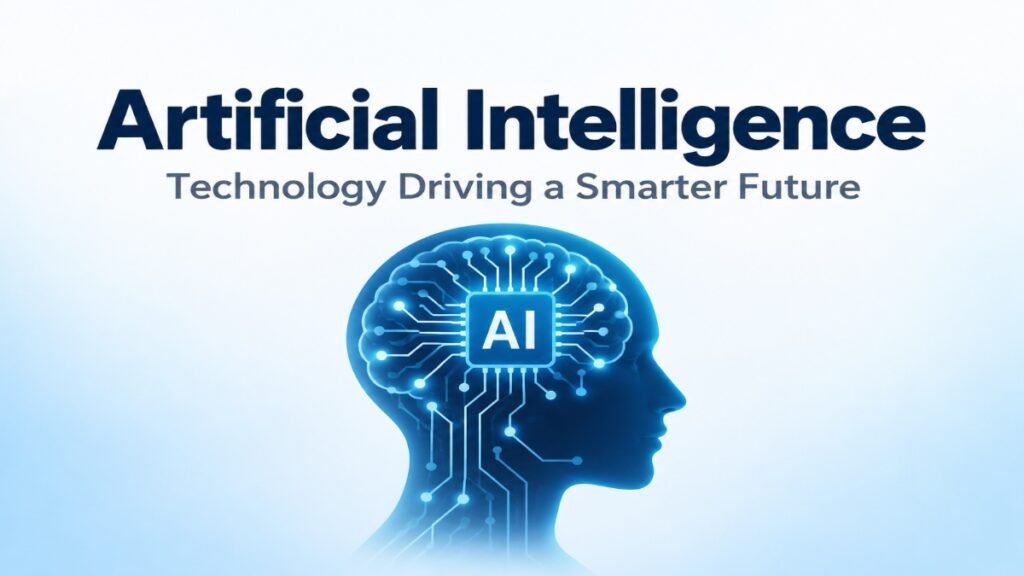
Artificial Intelligence (AI) is a branch of computer science that enables machines or computer systems to perform tasks that normally require human intelligence, such as learning, reasoning, problem-solving, decision-making, language understanding and pattern recognition. Artificial Intelligence systems analyse large volumes of data, identify patterns and continuously improve their performance through experience. Unlike traditional computer programs that follow fixed instructions, Artificial Intelligence can make predictions and support decision-making based on available data.
Artificial Intelligence is not intended to replace human intelligence completely. Rather, it acts as an intelligent assistant by improving efficiency, reducing human effort and enabling faster and more accurate decisions in various sectors. Machine Learning (ML) and Deep Learning (DL) are important subsets of AI that enable computers to learn from data and solve increasingly complex problems. Recent advances in Generative AI (such as ChatGPT and Gemini) have further expanded AI’s capabilities by enabling machines to generate text, images, audio and computer code.
Why is Artificial Intelligence Important Today?
- AI is driving the Fourth Industrial Revolution (Industry 4.0) by transforming industries through automation, intelligent decision-making and data-driven innovation.
- It is becoming an essential technology for improving healthcare, agriculture, education, governance, defence, manufacturing, finance and scientific research.
- Governments across the world, including India, are investing heavily in Artificial Intelligence to promote economic growth, improve public service delivery and enhance global competitiveness.
- India’s vision of “AI for All”, promoted by NITI Aayog and strengthened through the IndiaAI Mission, aims to ensure that AI benefits every section of society while promoting responsible and ethical use.
- Artificial Intelligence in India is increasingly being integrated into key sectors such as agriculture, healthcare, education, governance and public services.
AI is often called the “new electricity” because, like electricity transformed every industry in the 20th century, Artificial Intelligence is expected to transform almost every sector of the economy in the 21st century.
Master Science & Technology. Maximize Your BPSC Mains Score.
Enroll in the BPSC Science & Tech Course Today
Master Science & Technology for BPSC Mains GS Paper-2 with 75+ exam-oriented topics, 6 structured lessons, and downloadable PDF notes—all in one course.
✔ 75+ Exam-Oriented Topics • ✔ 6 Comprehensive Lessons • ✔ Downloadable PDF Notes • ✔ Updated for 72nd BPSC Mains
2. Evolution of Artificial Intelligence (AI)
- 1956: The term “Artificial Intelligence” was coined by John McCarthy at the Dartmouth Conference, marking the birth of Artificial Intelligence as a scientific discipline.
- 1980s–1990s: Development of Machine Learning (ML) enabled computers to learn from data instead of relying only on fixed programming.
- 2010s: Advances in Deep Learning (DL), cloud computing and big data significantly improved AI’s ability in image recognition, speech processing and language understanding.
- 2022 onwards: The emergence of Generative AI (e.g., ChatGPT, Gemini, Claude) revolutionized AI Technology by enabling machines to generate human-like text, images, audio and computer code.
- Present: Artificial Intelligence has become a strategic technology driving innovation in sectors such as healthcare, agriculture, education, governance, defence and scientific research.
Prepare Smarter. Study Better. Ace BPSC Mains.
BPSC Mains GS Paper 1 & 2 Complete Course
Access comprehensive BPSC Mains Notes for GS Paper 1 & 2, covering 378+ topics across 24 PDF lessons, with dedicated Bihar coverage, practice questions and downloadable study material.
✓ GS Paper 1 & 2 • ✓ 378+ Topics • ✓ 24 PDF Lessons • ✓ Bihar-Specific Coverage • ✓ Downloadable Notes
3. Difference between Artificial Intelligence, Machine Learning (ML), Deep Learning (DL) and Generative AI
| Aspect | Artificial Intelligence (AI) | Machine Learning (ML) | Deep Learning (DL) | Generative AI |
|---|---|---|---|---|
| Meaning | Broad field that enables machines to mimic human intelligence | Subset of AI that learns from data | Subset of ML using multi-layered neural networks | AI that creates new content such as text, images, audio and videos |
| How it Works | Uses rules, logic and learning techniques | Learns patterns from data | Learns complex patterns from large datasets | Generates new content based on learned patterns |
| Data Requirement | Low to High | Moderate | Very High | Very High |
| Examples | Virtual assistants, expert systems | Spam filters, recommendation systems | Face recognition, speech recognition | ChatGPT, Gemini, DALL·E, Midjourney |
4. Applications of Artificial Intelligence (AI)
AI in Agriculture
Artificial Intelligence is making agriculture more productive, efficient and climate-resilient by enabling data-driven farming practices.
- Precision Farming: AI analyses soil health, weather conditions and satellite images to recommend the optimum time for sowing, irrigation and fertilizer application, thereby increasing productivity while reducing input costs.
- Crop Disease Detection: AI-powered applications can identify crop diseases and pest attacks at an early stage by analysing images of affected crops, enabling timely treatment and reducing crop losses. Example: Plantix helps farmers diagnose crop diseases through smartphone images.
- Yield Prediction: AI uses historical data, weather forecasts and crop conditions to estimate agricultural output, helping farmers and governments plan procurement and food distribution efficiently. Example: The Microsoft–ICRISAT AI Project in Andhra Pradesh increased groundnut yield by nearly 30% through AI-based sowing advisories.
- Farmer Advisory Services: AI-powered chatbots and digital platforms provide farmers with real-time information on government schemes, weather forecasts and best farming practices. Example: The Government of India’s Kisan e-Mitra chatbot under PM-KISAN offers instant assistance to farmers.
Artificial Intelligence Applications in agriculture can therefore support farmers in improving productivity, reducing input costs and making better decisions.
AI in Healthcare
Artificial Intelligence is transforming healthcare by improving diagnosis, treatment, medical research and healthcare delivery.
- Early Disease Diagnosis: AI analyses X-rays, CT scans and MRI images with high accuracy, enabling doctors to detect diseases such as tuberculosis, cancer and pneumonia at an early stage. Example: Indian startup Qure.ai uses AI for rapid detection of TB from chest X-rays.
- Cancer Screening and Personalized Treatment: AI helps identify diseases in their early stages and assists doctors in designing personalized treatment plans based on patient data. Example: Bengaluru-based Niramai uses AI-based thermal imaging for early breast cancer screening without radiation.
- Drug Discovery and Medical Research: AI significantly reduces the time and cost of developing new medicines by analysing vast biomedical datasets. Example: AI accelerated vaccine and drug research during the COVID-19 pandemic.
- Telemedicine and Healthcare Access: AI-powered virtual assistants and remote monitoring systems improve healthcare access in rural and underserved areas. Example: The Indian Council of Medical Research (ICMR) has issued ethical guidelines for the responsible use of AI in healthcare.
Artificial Intelligence in India is also supporting the use of AI-based solutions to improve healthcare access and delivery.
AI in Education
Artificial Intelligence is making education more personalized, accessible and effective by catering to the diverse learning needs of students.
- Personalized Learning: AI analyses students’ learning patterns, strengths and weaknesses to provide customized study materials, quizzes and learning paths, thereby improving learning outcomes.
- Smart Teaching and Assessment: AI automates routine tasks such as evaluation, attendance, question generation and performance analysis, allowing teachers to focus more on interactive teaching.
- 24×7 Learning Support: AI-powered virtual tutors and chatbots provide instant explanations, doubt resolution and multilingual learning support, making quality education accessible anytime and anywhere. Example: Platforms such as ChatGPT and Google Gemini are increasingly being used as learning assistants.
- Government Initiatives: AI is being integrated into digital education platforms to improve learning outcomes. Example: The DIKSHA platform uses AI-based recommendations to provide personalized digital learning resources, while PM eVIDYA expands access to online education across the country.
Artificial Intelligence Applications in education can improve personalized learning, automated assessment and access to learning support.
AI in Governance and Public Services
Artificial Intelligence is improving governance by making public service delivery faster, transparent and citizen-centric.
- Efficient Public Service Delivery: AI-powered chatbots and virtual assistants provide citizens with instant information on government schemes, certificates and grievance redressal, reducing delays and improving accessibility. Example: Kisan e-Mitra assists farmers under the PM-KISAN scheme.
- Better Decision-Making: AI analyses large volumes of administrative data to support evidence-based policymaking, resource allocation and implementation of welfare schemes.
- Smart Governance and Urban Management: AI helps monitor traffic, manage public utilities, detect tax evasion and improve municipal services through real-time data analysis. Example: AI-enabled Integrated Command and Control Centres (ICCCs) under the Smart Cities Mission help manage traffic, surveillance and emergency response.
- Language Inclusion and Digital Governance: AI is breaking language barriers by enabling real-time translation and voice-based access to government services. Example: The BHASHINI initiative promotes AI-driven translation and speech technologies to deliver digital services in Indian languages.
AI in India is therefore becoming an important tool for improving accessibility, efficiency and citizen-centric governance.
AI in Banking and Financial Services
Artificial Intelligence is transforming the banking and financial sector by improving efficiency, security and customer experience.
- Fraud Detection and Cybersecurity: AI analyses millions of financial transactions in real time to detect suspicious activities, helping banks prevent fraud, phishing and cyberattacks before major losses occur.
- Digital Banking and Customer Support: AI-powered chatbots and virtual assistants provide 24×7 customer support, resolve queries instantly and reduce waiting time. Example: SIA (State Bank of India) and EVA (HDFC Bank) assist customers with banking services and information.
- Credit Assessment and Loan Approval: AI evaluates customers’ financial history, spending behaviour and repayment capacity to assess creditworthiness, enabling faster and more accurate loan approvals while reducing the risk of bad loans.
- Investment and Financial Planning: AI-based robo-advisors analyse market trends and investor preferences to provide personalised investment advice and portfolio management, making financial services more accessible.
AI in Defence and National Security
Artificial Intelligence is strengthening national security by enhancing surveillance, intelligence gathering, border management and modern warfare capabilities.
- Intelligence, Surveillance and Reconnaissance (ISR): AI analyses satellite imagery, drone feeds and sensor data to identify suspicious activities, enabling faster and more accurate intelligence for security agencies.
- Autonomous Defence Systems: AI enables drones, unmanned ground vehicles and robotic systems to carry out surveillance, reconnaissance and logistics operations in high-risk areas with minimal human intervention. Example: DRDO’s Alpha-S swarm drone system can coordinate multiple drones simultaneously for surveillance and combat missions.
- Border Management: AI-powered cameras, sensors and facial recognition systems help monitor borders, detect illegal infiltration and improve real-time situational awareness. Example: AI-enabled surveillance systems are being deployed along India’s international borders to strengthen border security.
- Cyber Defence and Threat Detection: AI continuously monitors digital networks to detect cyberattacks, malware and unusual activities, enabling rapid response to emerging security threats.
These Artificial Intelligence Applications demonstrate the growing role of AI Technology in strengthening India’s defence and national security capabilities.
AI in Industry and Manufacturing
Artificial Intelligence is driving Industry 4.0 by making manufacturing smarter, faster and more cost-effective.
- Smart Manufacturing: AI automates production processes, monitors machinery in real time and optimizes manufacturing operations, leading to higher productivity and lower operational costs.
- Predictive Maintenance: AI analyses machine performance and sensor data to predict equipment failures before they occur, reducing downtime and maintenance costs. Example: Tata Steel uses AI-based predictive maintenance to improve operational efficiency in its manufacturing plants.
- Quality Control: AI-powered computer vision systems inspect products with high precision, detect defects and ensure consistent product quality. Example: Maruti Suzuki uses AI-enabled vision systems for quality inspection during automobile manufacturing.
- Supply Chain Optimization: AI forecasts demand, manages inventory and optimizes logistics, enabling industries to reduce waste and improve delivery efficiency.
AI in Transport and Smart Mobility
Artificial Intelligence is making transportation safer, faster and more efficient by improving traffic management, logistics and public transport systems.
- Intelligent Traffic Management: AI analyses real-time traffic data to optimize traffic signals, reduce congestion and improve road safety. Example: AI-based Adaptive Traffic Management Systems (ATMS) have been implemented in cities such as Bengaluru and Delhi to reduce travel time.
- Road Safety and Accident Prevention: AI-enabled cameras detect traffic violations such as overspeeding, wrong-side driving and red-light jumping, helping authorities enforce traffic rules more effectively.
- Railway Safety and Operations: AI monitors railway tracks, signalling systems and locomotives to predict faults and prevent accidents, thereby improving operational efficiency. Example: Indian Railways is increasingly using AI-based predictive maintenance for locomotives and critical railway infrastructure.
- Smart Logistics and Route Optimization: AI identifies the shortest and most fuel-efficient routes for passenger and freight transport, reducing transportation costs and carbon emissions.
AI in Disaster Management
Artificial Intelligence is enhancing disaster management by enabling early warning, rapid response and effective damage assessment, thereby reducing the loss of life and property.
- Early Warning Systems: AI analyses weather, satellite and historical disaster data to accurately predict floods, cyclones, heatwaves and other natural disasters, allowing authorities to issue timely warnings.
- Disaster Monitoring and Damage Assessment: AI processes satellite images and drone data to identify affected areas, assess the extent of damage and support faster relief and rehabilitation operations.
- Search and Rescue Operations: AI-powered drones and robots help locate survivors, monitor inaccessible areas and assist rescue teams during earthquakes, floods and landslides.
- Disaster Risk Planning: AI helps governments identify disaster-prone regions and prepare mitigation strategies through predictive modelling. Example: Google Flood Hub uses AI to provide flood forecasts in India, while the India Meteorological Department (IMD) is increasingly using AI for improving weather prediction.
AI in Environment and Climate Change
Artificial Intelligence is supporting environmental conservation by enabling efficient monitoring, sustainable resource management and climate action.
- Air and Water Quality Monitoring: AI analyses real-time environmental data to predict pollution levels, identify pollution hotspots and support timely policy interventions. Example: AI-based models are being used to improve Air Quality Index (AQI) forecasting in major Indian cities.
- Wildlife and Forest Conservation: AI-powered camera traps, drones and image recognition systems help monitor wildlife populations, detect poaching activities and protect biodiversity. Example: AI-enabled camera traps are being used for tiger monitoring in several Indian tiger reserves.
- Forest Fire Detection and Climate Monitoring: AI analyses satellite imagery to detect forest fires at an early stage and supports climate modelling by analysing large volumes of environmental data.
- Sustainable Resource Management: AI optimizes the use of water, energy and natural resources, helping reduce wastage and supporting sustainable development.
AI in Space Research
Artificial Intelligence is revolutionizing space research by improving mission planning, satellite operations and analysis of vast amounts of space data.
- Satellite Data Analysis: AI rapidly analyses images received from Earth observation satellites to monitor agriculture, urbanization, natural disasters and climate change, enabling faster and more accurate decision-making.
- Space Mission Planning: AI assists scientists in mission planning, spacecraft navigation and autonomous decision-making, reducing human intervention and improving mission efficiency.
- Space Debris Monitoring: AI tracks thousands of space objects, predicts possible collisions and helps protect operational satellites from damage, ensuring safer space operations.
- Planetary Exploration: AI enables robotic spacecraft and planetary rovers to navigate unfamiliar terrain, identify scientific targets and perform autonomous operations. Example: ISRO is increasingly integrating AI into satellite data processing and future missions such as Gaganyaan and Chandrayaan to improve mission efficiency.
AI in Cyber Security
Artificial Intelligence is strengthening cybersecurity by enabling real-time threat detection, faster response and proactive defence against cyber threats.
- Threat Detection and Prevention: AI continuously monitors network activity, identifies unusual behaviour and detects cyber threats such as malware, ransomware and phishing attacks before they cause significant damage.
- Fraud Detection: AI analyses millions of digital transactions in real time to identify suspicious activities, helping banks, e-commerce platforms and payment systems prevent financial fraud.
- Automated Incident Response: AI automatically isolates infected systems, blocks malicious traffic and assists cybersecurity teams in responding quickly to cyber incidents, thereby minimizing damage.
- Protection of Critical Infrastructure: AI safeguards critical sectors such as banking, power grids, defence and telecommunications by continuously monitoring digital networks and identifying vulnerabilities. Example: CERT-In is increasingly leveraging AI and advanced analytics to strengthen India’s cyber resilience against evolving cyber threats.
These Artificial Intelligence Applications show how AI can strengthen India’s digital security while enabling faster detection and response to cyber threats.
5. Advantages / Significance of Artificial Intelligence (AI)
- Economic Growth and Productivity: AI automates repetitive tasks, improves operational efficiency and reduces costs, thereby enhancing productivity across agriculture, manufacturing, healthcare and services. It is expected to become a major driver of India’s digital economy.
- Improved Public Service Delivery: AI enables faster, transparent and citizen-centric governance through smart administration, digital service delivery, grievance redressal and evidence-based policymaking.
- Better Healthcare and Quality of Life: AI supports early disease diagnosis, personalized treatment, drug discovery and telemedicine, making quality healthcare more accessible, especially in rural and remote areas.
- Scientific Innovation and Research: AI accelerates research by analysing large datasets, supporting discoveries in fields such as biotechnology, pharmaceuticals, climate science and space exploration.
- National Security and Disaster Resilience: AI strengthens border surveillance, cybersecurity, disaster prediction and emergency response, thereby enhancing India’s internal security and disaster preparedness.
- Inclusive and Sustainable Development: AI promotes financial inclusion, smart agriculture, environmental conservation and efficient resource management, contributing to the achievement of the Sustainable Development Goals (SDGs) and Viksit Bharat 2047.
6. Challenges and Concerns of Artificial Intelligence (AI)
- Job Displacement and Skill Gap: AI-driven automation may replace routine and repetitive jobs, particularly in manufacturing, customer support and data entry, increasing the need for reskilling and upskilling of the workforce.
- Bias and Ethical Concerns: AI systems learn from existing data, which may contain biases based on gender, caste or race. As a result, AI-based decisions may be unfair or discriminatory if not properly monitored.
- Privacy and Data Security: AI requires vast amounts of personal data for training and decision-making. Inadequate protection of such data may lead to privacy violations, identity theft and misuse of sensitive information.
- Deepfakes and Misinformation: AI-generated fake images, videos and audio (deepfakes) can spread misinformation, influence elections, damage reputations and pose serious challenges to national security.
- Cybersecurity Risks: While AI strengthens cyber defence, it can also be misused by cybercriminals to develop sophisticated malware, automate hacking attempts and launch large-scale cyberattacks.
- Lack of Transparency and Accountability: Many AI systems function as ‘black boxes’, making it difficult to understand how decisions are made or who should be held accountable when AI causes errors or harm.
- Legal and Regulatory Challenges: The rapid growth of AI has outpaced existing laws, creating challenges related to liability, copyright, intellectual property and ethical governance.
- Digital Divide and High Cost: Unequal access to digital infrastructure, skilled manpower and computing resources may widen the technology gap between developed and developing regions, including between urban and rural India.
7. AI Governance and Regulation in India
India follows a pro-innovation and risk-based approach to AI governance, aiming to promote innovation while ensuring that AI remains safe, transparent, ethical and accountable.
- National Strategy for AI (2018): Released by NITI Aayog with the vision of “AI for All”, focusing on inclusive growth and the use of AI in sectors such as healthcare, agriculture, education, smart mobility and smart cities.
- Responsible AI Framework: NITI Aayog’s Responsible AI for All guidelines promote principles such as fairness, transparency, accountability, privacy and safety in the development and deployment of AI.
- Digital Personal Data Protection (DPDP) Act, 2023: Provides a legal framework for the protection and lawful processing of personal data, which is crucial for AI systems relying on large datasets.
- Global Cooperation: India actively participates in global AI governance discussions through platforms such as the G20, Global Partnership on AI (GPAI) and the Bletchley Declaration on AI safety.
8. Government Initiatives Promoting Artificial Intelligence (AI)
- IndiaAI Mission (2024): Flagship mission with an outlay of ₹10,371.92 crore to strengthen AI computing infrastructure, indigenous AI models, startups, skill development and responsible AI innovation.
- National Strategy for AI – AI for All: Launched by NITI Aayog (2018) to promote the use of AI in priority sectors such as healthcare, agriculture, education, smart mobility and smart cities.
- IndiaAI Compute Portal: Provides access to high-performance Graphics Processing Units (GPUs), enabling startups, researchers and academic institutions to develop AI applications at affordable costs.
- BHASHINI (National Language Translation Mission): Uses AI to provide real-time translation and speech technologies in Indian languages, making digital services more inclusive and accessible.
- Centres of Excellence (CoEs) in AI: The Government has established AI Centres of Excellence in sectors such as healthcare, agriculture and sustainable cities to promote research, innovation and industry collaboration.
- AI Skilling and Innovation: Initiatives such as FutureSkills PRIME, Digital India and AI-focused programmes in IITs, IIITs and NITs are strengthening India’s AI talent pool and innovation ecosystem.
Artificial Intelligence in India is thus being promoted through initiatives covering computing infrastructure, indigenous AI development, language technology, research, skilling and responsible innovation.
9. Conclusion
Artificial Intelligence has emerged as a transformative technology with the potential to revolutionize sectors such as healthcare, agriculture, education, governance, manufacturing and national security. For India, Artificial Intelligence offers a unique opportunity to accelerate economic growth, improve public service delivery and achieve the vision of Viksit Bharat 2047.
However, the rapid adoption of AI must be accompanied by ethical governance, data privacy, transparency and skill development to address challenges such as job displacement, bias and cybersecurity risks. A human-centric and responsible AI ecosystem, guided by the principle of “AI for All”, will ensure that technological progress benefits every section of society.
BPSC Mains Practice Question
- Artificial Intelligence is transforming governance, economy and national security, but its benefits are accompanied by significant ethical and regulatory challenges. Discuss the opportunities and challenges of Artificial Intelligence in India.
- “AI for All” can become an important instrument for achieving inclusive and sustainable development in India. Examine the major applications of Artificial Intelligence in agriculture, healthcare, education and governance, and suggest measures to ensure responsible and inclusive AI adoption.
Learn More About Artificial Intelligence
For official information on Artificial Intelligence, India’s AI initiatives, and responsible AI development, visit the Ministry of Electronics and Information Technology (MeitY), Government of India: Ministry of Electronics and Information Technology – Artificial Intelligence. The Ministry provides official information on India’s Artificial Intelligence initiatives, policies and measures related to responsible development and adoption of AI technologies.