1. Definition
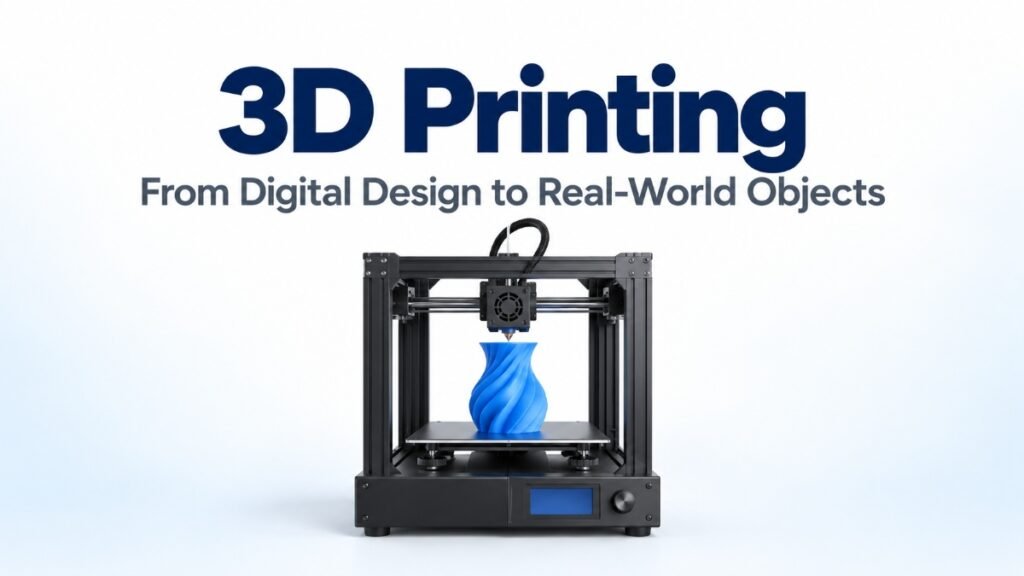
3D Printing, commonly known as Additive manufacturing (AM), is an emerging technology that is rapidly transforming manufacturing processes worldwide. This revolutionary method creates 3-dimensional objects by successively layering materials under computer control. 3D Printing Technology involves layering materials like plastics, composites, or bio-materials to create objects that range in shape, size, rigidity, and colour. Compared to traditional subtractive techniques, 3D Printing offers immense design flexibility, reduced waste, and the ability to produce complex geometries.
As one of the largest and fastest-growing economies, India holds tremendous potential for adopting 3D Printing Technology. The ‘Make in India’ initiative and vision for self-reliance have brought additive manufacturing into sharp focus. 3D Printing in India can support domestic manufacturing, innovation and the development of customized products.
Working process of a 3D printer
- 3D Model Design – The process begins with creating a 3D model of the object using computer-aided design (CAD) software. The model is sliced into layers.
- Machine Preparation – The 3D printer is loaded with the required raw materials like plastic filament, resin, metal powder etc. based on the printing technology used.
- Printing Materials – Unlike inkjet and laser printers, a 3D printer does not use liquid ink or solid powder. It deposits layers of molten plastic, metal wire, or powder and fuses them with the existing structure using adhesives or ultraviolet light.
- Layer-by-Layer Printing – The 3D printer deposits and fuses together material layer-by-layer as per the design file. The build platform lowers and the process is repeated until the object is formed.
- Post-Processing – Printed objects may require additional steps like cleaning, smoothening, baking, and polishing. Support structures are removed.
- Quality Checks – Printed objects are checked for dimensional accuracy and compliance with design specifications. Defects may require re-printing.
- Application – The final 3D printed part can then be put to functional use or for other applications like prototyping, education, art and so on.
- Materials: A range of materials are used for 3D printing including plastics like ABS, PLA, nylon, photopolymers, metals including titanium, aluminium, steel, gold, silver, alloys, ceramics, paper, wax, and even food materials like chocolate.
Master Science & Technology. Maximize Your BPSC Mains Score.
Enroll in the BPSC Science & Tech Course Today
Master Science & Technology for BPSC Mains GS Paper-2 with 75+ exam-oriented topics, 6 structured lessons, and downloadable PDF notes—all in one course.
✔ 75+ Exam-Oriented Topics • ✔ 6 Comprehensive Lessons • ✔ Downloadable PDF Notes • ✔ Updated for 72nd BPSC Mains
2. Applications of 3D Printing
3D Printing Technology is driving transformation across major industries in India due to its ability to enable faster design iterations, simplified production workflows and greater customization. Key sectors adopting 3D Printing Applications across various applications are:
Aerospace
Lightweight printed aircraft and spacecraft parts can replace traditionally manufactured parts to reduce weight and material needs.
- HAL and Wipro 3D printed an air blower component for the TEJAS aircraft using direct metal laser sintering (DMLS). It achieved a 50% weight reduction compared to conventional manufacturing.
- GE’s first 3D-printed jet engine fuel nozzle component manufactured in India improved durability and thermal efficiency.
Automotive
The automotive industry uses 3D Printing for rapid prototyping and to produce specialised parts and tools. Printed parts help improve design and can reduce weight.
- Mahindra produces around 200 3D-printed polymer parts annually for vehicle prototypes. This has accelerated design verification and development.
- Tata Motors uses selective laser sintering to batch-produce plastic and rubber spare parts. It has reduced costs by 80-90% compared to conventional techniques.
Construction
3D Printing Technology is being used to construct scale models of buildings, bridges, and even full-scale houses and other structures using concrete and other materials.
- India’s first 3D-printed house was built in just 2 weeks by Tvasta using the concrete extrusion technique. It enables faster, sustainable construction.
- ‘Amaze 28’, Kerala’s first 3D printed building, was constructed in just 28 days at 75% reduced labour cost.
Healthcare
3D Printing is revolutionising healthcare with customised prosthetics, implants, anatomical models for surgery practice, and pharmaceuticals.
- 3D printed skull implant by medtech startup Yaantra enabled surgeons to accurately visualise tumour shape and remove guesswork during surgery.
- Ossio’s 3D-printed orthopaedic implants made from proprietary Ossioglass match natural bone strength and hardness.
Public Infrastructure
3D Printing in India: India’s first 3D printed post office built in just 45 days by L&T and IIT Madras demonstrates rapid construction capabilities.
Prepare Smarter. Study Better. Ace BPSC Mains.
BPSC Mains GS Paper 1 & 2 Complete Course
Access comprehensive BPSC Mains Notes for GS Paper 1 & 2, covering 378+ topics across 24 PDF lessons, with dedicated Bihar coverage, practice questions and downloadable study material.
✓ GS Paper 1 & 2 • ✓ 378+ Topics • ✓ 24 PDF Lessons • ✓ Bihar-Specific Coverage • ✓ Downloadable Notes
3. Advantages of 3D Printing
3D Printing confers several unique advantages over traditional manufacturing methods:
- Customised Production: 3D printing easily creates customised products tailored to individual needs rather than mass-standardised products. It enables affordable personalisation and tool-less manufacturing.
- Complex Geometries: Intricate shapes and complex internal structures like lattices, and honeycombs that enhance strength and functionality can be 3D printed. These are impossible to manufacture otherwise.
- On-Demand Local Production: Digital inventories and distributed 3D printing reduce shipping costs, delays, carbon emissions and the need for global supply chains. Spare parts can be printed on-site.
- Material Savings: Additive 3D Printing deposits only required material minimising waste. Scrap can be recycled into filament, powder or feedstock.
- Democratised Manufacturing: 3D Printing Technology grants access to affordable, quality manufacturing capabilities to individuals, startups, and small firms. Reduces barriers of expensive tools, moulds and dedicated factories.
- Rapid Design Iteration: The ability to swiftly 3D print design prototypes enables faster innovation cycles, improvements and performance optimisation before finalising the design.
- Education and Training: 3D Printing develops creative design thinking and spatial skills. Student engagement and understanding of concepts like design, engineering, arts, and mathematics improve.
- Supply Chain Resilience: On-site 3D printing of parts using digital inventories reduces supply chain disruptions due to geopolitical tensions, pandemics, and natural disasters. It strengthens localised manufacturing capacity.
4. Concerns and Challenges of 3D Printing Technology
Despite rapid adoption, certain limitations and risks posed by 3-D printing need resolution:
- Limited scalability: Production volumes remain low compared to traditional manufacturing. Part size is restricted by printer dimensions.
- High equipment costs: Industrial-grade metal 3-D printer systems still cost over ₹1 crore limiting broader enterprise adoption.
- Material constraints: Limited number of 3-D printable materials. Remains challenging for ceramics and multi-material components.
- Process reliability: Defects like layer delamination, incomplete filling, and micro-porosity often affect final build quality and material properties.
- Standards: Lack of standardized design rules, data formats, quality benchmarks, and material specifications hamper interoperability and reliability.
- Legal Concerns: 3-D printing of weapons, controlled accessories, and patented objects by unregulated actors poses risks.
- Skilled labour: Operating printers and particularly designing optimized 3-D models requires specialized technical skills development.
5. Key Government Initiatives for 3D Printing (Additive Manufacturing) in India
- National Strategy for Additive Manufacturing (NSAM), 2022: Launched by the Ministry of Electronics and Information Technology (MeitY) to make India a global hub for 3D Printing by promoting research, innovation, skill development, and industrial adoption. Key Targets:
- Create 100 new 3D printing startups.
- Develop 50 India-specific technologies.
- Train 5,000 skilled professionals.
- Increase India’s share in the global additive manufacturing market.
- Samarth Udyog Bharat 4.0: An initiative of the Ministry of Heavy Industries that promotes Industry 4.0 technologies, including 3D Printing, Artificial Intelligence (AI), IoT, and robotics, to improve the competitiveness of Indian manufacturing.
- Make in India & Atmanirbhar Bharat: The government is encouraging the adoption of 3D Printing to strengthen domestic manufacturing, reduce import dependence, and promote indigenous design and production across sectors such as defence, healthcare, aerospace, and automotive.
- Research and Innovation Ecosystem: The Government has partnered with IITs, IISc, research institutions, and global technology companies to establish advanced research centres and accelerate innovation in additive manufacturing.
- Defence Sector Initiatives: DRDO, Bharat Electronics Limited (BEL), and the Indian Armed Forces are increasingly using 3D Printing to manufacture spare parts, prototypes, and mission-critical components, reducing production time and logistics costs.
- Healthcare Initiatives: The Biotechnology Industry Research Assistance Council (BIRAC) is promoting the development of 3D-printed medical devices, prosthetics, implants, and healthcare solutions through innovation challenges and startup support.
- Skill Development Programmes: The National Skill Development Corporation (NSDC) and Pradhan Mantri Kaushal Kendras (PMKKs) are providing training in 3D Printing and additive manufacturing to build a skilled workforce for emerging industries.
6. Way Forward
To fully realise the advantages of 3D Printing, India needs a multi-pronged approach:
- Promote indigenous 3D printer development through R&D grants and public procurement. Encourage cross-technology collaboration between IT, material science institutions and industry.
- Develop material recycling systems and formulate standards around eco-friendly materials. Mandate recycled content utilisation.
- Enhance curriculum focus from schools to higher education to develop relevant 3D modelling and data analysis skills among students.
- Facilitate IP sharing, international collaboration and FDI in 3D Printing to gain rapid technical expertise.
- Provide incentives to MSMEs for adopting 3D Printing Technology to make local manufacturing competitive. Cluster development will enable shared infrastructure.
- Use 3D Printing for affordable government procurement items like cheap prosthetics, rapid infrastructure modelling, defence spares etc. demonstrating viability.
Implement necessary regulations on manufacturing high-risk firearms, hazardous materials, and copyrighted objects through 3D Printing by unchecked actors.
7. Conclusion
3D Printing has emerged as a transformative manufacturing technology with significant applications in aerospace, automotive, construction, healthcare, defence and public infrastructure. For India, 3D Printing Technology can strengthen domestic manufacturing, promote innovation, reduce material wastage and support the vision of Make in India and Atmanirbhar Bharat.
However, challenges related to high equipment costs, limited scalability, material constraints, quality standards and skilled manpower need to be addressed. With greater investment in research and development, indigenous technologies, skill development, material recycling and appropriate regulation, 3D Printing in India can contribute significantly to a more innovative, sustainable and self-reliant manufacturing ecosystem.
BPSC Mains Practice Question
“3D Printing has the potential to transform India’s manufacturing ecosystem by promoting customization, reducing material wastage and strengthening supply-chain resilience.” Discuss the major applications, advantages and challenges of 3D Printing in India.
Learn More About 3D Printing
For official information on 3D Printing, additive manufacturing, and India’s initiatives in advanced manufacturing, visit the Ministry of Electronics and Information Technology (MeitY), Government of India: Ministry of Electronics and Information Technology – Additive Manufacturing. The Ministry provides information on government policies, programmes and initiatives related to emerging technologies and advanced manufacturing in India.