1. Semiconductor: Meaning & Importance
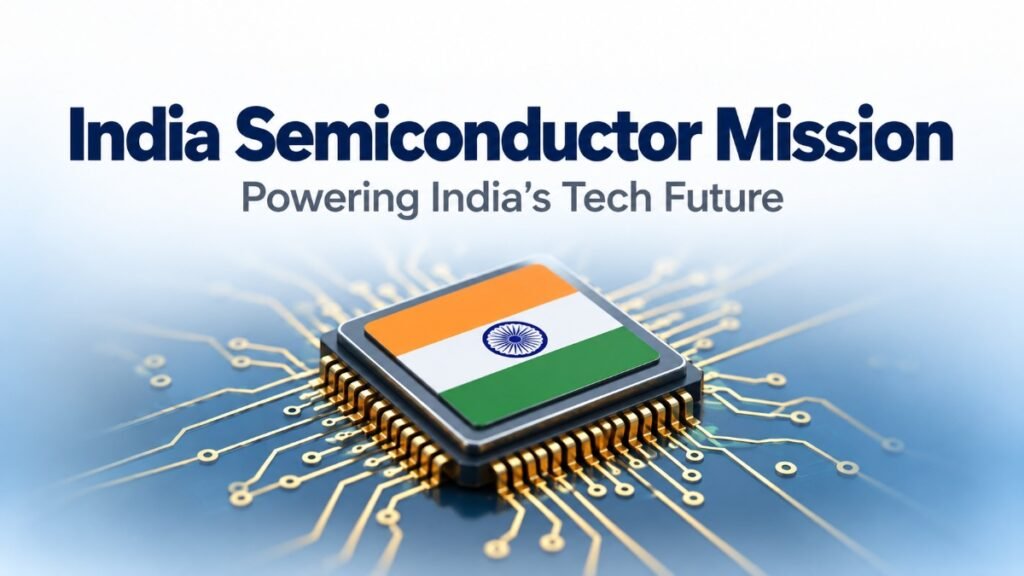
A semiconductor is a material whose electrical conductivity lies between that of a conductor and an insulator. The most commonly used semiconductor materials are silicon and germanium. Semiconductors are the basic building blocks of modern electronic devices and form the foundation of the Semiconductor Industry in India.
Semiconductors are used to manufacture integrated circuits (ICs), microprocessors, memory chips, sensors, transistors and other electronic components. They are essential for smartphones, computers, automobiles, medical devices, defence systems, telecommunications, artificial intelligence and other advanced technologies. Therefore, understanding semiconductors is important for understanding the India Semiconductor Mission and the strategic importance of semiconductor manufacturing.
For India, developing a strong semiconductor ecosystem is important for reducing dependence on imports, strengthening technological capabilities, creating high-skilled employment and ensuring supply-chain security. The development of a domestic Semiconductor Mission in India is therefore closely linked with India’s ambitions in electronics manufacturing and emerging technologies.
Semiconductors are also strategically important because modern economies and national security systems increasingly depend on reliable access to advanced electronic components. Hence, semiconductor manufacturing has become an important component of India’s industrial and technological development.
Master Science & Technology. Maximize Your BPSC Mains Score.
Enroll in the BPSC Science & Tech Course Today
Master Science & Technology for BPSC Mains GS Paper-2 with 75+ exam-oriented topics, 6 structured lessons, and downloadable PDF notes—all in one course.
✔ 75+ Exam-Oriented Topics • ✔ 6 Comprehensive Lessons • ✔ Downloadable PDF Notes • ✔ Updated for 72nd BPSC Mains
2. India Semiconductor Mission (ISM): Key Features
The India Semiconductor Mission (ISM) is a specialised programme of the Government of India aimed at developing a strong and sustainable semiconductor and display ecosystem in the country. It seeks to establish India as a global hub for electronics manufacturing and semiconductor production. Key features of the India Semiconductor Mission include:
- Semiconductor manufacturing: Promoting the establishment of semiconductor fabrication units and strengthening domestic chip manufacturing capabilities.
- Display manufacturing: Supporting the development of display fabrication facilities and related technologies.
- Semiconductor packaging: Encouraging advanced packaging, assembly, testing and related semiconductor activities.
- Financial support: Providing financial assistance and incentives to attract investment in semiconductor and display manufacturing.
- Technology development: Promoting technological capabilities and reducing dependence on imported semiconductor technologies.
- Ecosystem development: Building a complete semiconductor ecosystem involving design, manufacturing, packaging, testing and supply chains.
- Employment generation: Creating opportunities for skilled employment in semiconductor manufacturing, electronics and related high-technology sectors.
- Strategic self-reliance: Strengthening India’s technological and economic security by developing domestic semiconductor capabilities.
The mission is an important part of Semiconductor Policy in India, which seeks to strengthen domestic manufacturing and create a globally competitive semiconductor ecosystem. These aspects are also important for understanding the Semiconductor Mission Notes from a BPSC and UPSC perspective.
Prepare Smarter. Study Better. Ace BPSC Mains.
BPSC Mains GS Paper 1 & 2 Complete Course
Access comprehensive BPSC Mains Notes for GS Paper 1 & 2, covering 378+ topics across 24 PDF lessons, with dedicated Bihar coverage, practice questions and downloadable study material.
✓ GS Paper 1 & 2 • ✓ 378+ Topics • ✓ 24 PDF Lessons • ✓ Bihar-Specific Coverage • ✓ Downloadable Notes
3. Need for India Semiconductor Mission (Why India Needs ISM)
The India Semiconductor Mission is important for India’s technological, economic and strategic development. The major reasons for strengthening the Semiconductor Mission in India are:
- Reduce Import Dependence: India imports the majority of its semiconductor chips, making the electronics industry vulnerable to global supply chain disruptions and geopolitical tensions. The India Semiconductor Mission aims to build domestic manufacturing capacity and enhance self-reliance.
- Strengthen National Security: Semiconductors are critical components in defence systems, satellites, communication networks, missile technology, and cybersecurity infrastructure. Indigenous chip manufacturing is essential for safeguarding strategic and sensitive sectors.
- Support the Digital Economy: The rapid expansion of 5G, Artificial Intelligence (AI), Internet of Things (IoT), cloud computing, electric vehicles (EVs), and digital payments has significantly increased the demand for semiconductor chips. Domestic production is vital to sustain India’s digital transformation.
- Boost Electronics Manufacturing: India is emerging as one of the world’s fastest-growing electronics markets. A robust semiconductor ecosystem will strengthen programmes such as Make in India and help India become a global electronics manufacturing hub. This will also strengthen the Semiconductor Industry in India.
- Enhance Economic Growth and Employment: Semiconductor manufacturing is a high-value, technology-intensive industry that attracts large investments, promotes innovation, supports startups, and generates high-skilled employment across manufacturing, design, research, and allied sectors.
- Leverage India’s Design Strength: India already has a strong semiconductor design ecosystem, with over 20% of the world’s semiconductor design engineers working in the country. The India Semiconductor Mission seeks to complement this strength by developing domestic manufacturing and packaging capabilities.
- Address Global Supply Chain Risks: The global semiconductor shortage during the COVID-19 pandemic (2020–22) disrupted automobile, electronics, and telecom industries worldwide. The India Semiconductor Mission aims to improve India’s resilience against similar future disruptions.
4. Applications of Semiconductors
Semiconductors are essential for almost every modern technology. The India Semiconductor Mission aims to strengthen domestic semiconductor capabilities because these components are increasingly important for India’s digital economy, strategic sectors and industrial development. The major applications of semiconductors include:
Consumer Electronics
Semiconductor chips are the core components of smartphones, laptops, tablets, televisions, smartwatches, cameras, gaming devices and home appliances. They perform functions such as data processing, memory storage, connectivity, power management and sensing.
The rapid expansion of India’s electronics market has increased the demand for semiconductor chips. Strengthening domestic production through the India Semiconductor Mission can support electronics manufacturing and reduce dependence on imported components.
The growth of consumer electronics is therefore closely connected with the development of the Semiconductor Industry in India and the country’s ambition to become a major electronics manufacturing hub.
Artificial Intelligence (AI), 5G and Data Centres
Semiconductors are the backbone of Artificial Intelligence (AI), 5G networks, cloud computing and data centres. AI systems require powerful processors, graphics processing units (GPUs), memory chips and specialised accelerators to process large volumes of data.
The expansion of 5G technology also requires advanced semiconductor components for network equipment, communication devices and infrastructure. Similarly, the rapid growth of data centres in India is increasing demand for high-performance processors, memory and power-management chips.
The India Semiconductor Mission can help India develop domestic capabilities in these critical technologies and strengthen its position in the global digital economy. Developing semiconductor manufacturing alongside India’s growing technology sector is therefore an important part of Semiconductor Mission Notes for BPSC and UPSC preparation.
Electric Vehicles (EVs) and Automobile Industry
Modern vehicles increasingly rely on semiconductor chips for engine control, battery management, Advanced Driver Assistance Systems (ADAS), infotainment systems, navigation, and vehicle safety. Electric vehicles require significantly more semiconductor content than conventional vehicles to manage power electronics and battery performance. As India promotes electric mobility through schemes like FAME and PM E-Drive, domestic semiconductor production has become strategically important.
The India Semiconductor Mission can therefore support the growing demand for semiconductor components in India’s automobile and electric mobility sectors.
Example: The global semiconductor shortage (2020–22) forced major automobile manufacturers, including Maruti Suzuki and Tata Motors, to temporarily reduce production due to chip shortages.
Defence and National Security
Semiconductors are critical components of defence and national security systems. They are used in radars, communication systems, electronic warfare, missiles, satellites, surveillance systems and secure communication networks.
Dependence on imported semiconductor components can create strategic vulnerabilities, particularly during geopolitical tensions or disruptions in global supply chains. Therefore, developing domestic semiconductor capabilities through the India Semiconductor Mission is important for strengthening technological self-reliance and national security.
A reliable domestic semiconductor ecosystem can also support India’s defence technology development and reduce dependence on foreign suppliers for critical electronic components.
Healthcare and Medical Devices
Semiconductors play a vital role in modern healthcare and medical devices. They are used in MRI machines, CT scanners, ultrasound systems, patient monitoring devices, wearable health devices, medical sensors and diagnostic equipment.
The increasing use of digital healthcare, remote monitoring and advanced diagnostic technologies is creating greater demand for semiconductor-based medical equipment. The India Semiconductor Mission can support the development of domestic capabilities for such critical components.
A stronger semiconductor ecosystem can therefore contribute to healthcare innovation, medical-device manufacturing and technological self-reliance in India.
Space and Telecommunications
Semiconductors are essential for satellites, navigation systems, communication equipment, satellite phones, ground stations and space-based communication technologies. They enable signal processing, data transmission, sensing and control functions in space and telecommunications systems.
India’s growing space programme and expanding telecommunications infrastructure require reliable access to advanced semiconductor components. The India Semiconductor Mission can therefore support technological capabilities in these strategically important sectors.
A strong domestic semiconductor ecosystem can also strengthen India’s space technology, telecommunications infrastructure and strategic autonomy.
Industrial Automation and Industry 4.0
Semiconductors are the foundation of Industrial Automation and Industry 4.0. They are used in industrial robots, sensors, programmable logic controllers (PLCs), automated machinery, smart factories and connected industrial systems.
The growing adoption of automation, Internet of Things (IoT) and smart manufacturing is increasing demand for advanced semiconductor components. The India Semiconductor Mission can support this transformation by strengthening domestic semiconductor availability and manufacturing capabilities.
A robust semiconductor ecosystem will therefore contribute to India’s industrial modernisation, technological innovation and the development of a competitive Semiconductor Industry in India.
5. Recent Developments under India Semiconductor Mission (2024–26)
The India Semiconductor Mission has witnessed significant progress during 2024–26, with the Government of India approving semiconductor manufacturing and packaging projects to build a domestic semiconductor ecosystem. These developments are aimed at strengthening the Semiconductor Industry in India, attracting investment and reducing dependence on imported chips.
Key Developments
- Semiconductor fabrication units: India has moved towards establishing domestic semiconductor fabrication facilities with government support and financial incentives.
- Semiconductor assembly and testing: Several projects have been approved for semiconductor assembly, testing, marking and packaging, which are important components of the semiconductor value chain.
- Investment and employment: The approved projects are expected to attract significant investment and create employment opportunities in semiconductor manufacturing, packaging, design and related industries.
- Tata Electronics semiconductor project: Tata Electronics has been approved to establish a semiconductor fabrication facility at Dholera, Gujarat, strengthening India’s domestic chip manufacturing capabilities.
- CG Power semiconductor facility: CG Power and Industrial Solutions has received approval for a semiconductor assembly, testing, marking and packaging facility at Sanand, Gujarat.
- India Semiconductor Mission 2.0: The Union Budget 2026–27 announced India Semiconductor Mission 2.0 to expand and strengthen India’s semiconductor ecosystem, with greater focus on advanced manufacturing, domestic capabilities and integration with global semiconductor value chains.
These developments represent an important transition from policy formulation towards actual semiconductor manufacturing and ecosystem development. India Semiconductor Mission 2.0 is expected to build upon the foundation created by the initial mission.
6. Challenges Associated with India Semiconductor Mission
Despite significant progress, the India Semiconductor Mission faces several challenges that need to be addressed for building a globally competitive semiconductor ecosystem in India.
High Capital Requirement
Semiconductor fabrication plants require very high capital investment because they involve advanced manufacturing technologies, specialised equipment and highly controlled production environments. Attracting sustained private investment remains a major challenge.
Technological Complexity
Advanced semiconductor manufacturing requires sophisticated technologies, specialised machinery and highly skilled professionals. Developing these capabilities domestically will require continued investment in research and development, technology partnerships and skill development.
Water and Power Requirements
Semiconductor fabrication is highly resource-intensive. Manufacturing facilities require a continuous supply of high-quality water and reliable electricity. Ensuring adequate infrastructure can be challenging, particularly at large manufacturing clusters.
Dependence on Imported Equipment and Materials
India continues to depend significantly on other countries for semiconductor manufacturing equipment, specialised materials, chemicals and advanced technologies. Developing domestic supply chains will be important for reducing external dependence.
Global Competition
India faces competition from established semiconductor manufacturing centres such as Taiwan, South Korea, China, Japan and the United States. Building a competitive ecosystem will require attractive policies, infrastructure, technological capabilities and a skilled workforce.
Skilled Manpower
The semiconductor sector requires specialised professionals in chip design, fabrication, materials science, electronics engineering, packaging and testing. Developing an adequate talent pool is therefore essential for the long-term success of the India Semiconductor Mission.
Supply Chain Challenges
The semiconductor industry depends on a complex global supply chain involving raw materials, equipment, design, fabrication, packaging and distribution. Building a resilient domestic ecosystem while integrating with global supply chains remains a major challenge for the Semiconductor Mission in India.
7. Conclusion
The India Semiconductor Mission is a strategically important initiative for developing a strong and self-reliant semiconductor ecosystem in India. Semiconductors are essential for electronics, Artificial Intelligence, 5G, electric vehicles, defence, healthcare, space technology and industrial automation.
India has significant strengths in semiconductor design, a large domestic electronics market and a growing technology sector. However, challenges such as high capital requirements, technological complexity, dependence on imported equipment and materials, skilled manpower shortages and global competition need to be addressed.
The continued implementation of the India Semiconductor Mission and the expansion through India Semiconductor Mission 2.0 can help strengthen domestic manufacturing, attract investment, develop skilled manpower and integrate India more deeply into global semiconductor value chains.
A successful Semiconductor Policy in India should therefore focus on manufacturing, research and development, talent development, resilient supply chains and technological innovation. This will strengthen the Semiconductor Mission in India and contribute to India’s long-term technological and economic security.
BPSC Mains Practice Questions
- “Semiconductors are no longer merely an industrial commodity but a strategic asset for national security and technological sovereignty.” Discuss the significance of the India Semiconductor Mission in building a resilient semiconductor ecosystem in India.
- Examine the major challenges associated with semiconductor manufacturing in India. How can India Semiconductor Mission 2.0 help address these challenges and strengthen India’s position in the global semiconductor value chain?
Learn More About India Semiconductor Mission
Learn More About India Semiconductor Mission: Ministry of Electronics & Information Technology – India Semiconductor Mission