
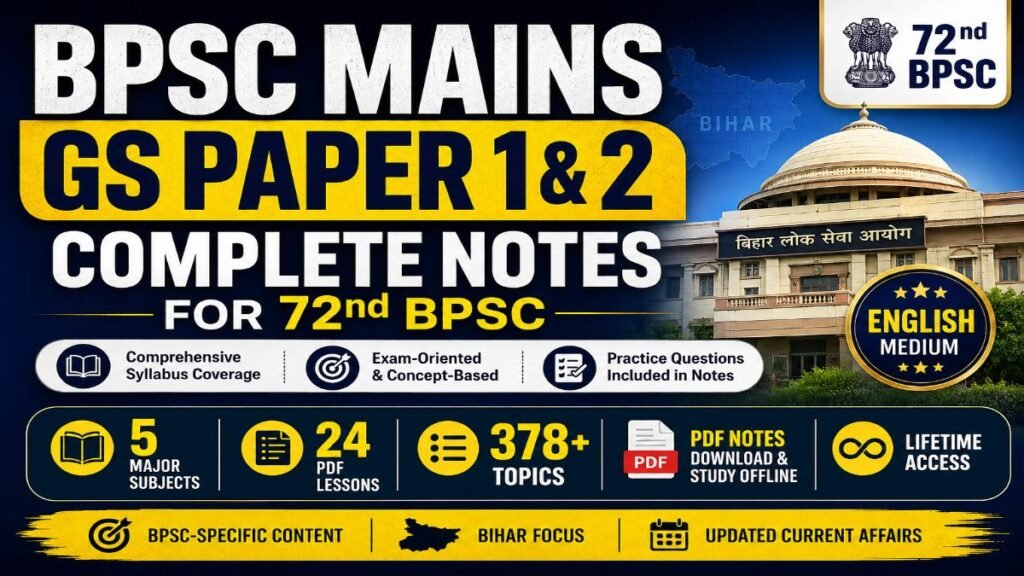
1. BPSC Mains GS Preparation in One Comprehensive Course
Prepare for the 72nd BPSC Mains Examination with a comprehensive BPSC Mains Course designed to cover the major areas of GS Paper 1 and GS Paper 2 in a structured and systematic manner.
This BPSC Mains Online Course brings together 378+ exam-relevant topics across 24 comprehensive PDF lessons, covering History & Culture, Current Affairs & International Relations, Indian Polity, Geography & Economy, and Science & Technology.
The BPSC Mains course provides extensive BPSC Mains Notes in English, with dedicated coverage of Bihar-specific History, Culture, Current Affairs, Geography and Economy, along with important national and international developments.
What This BPSC Mains Course Covers
- GS Paper 1: History & Culture; Current Affairs & International Relations
- GS Paper 2: Indian Polity; Geography & Economy; Science & Technology
- 378+ topics organised into 24 lesson-wise PDFs
- Updated content relevant to the 72nd BPSC Mains
- Bihar-focused topics and contemporary developments
- Practice questions incorporated within the notes
- Downloadable BPSC Mains Notes PDF for offline study
- Structured material designed for systematic study and revision
The objective of this BPSC Mains Course is to provide a single, organised and comprehensive BPSC Mains GS resource so that aspirants can prepare from structured study material instead of depending entirely on scattered sources.
Prepare Smarter. Write Better. Ace BPSC Mains.
BPSC Mains GS Paper 1 & 2 Complete Course
Comprehensive BPSC Mains preparation with 378+ topics, 24 PDF lessons, Bihar-specific coverage,
practice questions and updated current affairs.
✓ 378+ Topics • ✓ 24 PDF Lessons • ✓ Bihar-Specific • ✓ Downloadable PDFs • ✓ Updated Content for 72nd BPSC Mains
2. BPSC Mains Course at a Glance
Get a clear, structured and comprehensive study resource for 72nd BPSC Mains with extensive coverage of BPSC Mains GS Paper 1 and GS Paper 2.
| BPSC Mains Course Feature | Details |
|---|---|
| Target Examination | 72nd BPSC Mains |
| GS Coverage | GS Paper 1 & GS Paper 2 |
| Major Modules | 5 |
| Total Topics | 378+ |
| PDF Lessons | 24 |
| Study Material | Comprehensive BPSC Mains Notes |
| Format | Lesson-wise downloadable PDF |
| Language | English |
| Practice Questions | Included within the notes |
| Current Affairs | Updated coverage |
| Bihar Focus | Dedicated Bihar-specific coverage |
| Access | Lifetime |
| Platform | Tutor LMS |
3. Why Choose This BPSC Mains Course?
Preparing for BPSC Mains requires a focused approach, especially when the syllabus demands both static subject knowledge and current developments. This BPSC Mains course brings the major areas of BPSC Mains GS Paper 1 and GS Paper 2 together in a structured format.
- Comprehensive GS Coverage: Study the major areas of BPSC Mains GS Paper 1 and GS Paper 2 through 5 subject modules and 24 detailed PDF lessons.
- Extensive Topic Coverage: With 378+ topics, the BPSC Mains course provides broad coverage of the syllabus and important areas relevant to the 72nd BPSC Mains Examination.
- Bihar-Specific Focus: Get dedicated coverage of Bihar History & Culture, Bihar Current Affairs, Bihar Geography and Bihar Economy, along with Bihar-specific issues across relevant topics in this BPSC Mains course.
- Updated Content: The BPSC Mains course incorporates relevant contemporary developments, particularly in Current Affairs, International Relations, Economy, Environment and Science & Technology.
- Structured BPSC Mains Notes: Instead of studying from scattered sources, access systematically organised BPSC Mains Notes lesson by lesson, making study and revision easier through this BPSC Mains course.
- Practice Questions Included: Relevant practice questions are incorporated within the notes, allowing you to reinforce important concepts and topics as you study.
- Downloadable PDF Study Material: Every BPSC Mains course lesson includes a BPSC Mains Notes PDF that can be read online or downloaded for offline study.
- English-Medium Preparation: This BPSC Mains course content and study material are provided in English, making it suitable for aspirants preparing through the English medium.
- Lifetime Access: Once enrolled, you can access the course and its study material for a lifetime, allowing you to return to the notes whenever required for revision.
4. Complete BPSC Mains GS Paper 1 & 2 Syllabus Coverage
The BPSC Mains course is designed to provide extensive coverage of the major areas prescribed for BPSC Mains GS Paper 1 and GS Paper 2. The entire study material is organised into 5 major modules, 24 lessons and 378+ topics, making it easier to study the syllabus systematically. Each lesson contains a comprehensive BPSC Mains Notes PDF, along with an online PDF viewer and downloadable study material.
BPSC Mains GS Paper 1: History & Culture
Lesson 1: Ancient Indian History & Culture
| Major Heading | Topics Covered |
|---|---|
| Art, Architecture & Culture | Mauryan Art, Pal Art, Effect of Religion on Mauryan Art and Pal Art, Nagara, Dravida & Vesara Style of Temple Architecture |
| Painting & Cultural Traditions | Patna Kalam Painting |
Lesson 2: Modern Indian History
| Major Heading | Topics Covered |
|---|---|
| Tribal & Popular Movements | Santhal Revolt, Munda Revolt, Tribal Revolts in Indian Freedom Struggle |
| British Rule & Economic Policies | Economic Impact of British Rule in India, Concept of Drain of Wealth, Land Revenue System of British India |
| Education & Ideas | Orientalist–Anglicist Controversy, Downward Filtration Theory, Wood’s Despatch, Development of Western & Technical Education in India |
| National Movement & Ideologies | Causes of Sepoy Mutiny of 1857, Rise of Nationalism in India, Boycott and Swadeshi Movement, Rise and Progress of Revolutionary Movements in India, Khilafat Movement, Non-Cooperation Movement, Civil Disobedience Movement, Quit India Movement |
| Important Acts & Missions | Government of India Act 1858, Government of India Act 1892, Morley–Minto Act 1909, Government of India Act 1919, Government of India Act 1935, Rowlatt Act, Communal Award and Poona Pact, Cripps Mission, Cabinet Mission |
| Important Leaders & Thoughts | Thoughts of Mahatma Gandhi, Thoughts of Jawaharlal Nehru, Thoughts of Rabindranath Tagore, Role of Subhas Chandra Bose in Freedom Struggle, Lord Dalhousie, Lord Curzon |
Lesson 3: History & Culture of Bihar
| Major Heading | Topics Covered |
|---|---|
| Revolt of 1857 & Bihar | Mutiny of 1857 and Bihar, Kunwar Singh and Mutiny of 1857, Important Tribal Revolts of Bihar |
| National Movement & Bihar | Champaran Satyagraha and Bihar, Non-Cooperation Movement and Bihar, Civil Disobedience Movement and Bihar, Quit India Movement and Bihar, Quit India Movement and Jayaprakash Narayan |
| Bihar Specific Contributions | Role of Women of Bihar in Indian Freedom Struggle, Role of Peasants of Bihar in Freedom Struggle Post Champaran, Kisan Sabha and Swami Sahajanand Saraswati, Thoughts of Jayaprakash Narayan |
| Education in Bihar | Development of Western & Technical Education in Bihar |
BPSC Mains GS Paper 1: Current Affairs & International Relations
Lesson 1: India Current Affairs
| Major Heading | Topics Covered |
|---|---|
| Governance, Constitution & Electoral Reforms | Waqf (Amendment) Act, Delimitation of Parliamentary Constituencies, Population Census, Caste Census, One Nation One Election, Electoral Roll Revision, New Criminal Laws: One Year of Implementation, Digital Personal Data Protection Rules, 2025, Uniform Civil Code (UCC) |
| Economy, Infrastructure & Public Policy | PM Gati Shakti and Logistics Development, Green Hydrogen Mission, GST Rationalisation, National Manufacturing Mission, PM Dhan-Dhaanya Krishi Yojana, National Critical Mineral Mission, Employment Linked Incentive (ELI) Scheme, PM Internship Scheme, Gig Economy, Election Freebies |
| Education, Health & Social Development | National Education Policy (NEP) 2020: Recent Implementation, Ayushman Bharat Expansion, U-WIN Portal, PM Vidyalaxmi Scheme, Universal Basic Income (UBI), Minimum Support Price (MSP), National Multidimensional Poverty Index (India), NITI Aayog SDG India Index |
| Science, Technology & Innovation | SPADEX Mission (Space Docking Experiment), Bharat 6G Mission |
| Environment & Sustainable Development | Mission LiFE, Great Nicobar Development Project |
| Internal Security | Left Wing Extremism, Operation Sindoor |
Lesson 2: Bihar Current Affairs
| Major Heading | Topics Covered |
|---|---|
| Governance & Administrative Reforms | Bihar Caste Survey: Recent Developments, Land Survey and Digitisation in Bihar, Bihar Youth Policy and Bihar Youth Commission, Ghar Tak Registry (Home Registration Facility for Senior Citizens), Gram Panchayat Taxation Rules, 2026 (Holding Tax in Rural Areas), Sahyog Portal (RTMS), Saat Nischay-3 |
| Economy, Infrastructure & Urban Development | Greenfield Satellite Townships, Land Pooling Policy for Satellite Townships, Patna Metro: Recent Progress, Mukhya Mantri Vidyut Upbhokta Sahayata Yojana (Power Subsidy) |
| Agriculture | Bihar Agriculture Road Map |
| Education & Skill Development | Unnat Shiksha – Ujjwal Bhavishya Scheme, Model Schools in Every Block (Saraswati Gyan Niketan), Bihar Flying Training Institute |
| Women & Social Welfare | Mukhyamantri Mahila Rojgar Yojana, Social Security Pension Enhancement |
Lesson 3: International Relations
| Major Heading | Topics Covered |
|---|---|
| India’s Relations with Major Powers | India–USA Relations, India–Russia Relations, India–China Relations, India–Japan Relations, India–France Relations, India–United Kingdom Relations, India–European Union Relations |
| India’s Neighbourhood Relations | India–Bangladesh Relations, India–Nepal Relations, India–Bhutan Relations, India–Sri Lanka Relations, India–Myanmar Relations, India–Maldives Relations, India–Pakistan Relations, India–Afghanistan Relations |
| India’s Relations with West Asia | India–Israel Relations, India–Palestine Relations, India–Iran Relations, India–Saudi Arabia Relations, India–United Arab Emirates (UAE) Relations |
| India’s Regional and Strategic Partnerships | India–ASEAN Relations, India–Africa Relations, India–Central Asia Relations |
Lesson 4: International Organizations, Reports & Summits
| Major Heading | Topics Covered |
|---|---|
| International Organizations and India | United Nations Security Council (UNSC) and India (Permanent Membership), BRICS and India, G20 and India, G7 and India, Shanghai Cooperation Organisation (SCO) and India, QUAD and India, BIMSTEC and India, South Asian Association for Regional Cooperation (SAARC) and India, Indian Ocean Rim Association (IORA) and India, International Solar Alliance (ISA) and India, I2U2 and India, Global Biofuels Alliance (GBA) and India |
| International Reports and Indices | Human Development Report (HDR) 2025, Global Multidimensional Poverty Index (MPI) 2025, World Happiness Report 2026, Global Gender Gap Report 2025, Corruption Perceptions Index 2025, Global Innovation Index 2025, Global Hunger Index 2025, Sustainable Development Goals (SDG) Report 2025, Financial Action Task Force (FATF) and India |
| Major International Summits and Dialogues | G20 Summit 2025, BRICS Summit 2025, SCO Summit 2025, ASEAN Summit 2026, G7 Summit 2025, COP-30 2025, World Economic Forum (Davos), Raisina Dialogue 2026, Global South and India’s Leadership |
| International Agreements | India–Middle East–Europe Economic Corridor (IMEC), NATO Plus and India |
Lesson 5: World Current Affairs
| Major Heading | Topics Covered |
|---|---|
| Global Conflicts and Geopolitics | Russia–Ukraine War, Israel–Hamas Conflict, Israel–USA–Iran Conflict, Hormuz Strait Crisis, Iran’s Nuclear Programme, South China Sea Dispute, Greenland and Arctic Geopolitics |
| Global Economy and Strategic Competition | Global Trade Disruptions, Critical Minerals Race, De-dollarisation Debate, Global Energy Security |
BPSC Mains GS Paper 2: Indian Polity
Lesson 1: Constitution and Rights
| Major Heading | Topics Covered |
|---|---|
| Constitutional Provisions & Structure | Characteristics of Indian Constitution, Characteristic of Federal Structure of Indian Constitution, Concept of Separation of Power, Provision of Amendment in Indian Constitution, Basic Structure of Indian Constitution |
| Special Constitutional Laws & Amendments | Article 370, Citizenship Amendment Act (CAA), Nari Shakti Vandan [Constitution (106th Amendment)] Act, 2023, Uniform Civil Code, Sedition Law in India |
| Fundamental Rights | Right to Equality (Article 14), Right to Freedom (Article 19), Right of Life (Article 21), Fake Encounter and Article 21, Internet Shutdown & Article 21, Right to Constitutional Remedy (Article 32) |
| Directive Principles of State Policy (DPSP) | Classification of DPSP, Conflict between Fundamental Rights and DPSP, Implementation of DPSP in India, Implementation of DPSP in Bihar |
Lesson 2: Executive and Parliament
| Major Heading | Topics Covered |
|---|---|
| President of India | President of India: Power, Constitutional Position of President of India, Veto Power of President of India, Ordinance Power of President and Governor, Pardoning Power of President of India |
| Governor of State | Governor of State: Power, Constitutional Position of Governor |
| Parliament & Parliamentary Control | Functional Role of Indian Parliament, Parliamentary Privilege, Sovereignty of Parliament, No Confidence Motion |
| Forms & Comparative Government | Presidential Form of Government, Comparison of Indian and American Vice President |
Lesson 3: Judiciary & Emergency
| Major Heading | Topics Covered |
|---|---|
| Higher Judiciary | Power and Jurisdiction of High Court, Power and Jurisdiction of Supreme Court |
| Judicial Process & Access to Justice | Public Interest Litigation (PIL), Lok Adalat |
| Judicial Behaviour & Reforms | Judicial Activism vs Judicial Restraint, Judicial Reforms |
| Emergency Provisions | National Emergency (Article 352), President’s Rule in Indian States (Article 356), Financial Emergency (Article 360) |
Lesson 4: Politics, Elections & Governance
| Major Heading | Topics Covered |
|---|---|
| Local Governance & Decentralisation | Panchayati Raj (73rd Constitutional Amendment), Salient Features of 73rd Constitutional Amendment Act |
| Political System & Political Processes | Characteristic of Indian Political System, Anti-Defection Law in India, Pressure Group in India, Effect of Regional Parties in Indian Political System |
| Elections & Electoral Integrity | Electoral Reforms, Electoral Bonds, Model Code of Conduct, Decriminalization of Politics, One Nation One Election, The Chief Election Commissioner Act 2023 |
| Governance & Administrative Reforms | Citizens’ Grievances Redressal System in India, Good Governance, Right to Information Act (RTI), E-Governance, Police Reforms |
| Society, Caste & Regional Issues | Caste Politics in Context of India, Influence of Caste in Bihar Political System, Special Status for the State of Bihar, Liquor Ban in the State of Bihar |
| Foreign Policy & Diplomacy | Principle of India Foreign Policy, Soft Power Foreign Diplomacy of India |
BPSC Mains GS Paper 2: Geography & Economy
Lesson 1: Indian Geography
| Major Heading | Topics Covered |
|---|---|
| Climate & Atmospheric Processes | Characteristic of Indian Monsoon, Effect of Monsoon on Indian Economy, Rain Shadow Area, Urban Heat Island |
| Water Resources & River System | Inland Waterway in India, River Disputes among Indian States, River Valley Projects: Pros and Cons |
| Emerging Geography Concepts | Blue Economy, Sustainable Development |
Lesson 2: Bihar Geography
| Major Heading | Topics Covered |
|---|---|
| Physical Features | Physiographic Division of Bihar, Climate of Bihar |
| Natural Base | Soil of Bihar, River System of Bihar, Natural Resources in Bihar, Mineral Resources of Bihar |
| Water & Disaster Geography | Flood in Bihar, Drought in Bihar, Irrigation in Bihar, Inland Waterways in Bihar |
| Human Geography | Urbanization in Bihar |
Lesson 3: Indian Economy
| Major Heading | Topics Covered |
|---|---|
| Growth & Welfare | Inclusive Growth, Poverty and Government Programs, Social Sector Schemes |
| Demography & Employment | Demographic Dividend in India, Unemployment in India, Migration in India |
| External Sector | India and WTO, Trade War and Protectionism, Trade Deficit, Foreign Direct Investment (FDI) |
| Financial System | Monetary Policy, Fiscal Policy, Monetary Policy Committee |
| Economic Reforms & Governance | Disinvestment in PSU, Merger of PSU Banks, Ease of Doing Business, Start-up Ecosystem, Corporate Social Responsibility (CSR), JAM Trinity |
Lesson 4: Bihar Economy
| Major Heading | Topics Covered |
|---|---|
| Structural Issues | Economic Backwardness of Bihar, Migration from Bihar |
| Growth Areas | Tourism in Bihar, Demographic Dividend in Bihar |
| Government Initiatives | Bihar Saat Nishchay-3 |
Lesson 5: Agriculture & Allied Sector
| Major Heading | Topics Covered |
|---|---|
| Agriculture in India | Agriculture Reforms in India, Green Revolution, Second Green Revolution, Agricultural Subsidy, Contract Farming, Organic Farming |
| Food Processing & Schemes | Food Processing Industry in India, Pradhan Mantri Krishi Sampada Yojana, Mega Food Park Scheme |
| Agriculture in Bihar | Agriculture in Bihar, Horticulture in Bihar |
| Allied Activities | Fishing in Bihar |
Lesson 6: Industry & Allied Sector
| Major Heading | Topics Covered |
|---|---|
| Industrial Policy & Framework (India) | Make in India, Aatmanirbhar Bharat, Special Economic Zone (SEZ), National Logistics Policy (NLP) |
| Core Industries | Iron and Steel Industry, Cotton Industry, Chemical Industry, Software Industry |
| Infrastructure Linkage | Basic Infrastructure in India, Transportation & Industrial Development, Transportation & Agricultural Development |
| Bihar Industry | Industries in Bihar, Industrial Backwardness of Bihar, Food Processing Industry in Bihar |
BPSC Mains GS Paper 2: Science & Technology
Lesson 1: India’s Space Programme and Space Governance
| Major Heading | Topics Covered |
|---|---|
| Foundations and Launch Systems | Indian Space Programme, Characteristics of Indian Space Programme, Satellite Launch Vehicles: SLV, SLV III, ASLV, PSLV, GSLV, LVM3, SSLV (Small Satellite Launch Vehicle) Operationalisation |
| Space Applications and Major Missions | Use of Space Technology for Development of India, Upcoming Projects of ISRO, Gaganyaan Mission, Chandrayaan-3, Aditya L1 Mission, NAVIC, Artemis Programme (NASA Moon Mission) |
| Emerging Space Technologies and Governance | Reusable Satellite Launch Vehicle (RSLV), Space Debris, Mission Shakti, James Webb Telescope, Indian Space Policy 2023, Space Tourism, IN-SPACe and Private Sector Regulation in Space |
Lesson 2: Defence Technology and Internal Security
| Major Heading | Topics Covered |
|---|---|
| Defence Programmes and Missile Systems | Integrated Guided Missile Development Programme (IGMDP), Anti-Ballistic Missile Development Programme |
| Modern Defence Technologies | Application of Drone Technology, Swarm Drones, AI in Defence |
| Border Management and Defence Production | Use of Technology in Border Management, Science and Technology in Defence Equipment Production, Cyber Warfare, Electronic Warfare, Atmanirbhar Bharat in Defence, Defence Corridors |
Lesson 3: Environment, Climate Change and Energy Resources
| Major Heading | Topics Covered |
|---|---|
| Environmental Issues and Pollution | Environmental Pollution (Special Focus on Air Pollution), Waste Management, Plastic Pollution, Illegal Mining and Its Environmental Impact, Air Quality Index (AQI) and Health Impact, Net Zero Target of India (2070) |
| Climate Change and Biodiversity | Causes and Effects of Climate Change on Human, Global Warming, Biodiversity |
| Energy Resources and Sustainability | Renewable Energy Resources in Context of India, Solar Energy, Nuclear Energy in India, Energy Generation from Urban Waste, Electric Mobility in India, Energy Security vs Sustainability Debate, National Green Hydrogen Mission, Biofuels Policy (Ethanol Blending Programme), National Action Plan on Climate Change (NAPCC) |
Lesson 4: Agriculture, Biotechnology and Health Technologies
| Major Heading | Topics Covered |
|---|---|
| Agricultural Technologies and Practices | Organic Farming, Use of Technology in Indian Agriculture |
| Genetic and Biotechnology Applications | GM Crops, Application of Biotechnology |
| Health, Nutrition and Ethical Issues | Food Fortification Technology, DNA Profiling (Issue of Conflicts), Antimicrobial Resistance (AMR) |
Lesson 5: Digital Technology, Communication and Cyber Security
| Major Heading | Topics Covered |
|---|---|
| Digital Ecosystem and Communication Technologies | 5G Technology, Internet of Things (IoT) |
| Data Governance and Internet Regulation | Net Neutrality, Blockchain Technology, Cryptocurrency |
| Cyber Space and Social Impact | Cyber Security in India, Social Media (Positive and Negative Aspects), Digital Divide (Urban vs Rural Access Gap), Deepfake Technology |
Lesson 6: Emerging Technologies and Advanced Science
| Major Heading | Topics Covered |
|---|---|
| Advanced Digital and Intelligent Technologies | Artificial Intelligence (AI), ChatGPT Technology, Use of Robot Technology (Pros and Cons) |
| Industrial and Frontier Technologies | 3D Printing, Application of Nanotechnology, National Quantum Mission (NQM), India Semiconductor Mission (ISM) |
| Core Scientific Developments and Applications | Rare Earth Metals, Superconductivity, Gravitational Waves, Supercomputers in India, Cloud Seeding |
Prepare Smarter. Write Better. Ace BPSC Mains.
BPSC Mains GS Paper 1 & 2 Complete Course
Comprehensive BPSC Mains preparation with 378+ topics, 24 PDF lessons, Bihar-specific coverage,
practice questions and updated current affairs.
✓ 378+ Topics • ✓ 24 PDF Lessons • ✓ Bihar-Specific • ✓ Downloadable PDFs • ✓ Updated Content for 72nd BPSC Mains
5. Special Focus on Bihar for BPSC Mains
Bihar-specific preparation is an essential part of BPSC Mains. This BPSC Mains course provides dedicated coverage of Bihar along with national and international topics.
- Bihar History & Culture: Important historical developments, personalities, movements, cultural traditions and heritage of Bihar.
- Bihar Current Affairs: Recent government initiatives, policies, infrastructure, governance, social development, environment and other important state-level developments.
- Bihar Geography: Physical and human geography of Bihar, including rivers, climate, soil, natural resources, agriculture, population and regional characteristics.
- Bihar Economy: Bihar’s economic structure, agriculture, industry, infrastructure, employment, state finances, development challenges and major economic initiatives.
- Bihar in GS Topics: Bihar-specific examples and developments relevant to Governance, Economy, Agriculture, Environment, Science & Technology and Current Affairs.
- BPSC-Oriented Coverage: The dedicated Bihar content in this BPSC Mains course makes these BPSC Mains Notes more relevant to the specific requirements of the BPSC examination.
6. Updated Current Affairs & International Relations for BPSC Mains
Current Affairs connects with multiple areas of the BPSC Mains syllabus. This BPSC Mains course provides dedicated and structured coverage of 116 topics covering India, Bihar and important international developments.
- India Current Affairs: Government policies and initiatives, governance, economy, environment, science & technology, social issues and other important national developments.
- Bihar Current Affairs: State government initiatives, schemes, infrastructure, economy, governance, social development, environment and other important developments in Bihar.
- International Relations: India’s relations with major powers and neighbouring countries, strategic partnerships, regional groupings and major geopolitical developments.
- International Organizations, Reports & Summits: Important international organisations, reports, indices, rankings, global summits, dialogues and major international agreements.
- World Current Affairs: Major global conflicts, geopolitical developments, international economic issues, environmental developments and other significant world affairs.
- Structured Coverage: 5 dedicated lessons and 116 topics organised systematically for focused study and revision.
- 72nd BPSC Mains Focus: Current affairs content is designed specifically around the requirements of the 72nd BPSC Mains Examination.
- Current Updates: The Current Affairs & International Relations component can be updated as required to maintain its relevance for the examination.
7. How to Use These BPSC Mains Notes Effectively
A comprehensive BPSC Mains Online Course becomes most useful when the study material is followed systematically. Use the BPSC Mains course as a structured resource for preparation, practice and revision.
- Follow the Lessons Systematically: Start with the relevant lesson and proceed topic by topic instead of jumping randomly between subjects.
- Study the PDF Notes Actively: Focus on concepts, important facts, examples, data and contemporary developments while reading the BPSC Mains Notes PDF.
- Make Your Own Short Notes: While studying the PDFs, make concise short notes in your notebook containing important facts, keywords, data, examples and points that you can quickly revise before the examination.
- Attempt the Practice Questions: Practice questions are included within the notes. Attempt them after completing the relevant topics to assess your understanding.
- Connect Static Topics with Current Affairs: Link static concepts in Polity, Economy, Environment, Science & Technology and other subjects with relevant contemporary developments.
- Give Special Attention to Bihar: Revise the dedicated Bihar sections carefully and connect Bihar-specific examples with relevant national topics wherever applicable.
- Revise Regularly: Do not treat the PDFs as one-time reading material. Revisit important topics regularly and use your short notes for quick revision closer to the examination.
- Use the Course Alongside Answer Writing: Use the knowledge, facts, examples and practice questions from the course as a foundation for regular BPSC Mains answer-writing practice.
The objective of this BPSC Mains course is simple: study systematically, make concise revision notes, revise repeatedly and use your knowledge effectively in the examination.
8. Who Is This BPSC Mains Course For?
| Who Should Enrol? | How This BPSC Mains course Helps |
|---|---|
| 72nd BPSC Mains Aspirants | Structured and exam-oriented preparation for GS Paper 1 & GS Paper 2. |
| Aspirants Looking for Comprehensive Notes | Extensive BPSC Mains Notes covering major GS subjects in one organised course. |
| English-Medium Aspirants | Complete BPSC Mains Notes PDF and course content in English. |
| Students Seeking Bihar-Specific Preparation | Dedicated coverage of Bihar History & Culture, Current Affairs, Geography and Economy. |
| Candidates Building or Completing GS Preparation | Lesson-wise PDFs can be used for both syllabus completion and revision. |
| Aspirants Wanting One Organised Resource | GS Paper 1 & 2 material arranged systematically into 5 modules and 24 lessons. |
| Serious Mains-Focused Candidates | Extensive knowledge, facts, examples and practice questions to support Mains answer-writing preparation. |
9. Course Format, PDFs & Lifetime Access
| Course Feature | Details |
|---|---|
| Lesson-Wise Structure | 5 major modules, 24 lessons and 378+ topics covering BPSC Mains GS Paper 1 & 2. |
| Read PDFs Online | Embedded PDF viewer allows you to read the study material directly within the course. |
| Downloadable PDFs | Download the BPSC Mains Notes PDF for offline study and revision. |
| Practice Questions | Relevant practice questions are included within the notes for topic-wise practice. |
| Language | Complete course content and study material are provided in English. |
| Lifetime Access | Access the course, lessons and PDFs for a lifetime and revisit them whenever required. |
| Prerequisites | No specific prerequisites are required to enrol in the course. |
9. Why Choose BPSC PATHSHALA?
Preparing for BPSC Mains requires relevant content, Bihar-specific understanding, systematic coverage and consistent revision. BPSC PATHSHALA brings these elements together in one structured BPSC Mains Course.
- BPSC-Focused Approach: BPSC Mains course structure designed specifically around the requirements of BPSC Mains, with dedicated attention to Bihar along with national and international issues.
- Comprehensive GS Coverage: GS Paper 1 & GS Paper 2 covered through 5 major modules, 24 PDF lessons and 378+ topics.
- Bihar at the Core: Dedicated coverage of Bihar History & Culture, Bihar Current Affairs, Bihar Geography and Bihar Economy.
- Updated & Relevant Content: Important contemporary developments covered across Current Affairs, International Relations, Economy, Environment, Science & Technology and other relevant areas.
- Structured Study Material: Clear module → lesson → topic organisation makes it easier to study systematically and track your preparation.
- Built for Revision: Downloadable PDFs and lesson-wise organisation allow you to revisit important topics repeatedly throughout your preparation.
- One Comprehensive Resource: Extensive GS study material brought together in one organised platform, helping you reduce dependence on scattered sources.
Prepare Smarter. Write Better. Ace BPSC Mains.
BPSC Mains GS Paper 1 & 2 Complete Course
Comprehensive BPSC Mains preparation with 378+ topics, 24 PDF lessons, Bihar-specific coverage,
practice questions and updated current affairs.
✓ 378+ Topics • ✓ 24 PDF Lessons • ✓ Bihar-Specific • ✓ Downloadable PDFs • ✓ Updated Content for 72nd BPSC Mains
Frequently Asked Questions About the BPSC Mains Course
1. Is this BPSC Mains course designed for the 72nd BPSC Mains Examination?
Yes. The course is specifically designed for aspirants preparing for the 72nd BPSC Mains Examination, with extensive coverage of GS Paper 1 and GS Paper 2.
2. How many topics are covered in the course?
The BPSC Mains course covers 378+ topics organised across 5 major modules and 24 comprehensive PDF lessons.
3. Which subjects are covered in the BPSC Mains course?
The course covers History & Culture, Current Affairs & International Relations, Indian Polity, Geography & Economy, and Science & Technology. Together, these modules provide comprehensive coverage of the major areas of BPSC Mains GS Paper 1 and GS Paper 2.
4. Are Bihar-specific topics included?
Yes. The BPSC Mains course provides dedicated coverage of Bihar History & Culture, Bihar Current Affairs, Bihar Geography and Bihar Economy, along with Bihar-specific issues and examples in relevant areas.
5. Are the notes available in PDF format?
Yes. Every lesson includes a downloadable BPSC Mains Notes PDF, along with an embedded PDF viewer for convenient online reading.
6. Is the BPSC Mains course available in Hindi?
No. The course is currently available in English only.
7. Are practice questions included?
Yes. Relevant practice questions are included within the notes, allowing students to practise alongside their preparation.
8. Is this a video lecture course?
No. This is primarily a PDF-based BPSC Mains Online Course. Each lesson provides comprehensive study material through downloadable and online-viewable PDFs.
9. Does the BPSC Mains course include Current Affairs?
Yes. The dedicated Current Affairs & International Relations module contains 116 topics covering India Current Affairs, Bihar Current Affairs, International Relations, International Organisations, Reports & Summits, and World Current Affairs.
10. Will the Current Affairs content be updated?
Yes. The Current Affairs & International Relations component can be updated as required to keep the material relevant to the examination.
11. Do I get lifetime access?
Yes. The BPSC Mains course provides lifetime access to the lessons and study material, allowing you to revisit the content and PDFs whenever required.
12. Do I need any specific prerequisites?
No. There are no specific prerequisites for enrolling in the course. However, having a basic understanding of the BPSC Mains syllabus can help you use the study material more effectively.
13. Can I download the study material?
Yes. The PDF for each lesson can be downloaded for offline study, allowing you to access the notes whenever and wherever required.
14. Who is this BPSC Mains course suitable for?
The BPSC Mains course is primarily designed for aspirants preparing for the 72nd BPSC Mains Examination, particularly candidates looking for comprehensive English-medium BPSC Mains Notes, Bihar-specific coverage and structured GS Paper 1 and GS Paper 2 study material.
Learn More About BPSC Mains
For official information about the Bihar Public Service Commission (BPSC), including examination notifications, syllabus, results and other updates, visit the Bihar Public Service Commission (BPSC) website. For comprehensive preparation, structured study material and BPSC Mains Course resources, explore BPSC PATHSHALA.