Introduction
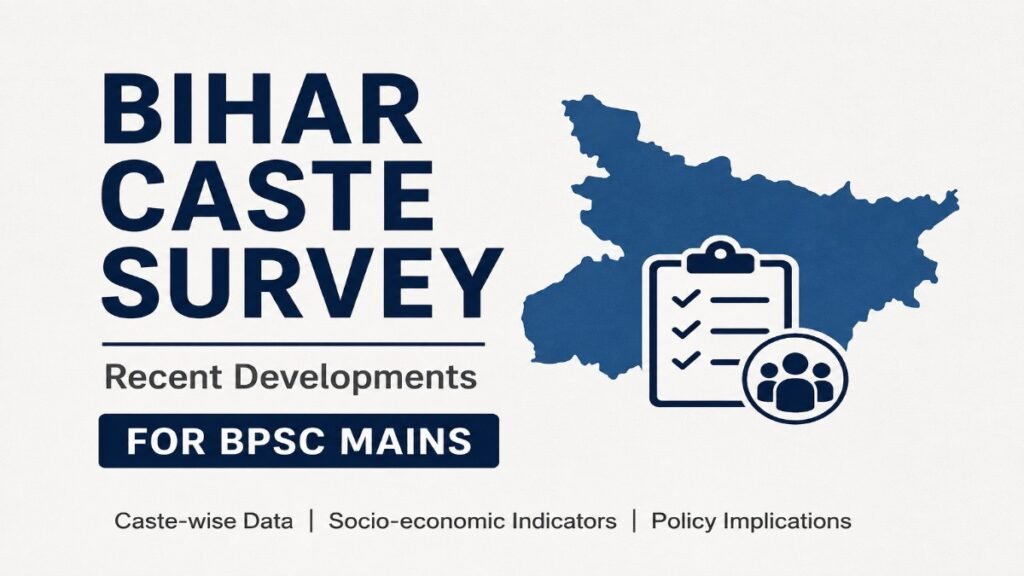
The Bihar Caste Survey is the first comprehensive State-sponsored caste-based socio-economic survey conducted after Independence. It was carried out in two phases during 2023, and the survey findings were released on 2 October 2023. Unlike a conventional population census, the survey collected not only caste-wise population data but also information on income, education, occupation, housing conditions, and other socio-economic indicators to facilitate evidence-based policymaking and targeted welfare interventions.
The caste survey in Bihar has acquired national significance because its findings have influenced reservation policy in Bihar, triggered important constitutional litigation, and revived the national debate on caste enumeration in the forthcoming Census. Consequently, the focus has shifted from mere data collection to its implications for social justice, inclusive development, and evidence-based governance.
This Bihar caste survey notes topic is highly relevant for BPSC Mains as it covers important developments related to governance, reservation policy, and evidence-based policymaking.
Master Current Affairs. Ace BPSC Mains.
BPSC Mains Current Affairs & International Relations Course
Master GS Paper-I (Section-II) with 116 exam-oriented topics, 5 structured lessons and downloadable PDF notes—all in one comprehensive course.
✔ 116 Exam-Oriented Topics • ✔ 5 Comprehensive Lessons • ✔ Downloadable PDF Notes • ✔ Updated for 72nd BPSC Mains
2. Major Findings of the Bihar Caste Survey
- Total Population: Bihar’s population was estimated at 13.07 crore (130.7 million) through the survey.
- Caste-wise Population Composition:
- Extremely Backward Classes (EBC): 36.01%
- Other Backward Classes (OBC): 27.12%
- Scheduled Castes (SC): 19.65%
- Scheduled Tribes (ST): 1.68%
- Forward (General) Castes: 15.52%
- Dominance of Backward Communities: The combined share of OBCs and EBCs is 63.13%, making them the largest social group in Bihar.
- Comprehensive Socio-economic Database: Besides caste enumeration, the Bihar Caste Survey collected information on family income, educational attainment, occupation, housing conditions, land ownership, and other socio-economic indicators to facilitate evidence-based policymaking.
- Income Profile: The survey revealed significant economic disparities. Around 34.13% of families earned less than ₹6,000 per month, while only 3.9% of households reported a monthly income exceeding ₹50,000.
Prepare Smarter. Study Better. Ace BPSC Mains.
BPSC Mains GS Paper 1 & 2 Complete Course
Access comprehensive BPSC Mains Notes for GS Paper 1 & 2, covering 378+ topics across 24 PDF lessons, with dedicated Bihar coverage, practice questions and downloadable study material.
✓ GS Paper 1 & 2 • ✓ 378+ Topics • ✓ 24 PDF Lessons • ✓ Bihar-Specific Coverage • ✓ Downloadable Notes
3. Recent Developments
Revision of Reservation Policy
- Based on the findings of the Bihar Caste Survey, the Bihar Legislature passed the Bihar Reservation (Amendment) Act, 2023, increasing reservation for SCs, STs, OBCs, and EBCs from 50% to 65% in public employment and educational institutions.
- With the existing 10% reservation for Economically Weaker Sections (EWS) under the 103rd Constitutional Amendment, the total reservation in Bihar increased to 75%.
Judicial Developments
- On 20 June 2024, the Patna High Court struck down the legislation enhancing reservation from 50% to 65%, holding that it violated constitutional principles governing reservation.
- The Bihar Government challenged the High Court judgment before the Supreme Court, where the matter is currently pending. The litigation has raised important questions regarding the extent of reservation, the use of caste survey in Bihar data in policymaking, and the constitutional validity of breaching the 50% ceiling.
Influence on National Policy
- The Bihar Caste Survey revitalised the national debate on caste-based data and evidence-driven social justice policies.
- On 30 April 2025, the Cabinet Committee on Political Affairs (CCPA) approved the inclusion of caste enumeration in the forthcoming national Census, marking a significant shift in the Union Government’s approach.
- Bihar’s experience is now widely regarded as a reference point for discussions on reservation policy, targeted welfare schemes, and inclusive development across India.
4. Significance and Challenges
The Bihar Caste Survey has strengthened evidence-based policymaking by providing detailed caste-wise and socio-economic data for the formulation of targeted welfare schemes. It enables the Government to identify disadvantaged communities more accurately, improve the targeting of public expenditure, and design policies for education, employment, healthcare, housing, and social welfare.
The survey has also reinforced the constitutional objectives of social justice, inclusive development, and substantive equality, while encouraging data-driven governance. Further, Bihar’s initiative has influenced the national discourse on caste enumeration and contributed to the Union Government’s decision to include caste enumeration in the forthcoming Census, highlighting its significance beyond the state.
At the same time, the survey has generated important legal, constitutional, and administrative challenges. The enhancement of reservation based on the survey findings was struck down by the Patna High Court, and the matter is presently pending before the Supreme Court, raising questions regarding the constitutional limits of reservation and the use of caste data in public policy.
Concerns have also been expressed regarding privacy of personal data, political polarisation, data accuracy, and the periodic updating of socio-economic information. Going forward, the effectiveness of the Bihar Caste Survey will depend not merely on data collection but on its transparent, constitutionally compliant, and equitable utilisation for achieving inclusive development and reducing socio-economic disparities.
5. Way Forward
- Use the survey as a policy tool rather than merely a demographic exercise by integrating caste-wise socio-economic data into the planning and implementation of welfare schemes, education, healthcare, employment, and poverty alleviation programmes. This will help ensure that public resources reach the most disadvantaged sections of society.
- Ensure constitutional and legal compliance while framing reservation and affirmative action policies. Future policy decisions based on the Bihar Caste Survey should be consistent with constitutional principles and the final verdict of the Supreme Court to avoid prolonged legal uncertainty.
- Strengthen data governance by periodically updating socio-economic databases, ensuring transparency in the use of survey findings, and protecting the privacy and confidentiality of citizens’ personal information. This will improve the credibility and long-term utility of the survey.
- Promote evidence-based and inclusive governance by using the survey findings to reduce regional and social disparities, improve targeting of development programmes, and strengthen social justice while maintaining social harmony and administrative efficiency.
Experience the Quality Before You Enroll
Download Free Sample Notes (PDF)
Download a free sample of our BPSC Mains Current Affairs Notes and experience the structured, exam-oriented content before enrolling. Explore the presentation, answer-writing approach, and overall quality of the complete course.
✔ Free Download • ✔ Exam-Oriented Notes • ✔ Updated Content • ✔ Structured for BPSC Mains
BPSC Mains Practice Question
Q1. The Bihar Caste Survey has emerged as an important instrument for evidence-based policymaking and social justice. Critically examine the major findings of the survey and analyse its impact on reservation policy, governance, and the national debate on caste enumeration.
Learn More from the Government of Bihar
Readers interested in the Bihar Caste Survey, caste survey in Bihar, reservation policy, socio-economic data, and evidence-based governance can visit the official website of the Department of Planning and Development, Government of Bihar. The portal provides authentic statistical information, official reports, socio-economic data, and government publications that support policy formulation and development planning in the State. Department of Planning and Development, Government of Bihar