1. Introduction
The Bihar Gram Panchayat Taxation Rules, 2026 were approved by the Bihar Cabinet to operationalise the taxation powers of Gram Panchayats under Section 27 of the Bihar Panchayat Raj Act, 2006. The Rules empower Gram Panchayats to levy and collect holding tax, user charges, licence fees and other local taxes to strengthen their financial resources and improve the delivery of civic services in rural areas. The Bihar Panchayat tax rule 2026 represents an important step towards strengthening fiscal decentralisation and local self-governance.
- In July 2026, the Bihar Cabinet approved the Bihar Gram Panchayat Taxation Rules, 2026, providing a comprehensive framework for taxation by Gram Panchayats.
- The tax rule in Bihar Panchayat aims to strengthen the Own Source Revenue (OSR) of Gram Panchayats and promote fiscal decentralisation, thereby reducing dependence on State and Central Finance Commission grants.
- The proposal triggered a debate in the Bihar Legislature regarding its impact on rural households, with the Government clarifying that kutcha houses are exempt and the Rules are intended to strengthen Panchayats without imposing an undue burden on poor families.
The Panchayat tax rule in Bihar is expected to improve the financial autonomy of Gram Panchayats and enable them to provide better civic amenities and public services in rural areas.
Master Current Affairs. Ace BPSC Mains.
BPSC Mains Current Affairs & International Relations Course
Master GS Paper-I (Section-II) with 116 exam-oriented topics, 5 structured lessons and downloadable PDF notes—all in one comprehensive course.
✔ 116 Exam-Oriented Topics • ✔ 5 Comprehensive Lessons • ✔ Downloadable PDF Notes • ✔ Updated for 72nd BPSC Mains
2. Salient Features of the Bihar Gram Panchayat Taxation Rules, 2026
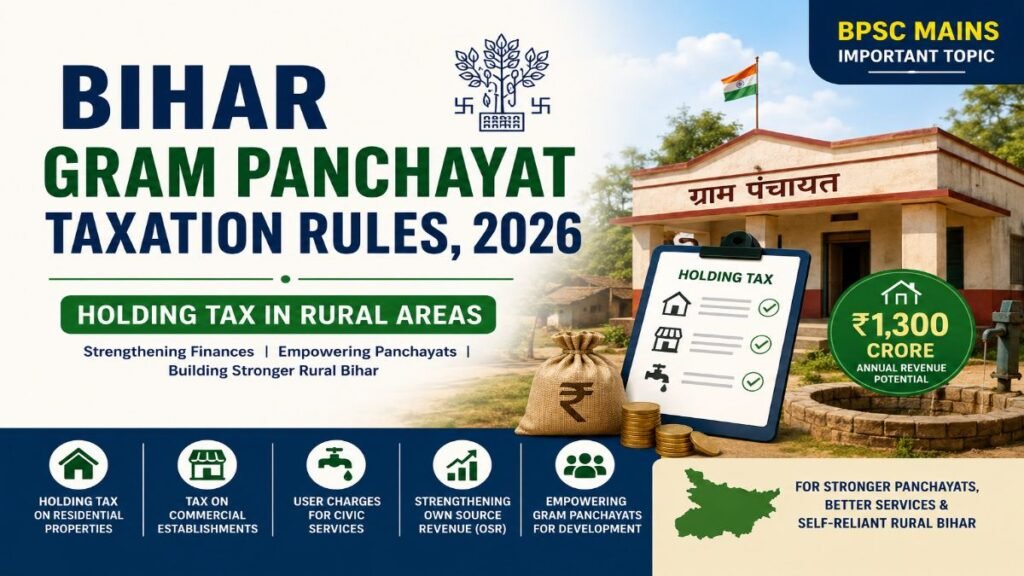
- Holding Tax on Residential Buildings: Under the Bihar Gram Panchayat Taxation Rules, 2026, Gram Panchayats are empowered to levy an annual holding tax on residential properties. Kutcha houses are exempt, while PMAY houses – ₹25, semi-pucca houses – ₹50, and pucca houses – ₹100 per year are liable to pay holding tax.
- Tax on Commercial Establishments: The Bihar Panchayat tax rule 2026 prescribes annual fees for commercial and industrial establishments such as petrol pumps, LPG agencies, brick kilns, cinema halls, marriage halls, hotels, rice mills and other businesses operating within Gram Panchayat limits. For example, petrol pumps and LPG agencies will pay ₹5,000 per year.
- User Charges for Civic Services: The tax rule in Bihar Panchayat empowers Gram Panchayats to levy water supply fees, cleanliness/sanitation charges, street lighting fees, market fees, licence fees, advertisement fees and other user charges for civic services provided to residents.
- Strengthening Own Source Revenue (OSR): The Rules are intended to enhance the financial autonomy of Gram Panchayats by enabling them to generate their own revenue instead of relying primarily on State and Central Finance Commission grants.
- Legal and Administrative Framework: The Bihar Gram Panchayat Taxation Rules, 2026 have been notified under Section 27 of the Bihar Panchayat Raj Act, 2006, making Gram Panchayats the authority responsible for the assessment, collection and utilisation of taxes, rates and fees within their jurisdiction.
- Revenue Generation Potential: The Panchayat tax rule in Bihar is estimated to generate nearly ₹1,300 crore annually, which can be utilised for improving rural infrastructure and civic amenities such as roads, drainage, drinking water, sanitation and street lighting.
Prepare Smarter. Study Better. Ace BPSC Mains.
BPSC Mains GS Paper 1 & 2 Complete Course
Access comprehensive BPSC Mains Notes for GS Paper 1 & 2, covering 378+ topics across 24 PDF lessons, with dedicated Bihar coverage, practice questions and downloadable study material.
✓ GS Paper 1 & 2 • ✓ 378+ Topics • ✓ 24 PDF Lessons • ✓ Bihar-Specific Coverage • ✓ Downloadable Notes
3. Significance of the Bihar Gram Panchayat Taxation Rules, 2026
The Bihar Gram Panchayat Taxation Rules, 2026 mark an important step towards fiscal decentralisation by enabling Gram Panchayats to generate their own revenue through taxes, rates and user charges. This strengthens the Own Source Revenue (OSR) of Panchayats, reducing their excessive dependence on State and Central Finance Commission grants. The Panchayat tax rule in Bihar operationalises the constitutional vision of Article 243H and the 73rd Constitutional Amendment, which empower Panchayats to levy and collect taxes for local self-governance.
Improved financial autonomy under the Bihar Panchayat tax rule 2026 is expected to enhance the capacity of Gram Panchayats to provide essential civic services such as drinking water, sanitation, drainage, street lighting, waste management and maintenance of rural infrastructure. With an estimated ₹1,300 crore in annual revenue potential, Panchayats will have greater flexibility to address local development priorities and respond to community needs more effectively.
The tax rule in Bihar Panchayat also promotes accountability and participatory governance by linking locally generated revenue with local public expenditure. When citizens directly contribute through local taxes, there is greater demand for transparency, efficient utilisation of funds and improved service delivery. In the long run, the Bihar Gram Panchayat Taxation Rules, 2026 can strengthen grassroots democracy and make Panchayati Raj Institutions more financially sustainable and self-reliant.
4. Challenges and Concerns
Burden on Rural Households
Although the tax rates under the Bihar Gram Panchayat Taxation Rules, 2026 are relatively low and kutcha houses are exempt, concerns have been raised that the new taxation system may impose an additional financial burden on poor and lower-middle-income rural households. During the Bihar Legislature session, opposition leaders argued that many rural families still depend on welfare schemes and should not face additional taxes. The Government, however, clarified that the Panchayat tax rule in Bihar is not intended to burden the poor.
Administrative Capacity of Gram Panchayats
Many Gram Panchayats lack trained personnel, updated property records and digital systems for property assessment, tax collection and accounting. Weak institutional capacity may lead to inefficient implementation of the Bihar Panchayat tax rule 2026, low tax compliance and higher administrative costs.
Transparency and Accountability
The success of the Bihar Gram Panchayat Taxation Rules, 2026 will depend on transparent assessment, collection and utilisation of tax revenue. Without strong financial management, social audits and public disclosure of accounts, there is a risk of misuse of funds and reduced public trust in Panchayati Raj Institutions.
Property Assessment and Revenue Collection
Accurate identification of holdings, periodic valuation of commercial establishments and maintenance of updated land and property records remain major challenges in implementing the tax rule in Bihar Panchayat. Disputes over ownership, classification of properties and tax assessment may affect effective revenue collection and reduce the expected ₹1,300 crore annual revenue target.
5. Way Forward
The successful implementation of the Bihar Gram Panchayat Taxation Rules, 2026 requires strengthening the institutional and financial capacity of Gram Panchayats. The Government should digitise property records, adopt GIS-based property mapping, provide training to Panchayat functionaries and introduce transparent online systems for tax assessment, collection and grievance redressal. These measures will improve the effectiveness of the tax rule in Bihar Panchayat while ensuring greater transparency and accountability. Regular social audits and public disclosure of revenue utilisation can further enhance citizens’ trust in Panchayati Raj Institutions.
At the same time, the Bihar Panchayat tax rule 2026 should remain equitable and citizen-centric by protecting economically weaker households while broadening the tax base through commercial establishments and user charges. Additional revenue generated under the Panchayat tax rule in Bihar should be visibly invested in drinking water, sanitation, roads, street lighting, drainage and other local civic services, thereby reinforcing the principles of fiscal decentralisation and strengthening grassroots self-governance envisioned under the 73rd Constitutional Amendment.
Experience the Quality Before You Enroll
Download Free Sample Notes (PDF)
Download a free sample of our BPSC Mains Current Affairs Notes and experience the structured, exam-oriented content before enrolling. Explore the presentation, answer-writing approach, and overall quality of the complete course.
✔ Free Download • ✔ Exam-Oriented Notes • ✔ Updated Content • ✔ Structured for BPSC Mains
BPSC Mains Practice Question
Q. The Bihar Gram Panchayat Taxation Rules, 2026 mark a significant step towards fiscal decentralisation in Bihar. Critically examine their significance in strengthening the financial autonomy of Gram Panchayats. Also discuss the major implementation challenges and suggest measures for effective local revenue mobilisation.
Learn More from the Panchayati Raj Department, Government of Bihar
Readers interested in the Bihar Gram Panchayat Taxation Rules, 2026, tax rule in Bihar Panchayat, Bihar Panchayat tax rule 2026, fiscal decentralisation, Gram Panchayat finances, and Panchayati Raj governance can visit the official website of the Panchayati Raj Department, Government of Bihar. The portal provides authentic information on Panchayati Raj Institutions, rural local governance, government notifications, Gram Panchayat administration, and policy initiatives aimed at strengthening grassroots democracy and local self-governance.