1. Introduction
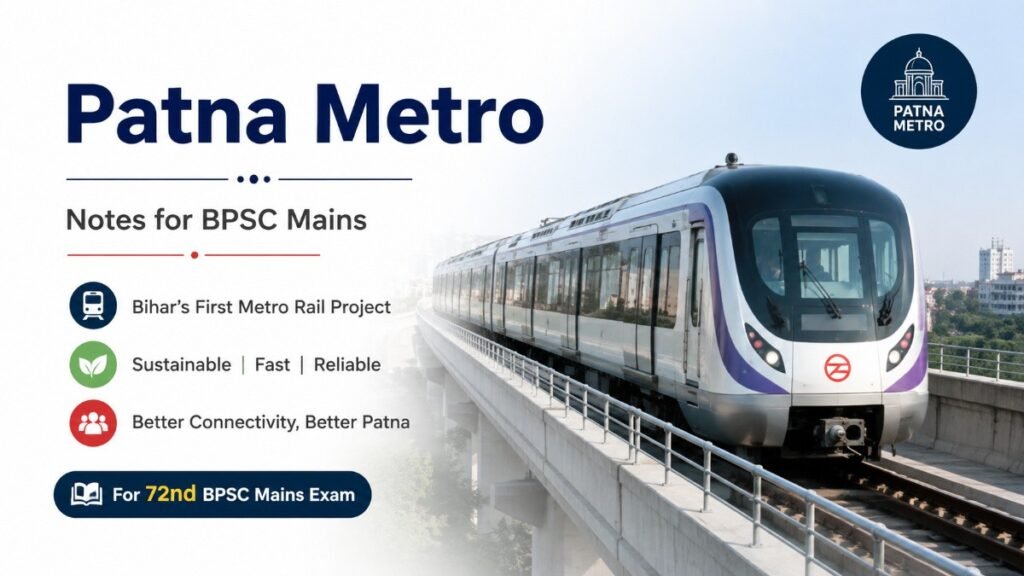
The Patna Metro Rail Project is Bihar’s first Mass Rapid Transit System (MRTS), designed to provide a safe, fast, reliable, and environment-friendly public transport system for the state capital. The project is being implemented by the Patna Metro Rail Corporation Limited (PMRCL) with technical support from the Delhi Metro Rail Corporation (DMRC). It comprises two metro corridors covering major residential, commercial, educational, and transport hubs of Patna through a combination of elevated and underground sections.
The Patna Metro project has entered a significant implementation phase with the operationalisation and expansion of the Priority Corridor between New ISBT and Malahi Pakri, while construction of the remaining elevated and underground sections is progressing rapidly. The metro train in Patna is expected to become the backbone of the city’s public transport network and play a crucial role in improving urban mobility, reducing congestion, and supporting planned urban development in Bihar.
These Patna Metro Notes are important for BPSC Mains as they cover one of Bihar’s most significant urban infrastructure projects with relevance to sustainable urbanisation, public transport, and planned urban development.
Master Current Affairs. Ace BPSC Mains.
BPSC Mains Current Affairs & International Relations Course
Master GS Paper-I (Section-II) with 116 exam-oriented topics, 5 structured lessons and downloadable PDF notes—all in one comprehensive course.
✔ 116 Exam-Oriented Topics • ✔ 5 Comprehensive Lessons • ✔ Downloadable PDF Notes • ✔ Updated for 72nd BPSC Mains
2. Why in News?
- On 2 July 2026, the Patna Metro Priority Corridor’s Bhootnath–Malahi Pakri stretch was inaugurated, extending metro services and marking another major milestone in Bihar’s first metro rail project.
- The newly operational 6.5 km Priority Corridor (New ISBT–Zero Mile–Bhootnath–Khemnichak–Malahi Pakri) has significantly enhanced connectivity in East Patna. The metro train in Patna is expected to reduce traffic congestion in densely populated areas such as Kankarbagh.
- The Bihar Government has also accelerated work on the remaining Patna Metro corridors, including the technically challenging underground sections, to create a comprehensive urban mass transit network for Patna.
These recent developments make Patna Metro Notes highly relevant for BPSC Mains from the perspective of urban infrastructure, sustainable mobility, and Bihar’s ongoing development initiatives.
3. Recent Progress of Patna Metro
- Expansion of the Priority Corridor: The Patna Metro Bhootnath–Malahi Pakri section was inaugurated on 2 July 2026, extending metro services to five operational stations—New ISBT, Zero Mile, Bhootnath, Khemnichak, and Malahi Pakri—over a 6.5 km elevated corridor.
- Reduced Travel Time: The operational Priority Corridor now enables commuters to travel between New ISBT and Malahi Pakri in about 16 minutes, offering a faster and more reliable alternative to road transport. The metro train in Patna is expected to significantly improve daily commuting for thousands of passengers.
- Progress on Remaining Corridors: Construction is progressing on the underground sections, including Patna Junction, Gandhi Maidan, PMCH, Patna Science College, Moin-ul-Haq Stadium, and Rajendra Nagar, while elevated works on Corridor-1 are also advancing. These sections will eventually connect major residential, commercial, educational, and administrative centres across the city, further strengthening the Patna Metro network.
- Digital and Passenger-Friendly Services: To promote seamless travel, SBI Mobility Cards have been introduced for cashless ticketing. The metro train in Patna is also being integrated with bus terminals and railway stations to strengthen multimodal urban transport.
The above developments make these Patna Metro Notes particularly important for understanding the recent progress of Bihar’s first metro rail project from the BPSC Mains examination perspective.
Prepare Smarter. Study Better. Ace BPSC Mains.
BPSC Mains GS Paper 1 & 2 Complete Course
Access comprehensive BPSC Mains Notes for GS Paper 1 & 2, covering 378+ topics across 24 PDF lessons, with dedicated Bihar coverage, practice questions and downloadable study material.
✓ GS Paper 1 & 2 • ✓ 378+ Topics • ✓ 24 PDF Lessons • ✓ Bihar-Specific Coverage • ✓ Downloadable Notes
4. Impact of Patna Metro on Urban Mobility
Reduction in Traffic Congestion
Patna is one of India’s fastest-growing cities and faces severe traffic congestion due to rapid urbanisation, rising vehicle ownership, and limited road space. The Patna Metro provides a high-capacity mass transit alternative that can shift a significant number of commuters from private vehicles to public transport. The operational New ISBT–Malahi Pakri Priority Corridor serves densely populated areas such as Kankarbagh, Bhootnath, and Transport Nagar, reducing pressure on major roads like NH-30 and the New Bypass.
Faster, Reliable and Comfortable Commuting
The metro train in Patna offers predictable travel time by avoiding road congestion. The operational 6.5 km Priority Corridor enables commuters to travel between New ISBT and Malahi Pakri in about 16 minutes, significantly reducing journey time compared to peak-hour road travel. Air-conditioned coaches, punctual services, and digital ticketing further improve the overall commuting experience.
Improved Multimodal Connectivity
Patna Metro is being integrated with key transport hubs such as New ISBT, the upcoming Patna Junction Interchange Station, and in the future, connectivity to major commercial and institutional areas. This integration will facilitate seamless transfers between metro, buses, railways, auto-rickshaws, and e-rickshaws, creating a more efficient urban transport network and improving last-mile connectivity.
Environmentally Sustainable Urban Transport
As an electric mass rapid transit system, the Patna Metro is expected to reduce dependence on private vehicles, thereby lowering fuel consumption, air pollution, greenhouse gas emissions, and noise pollution. This supports Bihar’s commitment to sustainable urban development and contributes to cleaner air in Patna.
Catalyst for Planned Urban Development
The Patna Metro is expected to promote Transit-Oriented Development (TOD) by encouraging residential, commercial, and institutional development around metro stations. It will complement Bihar’s Greenfield Satellite Township Project, helping create compact, well-connected urban growth centres instead of unplanned urban sprawl. Improved connectivity is also likely to increase property values and attract private investment around metro corridors.
Boost to Economic Productivity and Ease of Living
Improved connectivity through the Patna Metro enables quicker access to educational institutions, hospitals, government offices, markets, and workplaces, reducing travel costs and increasing productivity. Faster and more reliable public transport also improves the Ease of Living for citizens, enhances labour mobility, and supports the growth of commerce, tourism, and service sectors in the city.
Promoting Digital and Smart Mobility
The launch of the SBI Mobility Card enables cashless, tap-and-travel services on the metro train in Patna, making public transport more convenient and encouraging digital payments. Such initiatives support the broader goals of Digital India, smart urban mobility, and integrated public transport systems.
These developments highlight why Patna Metro Notes are important for understanding the role of modern urban transport in achieving sustainable and planned urban development in Bihar.
5. Way Forward
- Complete the remaining Patna Metro corridors on schedule: Expedite construction of the underground and elevated sections to provide seamless city-wide metro connectivity and maximise the benefits of mass rapid transit.
- Strengthen multimodal integration: Integrate the Patna Metro with city buses, New ISBT, Patna Junction, the proposed Water Metro, feeder buses, e-rickshaws, cycling tracks, and pedestrian infrastructure to improve first- and last-mile connectivity.
- Promote Transit-Oriented Development (TOD): Encourage mixed land use, affordable housing, commercial development, and public amenities around Patna Metro stations to reduce dependence on private vehicles and support planned urban growth.
- Adopt Smart Mobility Solutions: Expand digital ticketing through the SBI Mobility Card, introduce integrated mobility apps, real-time passenger information systems, and intelligent traffic management to make the metro train in Patna more convenient, efficient, and user-friendly.
Conclusion
The recent progress of the Patna Metro marks a significant step towards building a modern, sustainable, and integrated urban transport system in Bihar. With timely completion of the remaining corridors, stronger multimodal integration, and the adoption of smart mobility solutions, the metro train in Patna has the potential to become the backbone of urban mobility. These developments will support economic growth, planned urbanisation, environmental sustainability, and an improved quality of life, making Patna Metro Notes highly relevant for BPSC Mains preparation.
Experience the Quality Before You Enroll
Download Free Sample Notes (PDF)
Download a free sample of our BPSC Mains Current Affairs Notes and experience the structured, exam-oriented content before enrolling. Explore the presentation, answer-writing approach, and overall quality of the complete course.
✔ Free Download • ✔ Exam-Oriented Notes • ✔ Updated Content • ✔ Structured for BPSC Mains
BPSC Mains Practice Question
Q1. “Patna Metro is not merely a transport project but a catalyst for sustainable urban mobility.” Examine the impact of the recent progress of the Patna Metro Rail Project on urban mobility in Bihar. Suggest measures to maximise its long-term benefits for planned urban development.
External Reference
For detailed and authentic information on the Patna Metro project, including project updates, route details, stations, and official notifications, readers may refer to the official website of the Patna Metro Rail Corporation Limited (PMRCL). This is the primary source for the latest information related to Patna Metro Notes and the metro train in Patna.