1. Introduction
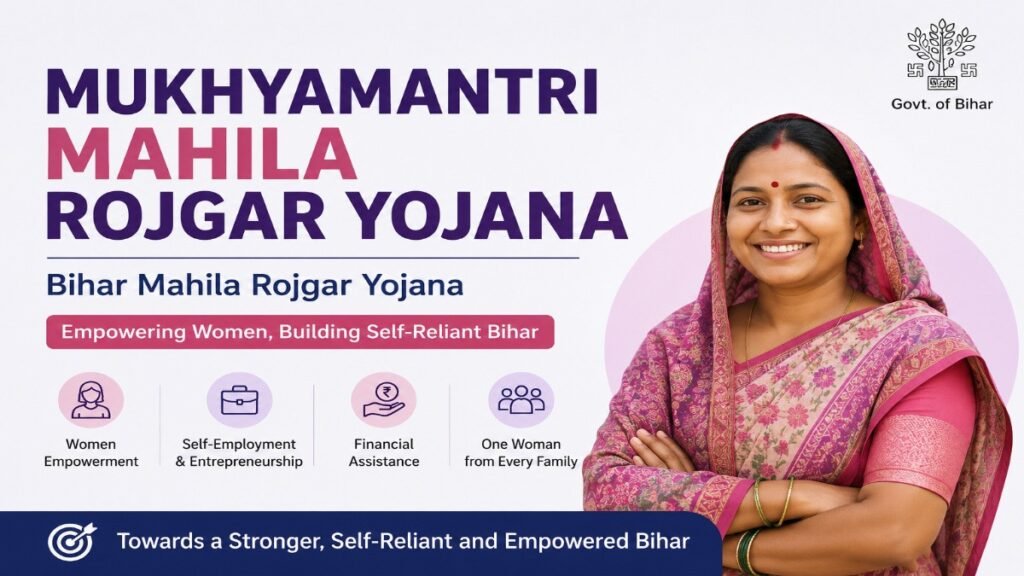
The Mukhyamantri Mahila Rojgar Yojana (MMRY) is a flagship women-centric livelihood initiative of the Government of Bihar aimed at promoting women-led entrepreneurship, self-employment, and economic empowerment. Approved by the Bihar Cabinet on 29 August 2025 and launched on 26 September 2025, the Mukhyamantri Mahila Rojgar Yojana seeks to provide financial assistance to one eligible woman from every family so that she can establish a micro-enterprise or undertake a livelihood activity of her choice. The programme is built around the philosophy that empowering women economically strengthens households, enhances community development, and contributes to inclusive economic growth.
The Bihar Mahila Rojgar Yojana adopts a graduated support model. Eligible women receive initial financial assistance of ₹10,000 through Direct Benefit Transfer (DBT) to start an enterprise. Based on the progress and sustainability of the business, they become eligible for additional financial assistance of up to ₹2 lakh in phased instalments. The implementation of the Mukhyamantri Mahila Rojgar Yojana is supported by the Rural Development Department, Urban Development & Housing Department, and the JEEViKA Self-Help Group (SHG) network, ensuring financial assistance is complemented by community-based handholding and enterprise support.
Master Current Affairs. Ace BPSC Mains.
BPSC Mains Current Affairs & International Relations Course
Master GS Paper-I (Section-II) with 116 exam-oriented topics, 5 structured lessons and downloadable PDF notes—all in one comprehensive course.
✔ 116 Exam-Oriented Topics • ✔ 5 Comprehensive Lessons • ✔ Downloadable PDF Notes • ✔ Updated for 72nd BPSC Mains
2. Why in News?
- The Mukhyamantri Mahila Rojgar Yojana was formally launched on 26 September 2025, during which ₹10,000 each was transferred to about 75 lakh women, amounting to ₹7,500 crore through Direct Benefit Transfer (DBT).
- In 2026, the Bihar Government announced the next instalment under the Bihar Mahila Rojgar Yojana for eligible beneficiaries whose enterprises showed satisfactory progress, reaffirming its commitment to long-term livelihood support rather than one-time assistance.
- The Government has reiterated its objective of covering one eligible woman from every family through the Mukhyamantri Mahila Rojgar Yojana to promote widespread women’s entrepreneurship and self-reliance.
Prepare Smarter. Study Better. Ace BPSC Mains.
BPSC Mains GS Paper 1 & 2 Complete Course
Access comprehensive BPSC Mains Notes for GS Paper 1 & 2, covering 378+ topics across 24 PDF lessons, with dedicated Bihar coverage, practice questions and downloadable study material.
✓ GS Paper 1 & 2 • ✓ 378+ Topics • ✓ 24 PDF Lessons • ✓ Bihar-Specific Coverage • ✓ Downloadable Notes
3. Salient Features of the Scheme
Universal Coverage of Women
The Mukhyamantri Mahila Rojgar Yojana aims to benefit one eligible woman from every family in Bihar, making it one of the largest women-centric livelihood programmes in the country. Eligible applicants must be permanent residents of Bihar, generally in the 18–60 years age group, with preference given to women associated with JEEViKA Self-Help Groups (SHGs) to ensure better community mobilisation and implementation. This broad coverage makes the Bihar Mahila Rojgar Yojana a significant initiative for promoting women’s economic empowerment across the state.
Phased Financial Assistance
The Mukhyamantri Mahila Rojgar Yojana follows a graduated enterprise support model rather than a one-time cash transfer. Eligible beneficiaries receive an initial ₹10,000 through Direct Benefit Transfer (DBT) to start a livelihood activity. Based on satisfactory progress of the enterprise, they can receive additional financial assistance of up to ₹2 lakh in phased instalments for business expansion and sustainability.
Community-based Implementation through JEEViKA
Unlike conventional subsidy schemes, the Bihar Mahila Rojgar Yojana is implemented through the extensive JEEViKA SHG network, where Community Resource Persons (CRPs) assist beneficiaries in identifying viable livelihood activities, preparing business plans, acquiring skills, and managing enterprises. This community-driven approach enhances accountability and reduces the risk of enterprise failure.
Promotion of Diverse Livelihood Activities
Under the Mukhyamantri Mahila Rojgar Yojana, women are encouraged to establish micro-enterprises based on local resources and market demand. Supported activities include dairy farming, goat rearing, poultry, fisheries, tailoring, handicrafts, food processing, retail shops, beauty parlours, digital services, and other small businesses, allowing flexibility according to local economic conditions.
Skill Development and Market Linkages
Financial assistance under the Mukhyamantri Mahila Rojgar Yojana is complemented by entrepreneurship training, financial literacy, business mentoring, and market linkage support. The scheme also envisages strengthening rural haats and local markets to facilitate the sale of products manufactured by women entrepreneurs, thereby improving enterprise sustainability and income generation.
Transparent and Technology-driven Delivery
The Bihar Mahila Rojgar Yojana adopts Direct Benefit Transfer (DBT) to transfer financial assistance directly into beneficiaries’ bank accounts, minimising leakages and ensuring transparency. Progress of enterprises is monitored before the release of subsequent instalments, shifting the focus from mere fund distribution to the creation of sustainable women-owned enterprises.
4. Significance of the Scheme
Women Economic Empowerment
The Mukhyamantri Mahila Rojgar Yojana represents a significant shift from welfare-based assistance to enterprise-led economic empowerment. By providing financial support directly to women, the scheme enables them to establish income-generating activities, increase household earnings, and achieve greater financial independence. Ownership of productive assets and enterprises also enhances women’s participation in household decision-making and strengthens their social status within the family and community. The Bihar Mahila Rojgar Yojana thus promotes long-term socio-economic empowerment rather than short-term financial assistance.
Promotion of Entrepreneurship and Self-employment
The Mukhyamantri Mahila Rojgar Yojana encourages women to move beyond wage labour by establishing micro-enterprises in sectors such as dairy, livestock rearing, tailoring, handicrafts, food processing, retail trade, and service activities. This not only creates self-employment opportunities but also generates additional employment for family members and local communities, contributing to the growth of the rural non-farm economy.
Strengthening the JEEViKA SHG Ecosystem
Implementation of the Bihar Mahila Rojgar Yojana through the JEEViKA Self-Help Group (SHG) network strengthens Bihar’s successful community-based livelihood model. Besides financial assistance, beneficiaries receive capacity building, business mentoring, financial literacy, and market linkage support, improving the survival and growth prospects of women-owned enterprises. The scheme further deepens social capital by encouraging collective entrepreneurship and mutual support among SHG members.
Financial Inclusion and Digital Governance
The Mukhyamantri Mahila Rojgar Yojana uses Direct Benefit Transfer (DBT) to ensure transparent and timely transfer of funds directly into beneficiaries’ bank accounts, reducing leakages and intermediary dependence. By integrating women into the formal banking system, the scheme promotes financial inclusion, digital transactions, savings behaviour, and improved access to institutional credit for future enterprise expansion.
Poverty Reduction and Inclusive Growth
By creating sustainable livelihood opportunities, the Mukhyamantri Mahila Rojgar Yojana has the potential to reduce rural poverty, diversify household income sources, and improve economic resilience against shocks such as crop failure or unemployment. Since the programme targets one eligible woman from every family, its benefits are expected to reach a broad section of society, making growth more inclusive and equitable.
Employment Generation and Reduction in Distress Migration
Expansion of women-led micro-enterprises under the Bihar Mahila Rojgar Yojana can generate employment within villages and small towns, reducing dependence on seasonal migration for livelihood. The promotion of local enterprises also stimulates rural markets, strengthens local value chains, and supports balanced regional development by creating economic opportunities closer to home.
Contribution to Sustainable Development Goals (SDGs)
The Mukhyamantri Mahila Rojgar Yojana contributes directly to several United Nations Sustainable Development Goals (SDGs), particularly:
- SDG 1: No Poverty
- SDG 5: Gender Equality
- SDG 8: Decent Work and Economic Growth
By combining financial assistance with entrepreneurship support, the Bihar Mahila Rojgar Yojana advances women’s economic participation while promoting sustainable and inclusive development.
Long-term Impact on Bihar’s Economy
In the long run, the Mukhyamantri Mahila Rojgar Yojana can strengthen Bihar’s micro-enterprise ecosystem, increase female labour force participation, and expand the contribution of women to the State’s Gross Domestic Product (GSDP). A larger base of successful women entrepreneurs will also encourage innovation, local manufacturing, and rural industrialisation, supporting Bihar’s transition towards a more diversified and resilient economy.
5. Challenges in Implementation
The success of the Mukhyamantri Mahila Rojgar Yojana depends not merely on financial assistance but on the sustainability of women-led enterprises. Many beneficiaries, particularly in rural areas, have limited entrepreneurial experience, financial literacy, and market exposure. Without adequate skill development, business mentoring, access to credit, and market linkages, there is a risk that enterprises may remain small or become financially unviable. Effective monitoring of fund utilisation and continuous handholding through the JEEViKA SHG network will therefore be critical for ensuring the long-term success of the Bihar Mahila Rojgar Yojana.
Another challenge is ensuring that the Mukhyamantri Mahila Rojgar Yojana reaches the most vulnerable women, including those from economically weaker households, remote areas, and marginalised communities. The Government also needs to create stronger value chains, digital marketing platforms, and institutional support so that women entrepreneurs can compete in wider markets. As the Bihar Mahila Rojgar Yojana expands to cover one eligible woman from every family, maintaining fiscal sustainability, ensuring timely release of subsequent instalments, and establishing robust impact evaluation mechanisms will be essential for achieving durable livelihood outcomes rather than short-term financial assistance.
6. Way Forward
The Mukhyamantri Mahila Rojgar Yojana should gradually evolve from a financial assistance programme into a comprehensive women entrepreneurship ecosystem by integrating skill training, financial literacy, enterprise incubation, digital marketing, and market access. Convergence with programmes such as DAY-NRLM, PM MUDRA Yojana, PM Vishwakarma, PMFME, and other MSME support initiatives can provide beneficiaries with technology, credit, branding, and marketing opportunities. Regular mentoring through JEEViKA SHGs, partnerships with banks and private enterprises, and periodic impact assessments will help improve enterprise survival and income generation. A sustained focus on innovation, value addition, and women-led micro-enterprises can transform the Bihar Mahila Rojgar Yojana into a powerful instrument for women’s economic empowerment, rural industrialisation, and inclusive growth in Bihar.
7. Conclusion
The Mukhyamantri Mahila Rojgar Yojana marks a significant shift from welfare-oriented assistance to an entrepreneurship-driven model of women’s empowerment in Bihar. By combining phased financial assistance with skill development, community support through JEEViKA SHGs, and enterprise mentoring, the Bihar Mahila Rojgar Yojana has the potential to create sustainable livelihoods, strengthen women’s financial independence, and promote inclusive economic growth. Its long-term success will depend on effective implementation, market linkages, continuous capacity building, and institutional support for women-owned enterprises.
Experience the Quality Before You Enroll
Download Free Sample Notes (PDF)
Download a free sample of our BPSC Mains Current Affairs Notes and experience the structured, exam-oriented content before enrolling. Explore the presentation, answer-writing approach, and overall quality of the complete course.
✔ Free Download • ✔ Exam-Oriented Notes • ✔ Updated Content • ✔ Structured for BPSC Mains
BPSC Mains Practice Question
Q1. The Mukhyamantri Mahila Rojgar Yojana marks a shift from welfare-oriented assistance to women-led entrepreneurship in Bihar. Critically examine its role in promoting women’s economic empowerment, inclusive growth, and rural livelihoods. Also discuss the major implementation challenges and suggest measures to enhance the sustainability of women-owned enterprises.
External Reference
For detailed and authentic information on the Mukhyamantri Mahila Rojgar Yojana, women empowerment initiatives, JEEViKA programmes, and rural livelihood schemes in Bihar, readers may refer to the official website of the Rural Development Department, Government of Bihar. This is the primary official source for updates related to the Mukhyamantri Mahila Rojgar Yojana and the Bihar Mahila Rojgar Yojana.