1. Introduction and Evolution of Mobile Communication
Definition of 5G Technology
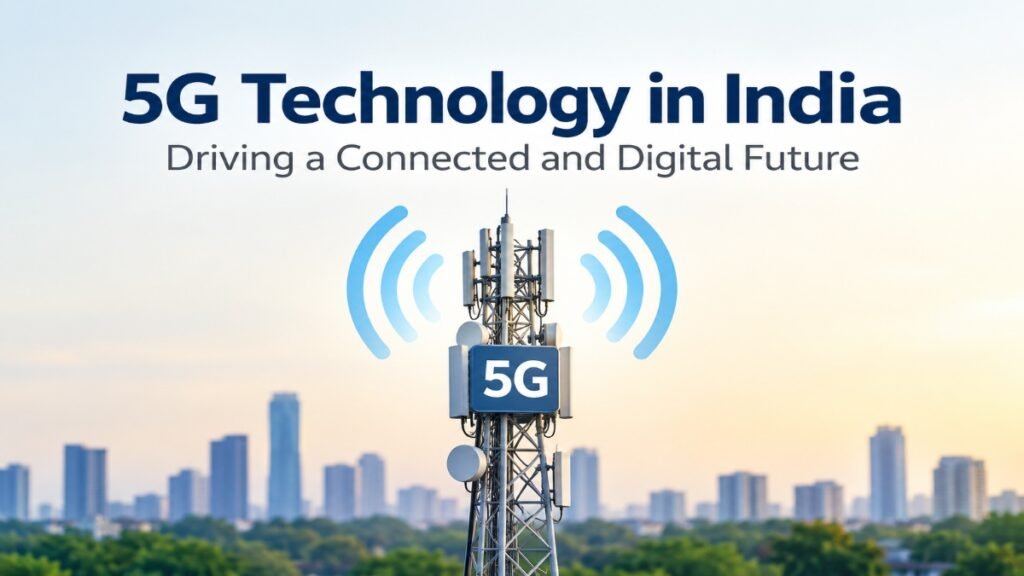
5G Technology in India is the latest generation of mobile communication technology and the successor to 4G networks. It is a global wireless communication standard designed to provide ultra-high internet speed, extremely low latency (response time), greater network capacity, and seamless connectivity among billions of devices. Unlike previous generations that primarily focused on connecting people through voice and mobile internet, 5G aims to connect people, machines, sensors, vehicles, industries, and public infrastructure, making it the backbone of the Digital Economy and the Fourth Industrial Revolution (Industry 4.0).
The International Telecommunication Union (ITU) has set ambitious performance targets for 5G, including peak data speeds of up to 20 Gbps, user-experienced speeds of around 100 Mbps, latency as low as 1 millisecond, and the ability to support up to one million connected devices per square kilometre. In comparison, 4G networks generally provide peak speeds of around 1 Gbps under ideal conditions. These improvements enable applications that require real-time communication, such as autonomous vehicles, remote surgery, smart factories, and intelligent transport systems.
Evolution of Mobile Communication
Mobile communication technology has evolved continuously over the past four decades to meet growing communication and data needs.
| Generation | Period | Key Features |
|---|---|---|
| 1G | 1980s | Analog technology supporting only voice calls with limited quality and security. |
| 2G | 1990s | Introduced digital communication, SMS, and basic internet services with data speeds up to about 64 Kbps. |
| 3G | 2000s | Enabled mobile internet, video calling, multimedia services, and speeds ranging from 1–2 Mbps. |
| 4G | Around 2009 | Offered broadband internet, HD video streaming, online gaming, cloud computing, and peak speeds up to about 1 Gbps. |
| 5G | Commercial rollout since 2019 globally; launched in India in 2022 | Provides ultra-fast broadband, ultra-low latency, massive machine connectivity, and supports advanced technologies such as Artificial Intelligence (AI), Internet of Things (IoT), cloud computing, augmented reality (AR), and virtual reality (VR). |
India officially launched 5G Technology in India on 1 October 2022 under the National Digital Communications Policy (NDCP), 2018, which recognizes 5G as a key enabler of Digital India, Industry 4.0, Artificial Intelligence (AI), Internet of Things (IoT), cloud computing, and data-driven economic growth.
Key Features of 5G Technology
5G Technology in India represents a major technological leap because it offers several improvements over previous generations:
- Ultra-high Speed: It can theoretically achieve data speeds of up to 20 Gbps, allowing ultra-high-definition video streaming, rapid downloading, and seamless cloud-based services.
- Ultra-low Latency: With response times as low as 1 millisecond, 5G enables real-time applications such as robotic surgery, autonomous vehicles, industrial automation, and remote-control systems.
- Massive Connectivity: It can support nearly one million connected devices per square kilometre, making it suitable for smart cities, smart homes, precision agriculture, and industrial IoT.
- Higher Network Capacity: It can efficiently handle a much larger number of users and connected devices simultaneously without significant reduction in network performance.
- Improved Energy Efficiency: Modern 5G networks are designed to reduce energy consumption per unit of transmitted data, improving the battery life of connected IoT devices and supporting sustainable digital infrastructure.
Spectrum Bands Used in 5G
To achieve different levels of speed and coverage, 5G Technology in India operates across three frequency bands.
- Low Band Spectrum (Below 1 GHz): It offers the widest geographical coverage and good signal penetration inside buildings but provides relatively lower internet speeds, generally up to about 100 Mbps. It is particularly suitable for extending broadband services to rural and remote areas.
- Mid Band Spectrum (1–6 GHz): It provides a balanced combination of speed, coverage, and capacity. Consequently, it is considered the most practical spectrum for large-scale commercial deployment and industrial applications.
- High Band Spectrum (Millimetre Wave/mmWave): It offers extremely high speeds, reaching several gigabits per second, and very low latency. However, its coverage area is limited, and signals are easily blocked by buildings, trees, and other obstacles. Therefore, it requires a dense network of small cellular towers and is mainly suitable for smart factories, airports, stadiums, and other high-density urban locations.
India officially launched 5G Technology in India on 1 October 2022 under the National Digital Communications Policy (NDCP), 2018, which recognizes 5G as a key enabler of Digital India, Industry 4.0, Artificial Intelligence (AI), Internet of Things (IoT), cloud computing, and data-driven economic growth.
Master Science & Technology. Maximize Your BPSC Mains Score.
Enroll in the BPSC Science & Tech Course Today
Master Science & Technology for BPSC Mains GS Paper-2 with 75+ exam-oriented topics, 6 structured lessons, and downloadable PDF notes—all in one course.
✔ 75+ Exam-Oriented Topics • ✔ 6 Comprehensive Lessons • ✔ Downloadable PDF Notes • ✔ Updated for 72nd BPSC Mains
2. Applications of 5G Technology
Digital Governance and Public Service Delivery
5G Technology in India has the potential to significantly strengthen e-Governance by enabling faster, more reliable, and real-time digital public services. Its ultra-low latency and high-speed connectivity facilitate instant communication between government departments, reducing delays in service delivery and improving administrative efficiency. It can support AI-based citizen service platforms, real-time monitoring of public infrastructure, intelligent traffic management, digital land record management, and integrated command and control centres in Smart Cities. In policing, 5G-enabled CCTV cameras, facial recognition systems, drones, and connected surveillance networks can improve crime prevention and emergency response.
The technology also enhances the delivery of digital services such as DigiLocker, e-Hospital, UMANG, e-Courts, and Aadhaar-enabled services, particularly in remote areas with reliable connectivity. Under the National Digital Communications Policy (NDCP), 2018, 5G has been recognised as a key enabler of Digital India. As India moves towards Viksit Bharat 2047, 5G is expected to make governance more transparent, efficient, and citizen-centric.
Agriculture and Precision Farming
5G Technology in India can transform Indian agriculture by promoting precision farming, where farm operations are guided by real-time data rather than traditional practices. Through the Internet of Things (IoT), farmers can monitor soil moisture, nutrient levels, weather conditions, crop health, and irrigation requirements using smart sensors connected over 5G networks. High-speed connectivity also enables the effective use of drones for crop monitoring, pesticide spraying, fertilizer application, and yield estimation, thereby reducing input costs and improving productivity. Artificial Intelligence integrated with 5G can provide farmers with timely advisories on pest attacks, irrigation scheduling, and market prices.
The technology also supports livestock monitoring through smart wearable devices and improves agricultural supply chains by enabling real-time tracking of produce. These applications complement initiatives such as the Digital Agriculture Mission (2021–2025) and the Sub-Mission on Agricultural Mechanization (SMAM). By increasing productivity while reducing resource use, 5G Technology in India can contribute to sustainable agriculture and higher farm incomes.
Healthcare and Telemedicine
5G Technology in India has the potential to revolutionise healthcare by enabling high-speed, reliable, and real-time medical services, especially in underserved and rural areas. Its ultra-low latency supports telemedicine, allowing doctors to conduct high-quality video consultations, remotely diagnose patients, and monitor chronic diseases through wearable health devices. In advanced healthcare, 5G can facilitate robot-assisted remote surgeries, where specialists can perform procedures from distant locations with minimal delay. Connected ambulances equipped with 5G can transmit patients’ vital signs, ECG, and medical history to hospitals before arrival, enabling faster emergency treatment.
The technology also strengthens Artificial Intelligence (AI)-based diagnostics, digital health records, and remote patient monitoring. In India, these applications complement the Ayushman Bharat Digital Mission (ABDM), which aims to create an integrated digital health ecosystem through digital health IDs and electronic health records. Thus, 5G Technology in India can improve healthcare accessibility, quality, and emergency response while reducing the rural-urban healthcare gap.
Education and Skill Development
5G Technology in India can significantly enhance the quality and accessibility of education by enabling interactive, immersive, and personalised learning experiences. High-speed internet and low latency allow seamless access to online classes, high-definition educational content, and cloud-based learning platforms without interruption. Technologies such as Augmented Reality (AR) and Virtual Reality (VR) can create virtual laboratories, simulations, and practical training environments, particularly beneficial for science, engineering, and medical education. Educational institutions can also use AI-powered learning platforms to provide personalised instruction and real-time assessments.
For skill development, 5G enables advanced vocational training through virtual simulations in sectors such as manufacturing, healthcare, and defence. It also supports government initiatives like PM eVIDYA, SWAYAM, DIKSHA, and the National Digital Education Architecture (NDEAR) by improving digital connectivity and expanding access to quality education in rural and remote regions. Overall, 5G Technology in India can bridge the digital divide and contribute to building a skilled workforce for the digital economy.
Industry 4.0 and Manufacturing
5G Technology in India is a key enabler of Industry 4.0, which refers to the integration of digital technologies such as Artificial Intelligence (AI), Internet of Things (IoT), robotics, cloud computing, and big data into manufacturing processes. Its high-speed connectivity and ultra-low latency allow machines, sensors, and robots to communicate in real time, resulting in smart factories with minimal human intervention.
Industries can use 5G for predictive maintenance, automated quality inspection, remote operation of machinery, inventory management, and supply chain optimisation, thereby reducing production costs and increasing efficiency. The technology also supports the development of private captive networks for factories, ensuring secure and uninterrupted industrial communication. In India, 5G is expected to strengthen initiatives such as Make in India, Production Linked Incentive (PLI) Scheme, Digital India, and Atmanirbhar Bharat by improving industrial competitiveness, encouraging advanced manufacturing, and attracting investment in high-technology sectors.
Smart Cities, Transport and Urban Infrastructure
5G Technology in India can play a transformative role in developing smart cities by enabling real-time communication between urban infrastructure, public services, and citizens. It supports intelligent traffic management systems, AI-enabled surveillance cameras, smart parking, adaptive street lighting, waste management, and efficient water and electricity distribution through connected sensors. In the transport sector, 5G enables Vehicle-to-Vehicle (V2V) and Vehicle-to-Infrastructure (V2I) communication, improving road safety, reducing traffic congestion, and supporting the future deployment of autonomous vehicles.
Public transport systems can also benefit from real-time tracking, predictive maintenance, and seamless digital ticketing. Under India’s Smart Cities Mission, Integrated Command and Control Centres (ICCCs) are increasingly using advanced communication technologies for urban governance, disaster response, and public safety. Thus, 5G Technology in India can improve the efficiency, sustainability, and quality of urban life while supporting the vision of smart and resilient cities.
Disaster Management and Public Safety
5G Technology in India can significantly improve disaster preparedness, emergency response, and public safety by enabling the rapid transmission of real-time data. During natural disasters such as floods, cyclones, earthquakes, and landslides, 5G networks can support early warning systems, high-definition drone surveillance, satellite communication, and real-time sharing of information among disaster management agencies. Emergency responders can use connected drones and robots to locate survivors in hazardous areas where human access is difficult. High-speed connectivity also enables uninterrupted communication between police, fire services, hospitals, and disaster response forces, ensuring faster rescue and relief operations.
In India, agencies such as the National Disaster Management Authority (NDMA) and India Meteorological Department (IMD) can leverage 5G to strengthen disaster forecasting, risk assessment, and emergency coordination. Thus, 5G Technology in India can help reduce loss of life and property by enabling faster and more effective disaster management.
Defence and Internal Security
5G Technology in India has emerged as a strategic technology for strengthening national security, defence preparedness, and internal security. Its high-speed, secure, and low-latency communication enables real-time coordination among defence forces during military operations. The technology supports advanced applications such as AI-enabled surveillance systems, unmanned aerial vehicles (drones), autonomous military vehicles, smart border monitoring, and network-centric warfare.
Security agencies can use 5G-enabled CCTV cameras, facial recognition systems, and intelligent surveillance networks for crime prevention, counter-terrorism, and crowd management. Along India’s international borders, 5G can improve the effectiveness of smart fencing, sensor networks, and drone-based monitoring to detect infiltration and illegal activities. However, the growing dependence on digital networks also increases the importance of cybersecurity, requiring robust encryption, indigenous telecom infrastructure, and secure communication systems to protect critical national assets.
Emerging Technologies Enabled by 5G
5G Technology in India serves as the foundation for several next-generation digital technologies by providing ultra-fast data transfer, ultra-low latency, and the ability to connect millions of devices simultaneously. It enables the large-scale deployment of the Internet of Things (IoT), where smart sensors continuously exchange data in homes, industries, agriculture, and cities. Artificial Intelligence (AI) and Big Data Analytics become more effective as 5G facilitates real-time collection and processing of massive volumes of data. The technology also strengthens Edge Computing, allowing data to be processed closer to the user, thereby reducing delays in applications such as autonomous vehicles and industrial automation.
Similarly, Cloud Computing benefits from faster and more reliable access to computing resources. 5G further supports immersive technologies such as Augmented Reality (AR) and Virtual Reality (VR) in education, healthcare, entertainment, and training. These technologies collectively drive Industry 4.0, digital innovation, and the growth of the digital economy. According to the National Digital Communications Policy (NDCP), 2018, the convergence of 5G with AI, IoT, cloud computing, and data analytics is expected to accelerate India’s digital transformation and create new opportunities for economic growth and employment.
Prepare Smarter. Study Better. Ace BPSC Mains.
BPSC Mains GS Paper 1 & 2 Complete Course
Access comprehensive BPSC Mains Notes for GS Paper 1 & 2, covering 378+ topics across 24 PDF lessons, with dedicated Bihar coverage, practice questions and downloadable study material.
✓ GS Paper 1 & 2 • ✓ 378+ Topics • ✓ 24 PDF Lessons • ✓ Bihar-Specific Coverage • ✓ Downloadable Notes
3. Status of 5G in India
Launch and Rollout of 5G
- India officially launched 5G Technology in India on 1 October 2022 at the India Mobile Congress in New Delhi.
- Commercial rollout began in major metropolitan cities and has been rapidly expanded across the country.
- As of 2026, 5G services are available in almost all districts, making India one of the fastest countries in terms of 5G deployment.
- Major telecom operators providing 5G services include Reliance Jio, Bharti Airtel, and BSNL (through phased indigenous 4G/5G rollout).
Government Policy Support
- The National Digital Communications Policy (NDCP), 2018 identified 5G Technology in India as a key technology for India’s digital transformation.
- The policy aims to provide universal broadband connectivity, promote digital infrastructure, and encourage innovation in emerging technologies.
- The government has also simplified procedures for telecom infrastructure deployment through the Telecommunication Act, 2023 and revised Right of Way (RoW) rules.
Spectrum Auction
- India conducted its first 5G spectrum auction in 2022, allocating spectrum across Low Band (700 MHz), Mid Band (3300 MHz), and High Band (26 GHz/mmWave).
- The auction generated over ₹1.5 lakh crore in revenue, making it one of the country’s largest spectrum auctions.
- Adequate spectrum allocation has enabled telecom companies to expand high-speed 5G services across India.
Indigenous 5G Development
- India has developed an indigenous 4G/5G technology stack under the leadership of C-DOT (Centre for Development of Telematics).
- The government is promoting domestic manufacturing of telecom equipment under Atmanirbhar Bharat, Make in India, and the Production Linked Incentive (PLI) Scheme.
- Indigenous development aims to reduce dependence on imported telecom equipment and strengthen national cybersecurity.
Research and Innovation
- The Bharat 6G Vision, launched in 2023, aims to position India among the global leaders in next-generation communication technologies by 2030.
- The 100 5G Use Case Labs initiative has been launched in higher educational institutions to promote innovation in sectors such as agriculture, healthcare, smart cities, education, and logistics.
- Collaboration among government, academia, startups, and industry is accelerating the development of indigenous telecom technologies.
4. Challenges in 5G Deployment
High Infrastructure Cost
- 5G Technology in India requires a much denser network of telecom towers, small cells, optical fibre, and advanced equipment than previous generations.
- Telecom operators need to make substantial investments in upgrading existing infrastructure, increasing the financial burden on the sector.
- The high capital expenditure may slow down expansion, particularly in economically less-developed regions.
Low Optical Fibre Connectivity
- Optical fibre forms the backbone of a high-speed 5G network, but only about one-third of India’s telecom towers are fibre-connected.
- Experts estimate that fibre connectivity needs to exceed 60–70% for efficient nationwide 5G services.
- Inadequate fibre infrastructure affects network speed, reliability, and service quality, especially in rural areas.
Rural-Urban Digital Divide
- The initial rollout of 5G Technology in India has largely been concentrated in metropolitan and urban areas due to higher commercial viability.
- Rural and remote regions continue to face challenges such as inadequate telecom infrastructure, unreliable electricity supply, and limited digital literacy.
- Unless addressed, 5G may widen the existing digital divide between urban and rural populations.
High Spectrum Pricing
- Spectrum acquisition involves significant financial investment by telecom companies.
- High spectrum costs reduce the financial capacity of telecom operators to invest in network expansion and technological innovation.
- Affordable spectrum pricing is essential for faster and wider 5G deployment.
Cybersecurity and Data Privacy Risks
- As billions of devices become interconnected through 5G, the risk of cyberattacks, data theft, ransomware, and network vulnerabilities increase significantly.
- Critical sectors such as defence, healthcare, banking, and power infrastructure require robust cybersecurity mechanisms and strong data protection frameworks.
- Strengthening indigenous telecom technologies and cyber resilience has become a national priority.
Dependence on Imported Telecom Equipment
- India continues to rely on imports for several advanced telecom components and semiconductor technologies.
- Excessive dependence on foreign equipment may create supply chain vulnerabilities and strategic security concerns.
- Promoting domestic manufacturing and indigenous research is crucial for achieving technological self-reliance.
5. Way Forward
- Strengthen Digital Infrastructure: Expand optical fibre connectivity, telecom towers, and small-cell networks to ensure seamless nationwide 5G Technology in India coverage.
- Promote Domestic Manufacturing: Encourage indigenous production of telecom equipment through Make in India, Atmanirbhar Bharat, and the PLI Scheme.
- Rationalise Spectrum Pricing: Adopt affordable and investor-friendly spectrum pricing to accelerate network expansion.
- Bridge the Rural-Urban Divide: Extend 5G connectivity to rural and remote areas through targeted government support and public-private partnerships.
- Enhance Cybersecurity: Develop strong cybersecurity frameworks, indigenous telecom technologies, and robust data protection mechanisms to secure critical infrastructure.
- Invest in Research and Innovation: Strengthen collaboration among academia, industry, startups, and research institutions to develop future communication technologies, including 6G.
- Promote Digital Skills: Improve digital literacy and create a skilled workforce capable of leveraging 5G-enabled technologies across sectors.
6. Conclusion
5G Technology in India is not merely a faster mobile network but a foundational technology for India’s digital transformation. By enabling advanced applications in governance, agriculture, healthcare, education, manufacturing, and smart cities, it has the potential to accelerate economic growth, improve public service delivery, and enhance citizens’ quality of life.
However, realizing the full potential of 5G Technology in India will require robust digital infrastructure, affordable spectrum, strong cybersecurity, and inclusive rural connectivity. With sustained policy support and indigenous innovation, 5G Technology in India can play a pivotal role in achieving the goals of Digital India, Atmanirbhar Bharat, and Viksit Bharat 2047.
BPSC Mains Practice Questions
- “5G Technology in India is not merely an advancement in mobile communication but a foundation for India’s digital transformation.” Discuss the major applications of 5G Technology in India and examine its potential impact on governance, agriculture, healthcare, education and Industry 4.0.
- Examine the major challenges in the deployment of 5G Technology in India. Suggest suitable measures to ensure affordable, secure, inclusive and nationwide 5G connectivity.
Learn More About 5G Technology in India
For official information on 5G deployment, applications, telecom policies, spectrum, infrastructure and the development of 5G services in India, visit the Department of Telecommunications (DoT), Ministry of Communications, Government of India: Department of Telecommunications – Government of India. The DoT also provides official information on 5G Applications, Bharat 5G Labs, 5G Proof of Concept (PoC), telecom policies and emerging communication technologies.