1. Introduction
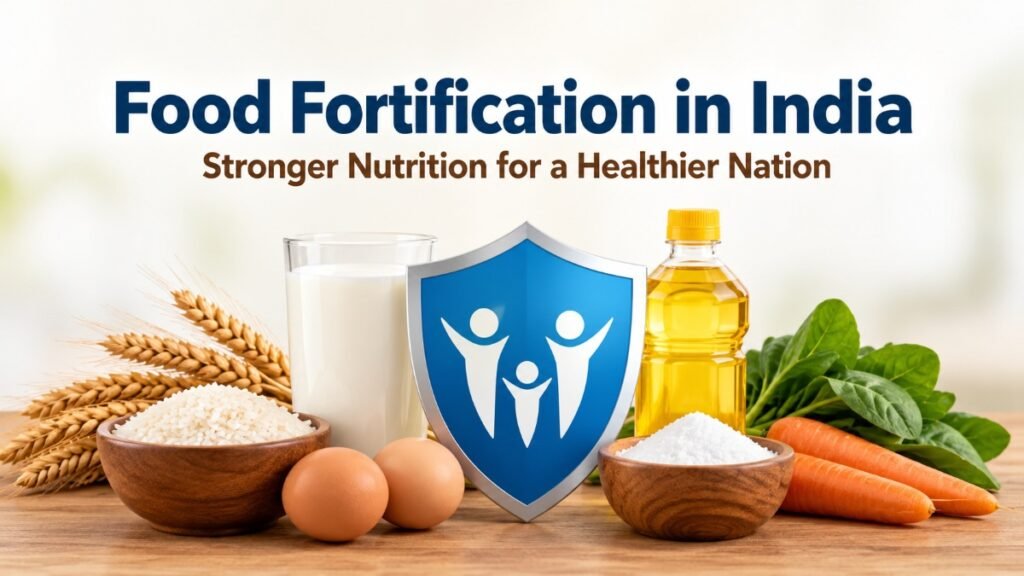
Food Fortification in India is the process of deliberately adding one or more essential micronutrients, such as vitamins and minerals, to commonly consumed foods to improve their nutritional quality and prevent micronutrient deficiencies in the population. It is recognised as one of the most cost-effective public health interventions for combating hidden hunger. Micronutrients are nutrients required by the human body in small quantities but are essential for normal growth, immunity, cognitive development, and overall health.
Important micronutrients include Iron, Iodine, Zinc, Vitamin A, Vitamin D, Vitamin B12, and Folic Acid. Deficiency of these nutrients can lead to anaemia, goitre, impaired immunity, blindness, poor learning outcomes, and developmental disorders. Food Fortification Notes help in understanding how this intervention addresses micronutrient deficiencies and improves nutritional security.
Food fortification differs from supplementation and biofortification. While supplementation involves providing nutrients in the form of tablets or syrups, and biofortification enhances nutrient content during crop cultivation through plant breeding or biotechnology, Food Fortification in India adds micronutrients during food processing to improve the nutritional value of staple foods consumed by the general population. The World Health Organization (WHO) and the Food and Agriculture Organization (FAO) recommend food fortification as an evidence-based strategy to reduce deficiencies of iron, iodine, vitamin A, folic acid, and other essential micronutrients.
Globally, Universal Salt Iodization (USI) is regarded as one of the most successful food fortification programmes for preventing iodine deficiency disorders. Micronutrient Fortification therefore forms an important part of strategies aimed at improving population-level nutritional security.
Master Science & Technology. Maximize Your BPSC Mains Score.
Enroll in the BPSC Science & Tech Course Today
Master Science & Technology for BPSC Mains GS Paper-2 with 75+ exam-oriented topics, 6 structured lessons, and downloadable PDF notes—all in one course.
✔ 75+ Exam-Oriented Topics • ✔ 6 Comprehensive Lessons • ✔ Downloadable PDF Notes • ✔ Updated for 72nd BPSC Mains
2. Need for Food Fortification in India
- High burden of micronutrient deficiencies: India continues to face a serious problem of “hidden hunger”, where people consume sufficient calories but lack essential vitamins and minerals. According to NFHS-5 (2019–21), 67.1% of children (6–59 months), 57% of women (15–49 years), and 25% of men (15–49 years) are anaemic, indicating widespread micronutrient deficiency.
- Combating malnutrition and improving public health: Deficiencies of iron, iodine, vitamin A, vitamin D, folic acid, and vitamin B12 contribute to anaemia, impaired cognitive development, poor immunity, maternal mortality, and low birth weight. Food Fortification in India offers a simple and cost-effective solution to improve nutritional outcomes at the population level.
- Limited access to a balanced diet: A large section of India’s population, particularly in rural and economically weaker regions, cannot afford a diverse diet rich in fruits, vegetables, milk, and animal proteins. Fortifying commonly consumed staples such as rice, wheat flour, milk, edible oil, and salt helps bridge this nutritional gap. Fortified Foods in India can therefore improve access to essential micronutrients through commonly consumed foods.
- Strengthening government nutrition programmes: Food fortification enhances the nutritional quality of food distributed through welfare schemes such as the Public Distribution System (PDS), PM POSHAN (Mid-Day Meal), Integrated Child Development Services (ICDS), and Poshan 2.0, thereby improving the health of vulnerable groups. The Food Fortification Programme in India uses these large-scale delivery systems to reach vulnerable populations.
- Achieving national and global nutrition goals: Food fortification supports the objectives of Anaemia Mukt Bharat, POSHAN Abhiyaan, SDG-2 (Zero Hunger), and SDG-3 (Good Health and Well-being) by reducing micronutrient deficiencies and improving overall nutritional security. Micronutrient Fortification is therefore an important component of India’s broader nutrition strategy.
Prepare Smarter. Study Better. Ace BPSC Mains.
BPSC Mains GS Paper 1 & 2 Complete Course
Access comprehensive BPSC Mains Notes for GS Paper 1 & 2, covering 378+ topics across 24 PDF lessons, with dedicated Bihar coverage, practice questions and downloadable study material.
✓ GS Paper 1 & 2 • ✓ 378+ Topics • ✓ 24 PDF Lessons • ✓ Bihar-Specific Coverage • ✓ Downloadable Notes
3. Types of Food Fortification
- Mass (Universal) Fortification: Micronutrients are added to staple foods widely consumed by the general population, such as iodized salt and fortified rice, to reduce micronutrient deficiencies.
- Targeted Fortification: Foods are fortified specifically for vulnerable groups such as pregnant women, children, and beneficiaries of nutrition programmes like ICDS and PM POSHAN.
- Point-of-Use Fortification: Micronutrient powders or supplements are added to food immediately before consumption at home, schools, or childcare centres.
- Voluntary Fortification: Food manufacturers fortify products on their own, subject to FSSAI regulations, to enhance nutritional value and consumer appeal.
4. Commonly Fortified Foods and Nutrients
| Food Item | Micronutrients Added | Major Health Benefit |
| Salt | Iodine / Iron + Iodine (Double Fortified Salt) | Prevents iodine deficiency disorders, goitre and anaemia |
| Rice | Iron, Folic Acid, Vitamin B12 | Reduces anaemia and improves nutritional security |
| Wheat Flour (Atta) | Iron, Folic Acid, Vitamin B12 | Prevents iron and folate deficiency, improves maternal health |
| Milk | Vitamin A and Vitamin D | Promotes bone health, immunity and vision |
| Edible Oil | Vitamin A and Vitamin D | Prevents vitamin deficiencies and supports healthy growth |
Food Fortification in India uses different approaches depending on the target population and nutritional objective. These approaches form an important part of the Food Fortification Programme in India, particularly for addressing widespread micronutrient deficiencies.
Note: In India, the Food Safety and Standards Authority of India (FSSAI) has prescribed standards for fortification of these five staple foods under the Food Safety and Standards (Fortification of Foods) Regulations, 2018. Fortified foods are identified by the ‘+F’ logo.
Food Fortification in India uses commonly consumed staples to deliver essential micronutrients to the population. The use of Food Fortification Technology helps incorporate these nutrients during food processing while maintaining the basic characteristics of the food.
5. Advantages of Food Fortification
Reduces Micronutrient Deficiencies
Food fortification helps address deficiencies of essential micronutrients such as iron, iodine, vitamin A, vitamin D, folic acid, and vitamin B12. Regular consumption of fortified staple foods can improve micronutrient intake and help reduce problems such as anaemia, iodine deficiency disorders, and vitamin deficiencies. Food Fortification in India is particularly important for populations that may not have regular access to a diverse and balanced diet.
Cost-effective Public Health Intervention
Food fortification is considered a cost-effective public health intervention because micronutrients can be added to commonly consumed foods and delivered to large sections of the population. Food Fortification Technology enables nutrients to be incorporated during food processing without requiring major changes in normal food consumption patterns.
Improves Maternal and Child Health
Adequate intake of iron, folic acid, iodine, vitamin A, vitamin D, and other micronutrients is important for maternal and child health. Fortified foods can contribute to reducing nutritional deficiencies among pregnant women, children, and other vulnerable groups. Government nutrition programmes can use Fortified Foods in India to improve the nutritional intake of beneficiaries.
Enhances Cognitive Development and Productivity
Micronutrient deficiencies, particularly deficiencies of iron and iodine, can adversely affect cognitive development, learning ability, work capacity, and productivity. By improving micronutrient intake, food fortification can contribute to better health outcomes, cognitive development, and productivity.
Supports National Food and Nutrition Security
Food fortification strengthens food and nutrition security by improving the nutritional quality of widely consumed staple foods. The Food Fortification Programme in India can help extend essential micronutrients to vulnerable sections of society through government nutrition and food distribution programmes. It therefore supports broader national objectives related to nutrition, health, and human development.
6. Limitations and Concerns of Food Fortification
Risk of Excess Micronutrient Intake
Excessive intake of certain micronutrients can have adverse health effects. Therefore, the level of nutrients added to foods must be carefully regulated to ensure that Food Fortification in India addresses deficiencies without creating a risk of excessive micronutrient intake.
Does Not Replace a Balanced Diet
Food fortification cannot replace a balanced and diversified diet. A healthy diet provides not only vitamins and minerals but also proteins, carbohydrates, fats, fibre, and other essential nutrients. Therefore, Food Fortification Notes should emphasise that fortification is a complementary strategy rather than a substitute for dietary diversity.
Quality Control and Implementation Challenges
Effective fortification requires proper quality control, laboratory testing, monitoring, and regulatory enforcement. Inadequate mixing, poor storage, incorrect nutrient levels, and weak monitoring systems can reduce the effectiveness of Food Fortification Technology. Ensuring consistent quality across the Food Fortification Programme in India remains important.
Health Concerns for Specific Population Groups
Different population groups may have different nutritional requirements. People with certain health conditions or specific dietary needs may require careful consideration regarding the intake of fortified foods. Therefore, fortification programmes should be based on scientific evidence and appropriate nutritional assessments.
Ethical and Policy Concerns
Food fortification policies may raise concerns regarding consumer choice, mandatory fortification, transparency, and the need for dietary diversification. Effective implementation requires clear regulations, public awareness, scientific evidence, and regular monitoring to ensure that Fortified Foods in India provide nutritional benefits while addressing legitimate consumer concerns.
7. Global Scenario and WHO Recommendations
The World Health Organization (WHO) and Food and Agriculture Organization (FAO) recommend large-scale food fortification as an evidence-based strategy to address micronutrient deficiencies, particularly deficiencies of iron, iodine, vitamin A, folic acid, and other essential micronutrients. WHO advocates Universal Salt Iodization (USI) and the fortification of staple foods such as wheat flour, maize flour, rice, and edible oil. These approaches provide important lessons for strengthening Food Fortification in India.
More than 140 countries have mandatory salt iodization programmes, making universal salt iodization one of the most widely implemented Food Fortification Programme in India-relevant global nutrition strategies. Many countries also mandate the fortification of wheat flour with iron and folic acid, while voluntary fortification is used for several processed food products. These global practices highlight the importance of appropriate Food Fortification Technology, regulation, quality control, and monitoring.
8. Food Fortification in India
Evolution of Food Fortification in India
Food Fortification in India has evolved as an important public health strategy to address micronutrient deficiencies, anaemia, malnutrition, and hidden hunger. The approach has gradually expanded from traditional iodized salt programmes to the fortification of rice, wheat flour, edible oil, milk, and double-fortified salt. The expansion of Fortified Foods in India has also been linked with government nutrition and food distribution programmes aimed at vulnerable sections of society.
The growing role of Food Fortification Technology has enabled essential micronutrients such as iron, folic acid, vitamin B12, iodine, vitamin A, and vitamin D to be added to commonly consumed foods. Food Fortification Notes are therefore important for understanding how technological interventions can support India’s broader nutrition objectives.
Regulatory Framework
The Food Safety and Standards Authority of India (FSSAI) provides the regulatory framework for food fortification in India. The Food Safety and Standards (Fortification of Foods) Regulations, 2018 prescribe standards for fortification of specified food products. The regulations also provide for the identification of fortified foods through the ‘+F’ logo, helping consumers identify fortified products.
A strong regulatory framework is essential for ensuring the quality, safety, appropriate nutrient levels, and effective implementation of Food Fortification in India. Regular monitoring and quality control are important components of the Food Fortification Programme in India.
Government Initiatives
The Government of India has promoted food fortification through various nutrition and welfare programmes, including the Public Distribution System (PDS), PM POSHAN, Integrated Child Development Services (ICDS), and Poshan 2.0. These programmes provide opportunities to deliver fortified staples to large sections of the population.
The promotion of Fortified Foods in India through government programmes can help improve micronutrient intake among vulnerable groups, particularly children, pregnant women, and economically weaker sections. Such initiatives make Food Fortification in India an important component of India’s broader nutrition strategy.
Rice Fortification Programme
Rice fortification has become an important component of the Food Fortification Programme in India. Fortified rice is generally enriched with iron, folic acid, and vitamin B12 and is supplied through government welfare and food distribution programmes.
The use of fortified rice can help increase the intake of essential micronutrients among beneficiaries who regularly consume rice as a staple food. Effective implementation requires appropriate Food Fortification Technology, quality standards, monitoring, and awareness among beneficiaries.
9. Way Forward
Food Fortification in India should be implemented as a complementary nutrition strategy rather than as a standalone solution to malnutrition. It should be combined with dietary diversification, nutrition education, sanitation, maternal and child healthcare, and improved access to nutritious foods. Strengthening Fortified Foods in India can help address micronutrient deficiencies while ensuring that people have access to balanced and diversified diets.
There is also a need to strengthen quality control, laboratory testing, monitoring, and regulatory mechanisms throughout the Food Fortification Programme in India. Evidence-based use of Food Fortification Technology, along with biofortification and promotion of balanced diets, can improve nutritional outcomes. Greater public awareness, regular nutrition surveys, research and development, and public-private partnerships can further strengthen food fortification initiatives and contribute to India’s nutrition goals and the vision of Viksit Bharat.
10. Conclusion
Food fortification is a scientifically proven, cost-effective, and sustainable public health intervention for addressing micronutrient deficiencies and hidden hunger. Food Fortification in India can play an important role in reducing anaemia and improving nutritional outcomes by increasing the availability of essential micronutrients through commonly consumed staple foods.
However, Food Fortification in India should not be considered a substitute for a balanced and diversified diet. The long-term success of the Food Fortification Programme in India depends on effective quality control, strong regulation, regular monitoring, consumer awareness, and integration with broader nutrition and healthcare strategies. With appropriate use of Food Fortification Technology, dietary diversification, and evidence-based nutrition policies, India can make further progress towards eliminating malnutrition, reducing anaemia, and building a healthier population under the vision of Viksit Bharat 2047.
BPSC Mains Practice Questions
- “Food fortification is an important technological intervention to address India’s persistent burden of micronutrient deficiencies and anaemia.” Discuss the need, major approaches, benefits and limitations of Food Fortification in India. Also examine why food fortification should be complemented by dietary diversification and broader nutrition interventions.
- “The effectiveness of food fortification depends not merely on adding micronutrients to food, but on the quality of technology, regulation, implementation and monitoring.” Examine the role of Food Fortification Technology and government nutrition programmes in improving nutritional security in India. Suggest measures to make food fortification more effective, safe and inclusive.
Learn More About Food Fortification in India
For authoritative information on Food Fortification in India, including the +F logo, fortified rice, wheat flour, milk, edible oil, double-fortified salt, FAQs and regulatory resources, you can link to the official FSSAI Fortification Portal. FSSAI Fortification Portal – Official Government Resource