1. Introduction and Concept of Net Neutrality
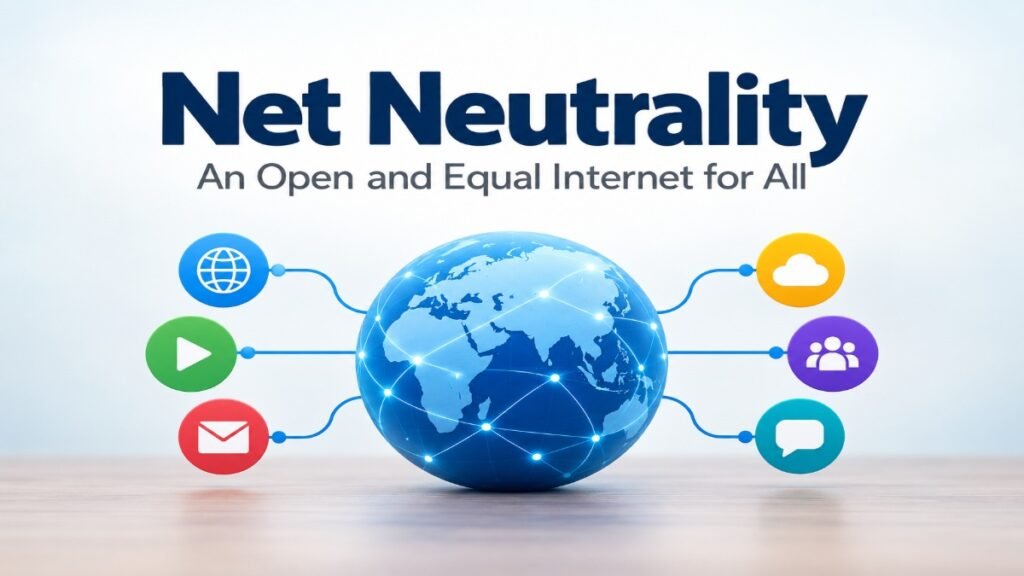
Net Neutrality in India is the principle that all internet traffic should be treated equally by Internet Service Providers (ISPs) and Telecom Service Providers (TSPs), without discriminating or charging differently based on the type of content, website, application, device, or user. It ensures that every individual has equal access to online information and services, regardless of financial capacity or the popularity of a website. In simple terms, an ISP should not block, slow down (throttle), or provide preferential speed to any particular website or application.
The term “Net Neutrality” was popularised by Tim Wu, a professor at Columbia Law School, in his 2003 paper Network Neutrality, Broadband Discrimination. The principle has become a cornerstone of an open, competitive, and democratic internet.
The major stakeholders in the net neutrality ecosystem include internet users, Telecom Service Providers (TSPs), Internet Service Providers (ISPs), Over-the-Top (OTT) platforms such as WhatsApp, Netflix and YouTube, the Government of India, and the Telecom Regulatory Authority of India (TRAI), which regulates the telecom sector and safeguards consumer interests.
Master Science & Technology. Maximize Your BPSC Mains Score.
Enroll in the BPSC Science & Tech Course Today
Master Science & Technology for BPSC Mains GS Paper-2 with 75+ exam-oriented topics, 6 structured lessons, and downloadable PDF notes—all in one course.
✔ 75+ Exam-Oriented Topics • ✔ 6 Comprehensive Lessons • ✔ Downloadable PDF Notes • ✔ Updated for 72nd BPSC Mains
2. Need and Importance of Net Neutrality
- Preserves an Open Internet: Net Neutrality in India ensures that all websites, applications, and online services are treated equally by Internet Service Providers (ISPs). It prevents blocking, throttling, or preferential treatment of internet traffic, thereby maintaining a free and open internet.
- Protects Freedom of Expression: By preventing discrimination against online content, Net Neutrality safeguards the free flow of information and ideas. It enables citizens to communicate, access diverse viewpoints, and participate in democratic processes without undue interference.
- Promotes Innovation and Fair Competition: Net Neutrality in India creates a level playing field where startups, small businesses, and entrepreneurs can compete with established companies without paying telecom operators for preferential access. This encourages innovation and healthy competition in the digital economy.
- Ensures Consumer Choice and Digital Inclusion: Users are free to access any lawful website, application, or online service without restrictions or additional charges. This promotes equitable access to education, healthcare, digital payments, e-governance, and other essential online services.
- Prevents Anti-Competitive Practices: Net Neutrality discourages telecom operators from favouring their own services or those of selected partners. It promotes transparency, protects consumer interests, and prevents the misuse of market power by dominant service providers.
Prepare Smarter. Study Better. Ace BPSC Mains.
BPSC Mains GS Paper 1 & 2 Complete Course
Access comprehensive BPSC Mains Notes for GS Paper 1 & 2, covering 378+ topics across 24 PDF lessons, with dedicated Bihar coverage, practice questions and downloadable study material.
✓ GS Paper 1 & 2 • ✓ 378+ Topics • ✓ 24 PDF Lessons • ✓ Bihar-Specific Coverage • ✓ Downloadable Notes
3. Status of Net Neutrality in India
Net Neutrality in India has one of the strongest regulatory frameworks for net neutrality. The debate gained national attention in 2015 following concerns over differential pricing and zero-rating services offered by some telecom operators. In response, TRAI initiated public consultations to formulate a balanced regulatory framework.
In 2016, TRAI notified the Prohibition of Discriminatory Tariffs for Data Services Regulations, which prohibited telecom operators from charging different prices for accessing different online content or applications. This effectively barred discriminatory pricing practices and reinforced the principle of equal access to the internet.
In 2017, TRAI further recommended that internet service providers should not discriminate against online content and advised the government to incorporate net neutrality principles into telecom licence conditions. Based on these recommendations, the Department of Telecommunications (DoT) accepted the framework in 2018, making Net Neutrality a binding condition under telecom licences in India.
Today, TRAI continues to monitor compliance with Net Neutrality in India while addressing emerging issues related to 5G networks, cloud services, and digital platforms, ensuring that India’s internet remains open, competitive, and accessible to all users.
4. Challenges of Net Neutrality
- Balancing Investment and Regulation: Telecom companies argue that they invest heavily in network infrastructure and seek additional revenue sources to recover costs, while excessive flexibility may undermine Net Neutrality in India.
- Rising Data Consumption: The rapid growth of bandwidth-intensive OTT platforms such as video streaming and cloud services has increased pressure on telecom networks, creating debates over infrastructure costs and revenue sharing.
- Network Management in the 5G Era: Managing network congestion while maintaining equal treatment of internet traffic has become more complex with the expansion of 5G, IoT, and other data-intensive technologies.
- Cybersecurity and Regulatory Challenges: Ensuring an open internet while protecting users from cyber threats, misinformation, and illegal online activities requires a balanced regulatory framework.
5. Way Forward
India should continue to strengthen its Net Neutrality in India framework by ensuring transparent and non-discriminatory internet practices. At the same time, policies should encourage telecom companies to invest in digital infrastructure through fair and sustainable revenue models without compromising the principle of equal internet access. Greater transparency in network management, regular regulatory oversight by TRAI, and stakeholder consultations are essential to address emerging challenges in the era of 5G, Artificial Intelligence (AI), and the Internet of Things (IoT). Promoting public awareness about digital rights and adopting global best practices will further strengthen India’s digital ecosystem.
6. Conclusion
Net Neutrality in India remains fundamental to preserving an open, competitive, and inclusive internet. By ensuring equal access to online information and services, it supports innovation, freedom of expression, digital inclusion, and fair competition. A balanced regulatory approach that protects users while encouraging investment in digital infrastructure will be essential for strengthening India’s digital ecosystem and supporting the vision of Digital India and Viksit Bharat 2047.
BPSC Mains Practice Question
“Net Neutrality in India is essential for ensuring an open, inclusive and competitive digital ecosystem.” Discuss the significance of net neutrality in India and examine the major challenges associated with its implementation.
Learn More About Net Neutrality in India
For official information on Net Neutrality in India, including regulations, recommendations, consultations, and telecom-related consumer protection, visit the Telecom Regulatory Authority of India (TRAI): Telecom Regulatory Authority of India – Net Neutrality. TRAI provides official information on India’s net neutrality framework, including the Prohibition of Discriminatory Tariffs for Data Services Regulations, 2016 and related recommendations.