1. Introduction
Meaning of Blockchain Technology
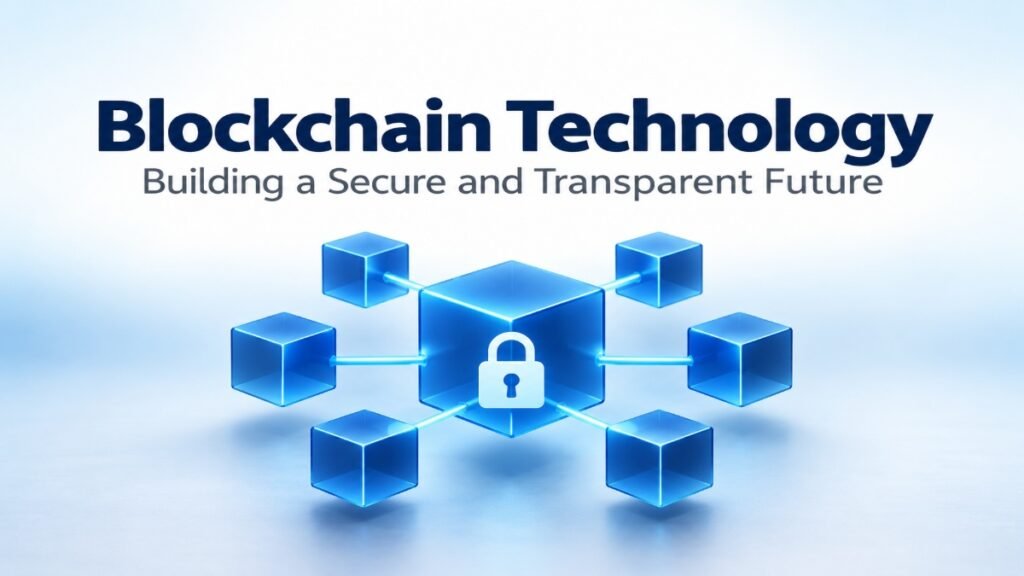
Blockchain Technology is a distributed digital ledger technology (DLT) that records transactions or information in a secure, transparent, and tamper-resistant manner. Instead of storing data at a single location, blockchain maintains identical copies of the ledger across multiple computers (called nodes) connected through a network. Every new transaction is verified by the participants of the network before being permanently added to the ledger, making unauthorized alteration or deletion of records extremely difficult.
The term “Blockchain” is derived from its structure—information is stored in blocks, and these blocks are linked together in chronological order to form a chain. Each block contains transaction data along with a unique digital signature (called a hash) that securely connects it to the previous block. As a result, any attempt to modify one block would affect all subsequent blocks, making manipulation easily detectable.
Distributed Ledger Technology (DLT)
Distributed Ledger Technology (DLT) is a system in which a common digital ledger is shared and synchronized across multiple computers or organizations rather than being controlled by a single central authority. Every authorized participant possesses the same version of the ledger, ensuring transparency, accountability, and trust among all stakeholders.
Blockchain Technology is the most widely used form of Distributed Ledger Technology, although not every DLT necessarily uses a blockchain structure.
Need for Blockchain Technology
The growing digital economy requires systems that can securely store and exchange information without excessive dependence on intermediaries. Traditional databases often rely on a central authority, making them vulnerable to cyberattacks, manipulation, single-point failures, and delays in verification. Blockchain Technology addresses these challenges by providing:
- Enhanced security through cryptographic protection and distributed storage of records.
- Greater transparency, as all authorized participants can verify transactions recorded on the shared ledger.
- Improved trust by eliminating the need for a single trusted intermediary.
- Tamper-resistant record keeping, reducing fraud and unauthorized alterations.
- Faster and more efficient transactions, especially in sectors involving multiple stakeholders.
- Cost reduction by minimizing paperwork, manual verification, and intermediary charges.
Difference between Traditional Database and Blockchain
| Traditional Database | Blockchain |
|---|---|
| Controlled by a central authority or organization | Maintained collectively by multiple participants in a distributed network |
| Data can generally be modified, updated or deleted by authorized administrators | Once verified and recorded, data is extremely difficult to alter, ensuring immutability |
| Limited transparency as access is usually restricted | Greater transparency among authorized participants through a shared ledger |
| Failure or compromise of the central server can affect the entire system | No single point of failure due to decentralized data storage |
| Requires intermediaries for verification in many transactions | Transactions can be verified collectively by the network, reducing dependence on intermediaries |
Relevance of Blockchain Technology in India
Blockchain Technology in India has emerged as an important component of India’s digital transformation. The Government of India is exploring its use in areas such as land record management, digital certificates, supply chain monitoring, healthcare records, agriculture, banking, customs, logistics, and public service delivery. It also complements flagship initiatives such as Digital India, Ease of Doing Business, Digital Public Infrastructure (DPI), and the Digital Rupee (Central Bank Digital Currency – CBDC) being piloted by the Reserve Bank of India.
With increasing emphasis on secure digital governance and transparent record management, Blockchain Technology is expected to play a significant role in building a trusted and efficient digital ecosystem in the country.
Master Science & Technology. Maximize Your BPSC Mains Score.
Enroll in the BPSC Science & Tech Course Today
Master Science & Technology for BPSC Mains GS Paper-2 with 75+ exam-oriented topics, 6 structured lessons, and downloadable PDF notes—all in one course.
✔ 75+ Exam-Oriented Topics • ✔ 6 Comprehensive Lessons • ✔ Downloadable PDF Notes • ✔ Updated for 72nd BPSC Mains
2. Basic Working Principle of Blockchain Technology
Blockchain Technology works by recording transactions in a secure and chronological manner across a distributed network. Instead of relying on a central authority, all participating computers (nodes) verify and maintain the same copy of the ledger.
Basic Working Process
- Step 1: A user initiates a transaction (e.g., transfer of money or sharing of data).
- Step 2: The transaction is broadcast to the blockchain network for verification.
- Step 3: Network participants validate the transaction according to predefined rules.
- Step 4: The verified transaction is grouped into a block.
- Step 5: The new block is linked to the previous block using a unique digital identifier called a hash, forming a continuous chain.
- Step 6: The updated blockchain is shared with all participants, making the transaction permanent and extremely difficult to alter.
Basic Concepts
- Block: A digital container that stores verified transaction data.
- Chain: A sequence of interconnected blocks arranged chronologically.
- Distributed Ledger: An identical copy of the transaction record maintained by all participating nodes.
- Hash: A unique digital fingerprint that securely links one block to another.
- Immutability: Once recorded, data cannot be altered without network consensus, ensuring integrity and trust.
Simple Analogy: A blockchain is like a shared digital register where every participant has the same copy. Once an entry is made and accepted by everyone, it cannot be secretly erased or changed.
Prepare Smarter. Study Better. Ace BPSC Mains.
BPSC Mains GS Paper 1 & 2 Complete Course
Access comprehensive BPSC Mains Notes for GS Paper 1 & 2, covering 378+ topics across 24 PDF lessons, with dedicated Bihar coverage, practice questions and downloadable study material.
✓ GS Paper 1 & 2 • ✓ 378+ Topics • ✓ 24 PDF Lessons • ✓ Bihar-Specific Coverage • ✓ Downloadable Notes
3. Key Features of Blockchain Technology
- Decentralization: No single authority controls the network; records are maintained collectively by participants.
- Distributed Ledger: Every authorized participant has access to the same updated ledger.
- Transparency: Transactions can be verified by network participants, increasing trust.
- Immutability: Once recorded, transactions cannot be altered or deleted easily.
- Security: Cryptographic techniques protect data from unauthorized access and tampering.
- Traceability: Every transaction can be tracked from its origin, improving accountability.
- Smart Contracts: Self-executing digital agreements that automatically perform predefined actions when conditions are met.
4. Types of Blockchain Technology
- Public Blockchain: Open to everyone for participation and verification. It offers high transparency but relatively lower privacy. Example: Bitcoin, Ethereum.
- Private Blockchain: Controlled by a single organization. Access is restricted to authorized users, making it suitable for enterprises.
- Permissioned Blockchain: Only approved participants can access or perform specific activities on the network. It provides better control and security.
- Consortium Blockchain: Managed jointly by multiple organizations instead of a single entity. It is commonly used where several institutions need to share trusted data.
5. Applications of Blockchain Technology
Banking and Financial Services
Blockchain Technology in India enables faster, secure, and low-cost financial transactions by reducing dependence on intermediaries such as banks and clearing houses. It facilitates cross-border payments, trade finance, digital asset management, and fraud prevention through tamper-proof records. The Reserve Bank of India (RBI) has launched pilot projects for the Digital Rupee (Central Bank Digital Currency – CBDC) in both wholesale and retail segments, using blockchain-inspired distributed ledger technology to modernize India’s payment ecosystem.
Land Records and Property Registration
Blockchain can significantly improve land record management by creating permanent and tamper-proof ownership records. It reduces land disputes, fraudulent registrations, duplicate ownership claims, and corruption in property transactions. Several Indian states, including Telangana, Maharashtra, and Andhra Pradesh, have experimented with blockchain-based land record systems to improve transparency and ease of property registration.
Healthcare
Blockchain helps create secure electronic health records (EHRs) that can be accessed by authorized hospitals and doctors while protecting patient privacy. It improves the sharing of medical records, reduces insurance fraud, ensures authenticity of medicines, and enhances traceability in pharmaceutical supply chains. During the COVID-19 pandemic, blockchain-based solutions were explored globally for vaccine supply chain monitoring.
Agriculture
Blockchain improves transparency across the agricultural value chain by enabling farm-to-fork traceability of food products. Consumers can verify the origin and quality of agricultural produce, while farmers benefit from better market access and fair pricing. It can also support crop insurance, fertilizer distribution, warehouse receipts, agricultural supply chains, and organic product certification, thereby reduce fraud and improve trust.
Supply Chain and Logistics
Blockchain enables real-time tracking of goods throughout the supply chain. Since every transaction is permanently recorded, businesses can verify the movement and authenticity of products, reducing counterfeiting and pilferage. It is increasingly used in industries such as food processing, pharmaceuticals, diamonds, automobiles, and e-commerce to improve efficiency and accountability.
Education
Educational institutions can issue tamper-proof digital certificates, degrees, diplomas, and academic transcripts using blockchain. Employers can instantly verify educational credentials without lengthy verification processes, reducing certificate forgery. Several universities across the world have started issuing blockchain-based academic certificates.
Governance and Public Service Delivery
Blockchain enhances transparency, accountability, and efficiency in government services by maintaining immutable public records. It has potential applications in birth and death registration, business licences, public procurement, welfare schemes, tax administration, and digital identity management, reducing corruption and improving service delivery.
Digital Identity Management
Blockchain enables citizens to securely manage their digital identities without depending entirely on centralized databases. Individuals can selectively share verified personal information while retaining greater control over their data, reducing identity theft and unauthorized access.
Insurance Sector
Blockchain simplifies the processing of insurance policies and claims through secure digital records and automated verification. It reduces fraudulent claims, minimizes paperwork, speeds up claim settlements, and improves trust between insurers and policyholders through greater transparency.
Internet of Things (IoT) and Artificial Intelligence (AI)
Blockchain complements IoT by securing communication between connected devices and maintaining trusted records of machine-generated data. When integrated with Artificial Intelligence (AI), blockchain ensures data integrity, transparency, and traceability, thereby improving the reliability of AI-based decision-making systems.
Defence and Cybersecurity
Blockchain can strengthen national security by protecting sensitive defence information from unauthorized modification. It supports secure communication, supply chain management of defence equipment, identity authentication, and cyber resilience, making critical digital infrastructure more reliable.
6. Advantages/Significance of Blockchain Technology
- Enhanced Security: Cryptographic encryption and distributed storage make data highly secure and resistant to tampering.
- Transparency: All authorized participants can verify transactions, increasing accountability and trust.
- Immutability: Once recorded, data cannot be easily altered or deleted.
- Decentralization: Eliminates dependence on a single central authority, reducing the risk of single-point failure.
- Reduced Fraud: Tamper-proof records help prevent forgery, duplication, and unauthorized modifications.
- Cost Efficiency: Minimizes the role of intermediaries, reducing transaction and administrative costs.
- Faster Transactions: Speeds up verification and settlement processes, especially in cross-border transactions.
- Improved Traceability: Enables end-to-end tracking of products and transactions across the supply chain.
- Better Governance: Promotes transparency and efficiency in public service delivery and record management.
- Supports Digital Economy: Acts as a key enabler for Digital India, fintech innovations, and secure digital governance.
7. Challenges and Limitations of Blockchain Technology
- High Implementation Cost: Developing and maintaining blockchain infrastructure requires significant investment.
- Scalability Issues: Processing a large number of transactions simultaneously remains a challenge.
- Energy Consumption: Some blockchain networks consume substantial electricity for transaction validation.
- Regulatory Uncertainty: Absence of comprehensive legal and regulatory frameworks in many countries.
- Data Privacy Concerns: Transparency may conflict with privacy requirements in certain applications.
- Interoperability Issues: Different blockchain platforms often face difficulties in communicating with each other.
- Shortage of Skilled Professionals: Limited availability of experts hinders large-scale adoption.
- Cybersecurity Risks: While blockchain is secure, applications, wallets, and smart contracts may still be vulnerable to attacks.
- Low Public Awareness: Lack of awareness and technical understanding limits widespread adoption.
8. Government Initiatives and India’s Progress in Blockchain Technology
National Blockchain Framework (NBF)
The Ministry of Electronics and Information Technology (MeitY) launched the National Blockchain Framework (NBF) in 2024 to promote the adoption of blockchain across government departments. The framework provides Blockchain-as-a-Service (BaaS), enabling states and ministries to develop secure and interoperable blockchain-based applications without creating separate infrastructure.
National Strategy on Blockchain
MeitY has prepared a National Strategy on Blockchain to promote research, innovation, indigenous technology development, capacity building, and standardization. The strategy aims to create a trusted digital ecosystem for governance, finance, healthcare, education, logistics, and agriculture.
Centre for Development of Advanced Computing (C-DAC)
C-DAC, under MeitY, has developed indigenous blockchain platforms and research solutions to support secure digital governance, document verification, supply chain management, and e-governance applications.
Reserve Bank of India (RBI) – Digital Rupee (CBDC)
The Reserve Bank of India launched pilot projects for the Digital Rupee (e₹) in 2022 for both wholesale and retail transactions. The Central Bank Digital Currency (CBDC) leverages distributed ledger technology concepts to improve payment efficiency, reduce transaction costs, and strengthen India’s digital payment ecosystem.
State Government Initiatives
Several states have initiated blockchain-based projects for public service delivery:
- Telangana – Land records, digital certificates, and document verification.
- Maharashtra – Property registration and governance applications.
- Andhra Pradesh – Land administration and citizen services.
- Kerala – Blockchain-based solutions for public administration and education.
Digital India and Future Adoption
Blockchain Technology has been identified as one of the emerging technologies supporting the Digital India Mission. It is expected to strengthen e-Governance, digital identity, supply chain management, agriculture, healthcare, education, and financial services, contributing to a transparent, secure, and efficient digital economy.
9. Conclusion
Blockchain Technology is emerging as a transformative technology that enhances transparency, security, efficiency, and trust in digital transactions. Its applications extend far beyond cryptocurrencies to sectors such as governance, banking, agriculture, healthcare, education, and supply chain management. With appropriate regulations, skilled manpower, and robust digital infrastructure, Blockchain Technology in India has the potential to become a key pillar of Digital India, promoting good governance, financial inclusion, and a secure digital economy.
BPSC Mains Practice Questions
- “Blockchain Technology is moving beyond cryptocurrencies and emerging as an important tool for improving transparency, security and efficiency in governance.” Discuss its major applications in India and examine the challenges that may limit its wider adoption.
- What is Blockchain Technology? Explain its working mechanism and key features. How can Blockchain Technology in India contribute to strengthening Digital India, financial inclusion and secure public service delivery?
Learn More About Blockchain Technology
For official information on Blockchain Technology initiatives in India, including the National Blockchain Framework (NBF), blockchain-based e-governance applications, research, and related emerging technologies, visit the Ministry of Electronics and Information Technology (MeitY), Government of India: Ministry of Electronics and Information Technology – Blockchain Technology. MeitY is the nodal ministry for promoting blockchain research, innovation, indigenous technology development and adoption of blockchain-based solutions in India.