1. Meaning of Digital Divide
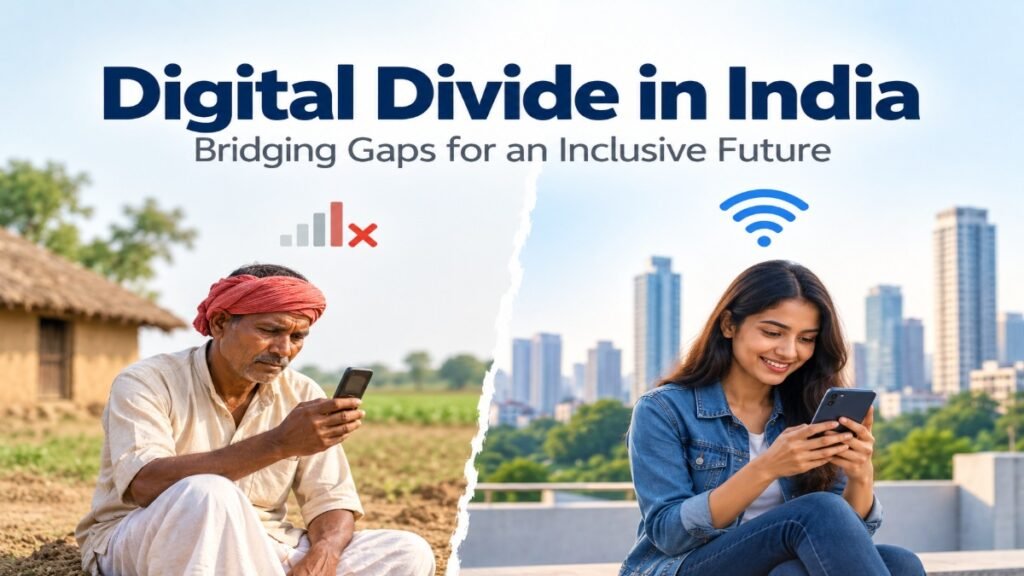
The Digital Divide in India refers to the gap between individuals, households, businesses or regions that have access to Information and Communication Technologies (ICTs) such as the internet, smartphones and computers, and those that do not. This divide limits people’s ability to access digital services, information and economic opportunities.
In India, the Digital Divide in India is most visible between urban and rural areas. Urban regions generally enjoy better internet connectivity, higher smartphone penetration and greater digital literacy, whereas many rural areas continue to face inadequate digital infrastructure, poor network coverage and limited access to digital devices.
The Digital Divide in Rural India is particularly significant because limited connectivity and digital skills can restrict access to education, healthcare, banking, governance and employment opportunities.
Bridging the digital divide has become essential in the era of Digital India, where education, healthcare, banking, governance and employment increasingly depend on digital platforms. Reducing this gap is crucial for ensuring inclusive growth, social equity and balanced regional development.
These Digital Divide notes are important for understanding the causes, impacts and government initiatives related to the Urban-Rural Digital Divide and the broader goal of Digital Inclusion in India. The focus of Bridging the Digital Divide in India is to ensure that the benefits of digital transformation reach all sections of society.
Master Science & Technology. Maximize Your BPSC Mains Score.
Enroll in the BPSC Science & Tech Course Today
Master Science & Technology for BPSC Mains GS Paper-2 with 75+ exam-oriented topics, 6 structured lessons, and downloadable PDF notes—all in one course.
✔ 75+ Exam-Oriented Topics • ✔ 6 Comprehensive Lessons • ✔ Downloadable PDF Notes • ✔ Updated for 72nd BPSC Mains
2. Causes of Digital Divide
Inadequate Digital Infrastructure
The availability of high-speed internet and telecom infrastructure is highly uneven across India. While urban areas have widespread 4G/5G connectivity and broadband networks, many rural and remote regions still suffer from poor network coverage and unreliable internet services. According to TRAI, India had over 970 million internet subscribers (2024), but broadband penetration remains significantly lower in rural areas. This infrastructure gap limits access to digital education, healthcare and e-governance.
Example: Many villages in hilly and tribal regions of Bihar, Jharkhand and the North-East continue to experience weak internet connectivity. This infrastructure gap is a major reason behind the Digital Divide in Rural India and continues to widen the Urban-Rural Digital Divide.
Affordability of Digital Devices and Internet Services
Although mobile data in India is among the cheapest globally, the cost of smartphones, computers and broadband connections remains unaffordable for many low-income households. As a result, a large section of the rural population depends on a single shared device or has no digital device at all.
According to the National Family Health Survey (NFHS-5, 2019–21), only about 54% of households in India had access to the internet, with rural households lagging significantly behind urban households. Affordable devices and internet services are therefore important for Digital Inclusion in India.
Low Digital Literacy
Access to digital technology alone is insufficient unless people possess the skills to use it effectively. Many citizens, particularly the elderly, women and economically weaker sections, lack basic digital skills required for online banking, digital payments, e-learning and accessing government services.
During the COVID-19 pandemic, many students and beneficiaries struggled to use online education platforms and digital government portals due to poor digital literacy. Improving digital literacy is an important component of Bridging the Digital Divide in India.
Socio-economic and Gender Inequality
Poverty, lower educational attainment and gender disparities continue to widen the digital divide. Women, especially in rural areas, have lower ownership of mobile phones and internet access than men, limiting their participation in the digital economy.
According to the NFHS-5, only about 33% of women had ever used the internet compared to 57% of men, highlighting a significant gender-based digital gap.
Language and Content Barriers
A large proportion of digital content is available in English, whereas a majority of Indians are more comfortable using regional languages. The lack of quality digital content and services in local languages discourages internet usage among rural populations.
Farmers and elderly citizens often face difficulties in using government portals and digital applications that have limited regional language support.
Prepare Smarter. Study Better. Ace BPSC Mains.
BPSC Mains GS Paper 1 & 2 Complete Course
Access comprehensive BPSC Mains Notes for GS Paper 1 & 2, covering 378+ topics across 24 PDF lessons, with dedicated Bihar coverage, practice questions and downloadable study material.
✓ GS Paper 1 & 2 • ✓ 378+ Topics • ✓ 24 PDF Lessons • ✓ Bihar-Specific Coverage • ✓ Downloadable Notes
3. Impact of Digital Divide
Educational Inequality
The Digital Divide in India has widened the gap in access to quality education, particularly between urban and rural students. Limited internet connectivity and lack of digital devices restrict access to online classes, digital learning platforms and educational resources.
During the COVID-19 pandemic, millions of rural students were unable to participate effectively in online education due to poor internet access and the absence of smartphones or computers. This is a major dimension of the Digital Divide in Rural India, where students may have significantly fewer digital learning opportunities than their urban counterparts.
Unequal Access to Healthcare
Digital healthcare services such as telemedicine, e-Sanjeevani and online health consultations are less accessible in rural areas because of inadequate digital infrastructure and low digital literacy. This reduces the effectiveness of digital health initiatives.
eSanjeevani, India’s national telemedicine platform, has provided over 39 crore teleconsultations (2025), but its benefits remain concentrated in areas with reliable internet connectivity. Thus, reducing the Urban-Rural Digital Divide is important for ensuring equitable access to digital healthcare.
Financial Exclusion
The lack of internet access and digital literacy prevents many people from using digital banking, UPI payments, internet banking and other fintech services. This limits financial inclusion and access to government benefits.
Many rural beneficiaries continue to depend on physical banking services due to limited awareness and poor digital connectivity despite the rapid growth of UPI and Direct Benefit Transfer (DBT). Greater Digital Inclusion in India can help ensure that rural and low-income populations participate more effectively in the digital financial system.
Governance and Public Service Delivery Gap
Many government services are now delivered through digital platforms such as DigiLocker, UMANG, Aadhaar-enabled services and online citizen portals. People without digital access face difficulties in availing welfare schemes, obtaining certificates and accessing public services.
Rural citizens often depend on Common Service Centres (CSCs) to access digital government services that urban citizens can easily access from their homes. This demonstrates why Bridging the Digital Divide in India is essential for equitable access to government services.
Reduced Employment and Economic Opportunities
Digital skills have become essential for education, entrepreneurship, freelancing and employment. The Digital Divide in India limits access to online job portals, e-commerce platforms, skill development programmes and remote work opportunities, thereby affecting economic mobility.
Small entrepreneurs in rural areas often struggle to market their products through digital platforms compared to businesses in urban areas.
Widening Urban-Rural and Social Inequality
The Digital Divide in India reinforces existing socio-economic disparities by creating unequal access to information, technology and opportunities. As digital technologies increasingly drive economic and social development, those without digital access risk being left behind.
While urban populations rapidly adopt AI, digital payments and e-governance, many rural communities still struggle with basic internet connectivity, leading to unequal development outcomes. Therefore, Digital Inclusion in India is not merely about providing internet connectivity; it is also about ensuring affordable devices, digital skills and meaningful access to digital opportunities.
4. Government Initiatives to Bridge the Digital Divide
Digital India Programme (2015)
- Flagship programme aimed at transforming India into a digitally empowered society and knowledge economy.
- Focuses on digital infrastructure, digital governance and digital literacy.
- Example: Services such as DigiLocker, UMANG, e-Hospital and e-NAM have improved citizens’ access to public services.
The Digital India Programme is a key pillar of Digital Inclusion in India and plays an important role in Bridging the Digital Divide in India by expanding access to digital infrastructure and services.
Bharat Net Project
- World’s largest rural broadband connectivity programme.
- Aims to provide high-speed broadband connectivity to all Gram Panchayats through optical fibre.
- It serves as the backbone for rural e-governance, telemedicine, digital education and e-commerce.
BharatNet directly addresses the Digital Divide in Rural India by improving broadband connectivity in rural areas and reducing the Urban-Rural Digital Divide.
Pradhan Mantri Gramin Digital Saksharta Abhiyan (PMGDISHA)
- Launched to make at least 6 crore rural households digitally literate.
- Provides training in basic computer operations, internet usage, digital payments and access to online government services.
PMGDISHA addresses the skills component of the Digital Divide in India, because access to technology becomes meaningful only when citizens have the ability to use digital services effectively.
Common Service Centres (CSCs)
- CSCs act as digital service delivery centres in rural and remote areas.
- They provide services such as Aadhaar enrolment, banking, insurance, telemedicine, utility bill payments and access to various government schemes.
- Fact: More than 6 lakh CSCs are operational across India, significantly improving digital inclusion in rural areas.
CSCs are particularly important for Bridging the Digital Divide in India, as they provide a physical point of access for citizens who lack personal devices, connectivity or digital skills.
PM-WANI (Prime Minister Wi-Fi Access Network Interface)
- Launched in 2020 to expand affordable public Wi-Fi hotspots across the country.
- Aims to improve internet accessibility, especially in rural and underserved areas, thereby reducing the digital divide.
PM-WANI can contribute to Digital Inclusion in India by expanding affordable internet access and addressing connectivity gaps that contribute to the Urban-Rural Digital Divide.
5. Conclusion
The Digital Divide in India remains a major challenge to achieving inclusive and equitable development in India. Unequal access to digital infrastructure, affordable devices and digital skills has created significant disparities between urban and rural populations in education, healthcare, employment and governance. Bridging this gap is essential to ensure that the benefits of digital transformation reach every citizen, regardless of their socio-economic background or geographical location.
Government initiatives such as Digital India, BharatNet, PMGDISHA, CSCs and PM-WANI have made significant progress in expanding digital access. However, sustained investment in digital infrastructure, affordable internet services, digital literacy and local-language content, coupled with active participation from the private sector and civil society, is crucial to building a digitally inclusive India and realizing the vision of Viksit Bharat 2047.
Effective Bridging the Digital Divide in India requires simultaneous attention to connectivity, affordability, digital skills and accessibility. Reducing the Digital Divide in Rural India and narrowing the Urban-Rural Digital Divide will be essential for strengthening Digital Inclusion in India and ensuring that India’s digital transformation benefits all sections of society.
BPSC Mains Practice Questions
- “The digital divide is not merely a connectivity gap but also a gap in access to opportunities.” Discuss the major causes and impacts of the Digital Divide in India, with special reference to rural areas.
- Examine the major government initiatives for bridging the urban-rural digital gap in India. What further measures are required to achieve meaningful digital inclusion?
Learn More About Digital Divide in India
For official information on India’s initiatives for expanding broadband connectivity and bridging the rural-urban digital gap, visit Bharat Broadband Network Limited (BBNL), Government of India: BharatNet – Government of India. The official portal provides information on BharatNet, rural broadband connectivity and digital infrastructure development.