1. Introduction
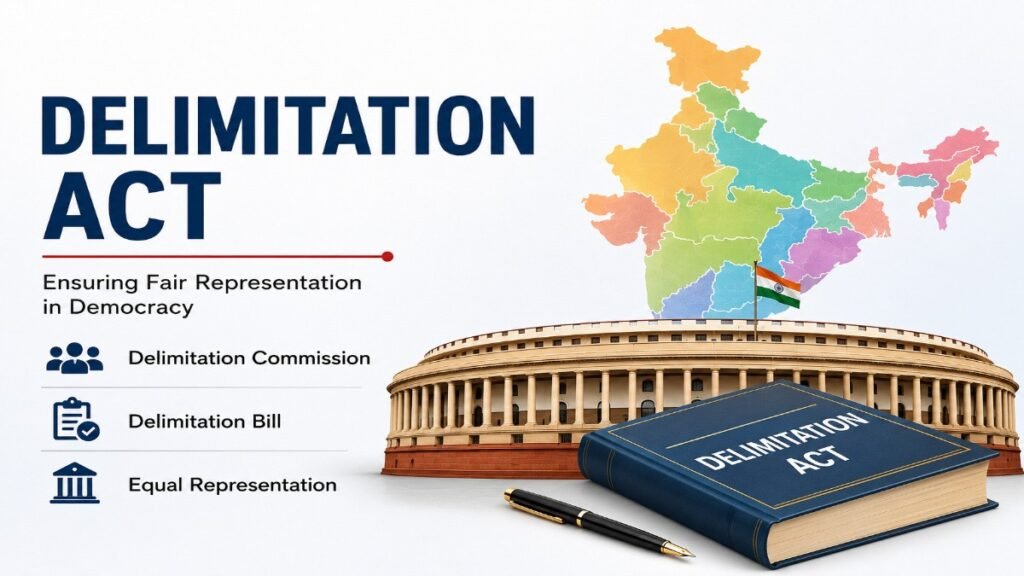
Delimitation is the process of redrawing the boundaries of Lok Sabha and State Legislative Assembly constituencies to ensure that each constituency represents, as far as practicable, an equal population. It also determines the reservation of seats for the Scheduled Castes (SCs) and Scheduled Tribes (STs) in proportion to their population. The exercise is carried out by an independent Delimitation Commission constituted by the Central Government after every Census under a law enacted by Parliament. The Delimitation Act provides the legal framework for constituting the Delimitation Commission and carrying out the delimitation exercise.
Delimitation has emerged as a major national issue because the next exercise is due after the first Census conducted after 2026, as mandated by the Constitution. The proposed delimitation has triggered debates over regional representation, federalism, and the balance of political power between northern and southern states, making it an important topic for BPSC Mains.
Master Current Affairs. Ace BPSC Mains.
BPSC Mains Current Affairs & International Relations Course
Master GS Paper-I (Section-II) with 116 exam-oriented topics, 5 structured lessons and downloadable PDF notes—all in one comprehensive course.
✔ 116 Exam-Oriented Topics • ✔ 5 Comprehensive Lessons • ✔ Downloadable PDF Notes • ✔ Updated for 72nd BPSC Mains
2. Why in News?
- Delimitation has become a major political issue as the constitutional freeze on the readjustment of Lok Sabha seats ends after 2026, making the next delimitation exercise imminent. The issue has also brought the Delimitation Act and its implementation into focus.
- The issue gained prominence due to the proposed implementation of the Women’s Reservation (Nari Shakti Vandan) Act, which is linked to the delimitation exercise after the first Census conducted post-2026.
- Several southern states have expressed concerns that delimitation based solely on population may reduce their relative representation in Parliament despite successful population control.
- The Union Government has stated that consultations with stakeholders will precede the next delimitation exercise to ensure a fair and balanced outcome. The role of the Delimitation Commission will be crucial in carrying out the exercise.
Prepare Smarter. Study Better. Ace BPSC Mains.
BPSC Mains GS Paper 1 & 2 Complete Course
Access comprehensive BPSC Mains Notes for GS Paper 1 & 2, covering 378+ topics across 24 PDF lessons, with dedicated Bihar coverage, practice questions and downloadable study material.
✓ GS Paper 1 & 2 • ✓ 378+ Topics • ✓ 24 PDF Lessons • ✓ Bihar-Specific Coverage • ✓ Downloadable Notes
3. Definition of Delimitation
Delimitation is the process of redrawing the boundaries of Lok Sabha and State Legislative Assembly constituencies based on the latest Census to ensure that each constituency, as far as practicable, has an equal population. It also involves the readjustment of seats reserved for Scheduled Castes (SCs) and Scheduled Tribes (STs) in proportion to their population.
The primary objective of delimitation is to uphold the democratic principle of “one person, one vote, one value” by ensuring fair and balanced political representation. In India, delimitation is carried out by an independent Delimitation Commission, whose orders have the force of law and cannot ordinarily be challenged in any court. The Delimitation Act provides the statutory basis for constituting the Commission and conducting the delimitation exercise.
4. Constitutional & Legal Provisions
- Article 82: Provides for the readjustment of Lok Sabha seats and delimitation of parliamentary constituencies after every Census, through a law made by Parliament.
- Article 170: Provides for the readjustment of State Legislative Assembly constituencies after every Census to ensure equitable representation.
- Article 327: Empowers Parliament to enact laws relating to elections, including the delimitation of constituencies.
- Delimitation Commission Acts: Parliament has enacted Delimitation Commission Acts (1952, 1962, 1972 and 2002) to constitute independent Delimitation Commissions for carrying out the exercise.
- Constitutional Freeze: The 42nd Constitutional Amendment Act, 1976 froze the allocation of Lok Sabha and Assembly seats based on the 1971 Census until 2000. The 84th Constitutional Amendment Act, 2001 extended the freeze until the first Census after 2026, while the 87th Constitutional Amendment Act, 2003 allowed delimitation of constituency boundaries using the 2001 Census without altering the total number of seats.
The above provisions form the constitutional and legal foundation of the Delimitation Act and the work of the Delimitation Commission.
5. Delimitation Commission
The Delimitation Commission is an independent statutory body constituted by the Central Government under the Delimitation Commission Act after every Census for carrying out the delimitation of Parliamentary and State Assembly constituencies. It is generally chaired by a retired Judge of the Supreme Court, with the Chief Election Commissioner (or Election Commissioner nominated by the CEC) and the State Election Commissioners of the concerned states as ex-officio members.
The Commission redraws constituency boundaries, readjusts reserved seats for SCs and STs, and publishes final delimitation orders. Its decisions have the force of law and cannot ordinarily be challenged in any court or modified by Parliament or State Legislatures, ensuring the independence and impartiality of the delimitation process. The Delimitation Act provides the statutory framework under which the Commission carries out these responsibilities.
6. Need for Delimitation
- Ensures Equal Representation: Delimitation seeks to maintain the democratic principle of “One Person, One Vote, One Value” by ensuring that constituencies have nearly equal populations. Example: A constituency with 25 lakh voters should not have the same representation as one with 10 lakh voters.
- Reflects Population Changes: Population shifts due to growth, migration, and urbanisation require periodic redrawing of constituency boundaries. Example: Rapidly growing cities like Bengaluru, Hyderabad, and Pune have witnessed significant population increases, necessitating fairer representation.
- Ensures Fair Representation for SCs and STs: Delimitation revises the number and location of reserved constituencies in proportion to the latest demographic changes. Example: If the SC or ST population increases in a district, the number of reserved seats may also be revised accordingly.
- Strengthens Democratic Governance: Balanced constituencies ensure that every elected representative serves a comparable number of citizens, improving political accountability. Example: Overcrowded constituencies often make it difficult for MPs/MLAs to effectively address local issues.
- Corrects Regional Imbalances: Delimitation helps align political representation with demographic realities while considering geographical features and administrative convenience. Example: The proposed post-2026 delimitation has triggered a debate between northern and southern states over equitable representation.
These objectives highlight the importance of the Delimitation Act and the role of the Delimitation Commission in ensuring balanced political representation.
7. Delimitation in India: Recent Developments
- Post-2026 Delimitation: As per the Constitution, the next delimitation exercise is expected after the first Census conducted after 2026, making it one of the most significant upcoming electoral reforms.
- Link with Women’s Reservation: The implementation of the Nari Shakti Vandan Adhiniyam, 2023 (106th Constitutional Amendment) is linked to the delimitation exercise, making delimitation crucial for operationalising 33% reservation for women in Parliament and State Legislatures.
- North–South Representation Debate: Southern states have expressed concern that delimitation based purely on population may reduce their relative share of Lok Sabha seats despite their success in population control, raising issues of federal balance and equity.
- Government’s Assurance: The Union Government has assured that the interests of all states will be protected and that extensive consultations will be held before undertaking the delimitation exercise.
- Political Significance: Delimitation has become a major national political issue due to its potential impact on Parliamentary representation, Centre–State relations, and the future electoral landscape of India.
These developments have increased the relevance of the Delimitation Act and the future role of the Delimitation Commission in India’s electoral system.
8. Challenges & Concerns
North–South Representation Debate
The biggest concern is that population-based delimitation may increase the number of Lok Sabha seats in northern states such as Uttar Pradesh, Bihar, Rajasthan and Madhya Pradesh, while reducing the relative share of southern states like Tamil Nadu, Kerala, Karnataka and Andhra Pradesh. Southern states argue that they may be penalised for successfully implementing family planning programmes, whereas states with higher population growth may gain greater political representation.
Impact on Federal Balance
Delimitation may alter the existing balance of power between the Union and the States. Since Lok Sabha representation determines a state’s political influence at the national level, states fear that a significant change in seat distribution could weaken the federal structure and reduce their voice in national policymaking. This has become one of the major constitutional debates surrounding the post-2026 delimitation exercise.
Population Control Paradox
States such as Tamil Nadu and Kerala, which have achieved replacement-level fertility and invested heavily in population stabilisation, argue that a purely population-based formula would disadvantage them. They contend that such an approach contradicts the objectives of the National Population Policy by rewarding states with higher population growth.
Delay in Census
The delimitation exercise depends on the first Census conducted after 2026. Since the 2021 Census was postponed, the timing of the next delimitation remains uncertain. This has also delayed the implementation of 33% reservation for women in Parliament and State Legislative Assemblies under the 106th Constitutional Amendment Act, 2023, which is linked to delimitation.
Political and Administrative Challenges
Delimitation is a politically sensitive exercise because changes in constituency boundaries may affect electoral prospects of political parties and sitting representatives. It also requires accurate Census data, extensive field verification, and coordination among the Election Commission, Delimitation Commission, and State Governments, making the process administratively complex.
These challenges highlight the importance of a balanced and transparent approach under the Delimitation Act, with the Delimitation Commission playing a central role in addressing concerns related to representation and federal balance.
9. Way Forward
- Conduct Delimitation after a Reliable Census: The next delimitation exercise should be based on accurate and updated Census data to ensure fair and evidence-based representation.
- Balance Population with Federal Equity: While population should remain the primary criterion, concerns of states that have successfully implemented population control should also be addressed to preserve cooperative federalism.
- Ensure Wider Stakeholder Consultation: The Delimitation Commission should hold extensive consultations with political parties, state governments, experts, and civil society to build consensus and enhance public confidence in the process.
- Adopt a Transparent and Scientific Process: The exercise should be based on objective criteria such as population, geographical contiguity, administrative convenience, and public accessibility, while ensuring transparency at every stage.
- Protect Democratic and Constitutional Values: The delimitation exercise should strengthen the principles of equal representation, free and fair elections, and cooperative federalism, while avoiding unnecessary political polarization.
A transparent and consultative implementation of the Delimitation Act, supported by the Delimitation Commission, will be essential to maintain public confidence in the delimitation process.
Experience the Quality Before You Enroll
Download Free Sample Notes (PDF)
Download a free sample of our BPSC Mains Current Affairs Notes and experience the structured, exam-oriented content before enrolling. Explore the presentation, answer-writing approach, and overall quality of the complete course.
✔ Free Download • ✔ Exam-Oriented Notes • ✔ Updated Content • ✔ Structured for BPSC Mains
BPSC Mains Practice Questions
Q1. Delimitation is essential for ensuring equitable political representation, but it has also emerged as a major challenge to India’s federal structure. Discuss the constitutional provisions governing delimitation and examine the key issues associated with the proposed post-2026 delimitation exercise.
Q2. What is delimitation? Explain the role and powers of the Delimitation Commission. Discuss the significance and challenges of the proposed delimitation of Parliamentary constituencies in India.
Learn More from the Election Commission of India
Readers interested in the Delimitation Act, Delimitation Bill, the Delimitation Commission, constituency boundaries, electoral representation, and the delimitation process in India can visit the official website of the Election Commission of India. The portal provides authentic information on elections, electoral constituencies, representation, and important electoral reforms in India.